
Most buyers compare prices and brand names. Very few look at the number that actually determines what they'll pay every summer for the next decade: power consumption.
This article breaks down exactly how much electricity a 1.5 ton split AC uses, why the rated figure on the label differs from what your meter records, how to calculate your real monthly bill, and what you can do to bring it down.
Key Takeaways
- A 1.5 ton split AC draws roughly 1.0–1.85 kW at rated conditions, translating to 1.0–1.85 units per hour
- A 5-star inverter AC typically uses 25–35% less energy than a non-inverter model of the same capacity — a difference that adds up to thousands of rupees annually at Indian tariff rates
- BEE tests at 35°C outdoor — Indian peak summer regularly hits 42–48°C, pushing real consumption above rated figures
- Setting the thermostat at 24°C–26°C and cleaning filters every 2–4 weeks delivers measurable bill savings
- When comparing ACs, check whether the model maintains its rated cooling at 43°C+ ambient — many derate significantly in peak Indian summer heat, consuming more power for less cooling
What "Power Consumption" Actually Means for a 1.5 Ton Split AC
Cooling Capacity vs. Electrical Power
"1.5 ton" describes cooling capacity — specifically, the rate at which the AC removes heat from a room. One refrigeration ton equals 12,000 BTU/hour, so 1.5 ton = 18,000 BTU/hour. This tells you how much heat the AC can extract, not how much electricity it draws to do it.
The electrical power draw depends on how efficiently the system achieves that cooling. To understand efficiency ratings, a few basic electrical terms help.
Key Terms to Know
- Watts (W) / Kilowatts (kW): Power at any instant. A 1,300W AC draws 1.3 kW right now.
- Kilowatt-hours (kWh) / "units": Energy consumed over time. Run that 1.3 kW AC for one hour = 1.3 units. Your monthly bill is total kWh consumed × your local tariff (₹/unit).
ISEER: The Number That Actually Matters
BEE's ISEER (Indian Seasonal Energy Efficiency Ratio) measures how much cooling an AC delivers per unit of electricity consumed, calculated across 1,600 annual cooling hours spanning India's actual outdoor temperature range (24°C to 43°C). A higher ISEER = more cooling per rupee spent on electricity.
Current BEE thresholds (January 2025–December 2026): 3-star requires ISEER 4.40–4.99; 5-star requires ISEER 5.60 or above.
Optimist's 1.4 Ton 5 Star+ Inverter Split AC carries an ISEER of 6.05 — India's highest current rating — delivering more cooling per unit of electricity than even the 5-star minimum demands.
Power Consumption by Star Rating
Reference Table
| Star Rating | Compressor Type | Typical Rated Input | Units per Hour | 8-Hour Daily Consumption |
|---|---|---|---|---|
| 5-star | Inverter | ~1,300 W | ~1.3 units | ~10.4 units |
| 3-star | Inverter | ~1,670–1,760 W | ~1.67–1.76 units | ~13.4–14.1 units |
| 3-star | Fixed speed | ~1,278 W | ~1.28 units | ~10.2 units |
Note: These figures are based on rated input at BEE's standard test conditions (35°C outdoor). Actual consumption varies with ambient temperature, room conditions, and usage patterns. Inverter ACs often draw less than their rated maximum once the room reaches the set temperature.
5-Star vs. 3-Star Inverter: The Efficiency Gap
A 5-star inverter model like the LG US-Q19JWZE1 has a rated input of 1,310 W. A comparable 3-star inverter — the Daikin MTKL50U — is rated at 1,670 W with a min-max range of 425–1,840 W. That 360 W gap widens with daily use: at 8 hours/day over 30 days, it adds up to roughly 72–114 extra units per month before accounting for how much each inverter modulates in practice.
What drives this difference isn't just the star label — it's how the compressor behaves once the room cools down.
Inverter vs. Non-Inverter: The Core Difference
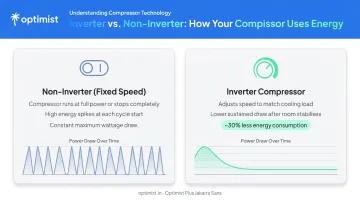
A non-inverter (fixed-speed) compressor switches fully on or off. Every time it cycles on, it draws maximum power. An inverter compressor continuously adjusts its speed to match the actual cooling load — running harder to cool the room quickly, then dialling back once the target temperature is reached. This is why the Daikin MTKL50U's rated 1,670 W is a ceiling, not a constant — real-world draw is typically lower once the room stabilises.
According to Daikin India, inverter ACs consume approximately 30% less energy than non-inverter models. This is a manufacturer claim, not a BEE-published standard, but it aligns with the real-world differences seen between inverter and fixed-speed models.
Why Real-World Consumption Differs from Rated Figures
BEE certifies AC efficiency under controlled lab conditions: 35°C outdoor dry bulb, 27°C indoor dry bulb. But in Delhi, Lucknow, Ahmedabad, and Nagpur, peak summer temperatures regularly hit 42–48°C. That gap between the lab and your rooftop is why your electricity bill doesn't match the star label.
Outdoor Temperature and Compressor Workload
As outdoor temperature rises, the refrigeration system must reject heat against a larger temperature differential. The compressor works harder and longer to achieve the same indoor temperature. BEE's own seasonal testing methodology includes temperature bins up to 43°C — but the rated label is based on 35°C. Any day hotter than that pushes your actual consumption above the rated figure.
At high ambient temperatures, AC capacity and efficiency (COP) deteriorate — the extent depends on refrigerant type and system design. This is a well-established thermal engineering principle, not a brand-specific claim.
Room Conditions
- Top-floor apartments absorb heat from the roof throughout the day
- West-facing or south-facing rooms with large windows receive intense afternoon solar load
- Poorly insulated walls allow heat to seep in continuously
These conditions force the AC to run near full capacity for extended periods, raising actual consumption by 15–25% or more above the rated figure.
Thermostat Setting
Setting 18°C doesn't cool the room faster. It just forces the compressor to run at higher intensity for longer to maintain a deeper temperature differential. According to BEE guidance, increasing the set point by 1°C saves approximately 6% electricity. Working backwards: dropping from 24°C to 18°C could increase consumption by roughly 30–36% — a significant swing on a summer electricity bill that compounds across months.
Maintenance State
Clogged air filters restrict airflow across the evaporator coil. The system works harder to move the same volume of air, efficiency drops, and the compressor runs longer to hit the set temperature. Industry testing data consistently shows that routine filter cleaning or replacement can lower AC energy use by 5–15%. Dirty outdoor coils work the same way: if the condenser can't reject heat efficiently, the compressor load climbs.
How to Calculate Your Monthly Electricity Bill
The formula:
Monthly Cost (₹) = (AC Wattage ÷ 1,000) × Daily Usage Hours × Days × ₹/Unit
Worked Example: Lab Scenario
- AC: 1.5 ton 5-star inverter, rated input 1.2 kW
- Usage: 8 hours/day
- Duration: 30 days
- Tariff: ₹7/unit
Calculation:
- 1.2 kW × 8 hours = 9.6 units/day
- 9.6 × 30 days = 288 units/month
- 288 × ₹7 = ₹2,016/month
Lab vs. Indian Summer Reality
| Scenario | Assumed Draw | Daily Hours | Monthly Units | Cost at ₹7/unit |
|---|---|---|---|---|
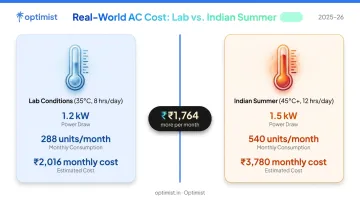
| Lab (35°C, 8 hrs) | 1.2 kW | 8 | 288 units | ₹2,016 |
| Indian Summer (45°C+, 12 hrs) | 1.5 kW | 12 | 540 units | ₹3,780 |
The same model costs ₹1,764 more per month when pushed by real Indian summer conditions. This isn't a flaw — it's just physics. The AC is working harder against higher heat loads for longer hours.
Electricity rates vary significantly by state and consumption slab. A few reference points:
- Karnataka residential: ₹5.80/unit (FY2025–26)
- Maharashtra residential: ₹4.28/unit (first 100 units) to ₹11.10/unit (101–300 units)
- Delhi high-consumption schedules: ₹7–8/unit
Use your actual bill's per-unit rate for accurate calculations.
Tracking Actual Consumption Instead of Estimating
Estimating from rated specs only gets you so far. An AC with built-in energy monitoring gives you actual numbers. Optimist's Live Energy Meter (via the Optimist App) tracks real usage in real time, showing:
- Current kWh consumption and live bill amount in rupees
- A Projected Monthly Bills figure based on actual usage patterns
- Consumption trends across 3-month, 6-month, and 1-year windows
That last point matters — you can see exactly how peak summer usage compares to shoulder months, without doing any math yourself.
Practical Ways to Lower Your 1.5 Ton Split AC's Power Consumption
Set the Thermostat at 24°C–26°C
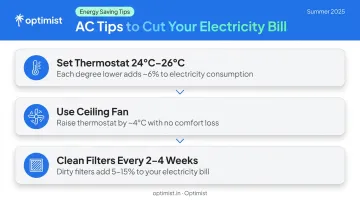
BEE recommends 24°C as the default AC temperature, and this became a mandatory minimum for commercial premises from January 2020. The 24°C–26°C range balances comfort with efficiency. Each degree lower increases consumption by approximately 6% — so running at 20°C instead of 24°C costs roughly 24% more electricity for the same cooling period.
Use Ceiling Fans Alongside the AC
A ceiling fan circulates air, making the room feel cooler at the same thermostat setting. Energy efficiency guidelines suggest a ceiling fan can let you raise the thermostat by about 4°C without reducing comfort. Set the AC to 26°C instead of 22°C, run the fan, and you'll feel equally comfortable while the compressor works significantly less.
Keep Up With Maintenance
Maintenance isn't optional upkeep — it directly affects your electricity bill:
- Clean filters every 2–4 weeks during heavy summer use (Daikin India's own recommendation is once every two weeks)
- Annual professional servicing to check refrigerant levels and clean outdoor coils
- Watch for refrigerant leaks — low refrigerant reduces heat rejection efficiency and increases compressor run time
Neglected filters alone can push power consumption 5–15% higher. If you're using the Optimist app, filter health tracking sends a "Needs cleaning" alert automatically, and you can book a technician directly from the same screen.
Frequently Asked Questions
How much power does a 1.5 ton split AC use?
A 1.5 ton split AC draws approximately 1.0–1.85 kW at rated conditions. A 5-star inverter model sits toward the lower end of that range; a 3-star non-inverter sits toward the upper end. Inverter compressors often draw below their rated maximum once the room reaches the target temperature.
How much does it cost to run a 1.5 ton split AC per hour?
At ₹7–₹8/unit, a 5-star inverter AC with a rated input of ~1.3 kW costs roughly ₹9–₹11 per hour at rated conditions. A 3-star inverter model rated at ~1.7 kW costs around ₹12–₹14 per hour. Real-world costs vary based on your state tariff slab, room size, insulation, and usage hours.
How many 1.5 ton AC units can run on a 3 kW supply?
A single 1.5 ton AC draws 1.28–1.76 kW at rated input (inverter max can touch 1.84 kW on some models). A 3 kW sanctioned load can handle one unit, but leaves limited headroom for other appliances running simultaneously. Running two units would require a higher sanctioned load.
Is a 1 ton AC sufficient for a 10 ft × 10 ft room?
A 100 sq. ft. room generally falls within the 1 ton capacity range under standard conditions — industry sizing guidelines typically place 1 ton ACs at up to 120–150 sq. ft. Top-floor placement, poor insulation, or large west-facing windows can raise the actual heat load; in those cases, a 1.5 ton unit will cool more effectively.
What is the difference in power consumption between a 3-star and 5-star 1.5 ton AC?
A 5-star model typically consumes 20–30% less electricity than a 3-star equivalent under similar conditions. Over a summer season running 8–10 hours daily, this translates to hundreds of units saved — and a meaningful reduction in monthly bills. The gap widens with longer daily usage, and 5 Star+ models (rated at ISEER 6.05 or higher) push savings even further beyond the standard 5-star threshold.
Does high outdoor temperature increase my AC's electricity consumption?
Yes. BEE's rated figures are based on 35°C outdoor conditions, but North Indian cities routinely hit 43–45°C during April–June. At those temperatures, the compressor works harder to reject heat, so your actual draw will exceed the label figure — often by a noticeable margin.