
Introduction
The 1.5 ton 3 star split AC is probably the most common air conditioner sitting in Indian bedrooms and living rooms right now. It's the default recommendation at most electronics stores, and for a 120-150 sq ft room, that sizing makes sense on paper.
But ask ten owners what their AC actually costs to run each month, and you'll get ten different answers. That's because "power consumption" for a 1.5 ton 3 star unit isn't one fixed number. A typical unit draws around 1,600 watts per hour, but the actual figure shifts with outdoor temperature, thermostat habits, and maintenance quality.
Most buyers assume tonnage or star rating tells them exactly how many watts an AC will draw. It doesn't. This guide breaks down real hourly, daily, and monthly consumption figures for a 1.5 ton 3 star AC. You'll see what drives that number up or down, and how it compares to more efficient alternatives.
Key Takeaways
- A 1.5 ton 3 star AC draws about 0.6 kWh per operating hour (BEE-equivalent)
- Running 8 hours daily adds up to about 5 units, or ~150 units a month
- "3 star" reflects ISEER efficiency, not a fixed wattage number
- Heat, insulation, habits, and maintenance push real use above lab figures
- A higher-ISEER unit cuts electricity use meaningfully over the AC's lifetime
What Determines the Power Consumption of a 1.5 Ton 3 Star AC
Power consumption is simply the electrical energy — measured in kWh, or "units" on your bill — that an AC draws to run its compressor, fan, and electronics while delivering its rated cooling output.
Two numbers on the box confuse most buyers: "1.5 ton" and "3 star." Neither is actually a wattage figure.
Tonnage measures cooling capacity, not electricity draw. Under BEE's own conversion, 1 ton of refrigeration equals 3.516 thermal kW of cooling output — so a 1.5 ton unit delivers about 5.27 thermal kW of cooling. That's heat removed from your room, not power pulled from the socket.
Star rating is a BEE efficiency classification derived from ISEER, the Indian Seasonal Energy Efficiency Ratio. ISEER equals total seasonal cooling delivered divided by total seasonal electricity consumed.
A 3 star AC has a lower ISEER than a 5 star one, meaning it uses more electricity to deliver the same cooling over a season. Consumption, in other words, is a derived characteristic of tonnage divided by ISEER — not a spec printed anywhere as one fixed wattage.
Factors That Influence Real-World Power Draw
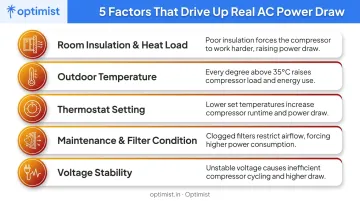
The BEE label reflects lab-tested averages. Your actual bill depends on several variables the label doesn't capture:
- Room insulation and heat load — poorly insulated rooms, large glass windows, or west/south-facing walls force the compressor to run longer and harder.
- Outdoor temperature — BEE's ISEER calculation uses a seasonal range of 24°C to 43°C across Indian climate bins. During genuine peak-summer spells above 43°C, most units operate outside this tested range entirely.
- Thermostat setting — BEE data shows raising your AC's set temperature by just 1°C can save around 6% on power use, and moving from 20°C to 24°C saves close to 24%.
- Maintenance and filter condition — a dirty filter restricts airflow, and low refrigerant gas forces the compressor to run longer than it should.
- Voltage stability — unstable input voltage can push fixed-speed compressors, common in non-inverter 3-star units, into inefficient operation.
None of this shows up on the star label. It's the difference between what a lab predicts and what you'll actually pay in June.
Power Consumption Range: Hourly, Daily & Monthly Figures
Now for the numbers buyers actually want.
An independent analysis of BEE-labelled 1.5 ton, 3 star, variable-speed split ACs found an average annual consumption of 1,008.33 kWh a year. That figure comes from a Centre for Science and Environment review reported by Down To Earth. BEE calculates its seasonal average over 1,600 reference operating hours a year, so:
1,008.33 kWh ÷ 1,600 hours ≈ 0.63 kWh per hour
That's the baseline hourly draw for a typical 3 star inverter unit under standardised test conditions, not a peak-summer, 45°C afternoon.
Daily and Monthly Numbers
| Daily Usage | Units Consumed | Approx. Monthly Cost* |
|---|---|---|
| 8 hours | ~5 kWh/day (~151 kWh/month) | ₹680-₹1,005 |
| 12 hours | ~7.6 kWh/day (~227 kWh/month) | ₹1,020-₹1,510 |
| 24 hours | ~15.1 kWh/day (~454 kWh/month) | ₹2,040-₹3,020 |
*Cost range based on illustrative tariffs of ₹4.50-₹6.65 per unit; actual DISCOM slabs vary by state and consumption level.
Worked example: at 0.63 kWh/hour, 8 hours a day, 30 days a month, at a flat ₹6/unit tariff: 0.63 × 8 × 30 = 151.2 units, costing roughly ₹907 a month.
These figures come from lab-based averages. Fixed-speed (non-inverter) 3 star models lack a comparable published figure, but they typically run less efficiently than inverter equivalents because they cycle on and off at full power instead of modulating.
BEE's own label carries a disclaimer that actual consumption depends entirely on how the appliance is used. Real Indian summers regularly push past the 43°C upper limit of BEE's ISEER test bins. Every degree above that, plus a poorly set thermostat or dirty filter, adds to what you'll actually pay beyond the lab number.
3 Star vs 5 Star AC: Which Really Saves More Electricity
Star rating exists precisely to answer this question. The same 1.5 ton category comparison found 3 star variable-speed splits averaging 1,008.33 kWh a year, while 5 star equivalents averaged around 740 kWh. Do the maths and that's a **26.6% drop in annual electricity use**, purely from choosing 5 star over 3 star, for identical cooling capacity.
What That Means for Your Wallet
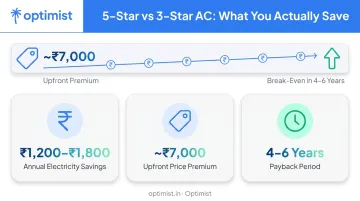
- Annual electricity cost savings: roughly ₹1,200-₹1,800, depending on local tariff
- A 2024 Prayas Energy Group survey found the median price gap between 3 star and 5 star 1.5 ton ACs sits around ₹7,000
- That upfront premium typically pays for itself in 4-6 years through lower bills alone
Beyond Standard 5 Star: Where Optimist Fits
Star ratings top out at 5 star, but ISEER values within that band still vary widely. This matters for anyone shopping seriously on running costs, not just the sticker.
Optimist's 1.4 ton inverter split AC carries an ISEER of 6.05, currently the highest declared rating in India, against a typical 5 star ISEER closer to 4.5-5, and a 3 star AC sitting somewhere near 3.0-3.5. Its annual energy consumption comes in at just 620.2 kWh, against roughly 1,008 kWh for a comparable 3 star unit.
There's a second issue rated units rarely address: derating. Most conventional ACs, including 3 star models and plenty of 5 star ones, automatically reduce cooling output once outdoor temperatures climb past 43°C, exactly when full performance matters most.
Optimist's unit is government-lab tested to sustain full rated cooling all the way to 50°C. It uses a dual-rotary inverter compressor paired with a micro-channel heat exchanger that moves heat four times faster than conventional fin-and-tube designs.
Its Turbo+ mode goes further, delivering an effective 1.9-ton cooling output from the 1.4 ton unit, positioning it as a direct alternative to a standard-rated 1.5 ton AC, but at meaningfully lower running cost. Real usage data from the Optimist app has shown monthly bills as low as ₹986, against roughly ₹6,020 for a conventional AC over the same period.
For anyone weighing 3 star against 5 star on paper, the answer is straightforward: 5 star wins on running costs, and units with ISEER meaningfully above the 5 star floor push those savings even further.
How to Calculate and Verify Your AC's Actual Power Draw
Want to check whether your own AC's numbers add up? Here's the method BEE itself uses.
Formula: Power (kW) = Cooling Capacity ÷ ISEER — though this only gives a seasonal average, not real-time draw, since ISEER itself is calculated across a full range of outdoor temperature bins, not one fixed condition.
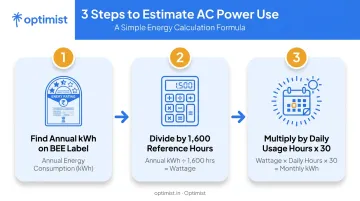
A more practical, three-step approach:
- Find the annual energy consumption (kWh/year) printed on the BEE star label. This is mandatory disclosure, not a marketing number.
- Divide by 1,600 (BEE's standard reference operating hours) to get average hourly draw.
- Multiply by your actual daily usage hours, then by 30, to estimate monthly units.
Clearing Up the "1,500 Watts" Myth
A common misconception: "1.5 ton means 1,500 watts." It doesn't. As established earlier, tonnage measures cooling capacity, while electrical input wattage is a separate figure that depends on compressor efficiency, not cooling size.
A typical 1.5 ton 3 star split AC draws somewhere between 1,400-1,700 watts of input power during compressor-on cycles, roughly 6-8 amps at 230V household supply. This varies by model and isn't uniform across all fixed-speed units.
Why Lab Figures Aren't Your Real Bill
BEE tests ACs across a defined climate profile (outdoor bins from 24°C to 43°C), not a single fixed 35°C condition as older EER tests once used. If you live somewhere that regularly exceeds 43°C for weeks at a stretch, your actual consumption will diverge from the label's seasonal average.
The most reliable comparison method: don't rely on star rating alone. Check the annual kWh figure on the BEE label directly for each model under consideration.
Two 3 star ACs can carry meaningfully different ISEER values. One CSE sample found roughly 180 kWh/year of spread within the 3 star category alone. Comparing declared annual consumption, model to model, beats going by star count printed on the box.
Some newer inverter models close this gap with live tracking. Optimist's 1.4 ton unit, for instance, displays real-time energy draw through its app instead of leaving you to estimate from an annual label.
Conclusion
The power consumption of a 1.5 ton 3 star AC depends on more than the number printed on the box. It varies based on:
- ISEER rating: higher ratings mean less power for the same cooling output
- Compressor type: inverter compressors adjust output to match demand instead of running full-blast
- Usage patterns: hours run, thermostat setting, and room insulation all shape the final bill
Star rating remains useful for a quick, at-a-glance comparison. But checking the declared annual kWh figure, and being honest about your own usage (hours run, thermostat setting, room insulation) matters just as much for predicting what you'll actually pay.
For buyers who want the lowest bills over the AC's lifetime, not just at purchase, comparing ISEER values directly tells a clearer story than star count alone. Options like Optimist's 1.4 ton unit, rated at ISEER 6.05 and tested to hold full cooling at 50°C, show how wide that efficiency gap can run. It goes well beyond what a standard 3 star or even 5 star label suggests.
Frequently Asked Questions
How much power does a 1.5 ton 3 star AC consume per hour?
Based on BEE-label averages, a 1.5 ton 3 star inverter AC draws roughly 0.6-0.7 units (kWh) per hour under standard test conditions. Non-inverter variants often run slightly higher since they cycle at full power rather than modulating.
Does a 3 star AC consume more electricity?
Yes. Compared to a 5 star model of the same tonnage, a 3 star AC typically consumes around 25-27% more electricity annually for identical cooling output, based on BEE-label category averages.
Is there a more energy-efficient alternative to a 1.5 ton 3 star AC?
Yes. Optimist's 1.4 Ton 5 Star+ inverter AC (ISEER 6.05) delivers Turbo+ cooling equivalent to a 1.9-ton unit while using significantly less power than a typical 1.5 ton 3 star model, translating to 25-35% lower electricity bills.
What is the monthly electricity bill for a 1.5 ton 3 star AC?
Running 8 hours a day, expect around 150 units a month, translating to approximately ₹680-₹1,000 on your electricity bill, depending on your local tariff slab.
How many units does a 1.5 ton 3 star AC use in 24 hours?
Under standard BEE-label testing, continuous 24-hour operation works out to roughly 15 units a day — though real-world use rarely runs a full 24 hours without cycling off.
Is a 3 star inverter AC better than a 3 star non-inverter AC?
Yes. An inverter compressor modulates its speed to match cooling demand, avoiding the energy spikes of a fixed-speed compressor's constant on/off cycling, which typically lowers average consumption.