
The honest answer is that there's no single number. Consumption swings widely based on BEE star rating, whether the compressor is inverter-driven or fixed-speed, how insulated your room is, and how brutal your local summer gets.
This guide breaks down the exact unit-per-hour figures for every common configuration, walks you through the formula to calculate your own bill, and shows practical ways to cut consumption without sacrificing cooling.
Key Takeaways
- Most 1.5 ton ACs draw 1.2 to 1.8 units (kWh) per hour, depending on star rating and compressor type
- 5-star inverter models draw near 1.2-1.4 units/hr
- 2-star non-inverter models climb to 1.7-1.9 units/hr
- Inverter compressors cut daily consumption by 20-30% compared to fixed-speed units
- Extreme heat above 40°C can strain standard ACs, but heat-tested inverters like Optimist's 1.4 Ton stay efficient at 50°C
How Many Units Does a 1.5 Ton AC Consume? (Overview)
There's no fixed kWh figure stamped on every 1.5 ton AC. Across the Indian market, hourly draw typically falls between 1.2 and 1.8 units, with the exact number shaped by the compressor's efficiency and the ISEER rating on the BEE label.
One common misconception: "1.5 ton" describes cooling capacity (around 18,000 BTU/hr), not electricity consumption. A 1.5 ton AC doesn't draw 1,500 watts. Its actual power input depends entirely on its ISEER value, which is why two 1.5 ton units from different brands can post very different electricity bills.
Units Consumption by BEE Star Rating
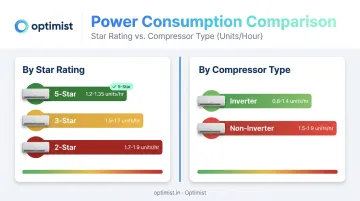
- 5-Star AC: approximately 1.2-1.35 units/hour, the most efficient standard tier with the lowest running cost
- 3-Star AC: approximately 1.5-1.7 units/hour, moderate efficiency common in the budget segment
- 2-Star AC: approximately 1.7-1.9 units/hour, the least efficient tier with the highest running cost
- ISEER 6.0+ (like Optimist's 1.4 Ton): approximately 1.07 units/hour, beating standard 5-star efficiency while its Turbo+ mode still delivers 1.9-ton effective cooling
Units Consumption: Inverter vs Fixed-Speed Technology
- Inverter AC: fluctuates between roughly 0.8-1.4 units/hour once the room stabilises and the compressor throttles down
- Non-inverter AC: runs at a near-constant 1.5-1.9 units/hour, because the compressor keeps cycling fully on and off to maintain temperature
Key Factors That Affect Unit Consumption
Unit consumption isn't decided by one spec sheet number. It's the combined effect of the AC's technical build, your room's environment, and how you actually use it day to day.
BEE Star Rating & ISEER Value
ISEER (Indian Seasonal Energy Efficiency Ratio) measures how much cooling a unit delivers per unit of energy consumed over India's cooling season. Under the last officially verified BEE band, split ACs were rated as:
- 3-star: ISEER 3.80-4.39
- 4-star: ISEER 4.40-4.99
- 5-star: ISEER 5.00 and above
A higher ISEER means more cooling output for every watt drawn — directly lowering the units/hour figure. Optimist's 1.4 ton unit carries an ISEER of 6.05, well above the 5-star floor, which is a major reason its annual energy consumption is rated at just 620.2 kWh.
Compressor Type (Inverter vs Fixed-Speed)
Inverter compressors vary their speed continuously to match the room's actual cooling load. Fixed-speed compressors can only run at full power or shut off completely, creating repeated energy spikes every time they restart. That start-stop cycling is exactly why non-inverter units draw more units on average, even at the same star rating. In practical terms, an inverter drawing 30-100% load uses far less current than a fixed-speed unit cycling on and off at full power.
Room Size, Insulation & Sunlight Exposure
An AC that's undersized for its room, a poorly sealed window, or a wall that faces direct afternoon sun all force the compressor to run longer than it should. Longer runtime means more units consumed, regardless of how efficient the AC's rating looks on paper. A west-facing room with a single-pane window, for example, can push even a well-rated unit to run almost continuously through peak afternoon hours.
Outdoor Temperature & Peak Summer Derating
Most standard ACs lose cooling capacity as outdoor temperatures rise, forcing them to run longer to compensate. A Centre for Science and Environment lab study tested three 5-star split ACs between 40°C and 50°C and found cooling capacity fell by 8-21% while power input rose 10-28% compared to declared performance.
At 45°C, some 5-star units performed worse than a 1-star unit rated at normal conditions.
Thermostat Setting & Daily Usage Duration
According to a BEE-issued FAQ shared via PIB, raising your thermostat setting by just 1°C can save around 6% electricity, and shifting from 20-21°C to 24°C can save close to 24%.
Total units consumed also scale directly with how many hours a day the AC runs, so a unit used for 12 hours will naturally rack up more than one used for 6.
Unit Consumption Breakdown: Hourly to Annual
Hourly draw is just the starting point. What actually shows up on your electricity bill is the monthly and annual total, so it helps to see the full picture.
Hourly Consumption
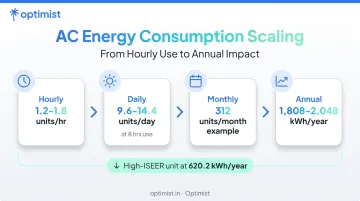
As covered above, the working range is 1.2 to 1.8 units/hour. 5-star inverter models anchor the lower end; 2-star non-inverter models anchor the higher end.
Daily Consumption (Typical 8-Hour Usage)
At 8 hours of daily use:
- 5-star AC: roughly 9.6-10.8 units/day
- 3-star AC: roughly 12-13.6 units/day
- 2-star AC: up to 14.4 units/day
Monthly Consumption & Bill Calculation Formula
The core formula for calculating consumption:
Units (kWh) = (Watts ÷ 1000) × Hours Used × Days
Worked example: a 5-star AC drawing 1.3 units/hr, used 8 hours a day for 30 days:
1.3 × 8 × 30 = 312 units/month
Since electricity tariffs in India vary sharply by state and consumption slab (CEA data shows effective residential rates ranging anywhere from roughly ₹2.21 to ₹10.80 per unit), your actual bill depends on your local slab. At a mid-range tariff of ₹7/unit, 312 units would cost approximately ₹2,184 for that month of AC use alone.
Annual Consumption Estimate
Government reference data on 1.5 ton split ACs (based on 1,200 hours of seasonal use) lists 2-star models around 2,048 kWh/year and 5-star models around 1,808 kWh/year. Real-world annual figures for typical Indian summer usage patterns generally land somewhere in this broader band, with efficient inverter units running meaningfully lower depending on actual daily hours and climate.
For comparison, Optimist's 1.4 Ton 5 Star+ model consumes just 620.2 kWh a year, noticeably below this 1.5 ton range, while delivering Turbo+ 1.9-ton effective cooling.
Inverter vs Non-Inverter: Which Consumes Fewer Units?
Inverter ACs consistently win on running cost, drawing far less power than non-inverter models because compressor modulation avoids the energy spikes that come with constant on/off cycling.
| AC Type | Average Power Draw |
|---|---|
| Inverter | 0.8-1.4 units/hour |
| Non-inverter | 1.5-1.9 units/hour |
Inverter tech does cost more upfront, but the gap closes fast. A Lawrence Berkeley National Laboratory study found that upgrading a 1.5 ton baseline unit's efficiency delivered a payback period as short as 0.7 years. Most efficiency gains paid back within 0.4 to 1.1 years, meaning the extra spend often pays for itself within the first cooling season.
There's a catch most buyers miss: inverter status alone doesn't guarantee performance at extreme heat. Many standard ACs, inverter or not, begin derating cooling capacity above 40-45°C outdoor temperature, forcing longer compressor runtime exactly when you need cooling most.
This is where Optimist's 1.4 ton unit stands apart. With an ISEER of 6.05, it's government-lab tested to hold full rated cooling at 50°C ambient, avoiding the hidden consumption spike that hits most units during peak Indian summers.
How to Reduce Your 1.5 Ton AC's Unit Consumption
A few consistent habits go a long way toward lowering your monthly units:
- Set the thermostat to 24-26°C instead of 18-20°C — every degree lower adds to compressor runtime
- Pair with a ceiling fan to circulate cool air, allowing a higher thermostat setting without losing comfort
- Clean filters every 2-3 weeks: dirty filters can raise AC energy consumption by 5-15%, according to energy efficiency research
- Seal the room against sunlight and drafts to reduce how hard the compressor has to work
- Service the unit annually to keep airflow and refrigerant levels performing as designed
Beyond habits, the single biggest lever is choosing a higher-ISEER AC in the first place. Optimist's high-ISEER 1.4 ton unit is built to deliver 25-35% lower electricity bills compared to typical 5-star inverter ACs, without any cooling drop when summer peaks hit hardest.
Beyond hardware upgrades, real-time tracking helps catch waste before it inflates your bill. The Optimist app's Live Energy Meter shows current kWh usage and a projected monthly bill as you go. A spike from a left-open window or an overworked compressor gets flagged early, instead of showing up as a surprise on your electricity bill.

Frequently Asked Questions
How much electricity does a 1.5 ton AC consume per hour?
Most 1.5 ton ACs consume between 1.2 and 1.8 units per hour. 5-star inverter models sit near the lower end, while 2-star non-inverter models push toward the higher end.
How much does it cost to run a 1.5 ton AC unit?
Using roughly 1.3-1.7 units/hour and 8 hours of daily use, you'd consume about 10-14 units a day. At an average tariff of ₹6-8/unit, that's roughly ₹60-₹110 per day of running cost.
Is it better to leave a 1.5 ton AC on all day?
For inverter ACs, continuous operation at a stable temperature can sometimes use fewer total units than frequent on/off cycling. Even so, usage should always match your actual cooling needs, not run by default.
How many units does a 1.5 ton AC use in 8 hours?
Expect roughly 9.6 to 14.4 units over 8 hours, depending on star rating — 5-star models at the lower end, 2-star models at the higher end.
What is the consumption difference between a 3-star and 5-star 1.5 ton AC?
5-star models typically consume 20-25% less electricity than 3-star models for the same usage pattern, thanks to their higher ISEER rating. Optimist's 1.4 Ton 5 Star+ Inverter Split AC illustrates this well, with an ISEER of 6.05 — India's highest — keeping running costs well below typical 3-star 1.5 ton units.
How many units does a 1.5 ton inverter AC consume per hour?
Once the room temperature stabilises, inverter models typically draw 0.8 to 1.4 units per hour, with the compressor throttling down as cooling demand drops.