
Introduction
The 1.5 ton split AC is India's best-selling cooling capacity, and for good reason: it fits the country's most common room dimensions. Yet most buyers still size their AC by guesswork, or worse, by what a neighbour bought.
That guesswork carries a cost. Undersized units run non-stop and inflate electricity bills. Oversized ones short-cycle, leaving rooms cold but clammy.
The short answer: a 1.5 ton AC comfortably cools roughly 140-190 sq. ft., but this window shrinks or stretches depending on ceiling height, sun exposure, occupancy, and your local climate.
Below, we break down the exact formula, the verified boundaries from brand data, and the technology now closing the gap between rated and real-world capacity.
Key Takeaways
- A 1.5 ton AC's sweet spot is 140-160 sq. ft., extending to 190 sq. ft. in favourable conditions
- Direct sunlight, high occupancy, and appliance heat load can shrink your effective room size by 15-20%
- BEE tests capacity at 35°C outdoor / 27°C indoor; performance can drop above 43°C unless the unit carries anti-derating certification
- Oversizing and undersizing both raise electricity bills, just through different mechanisms
- Checking the ISEER and rated Watts on the energy label matters more than trusting the "1.5 ton" name alone
What Does 1.5 Ton AC Capacity Mean for Room Size?
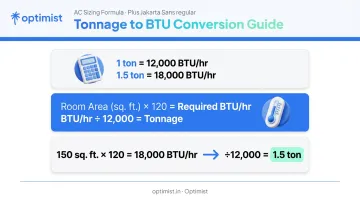
A "ton" of cooling describes a heat-removal rate, not a physical weight. One refrigeration ton equals 12,000 BTU/hr, or 3.517 kW, a standard set by ASHRAE's SI conversion guide. Multiply by 1.5 and you get 18,000 BTU/hr, or roughly 5.28 kW of rated cooling capacity.
That number, though, comes from a lab, not your living room. India's BEE tests room ACs at a fixed benchmark: 27°C dry bulb indoors, 35°C dry bulb outdoors. Everything sold in the country carries a capacity rating built on this exact condition, not on a 45°C Delhi afternoon.
This matters because tonnage functions as an operating specification, not a fixed physical trait like a unit's dimensions. It matches the compressor's designed heat-removal rate to a room's expected heat load. Change the room's sun exposure, occupancy, or insulation, and the "right" tonnage shifts even though the AC itself hasn't changed.
Standard Room Size Range Cited for 1.5 Ton AC
Brand-published guides don't fully agree on the exact cutoff, but there's meaningful overlap once you line them up.
| Source | Published Range for 1.5 Ton |
|---|---|
| Voltas | 131-190 sq. ft. |
| Hitachi India | 140-160 sq. ft. |
| LG India | 120-180 sq. ft. |
The tightest agreement across all three sits at 140-160 sq. ft., so treat this as your safest baseline. Anything up to 190 sq. ft. is workable but conditional on good insulation and limited heat gain.
Hitachi's published formula offers a simple starting calculation: room area (sq. ft.) × 120 = required BTU/hr, then divide by 12,000 to get tonnage.
Worked example for a 150 sq. ft. room:
- 150 × 120 = 18,000 BTU/hr
- 18,000 ÷ 12,000 = 1.5 ton
That checks out cleanly. But this baseline assumes a standard 9-10 ft ceiling, two occupants, and moderate sun. Real rooms rarely tick every box, which is exactly why the next section matters.
Room Size Range for 1.5 Ton AC: Nominal Range, Tolerance & Safe Margins
Nominal Operating Range
The 140-160 sq. ft. band is where a 1.5 ton AC runs efficiently without strain. This zone assumes:
- Standard wall and roof insulation, no exposed heat-absorbing surfaces
- Two occupants, average activity level
- No major heat-generating appliances (large TVs, multiple computers, kitchen equipment) running continuously
- Moderate window area with curtains or shading
Push past these assumptions, and the "correct" tonnage on paper stops matching comfort in practice.
Allowable Tolerance and Boundary Limits
Upper boundary (around 190 sq. ft.): Voltas's published capacity charts support stretching a 1.5 ton unit this far, but only with strong insulation, minimal direct sun, and lower occupancy. Push beyond 190-200 sq. ft. and you're outside every verified brand range; expect longer pulldown times and a compressor working near its ceiling most of the day.
Lower boundary (below roughly 130 sq. ft.): Here, a 1.5 ton unit becomes oversized for the space. The symptoms:
- Short-cycling (frequent on/off switching)
- Poor humidity removal, leaving rooms feeling cold but damp
- Uneven cooling despite reaching the set temperature quickly
Safe Operating Margin
Floor area alone never tells the whole story. Extra heat load creeps in from:
- Direct sunlight or top-floor placement, especially west-facing rooms
- Higher occupancy than the two-person baseline
- Heat-generating electronics: desktop setups, large TVs, or a kitchenette nearby
Ignore this margin near a boundary, and the consequences compound through summer. The compressor runs continuously at peak heat, bills climb, and dehumidification suffers, even in a room that's technically "within range" on paper.
Choosing a unit with cooling headroom, such as a 1.4 Ton AC with Turbo+ mode delivering 1.9-Ton effective cooling, removes much of this guesswork by absorbing load spikes without stepping up to a bulkier 1.5 or 2 Ton unit.
Key Technical Properties & Smart Capacity Features
Stability of Cooling Capacity Under Real Heat Conditions
Here's what most buyers miss: the 1.5 ton rating is tested at 35°C outdoor. Once temperatures climb past 43°C, many conventional AC units, fixed-speed and standard inverter alike, begin to derate, delivering less than their nameplate capacity exactly when you need it most.
Fixed-speed compressors cycle on and off at a single output level and lose efficiency fastest as ambient heat rises. Standard inverter compressors modulate speed but still tend to throttle back once thermal load exceeds their design margin.
Coupling With Room Conditions
This creates a genuine trade-off. Size up "to be safe" against harsh sun or poor insulation, and you sacrifice efficiency and pay more upfront. Size to the exact nominal range, and a harsher-than-average room risks under-cooling on the worst days of the year. There's no perfect answer from tonnage alone. That's why boost technology has become relevant.
Adjustable Boost Capacity as a Buffer for Borderline Rooms
This is where smart-cooling tech changes the calculation. Optimist's Turbo+ Mode, built into its 1.4 ton unit, delivers a 135% capacity boost, pushing effective output to roughly 1.9 tons on demand. A dual-rotary inverter compressor and microchannel heat exchanger with 1,180 flow paths power the boost.
Practically, that means:
- A borderline 180-190 sq. ft. room gets faster pulldown without buying a larger, less efficient full-time unit
- The boost activates manually via remote or the Optimist app, then the system returns to standard efficient operation
- Optimist's unit carries an ISEER of 6.05 (India's highest) and is government-lab tested at 50°C ambient, closing the gap between rated and real-room cooling in peak Indian summer.
This is the core argument for treating tonnage as a starting point, not the whole answer. A well-engineered 1.4 ton system with genuine high-heat headroom can outperform a poorly-derating 1.5 ton unit on the hottest days of the year.

How AC Capacity Is Specified, Rated & Verified
India's BEE energy label documents capacity and efficiency together through ISEER, the ratio of total seasonal cooling delivered to total seasonal energy consumed. This is the number that actually predicts your running cost, not the tonnage printed on the box.
Before buying, check the nameplate or energy label for:
- Rated cooling capacity in Watts or kW rather than just the "1.5 ton" marketing label
- ISEER value: higher means more cooling per unit of electricity over a full season
- Annual energy consumption in kWh, a direct, comparable running-cost figure
The nominal-to-actual capacity ratio varies by manufacturer. Optimist's 1.4 ton unit, for instance, is rated at 4.85 kW cooling with 1,070 W power input, delivering an ISEER of 6.05 and an annual consumption of just 620.2 kWh. You can verify these figures directly on the label rather than trusting a tonnage name alone.
Transparent, high-ISEER labelling makes it far easier to compare two units on real performance instead of guessing from a rounded tonnage figure.
Risks & Misconceptions: What Happens When Sizing Goes Wrong
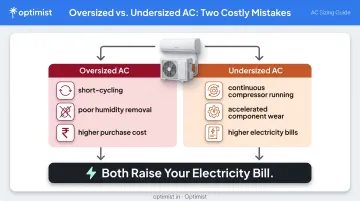
Oversizing looks appealing (faster cooling!) but backfires:
- Short-cycling wears compressor components faster
- Poor humidity removal leaves rooms feeling cold and clammy
- Higher purchase price locks in capacity you rarely use fully
Undersizing seems economical upfront but costs more over time:
- Continuous compressor running with no rest cycles
- Accelerated component wear from constant load
- Higher electricity bills despite the smaller sticker price
The biggest misconception, though, is treating published room-size charts as fixed rules. They're baselines built on average conditions — two occupants, moderate sun, standard insulation. Your room's actual sunlight exposure, occupant count, ceiling height, and local climate all shift where you sit within (or outside) that range. Optimist's Turbo+ Mode helps here, flexing up to 1.9 Tons of cooling only when needed.
Conclusion
A 1.5 ton AC is best understood as a range-governed specification, roughly 140-190 sq. ft., not a single magic number that applies identically to every room. The tightest, most reliable zone sits at 140-160 sq. ft.; anything beyond that needs favourable conditions to hold up.
Understanding these tolerance limits prevents the two costliest sizing mistakes: chasing comfort with an oversized unit, or inflating bills with an undersized one. Pair correct sizing with cooling technology tested for Indian heat conditions. Optimist's 1.4 Ton Turbo+ AC, for instance, delivers 1.9-Ton effective cooling and holds steady at 50°C — proof that reliable comfort doesn't have to fade the moment the thermometer crosses 40°C.
Frequently Asked Questions
How many square feet can a 1.5 ton AC cool?
A 1.5 ton AC typically cools 140-190 sq. ft., with the strongest overlap across brand guides at 140-160 sq. ft. This shifts based on insulation, sunlight exposure, and ceiling height.
What size AC do I need for a 20x20 room?
A 20x20 room is 400 sq. ft., which requires roughly 4 tons of cooling capacity by the standard area-based formula. This calls for a professional load assessment and likely multiple units, not a single 1.5 ton AC.
Is 1 ton AC enough for a 12x12 room?
A 12x12 room is 144 sq. ft., which sits directly in the supported range for a 1.5 ton AC across major brand guides. A 1 ton unit only works here with excellent shading, insulation, and low occupancy.
Is 1.5 ton AC enough for a 200 sq. ft. room?
This sits right at the outer edge of the verified range, and works only with strong insulation and minimal direct sunlight. If your room runs hotter than average, Optimist's 1.4 Ton AC with Turbo+ mode delivers 1.9-ton effective cooling for that extra headroom.
How do I calculate the right AC tonnage for my room?
Multiply your room's area in sq. ft. by 120, then divide by 12,000 to get a baseline tonnage. Adjust upward for direct sunlight, higher occupancy, or lower ceiling height.
Does a 1.5 ton AC use more electricity than a 1 ton AC?
Rated power draw is higher for 1.5 ton units, generally 1,200-1,500W versus 900-1,200W for 1 ton. However, actual running cost depends more on the ISEER and star rating than tonnage alone.