

Introduction
Every summer, millions of Indian homeowners face the same question at the AC showroom: 1 ton or 1.5 ton? Get it wrong, and you're either sweating through May in a room that never quite cools down, or paying electricity bills that make no sense for a room that chills in twenty minutes.
The stakes are higher in India than most buyers realise. Cities like Delhi, Jaipur, and Ahmedabad recorded temperatures above 46°C in May 2024, according to IMD's Annual Climate Summary 2024. At those temperatures, even a half-ton miscalculation means a compressor that never stops running, bills that spiral, and a room that stays stubbornly warm.
This guide walks through exactly how to choose — covering room size, heat load, floor level, window orientation, and the ISEER efficiency rating that most buyers skip past at the showroom.
Key Takeaways
- A 1 ton AC suits rooms up to ~120 sq. ft. with normal heat load and 1–2 occupants
- A 1.5 ton AC is better for 120–180 sq. ft. rooms, or any room with high sun exposure, top-floor location, or 3+ occupants
- Room size is just the starting point; ceiling height, floor level, and window direction all affect the final calculation
- Wrong sizing hurts either way — oversizing causes short-cycling and poor dehumidification, while undersizing strains the compressor and inflates bills
- ISEER rating determines actual electricity cost — a correctly sized, high-efficiency AC outperforms a bigger, inefficient one
1 Ton vs 1.5 Ton AC: Quick Comparison
| Factor | 1 Ton AC | 1.5 Ton AC |
|---|---|---|
| Cooling Capacity | ~12,000 BTU/hr | ~18,000 BTU/hr |
| Ideal Room Size | Up to ~120 sq. ft. | 120–180 sq. ft. |
| Rated Power Input | ~785 W (Daikin 5-star model) | ~1,230 W (Daikin 5-star model) |
| Purchase Price | Lower | Higher |
| Best For | Single bedrooms, study rooms, small apartments | Master bedrooms, mid-size living rooms, west-facing or top-floor rooms |
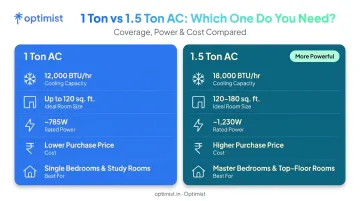
Power figures sourced from Daikin India's 2025 residential AC catalogue for matched 5-star inverter split models. Actual inverter consumption varies with load and operating conditions.
If you're weighing a 1.5 Ton AC for a room between 120–180 sq. ft., it's also worth considering Optimist's 1.4 Ton 5 Star+ Inverter Split AC — rated at India's highest ISEER of 6.05 and equipped with Turbo+ mode that delivers up to 1.9 Tons of effective cooling when needed, at lower running costs than a standard 1.5 Ton unit.
What Is a 1 Ton AC?
A 1 ton AC removes approximately 12,000 BTUs of heat per hour. The word "ton" has nothing to do with weight. It's a legacy measure tied to how much heat a ton of ice absorbs as it melts. For Indian buyers, the rating tells you whether a unit can actually keep up with the heat load in your room.
When a 1 Ton AC Works Well
A 1 ton unit performs best in small, enclosed spaces. When the room size matches the capacity, the compressor hits the set temperature and cycles off — rather than running non-stop. Inverter-based models refine this further by varying compressor speed instead of switching abruptly on and off, which cuts energy draw and reduces wear over time.
Ideal conditions for a 1 ton AC:
- Studio bedroom or single room up to 110–120 sq. ft.
- 1–2 occupants with moderate activity
- North or east-facing windows with limited direct afternoon sun
- Ground floor or lower floors that stay naturally cooler
- Home office or study with minimal heat-generating appliances
The Common Mistake to Avoid
Many buyers stretch a 1 ton unit to a 150 sq. ft. room to save on upfront cost. The compressor ends up running continuously without ever reaching the set temperature — especially in cities like Delhi, Jaipur, and Ahmedabad where outdoor temperatures cross 45°C. Bills rise, comfort drops, and the compressor wears out faster than it should.
What Is a 1.5 Ton AC?
A 1.5 ton AC removes approximately 18,000 BTUs of heat per hour — 50% more cooling power than a 1 ton unit. That extra capacity matters when the room is larger, when heat load is elevated, or when conditions make cooling harder.
When the Extra Capacity Is Needed
Room size alone doesn't tell the whole story. A 1.5 ton unit is the right call when:
- Room exceeds 120 sq. ft. — typically master bedrooms or mid-size living rooms in 2BHK apartments
- West or south-facing windows add significant afternoon heat load
- Top-floor location — heat radiates through the roof slab and raises the room's thermal demand by 15–20%
- Three or more regular occupants generating body heat throughout the day
- High-heat cities like Delhi NCR, Ahmedabad, Jaipur, and Nagpur, where outdoor temperatures penetrate faster
According to 6Wresearch's India room AC market report, 1.5 ton is the largest capacity segment by market revenue in India — a position attributed to its fit with typical Indian residential room dimensions.
The Oversizing Risk
A 1.5 ton AC in a 90 sq. ft. room is actually a problem. It cools too rapidly, short-cycles (turns on and off frequently), and fails to run long enough to remove humidity from the air. The result: a room that feels cold but damp, and a unit that wears out faster. Capacity matched to the room keeps both comfort and the compressor's lifespan intact.
Practical tip: If your room is borderline — around 120–130 sq. ft. — but gets significant afternoon sun or sits on a top floor, choose the 1.5 ton. The extra cost pays off in comfort and lower long-run operating hours.
1 Ton vs 1.5 Ton AC: Which Is Right for You?
Room size is the starting point, but four additional variables often tip the balance.
The Key Decision Factors
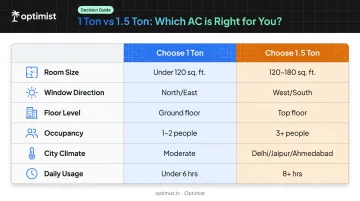
| Variable | Choose 1 Ton | Choose 1.5 Ton |
|---|---|---|
| Room Size | Under 120 sq. ft. | 120–180 sq. ft. |
| Window Direction | North or east-facing | West or south-facing |
| Floor Level | Ground or lower floors | Top floor or penthouse |
| Occupancy | 1–2 people | 3+ people |
| City Climate | Moderate temperatures | Delhi NCR, Jaipur, Ahmedabad, Nagpur |
| Daily Usage | Under 6 hours/day | 8+ hours/day |
The Efficiency Dimension Most Buyers Overlook
Beyond tonnage, the ISEER rating of the AC determines what you actually pay every month. ISEER (Indian Seasonal Energy Efficiency Ratio) is the BEE's official metric for measuring real-world seasonal cooling efficiency. The verified 2024 BEE thresholds are:
- 3-star: ISEER 3.80–4.39
- 4-star: ISEER 4.40–4.99
- 5-star: ISEER 5.00 and above
A correctly sized 1.5 ton AC with a high ISEER rating can cost less to run annually than a 1 ton unit with a poor efficiency rating — particularly for households running the AC 8–10 hours a day through Indian summers.
Where Optimist's 1.4 Ton Fits In
For buyers deciding between 1 ton and 1.5 ton, there's a third option worth considering. Optimist's 1.4 Ton 5 Star+ Inverter Split AC carries India's highest declared ISEER of 6.05 — significantly above the typical 5-star range of 5.0–5.4 — and delivers up to 1.9 tons of effective cooling via Turbo+ Mode when you need it most.
At its rated capacity, it draws 1,070 W with an annual energy consumption of just 620.2 kWh. For comparison, a typical 5-star 1.5 ton AC consumes 850–920 kWh annually. That gap translates to roughly 25–35% lower electricity bills every day.
The Optimist 1.4 Ton is tested for full rated cooling at 50°C ambient with no derating — a meaningful advantage when cities like Delhi and Jaipur exceed 46°C. Most standard ACs are rated only to 43°C; beyond that, they progressively lose 10–40% of their cooling output precisely when demand is highest.
The unit's micro-channel heat exchanger — 1,180 flow paths, 4× faster heat transfer — is the engineering behind that extreme-heat performance.
For borderline rooms — 120–160 sq. ft. with moderate heat load — it gives you near-1.5-ton capacity on demand with best-in-class efficiency. If your room sits in that grey zone, this is the unit to compare directly against a standard 1.5 ton.

Final Decision Guidance
Three rules that hold regardless of which unit you choose:
- Don't buy up "just to be safe." An oversized AC short-cycles, dehumidifies poorly, and wears out faster
- Don't stretch a smaller unit. An undersized AC runs continuously, strains the compressor, and increases bills
- Check the ISEER label. Tonnage sets the capacity — ISEER determines the actual monthly cost
Conclusion
There is no universal winner between 1 ton and 1.5 ton. The right answer depends on your room's specific combination of size, orientation, floor level, occupancy, and local climate. Measure your room, assess your heat load honestly, and match the tonnage to actual conditions rather than defaulting to the larger size by reflex.
Tonnage alone doesn't determine comfort — efficiency does. A correctly sized AC with a high ISEER rating (6.05 is the current benchmark in India) will consistently outperform an oversized unit on electricity bills, cooling consistency, and compressor longevity. If your room sits in the 120–175 sq ft range where 1 ton and 1.5 ton overlap, the Optimist 1.4 Ton is worth a close look: its Turbo+ mode delivers up to 1.9 tons of effective cooling, so you get 1.5 ton performance without the energy penalty of actually running one.
Frequently Asked Questions
Which AC is better, 1 ton or 1.5 ton?
Neither is universally better. A 1 ton is ideal for rooms up to 120 sq. ft. with normal heat load, while a 1.5 ton suits 120–180 sq. ft. rooms or spaces with higher heat exposure. The right choice depends on room size, window orientation, floor level, and daily usage hours.
Is 1 ton AC enough for what room size?
A 1 ton AC works well for rooms up to 110–120 sq. ft. with standard insulation and 1–2 occupants. For rooms at the upper edge of this range with direct afternoon sunlight, high ceilings, or a top-floor location, a 1.5 ton unit will perform more reliably.
Is 1.5 ton AC enough for 2 rooms?
No. A single 1.5 ton AC is designed for one room. Moving cooled air through a closed doorway is effectively impossible; each room needs its own unit sized to its specific dimensions and heat load.
Does a 1.5 ton AC consume significantly more electricity than a 1 ton AC?
A 1.5 ton AC draws more power per hour on paper, but when matched to a larger room it cools faster and cycles off sooner, so total daily electricity use can be similar to or lower than a 1 ton unit straining in the same space. The ISEER star rating matters as much as tonnage for actual bill impact.
What happens if I install the wrong tonnage AC?
An undersized AC runs continuously without reaching the set temperature, straining the compressor and increasing bills. An oversized AC short-cycles — cools too fast, shuts off, and fails to remove humidity — leaving the room cold but clammy while also shortening the unit's lifespan.
How does Indian peak summer heat (45°C+) affect AC tonnage selection?
Extreme outdoor temperatures significantly increase the heat load inside rooms, particularly on top floors and in west-facing spaces. In cities like Delhi, Jaipur, and Ahmedabad — which recorded peaks above 46°C in May 2024 — buyers should consider sizing up even for rooms near the boundary of the recommended range, and prioritise ACs tested to deliver full cooling at 50°C ambient.