
The short answer is that the star rating measures seasonal efficiency under controlled lab conditions, not what your AC actually draws at 46°C in Jaipur or Delhi. This article breaks down what the 5-star rating genuinely tells you about power consumption, how to calculate realistic bills by tonnage, and why real-world Indian conditions push consumption beyond label estimates.
Key Takeaways
- The BEE 5-star label reflects efficiency under standardised test conditions (35°C ambient), not Indian peak summer reality
- ISEER — not just star count — determines how much electricity your AC truly consumes per unit of cooling
- Actual power draw varies by tonnage, inverter technology, set-point temperature, and outdoor heat
- Two 5-star ACs with different ISEER values can have meaningfully different annual bills
- Smart ACs with a live energy meter and projected monthly bills show exactly what you're spending — before the electricity bill arrives
What the 5-Star Rating Actually Tells You About Power Consumption
The 5-star label is not a power consumption figure. It is an energy efficiency rank assigned by BEE based on how much cooling an AC delivers per unit of electricity consumed — across a simulated annual cycle.
ISEER: The Number That Actually Matters
ISEER (Indian Seasonal Energy Efficiency Ratio) is calculated as:
Cooling Seasonal Total Load ÷ Cooling Seasonal Energy Consumption
A higher ISEER means more cooling delivered per kWh consumed. BEE's current rating framework defines thresholds as follows:
- Standard 5-star: Minimum ISEER 5.0
- 5-Star+ (elevated tier): Minimum ISEER 5.5
Most 5-star inverter ACs from established brands sit in the 5.0–5.6 range. Optimist's 1.4 Ton 5 Star+ Inverter Split AC carries a BEE-declared ISEER of 6.05 — the highest-rated AC in India as of 2026 — which translates to a real-world efficiency advantage of 12–35% over typical 5-star competitors.
Inverter vs. Non-Inverter: Why It Matters for Your Bill
| Type | How It Works | Power Draw Pattern |
|---|---|---|
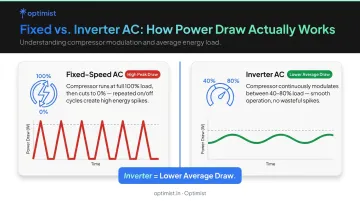
| Fixed-speed (non-inverter) | Cycles fully on and off | High peak draw repeatedly |
| Inverter | Modulates compressor speed continuously | Lower average draw across the day |
Most modern 5-star ACs are inverter-based, and for good reason. An inverter compressor running at 60% load to maintain temperature uses far less power than a fixed-speed unit that switches between full load and zero.
That modulation also explains why power consumption varies through the day. An AC working against 46°C outdoor heat draws more current than the same unit at 35°C — the compressor ramps up to reject more heat through the condenser. In North Indian summers, this difference can push actual consumption well above the BEE label figure during peak afternoon hours.
Factors That Determine Which 5-Star AC Consumes Less
Two ACs can both carry 5-star labels and have genuinely different real-world consumption. Here is what drives the difference.
Compressor Type
A variable-speed inverter compressor adjusts power draw continuously based on actual cooling demand. At part-load — when the room is near the target temperature — it operates at a fraction of rated wattage. This is why average consumption sits well below the peak rated input figure on the spec sheet.
Heat Exchanger Design
A more efficient heat exchanger transfers heat faster, reducing the time the compressor needs to run at high intensity. Optimist's micro-channel heat exchanger uses 1,180 flow paths in advanced aluminium alloy to maximise heat transfer surface area, cutting compressor workload directly — and measurably lowering average power draw.
ISEER Value Within the 5-Star Band
Even within the 5-star category, the spread is wide. A unit at ISEER 5.0 and one at ISEER 6.05 will have meaningfully different annual consumption for the same cooling output — the gap shows up clearly in monthly bills across a full summer season.
Set-Point Temperature
According to Ministry of Power guidance from June 2018, every 1°C increase in thermostat setting saves approximately 6% of electricity consumed. BEE's FAQ on the same advisory estimated that moving from a 20–21°C default to 24°C saves approximately 24%. BEE recommends 24°C as the default set-point — this single habit can cut bills significantly.
5-Star AC Electricity Consumption: Actual Numbers by Tonnage and Usage
The figures below are derived from published BEE label data and manufacturer specifications for verified 5-star inverter split ACs.
Reference Table: 5-Star Inverter Split AC Consumption by Tonnage
| Tonnage | Rated Input (Full Load) | Annual Label Energy | Units in 8 hrs/day | Est. Monthly Units (8 hrs, 30 days) | Est. Monthly Bill (₹8/unit) |
|---|---|---|---|---|---|
| 1 Ton | ~940 W | ~524 kWh/year | ~7.5 units | ~225 units | ~₹1,800 |
| Optimist 1.4T (ISEER 6.05) | 1,070 W | 620 kWh/year | ~8.6 units | ~257 units | ~₹2,056 |
| 1.5 Ton (market avg.) | ~1,325 W | ~786 kWh/year | ~10.6 units | ~318 units | ~₹2,544 |
| 2 Ton | ~1,555 W | ~936 kWh/year | ~12.4 units | ~373 units | ~₹2,984 |
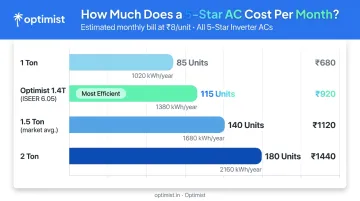
Sources: Daikin JTKJ35UV16W (1TR), Optimist OPTIMIST-1.4T-5S-INV-SPLIT (published BEE label: 620.2 kWh/year, 1,070 W rated input, ISEER 6.05), Daikin FTKR50UV16U (1.5T), Blue Star IC524DNUR (2T). Inverter ACs draw less at part-load; these figures reflect full-load rated input. Actual monthly consumption will vary.
What It Costs to Run a 1.5-Ton 5-Star AC for One Hour
A quick worked example at a typical Indian tariff of ₹7/unit:
- Rated input: ~1,325 W = 1.325 kW
- At full load for 1 hour: 1.325 kWh × ₹7 = ₹9.28
- At inverter part-load (say, 60% of rated): ~0.8 kWh × ₹7 = ₹5.60
In practice, your inverter AC spends most of its operating time at part-load. For a standard 1.5-ton unit, the actual hourly cost lands closer to ₹5–7 — well below the full-load peak. A higher ISEER rating (like the Optimist 1.4T's 6.05) means the compressor reaches its efficient range faster and stays there longer, which is where real-world bill savings accumulate.
Real-World Factors That Affect 5-Star AC Power Draw in Indian Homes
Ambient Temperature
BEE's seasonal calculation weights outdoor temperatures from 24°C to 43°C across 1,600 annual hours — it does not include 45°C or 50°C bins. Yet Delhi, Nagpur, and Jaipur regularly hit 46–50°C in May and June.
At higher ambient temperatures, the compressor must work harder to release heat through the condenser, pushing power draw beyond the label estimate. ACs with higher ISEER ratings handle this more efficiently because they start from a structurally stronger efficiency position.
Optimist's 1.4 Ton unit is tested at 50°C ambient with no derating, meaning it holds its rated cooling output at temperatures where most market ACs progressively lose capacity above 43°C.
Room Load Factors
Several factors increase the effective load on any AC, extending compressor run-time:
- Room size larger than the AC's tonnage recommendation
- Poor ceiling insulation or sun-facing walls
- Open doors and windows
- High occupancy or heat-generating appliances
- Upper floors with direct roof exposure
Filter and Maintenance Effects
ASHRAE confirms that a dirty, unchanged filter restricts airflow and degrades system performance. While no universal percentage penalty applies to all units, the direction is clear: blocked filters force the compressor to work longer and harder for the same cooling result. Cleaning filters monthly during summer is one of the simplest ways to keep consumption in check.
Power Quality
Voltage fluctuations — common in Indian residential supply — cause compressors to draw more current and reduce efficiency. Inverter ACs handle moderate voltage variation better than fixed-speed units, but significant drops or spikes still affect consumption. Daikin's specifications list a 130–285 V operating range, indicating inverter designs are built to tolerate wider voltage variation.
Common Misinterpretations of 5-Star AC Power Consumption
Three Myths Worth Clearing Up
"The 5-star label guarantees a fixed monthly bill." It doesn't. The label defines seasonal efficiency under controlled lab conditions. Your actual bill depends on usage hours, room load, outdoor temperature, and your state's electricity tariff. Think of it as a comparison benchmark, not a promise.
"All 5-star ACs perform equally." Not quite. ISEER values within the 5-star band range from 5.0 (the minimum threshold) up to 6.05 — the rating Optimist carries. Two products with identical star counts can have meaningfully different annual consumption. The ISEER number is what you should compare, not just the stars.
"A bigger tonnage with 5 stars always saves more." An oversized AC in a small room short-cycles: it hits the set temperature quickly, switches off, then fires up again repeatedly. As ASHRAE notes, frequent cycling reduces efficiency, shortens equipment life, and worsens humidity control. Correct tonnage selection matters as much as — sometimes more than — the star rating.
The Case for Real-Time Monitoring
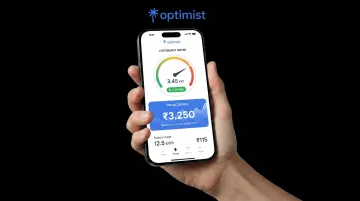
The most accurate way to understand your actual consumption is to measure it directly. Optimist's app-based Live Energy Meter tracks real kWh consumption and projects your monthly bill based on actual usage patterns — not rated specifications.
Say you've consumed 82 kWh partway through the month at ₹986. The app projects the full-month figure forward from your real usage rate. That's far more accurate than any estimate built on nameplate wattage.
Frequently Asked Questions
How much electricity does a 5-star AC consume per hour?
Consumption varies by tonnage: a 1-ton 5-star inverter AC draws approximately 0.8–0.94 kW, a 1.5-ton draws approximately 1.0–1.33 kW, and a 2-ton draws approximately 1.2–1.55 kW at full load. Inverter ACs draw significantly less at part-load, which covers most hours of a summer day.
How many 5-star ACs can a 3 kW power connection run?
A standard 1.5-ton 5-star inverter AC draws approximately 1.0–1.33 kW at steady state, with peaks up to 1.6 kW. A 3 kW connection can typically run one such AC alongside basic lighting loads, but running two simultaneously would almost certainly trip the connection.
What is the electricity bill for running a 5-star AC for 1 hour?
For a 1.5-ton 5-star inverter AC at approximately 1.0–1.3 kW average draw and a tariff of ₹7/unit, the hourly cost is roughly ₹7–9. At part-load (which is most of the time), expect closer to ₹5–7 per hour.
What is the monthly electricity bill of a 5-star AC?
For a 1.5-ton 5-star inverter AC used 8 hours/day at ₹7–8/unit, expect approximately ₹2,200–2,800/month. Variables include your state tariff, actual usage hours, outdoor temperatures, and the AC's specific ISEER rating.
Is a 5-star AC worth buying for daily use in Indian summers?
For daily usage of 6–8+ hours, the electricity savings over a 3–4 year period typically justify the higher upfront cost — particularly in high-tariff states like Maharashtra or Tamil Nadu. The higher the ISEER, the faster the payback.
Does a 5-star AC consume more electricity in extreme heat like 45–50°C?
Yes. Higher ambient temperatures force the compressor to work harder, pushing actual consumption above the BEE label estimate. ACs with higher ISEER ratings handle this better because they start from a more efficient baseline — and units tested at 50°C ambient, like the Optimist 1.4 Ton, maintain full rated output without derating under peak heat.