

Most buyers stop at the star label. That's a reasonable starting point, but it leaves several critical questions unanswered. Does the AC still cool effectively when it's 48°C outside? Will it hold up in a coastal city? What's the actual ISEER value — not just the star count?
This guide answers those questions and gives you a practical framework for choosing a 5-star AC that performs in real Indian conditions, not just in a test lab.
Key Takeaways
- 5-star means ISEER ≥ 5.00 per BEE's current schedule — but scores vary significantly within the band
- ISEER is calculated across a 24–43°C range, not at a single test point — so real-world efficiency differs from what a fixed-temperature test would show
- Many ACs derate above 43–46°C — the star label doesn't guarantee full cooling during peak Indian summer
- Corrosion resistance, smart monitoring, and warranty terms don't appear on the star label — you have to check for them separately
- Check the actual ISEER number on the BEE label, not just the star count
What Does a 5-Star Rating Actually Mean?
India's Bureau of Energy Efficiency assigns star ratings based on a unit's ISEER — Indian Seasonal Energy Efficiency Ratio. ISEER measures the ratio of total seasonal cooling delivered to total energy consumed across an entire Indian cooling season — unlike EER, which tests performance at a single fixed temperature.
BEE calculates ISEER using national weather bins from 24°C through 43°C, totalling 1,600 cooling hours per year. Laboratory measurements are taken at 29°C and 35°C, then a seasonal calculation method is applied across all the bins. This methodology reflects actual Indian conditions far better than a single-point test — but it still isn't a guarantee of performance at 45–50°C.
The Current ISEER Bands
Per BEE's schedule verified for the 2023–2024 period, the star bands for split inverter ACs are:
| Star Rating | ISEER Range |
|---|---|
| 1-star | 3.30 – 3.49 |
| 2-star | 3.50 – 3.79 |
| 3-star | 3.80 – 4.39 |
| 4-star | 4.40 – 4.99 |
| 5-star | ≥ 5.00 |
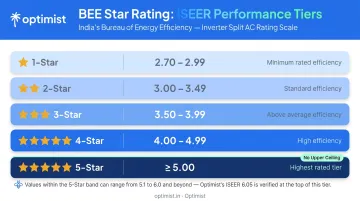
What the table doesn't show is the spread within each band. The 5-star category has a floor of 5.00 but no upper ceiling — one 5-star AC could carry an ISEER of 5.1, another could carry 6.0, and both wear identical star labels on the shelf.
BEE also revises these thresholds periodically. A model that qualified as 5-star under an older schedule may now fall short of current benchmarks. Always look at the actual ISEER number printed on the BEE label, not just the star count.
Why the Star Label Alone Isn't Enough for Indian Homes
The rating tells you how efficiently an AC performs under standardised test conditions. What it leaves out matters far more for Indian buyers.
The Deration Problem
BEE's seasonal calculation covers temperatures up to 43°C. But Delhi NCR, Ahmedabad, and large parts of Rajasthan, UP, and MP routinely cross 45–50°C in May and June. At these temperatures, most ACs automatically reduce their cooling output to protect the compressor — a process called derating.
This means the advertised tonnage and ISEER may not reflect what the unit actually delivers during the hottest hours of the day, when you need it most. The star label provides no information about this.
Coastal Conditions
Cities like Mumbai, Chennai, Kochi, and Visakhapatnam face a double problem: high humidity combined with salt-laden air accelerates corrosion of outdoor unit fins and heat exchanger coils. Most standard 5-star ACs aren't built to handle this, and progressive corrosion degrades both efficiency and lifespan well before the unit's expected service life.
Smart Features the Star System Can't See
The BEE star rating says nothing about:
- Whether the AC alerts you when refrigerant levels drop
- How much electricity it consumed last month
- When the filter needs cleaning
- Whether a technician can diagnose faults remotely
These features increasingly matter to Indian homeowners managing monthly bills and avoiding expensive service surprises — and they're invisible to the star system.
What to Consider When Choosing the Right 5-Star AC
Six factors separate a smart 5-star purchase from one that disappoints after the first summer.
ISEER Value — Check the Number, Not Just the Stars
Within the 5-star band, ISEER values span from 5.00 upward with no cap. A unit at ISEER 5.1 and a unit at ISEER 6.0 both carry the same 5-star label, but the latter delivers noticeably lower electricity consumption over months and years of daily use.
For households running the AC 6+ hours daily, the gap compounds quickly. Prioritise the highest ISEER you can afford — the BEE label displays the exact value, so it's straightforward to compare. For reference, the current top of the Indian market sits at ISEER 6.05 — a useful benchmark when comparing models.
Peak Temperature Performance
Ask specifically: does this AC deliver its full rated cooling capacity at 48–50°C outdoor temperature? Most units begin to derate (reduce output capacity) somewhere above 43–46°C. For cities where peak summer temperatures regularly cross 45°C, this is a non-negotiable specification.
Ask for explicit manufacturer data on high-ambient performance, and verify whether those claims are backed by actual lab testing — not just marketing copy.
Capacity and Room Size
Matching tonnage to room size matters more than most buyers realise:
- Undersized AC: Runs continuously, uses more electricity, and still fails to cool the room adequately
- Oversized AC: Cycles on and off too frequently, which reduces dehumidification and wastes energy
As a practical guide for typical Indian rooms:
| Room Size | Recommended Capacity |
|---|---|
| Up to ~120 sq ft | 1 Ton |
| 120–180 sq ft | 1.4–1.5 Ton |
| 180–250 sq ft | 2 Ton |
Ceiling height, west or south-facing walls, and insulation quality can shift these numbers. A well-insulated north-facing bedroom needs less cooling than a poorly insulated west-facing room of the same size.
Note: If you're considering the 120–180 sq ft range, Optimist's 1.4 Ton with Turbo+ delivers up to 1.9 Tons of effective cooling — covering this bracket without stepping up to a full 1.5 Ton unit.
Smart Features and Usage Transparency
Smart features aren't just about convenience — they directly affect running costs and maintenance outcomes:
- Real-time energy tracking lets you adjust usage before the bill arrives, not after
- Filter health monitoring prevents the efficiency drop that comes from a clogged filter over time
- Gas level monitoring alerts you when refrigerant is genuinely low — before cooling performance drops and before a technician arrives with an unverifiable claim
- Remote diagnostics can identify faults without a service visit, saving time and money
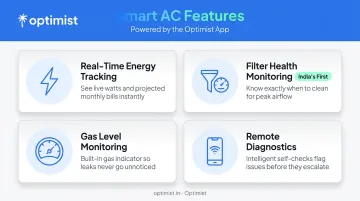
The right companion app surfaces all of this clearly — energy data, gas status, filter health — without requiring a technician visit for basic diagnostic information.
Build Quality and Corrosion Resistance
Indian conditions — coastal salt air, monsoon humidity, hard water — accelerate degradation of outdoor unit fins and coils. Buyers in coastal cities should specifically check for corrosion-resistant construction and ask how it's validated.
What to ask: Is there a named corrosion test standard, how many hours was it tested, and is there independent certification? An AC tested for 1,000 hours under a SIGMA-certified salt-spray protocol offers far more verifiable confidence than one with no stated corrosion testing. The market standard is typically 72 hours — 1,000 hours is 15× that benchmark.
Warranty Coverage and After-Sales Support
Warranty terms vary considerably across brands, and the gap between a strong and a weak warranty can cost ₹15,000–₹30,000 over the life of the unit. Evaluate:
- Length of comprehensive warranty (parts + labour together, not just parts)
- Compressor-specific coverage — the compressor is the most expensive component to replace
- Whether refrigerant gas is included — gas refill charges of ₹2,500–₹7,000 per incident add up fast
- On-site service vs. carry-in — on-site matters when you're dealing with a 15kg outdoor unit
- Service network in your city — a 5-year warranty is only as good as the technician who can honour it
Why Optimist Is Built for India's Real AC Needs
Optimist is an Indian climate tech company, headquartered in Gurgaon, that engineered its AC to address the performance gaps a star label cannot capture. The product was built for one purpose: to cool reliably when Indian summers are at their worst.
The founding team brings serious domain depth — Ashish Goel (ex-Urban Ladder CEO), Pranav Chopra (CTO), and Manjunath Rao (ex-Hitachi HVAC) — backed by technical advisory from Prof. Anurag Goyal of IIT Delhi. The company raised USD 12M from Accel, Arkam Ventures, and Sparrow Capital in December 2025.
Technical Differentiators
- ISEER 6.05 — India's highest certified efficiency rating, with annual energy consumption of 620.2 kWh (versus 850–920 kWh for typical 5-star competitors)
- Full cooling at 50°C, no derate — tested and validated for peak Indian summer conditions, not just the standard 43°C benchmark
- Microchannel heat exchanger — advanced aluminium alloy construction with 1,180 flow paths, delivering 4× faster heat transfer
- 1,000-hour salt-spray corrosion testing — SIGMA certified via ASTM B368; 15 times more rigorous than the 72-hour market standard
- India's first built-in Gas Level Indicator — live refrigerant monitoring in the Optimist App, so you always know your refrigerant level before a technician can charge you for a top-up you don't need
- Turbo+ Mode — delivers 1.9 Ton effective cooling from the 1.4 Ton unit, a genuine alternative for the 120–200 sq ft room segment
Smart Features and Warranty
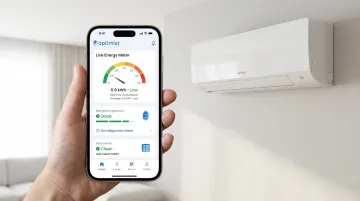
The Optimist App (iOS and Android) puts full control in one place:
- Live energy meter with projected monthly bill estimates
- Gas level indicator — India's first built into an AC app
- Filter health monitoring and maintenance alerts
- Intelligent remote diagnostics
- Scheduling and full remote control
On warranty, Optimist covers more than most: 5-year all-inclusive coverage (parts, labour, on-site service) on outdoor unit components and critical indoor parts, including refrigerant gas, plus a 10-year compressor warranty.
Conclusion
A 5-star label is the right starting point — but the right 5-star AC for an Indian home is one that holds up its efficiency promise on a 48°C May afternoon, not just under test conditions.
Before buying:
- Check the actual ISEER value on the BEE label — not just the star count
- Verify peak-heat performance — does the manufacturer explicitly claim full cooling at 48–50°C?
- Match tonnage to your room size, accounting for ceiling height and sun exposure
- Factor in warranty depth — parts, labour, gas, and on-site service together
- Consider smart monitoring features that give you visibility into running costs and maintenance needs
An older "5-star" AC bought under a previous BEE schedule may now consume significantly more electricity than a current 5-star model. If you're replacing a unit that's 5–7 years old, upgrading to a high-ISEER model typically pays for itself within 2–3 cooling seasons.
Optimist's 1.4 Ton 5 Star+ Inverter Split AC — rated at ISEER 6.05 (India's highest), tested at 50°C with no cooling derate, and backed by a 10-year compressor warranty — is built specifically around this checklist. It's worth measuring any AC you're considering against the same criteria.
Frequently Asked Questions
Which AC has a 5-star rating?
Multiple brands offer 5-star rated ACs in India — the BEE certification is based on ISEER performance and isn't exclusive to any brand. Voltas, LG, Daikin, Hitachi, Blue Star, and newer brands like Optimist all have 5-star models. Since ISEER values vary within the 5-star band, always check the actual number on the BEE label when comparing.
What does a 5-star AC mean?
A 5-star AC has been certified by India's Bureau of Energy Efficiency with an ISEER of 5.00 or above — the highest efficiency tier under the current BEE schedule. It means the unit delivers the most cooling per unit of electricity consumed across a typical Indian cooling season, based on 1,600 standardised annual hours.
Which AC is best as a 1.5-ton 5-star?
The best 1.5-ton 5-star AC depends on ISEER value, peak-heat performance, and features — not star count alone. Compare actual ISEER numbers on the BEE label and verify whether the unit maintains full cooling output above 45°C ambient. Optimist's 1.4 Ton with Turbo+ delivers 1.9-ton effective cooling, making it a strong alternative for 120–200 sq ft rooms.
Is there a 7-star AC?
No — the BEE star rating system in India currently goes up to 5 stars. There is no official 7-star category. Some manufacturers use proprietary ratings or marketing claims that aren't part of the BEE framework. Within the 5-star band, ISEER scores vary meaningfully, so a higher ISEER is the correct way to identify a more efficient unit.
How much electricity does a 5-star AC consume per month?
Monthly consumption depends on the model's ISEER, tonnage, daily usage hours, and ambient temperatures. The Optimist 1.4 Ton (ISEER 6.05) consumes 620.2 kWh annually under BEE's standardised calculation — roughly 55–100 kWh per month, compared to 850–920 kWh annually for typical 5-star competitors.
Does a 5-star AC perform well in extreme heat above 45°C?
Not necessarily. BEE's efficiency calculation covers temperature bins up to 43°C — it doesn't guarantee full cooling capacity at 45–50°C. Many 5-star ACs derate their output at higher ambient temperatures. Buyers in North Indian cities should specifically ask whether the unit is tested and rated for full performance at 48–50°C before purchasing.