
That confusion isn't your fault — it's because room size alone never tells the full story. Two identical 200 sq ft bedrooms in different cities, with different sun exposure, can need genuinely different cooling capacity.
Get it wrong in either direction and you pay for it. An undersized AC runs non-stop and still can't hit your set temperature. An oversized one blasts cold air, shuts off too soon, and leaves the room damp and uncomfortable.
This guide gives you a direct answer, a sizing chart, the real-world factors that shift the recommendation, and how modern AC technology changes the calculation entirely.
Key Takeaways
- A 200 sq ft room typically needs 1.5 to 2 ton depending on heat load, not room size alone
- Calculate tonnage using 120 BTU per sq ft, then divide the total by 12,000
- Occupancy, sun exposure, insulation, and ceiling height can each shift you up or down a size
- High-efficiency ACs that don't derate in extreme heat are safer bets for borderline room sizes
- Optimist's 1.4 ton Turbo+ mode delivers up to 1.9 ton effective cooling for this range
What Size AC Do You Need for a 200 Sq Ft Room?
Quick answer: a 1.5 ton AC generally works for a 200 sq ft room with standard 10 ft ceilings, two occupants, and moderate sun exposure. If your room faces south or west, sees heavy sun, or sits in a hotter region like Delhi NCR or Rajasthan, step up to 2 ton.
This isn't a hard rule. It's a starting point that the rest of this guide will help you refine.
AC Room Size Chart for Quick Reference
Manufacturer charts don't fully agree on where 200 sq ft belongs, which is exactly why it's called a boundary case.
| Room Size (sq ft) | Typical AC Tonnage |
|---|---|
| Up to 120 | 1 ton |
| 120 – 190 | 1.5 ton |
| 191 – 250 | 2 ton |
| 250 – 400 | 2.5 – 3 ton |
Some manufacturers place the entire 151–250 sq ft band under 1.5 ton. Others start their 2 ton recommendation right at 200 sq ft. Treat 200 sq ft as the edge, not a fixed answer: your final choice depends on the factors covered below.
How to Calculate the Exact Tonnage Using BTU
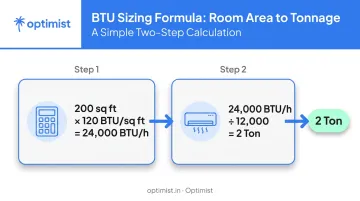
Rather than relying on a chart alone, you can work out a baseline yourself. Hitachi India uses a rule of thumb of 120 BTU per square foot for minimum cooling capacity. One ton of refrigeration equals 12,000 BTU/h.
The formula:
Room area (sq ft) × 120 BTU ÷ 12,000 = Tonnage required
For a 200 sq ft room:
- 200 × 120 = 24,000 BTU/h
- 24,000 ÷ 12,000 = 2 ton
This is why the BTU method often pushes a borderline 200 sq ft room into the higher bracket, even when a floor-area chart says 1.5 ton is fine. It's a baseline number, not the final word: the factors below adjust it up or down based on how the room actually behaves.
This is exactly where Optimist's 1.4 Ton model fits in. Its Turbo+ mode delivers 1.9-ton effective cooling on demand, covering the higher end of a 200 sq ft room's BTU need, then settles back to efficient 1.4 Ton operation once the room cools.
Factors That Determine the Right AC Tonnage for Your Room
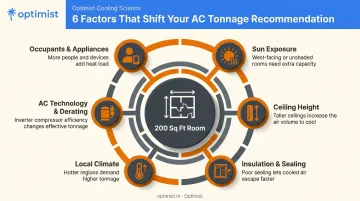
Two 200 sq ft rooms can need two different AC sizes. Manufacturer charts assume standard conditions: moderate sun, average occupancy, 10 ft ceilings, and decent insulation. Real rooms rarely match all four.
Number of Occupants and Heat-Generating Appliances
Every person in a room adds body heat. Daikin recommends adding roughly 0.18 kW of cooling capacity per person beyond two occupants, or about 614 BTU/h per extra person.
Appliances add to this load too:
- Television and set-top box
- Refrigerator or mini-fridge
- Desktop computer or gaming setup
- Kitchen equipment, if the room doubles as a kitchenette
A 200 sq ft study that's also a home office with two monitors and three occupants isn't the same cooling job as an empty guest bedroom.
Sun Exposure and Room Orientation
South- or west-facing rooms with large windows soak up significant heat through the day. Daikin's research notes this can require 10-20% more cooling capacity than a shaded, north-facing room of the same size.
If your 200 sq ft room gets direct afternoon sun for several hours, factor that in before settling on 1.5 ton.
Ceiling Height and Room Volume
AC charts assume 8-10 ft ceilings. Cooling load actually depends on room volume, not floor area.
- A 200 sq ft room with a 12 ft ceiling has roughly 20% more air to cool than the same footprint at 10 ft
- Open-plan layouts connecting to hallways or lofts increase effective volume further
- Some manufacturer guidance recommends adding 10% capacity for high-ceiling rooms
Insulation and Window/Door Sealing
Poor sealing lets cool air leak out and hot air seep in. Your AC ends up compensating for a leaky envelope, not just cooling the room.
- Gaps around windows and doors
- Uninsulated walls facing the outdoors
- Older construction without thermal breaks
Fixing these gaps before upsizing your AC is often cheaper and more effective than jumping a full ton.
Local Climate and City-Specific Heat
Peak summer temperatures vary sharply across India. Delhi NCR, Rajasthan, and parts of central India regularly cross 43-45°C during heat waves, well above the 35°C conditions most ACs are rated and tested under.
Rooms in these regions often need one size up compared to the same room in a milder coastal city, simply because the outdoor heat the AC must fight against is far more intense.
AC Technology and Efficiency Rating
This is where tonnage gets misleading. Not every "1.5 ton" AC delivers 1.5 ton of actual cooling once outdoor temperatures climb.
- Standard inverter ACs are rated at 35°C outdoor conditions
- Many units begin derating (losing cooling capacity) once temperatures cross 43°C
- A 1.5 ton unit that derates in peak summer may function closer to 1.2 ton exactly when you need full power
For a borderline 200 sq ft room, this single factor can matter more than any chart. Optimist's 1.4 ton units are tested at 50°C with no derate, so the tonnage on the spec sheet stays the tonnage you get during a heat wave.
Common Mistakes to Avoid When Sizing an AC for a 200 Sq Ft Room
Mistake 1: Trusting the room-size chart alone. Charts give you a starting point, not a final answer. Skipping the occupancy, sun, and ceiling adjustments is the single most common sizing error.
Mistake 2: Oversizing "just to be safe." This backfires. ASHRAE warns that an oversized AC cools too quickly, shuts off before it can properly remove humidity, and cycles on and off repeatedly — a problem called short-cycling.
The result of going too big:
- Increases electricity bills compared to a correctly sized unit
- Leaves the air clammy and humid even when the room feels cold
- Adds wear on the compressor from frequent starts and stops
Mistake 3: Ignoring real summer performance versus rated capacity. A 2 ton AC rated under lab conditions at 35°C doesn't automatically deliver 2 ton of cooling at 45°C outdoors. If the unit you're comparing derates in extreme heat, its "rated tonnage" is misleading you. Optimist's 1.4 Ton AC, for example, is lab-tested at 50°C with zero capacity drop.
How Optimist Helps You Get the Right Cooling for a 200 Sq Ft Room
This is exactly the borderline situation Optimist was built for. Standard tonnage charts assume lab-perfect conditions that rarely match a real Indian summer, and that gap is where most sizing decisions go wrong.
No derating at extreme heat. Optimist's 1.4 ton unit is government-lab tested to deliver full rated cooling at 50°C ambient, with no performance drop, well beyond the 43°C point where most competing ACs start losing capacity. In Delhi NCR, Rajasthan, or UP summers, that means the rated tonnage stays accurate when you need it most.
Turbo+ mode changes the math. Through its dual-rotary inverter compressor and micro-channel heat exchanger (1,180 flow paths, 4× faster heat transfer), the 1.4 ton unit delivers a 135% capacity boost on demand, reaching up to 1.9 ton of effective cooling.
That makes it a genuine alternative to a standard 1.5 ton AC for rooms in the 120-200 sq ft range, without carrying the higher running cost of a bigger unit.
Efficiency that lowers the bill, not just the temperature. With an ISEER rating of 6.05 — India's highest — and 5-star efficiency, the unit is built to run at 25-35% lower electricity bills than typical inverter ACs, even at higher cooling loads.
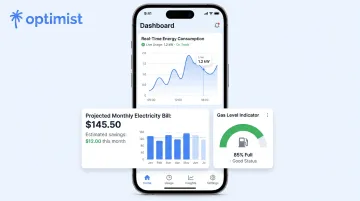
Full transparency through the app. Real-time energy tracking shows current usage and a projected monthly bill, so you know exactly what your chosen AC size costs to run. A built-in gas-level indicator, the first of its kind in India, flags refrigerant issues before they affect performance.
In practice, that combination often lets one 1.4 ton Optimist unit cover a borderline 200 sq ft room that would otherwise need a 1.5-2 ton competitor, while pulling noticeably less power to do it.
Conclusion
For most 200 sq ft rooms, the right answer sits between 1.5 and 2 ton, though the exact number depends on your occupants, sun exposure, insulation, and local climate, not the floor area alone. Optimist's 1.4 Ton AC closes that gap: Turbo+ mode delivers 1.9-ton effective cooling, matching a 1.5 Ton unit's output while using less power.
Match your AC choice to the room's actual heat load and the summer conditions it faces, rather than chasing the biggest or cheapest unit on the shelf.
Revisit your sizing if things change: more people move in, you add furniture or appliances, or you renovate the space. And remember that efficient, high-performance technology can make a given tonnage go further than a less efficient unit of the same size.
Frequently Asked Questions
What size AC for a 200 sq ft room?
A 1.5 ton AC works for standard conditions with moderate sun and average occupancy. Rooms with heavy sun exposure, more occupants, or extreme summer heat need extra cooling power, such as Optimist's 1.4 Ton AC, which delivers 1.9-ton effective cooling via Turbo+ mode.
Is a 1.5 ton AC enough for a 200 sq ft room?
It can be, especially in moderate climates with good insulation and two occupants. It may struggle during peak summer heat or in south/west-facing rooms with large windows.
How many BTU do I need to cool 200 square feet?
Using the 120 BTU/sq ft rule, 200 sq ft requires roughly 24,000 BTU, which rounds up to a 2 ton AC before any room-specific adjustments.
Can a 2 ton AC be too big for a 200 sq ft room?
Yes. Oversizing causes short-cycling and poor humidity removal. For most 200 sq ft rooms, right-sized cooling matters more than raw tonnage — Optimist's 1.4 Ton AC with Turbo+ mode reaches 1.9-ton effective cooling without the oversizing drawbacks.
Does room direction or sunlight affect AC size for a 200 sq ft room?
Yes. South- or west-facing rooms with large windows absorb far more heat, which often justifies moving up one AC size compared to a shaded, north-facing room.
Does a higher ceiling change the AC tonnage needed for 200 sq ft?
Yes. Standard charts assume roughly 10 ft ceilings. Taller ceilings or open layouts increase room volume, which can require higher tonnage despite an identical floor area.