
Introduction
Delhi's Mungeshpur station touched 49.9°C in May 2024. Churu in Rajasthan hit 50.5°C, and Sirsa in Haryana recorded 50.3°C on the same day, according to IMD station data reported by Times of India.
Here's the real question: can your AC actually handle that?
Many households discover the hard way that their AC struggles exactly when they need it most. Cooling drops, compressors strain, and electricity bills spike right as the mercury climbs past 43-45°C.
This guide breaks down what makes an AC genuinely "50°C-ready" and which models are actually engineered for this kind of heat. You'll also learn how to pick one without falling for generic marketing claims.
TL;DR
- A "50°C-rated" AC sustains full cooling power at 50°C, not merely avoiding shutdown
- Most split ACs lose cooling once temperatures cross 43-45°C, despite nameplates rated to 52-55°C
- This guide compares Optimist, Daikin, LG, Voltas, and Blue Star/Hitachi on ambient range, ISEER, build, and warranty
- Selection criteria: ISEER efficiency, documented ambient testing, corrosion-resistant build, and compressor warranty depth
Overview of ACs Built for 50-Degree Indian Summers
A heat-resilient AC is engineered to sustain full cooling output as outdoor temperatures approach or cross 50°C. It's a completely different design goal from simply not breaking down at that temperature.
India's heat problem isn't a one-off spike anymore. The country logged 536 heatwave days across its meteorological subdivisions in summer 2024, the highest count in 14 years, with northwest India recording its warmest June since 1901, according to reporting from the Indian Express.
That's sustained thermal load on your compressor for weeks, not a single bad afternoon.
Why Regular ACs Struggle Above 43°C
Here's the technical bit. India's official energy label, ISEER, is calculated using outdoor temperature bins between 24°C and 43°C, over 1,600 annual cooling hours. There's no test bin above 43°C in that formula.
That gap matters:
- A 5-star ISEER label tells you about seasonal efficiency, not what happens at 48°C or 50°C
- As outdoor temperature climbs past the compressor's design point, condenser heat-rejection margin shrinks, power draw rises, and cooling capacity can fall
- Most brands publish a maximum ambient ceiling (commonly 52-55°C), but that's a survival limit, not a performance guarantee
What Actually Prevents the Drop
A handful of engineering choices separate units that hold their capacity from ones that quietly derate:
- Automotive-derived aluminium alloy condensers: borrowed from vehicle thermal management, where similar designs already handle sustained heat loads
- Microchannel heat exchangers pack more flow paths into the same footprint, speeding up heat rejection per unit of compressor effort
- Outdoor units facing 50°C sun exposure also face faster material fatigue, which is why corrosion-tested components matter
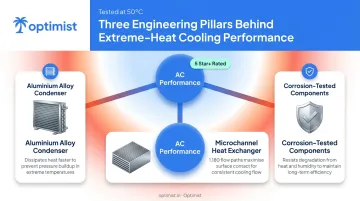
The list below covers the brands and models best positioned to hold cooling performance through extreme Indian heat, not just tolerate it.
Top ACs for 50-Degree Temperature in India
Each AC here was reviewed against five criteria: tested ambient operating range, ISEER/energy rating, build durability, smart diagnostics, and warranty strength.
Optimist – India's Real AC
Optimist is an India-first climate tech company that built its entire cooling architecture from scratch at its Nalanda 1 R&D Lab, rather than adapting a global platform for Indian weather. The design drew on input from IIT Delhi's mechanical engineering department, engineered specifically for extreme Indian summers.
What sets it apart:
- India's highest ISEER rating of 6.05, tested to deliver full cooling at 50°C with zero performance drop
- Turbo+ Mode delivering a 135% capacity boost — the 1.4-ton unit effectively performs like a 1.9-ton AC during rapid pull-down
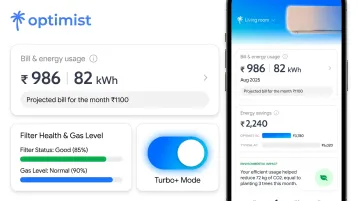
- India's first built-in gas-level indicator, showing real-time refrigerant status through the app instead of leaving customers dependent on a technician's word
| Category | Details |
|---|---|
| ISEER & Cooling | 6.05 ISEER, tested for full cooling at 50°C, micro-channel heat exchanger with 1,180 flow paths for 4X faster heat transfer than conventional systems |
| Durability & Warranty | 1,000-hour salt-spray corrosion testing (SIGMA certified, 15x typical market standard), 5-year comprehensive warranty, 10-year compressor warranty, refrigerant gas included |
| Smart Features | Live energy meter with projected monthly bills, filter health tracking, gas-level indicator, remote diagnostics and scheduling via the Optimist app |
The dual-rotary inverter compressor paired with that microchannel exchanger is what makes Turbo+ possible: the compressor pushes refrigerant faster, and the exchanger dissipates the extra heat load without saturating. Customers also get 25-35% lower electricity bills compared to typical 5-star inverter ACs, according to Optimist's own product data, driven largely by that 6.05 ISEER figure.
Daikin
Daikin brings decades of Japanese compressor engineering and one of the most established residential AC networks in India.
Its differentiators:
- Inverter compressor technology tuned for gradual load modulation rather than constant on-off cycling
- Coanda airflow design, which spreads cooled air along the ceiling instead of blasting it directly at occupants
- Wide after-sales service footprint across metro and tier-2 cities
| Category | Details |
|---|---|
| Technical Specs | 1.0-2.0 ton range (JTKJ35XV at 1.0 ton, JTKJ53XV at 1.5 ton); MTKM35U carries an ISEER of 5.2 |
| Key Features | Selected models (FTKM/FTKF/Waizu lines) rated for ambient operation up to 52-55°C |
| Warranty | 1 year on the full unit, 5 years on PCB, 10 years on the inverter compressor; a separate 5-year comprehensive offer applies with registration and authorised installation |
LG
LG's DUALCOOL range leans heavily on smart connectivity through its ThinQ ecosystem, paired with dual inverter compressors for efficiency.
Its differentiators:
- Dual inverter compressor for faster cooling with fewer on-off cycles, which also reduces compressor wear over time
- ThinQ app control, letting you start cooling before you get home or switch to a low-energy mode remotely
- Voice assistant and smart home integration for households already invested in connected devices
| Category | Details |
|---|---|
| Technical Specs | India catalogue spans roughly 3.5 kW (1 ton) to 7.0 kW (2 ton) capacity classes; the 2025 US-Q19JWZE3 is a 1.5-ton, 5-star model |
| Key Features | AI Convertible 6-in-1 mode, ThinQ Wi-Fi control, Energy Manager+ for consumption tracking |
| Warranty | 1-year basic warranty plus 9 additional years on the inverter compressor for units purchased from August 1, 2024 (compressor-only; gas charging and service costs excluded) |
Voltas
Voltas, the Tata-Voltas joint venture, is one of India's most recognised AC names, particularly through its "All-Weather AC" positioning.
Its differentiators:
- Adaptive cooling technology marketed for wide ambient temperature ranges
- Strong pan-India service network, especially in smaller towns where after-sales coverage matters most
- 5-step adjustable cooling on select models for finer control over output
- High-ambient cooling rated to 52°C on select models such as the Vertis Elite Gold
| Category | Details |
|---|---|
| Technical Specs | 185INV Vertis Elite Gold: 1.5 ton, 5-star inverter split; 245INV Vectra Plush: 2 ton, 5-star with 5-step adjustable cooling |
| Key Features | Official high-ambient cooling claim of 52°C on the Vertis Elite Gold |
| Warranty | 1-year comprehensive cover, 5 years on PCB, and 10 years on the compressor (1 basic + 9 additional years), subject to model and registration conditions |
Blue Star / Hitachi
Both brands carry long-standing HVAC heritage in India, with roots in commercial cooling that carry over into residential build quality.
Its differentiators:
- Reputation for robust construction, backed by decades in commercial refrigeration and HVAC
- Heavy-duty product lines positioned for demanding climates, even if neither publishes a universal high-ambient number
| Category | Details |
|---|---|
| Technical Specs | Blue Star D Series: 1.5 ton, 5-star, ISEER 5.41; Hitachi Sumo 5600XXL: 1.5-ton heavy-duty inverter class |
| Key Features | Blue Star D Series markets extreme-ambient cooling with a 43-inch indoor unit; Hitachi Sumo promoted for powerful, uniform airflow |
| Warranty | Blue Star warranty terms vary by model and promotion (some offers extend to 60 months); Hitachi offers 5 years on controller/PCB and 10 years on compressor for select inverter split models |
How We Chose the Best ACs for Extreme Heat
Most buyers pick an AC based on tonnage and sticker price alone. That's a mistake in a country where summer ambient temperatures routinely blow past the ISEER test range.
Here's what actually predicts real-world performance and running cost:
- Certified energy efficiency (ISEER/star rating): a higher ISEER doesn't just mean a better label; it directly correlates to lower electricity bills across a full summer
- Documented ambient temperature testing: look for a specific tested ceiling (50°C, 52°C) rather than vague "high-ambient" language with no number attached
- Corrosion and build validation: outdoor units facing direct sun and dust need tested durability, not just a warranty promise
- Warranty depth, especially compressor coverage: a 10-year compressor warranty signals the manufacturer trusts the part to survive sustained heat stress
- Smart diagnostics: real-time visibility into energy use and refrigerant levels catches problems, and prevents unnecessary service charges, before they become breakdowns
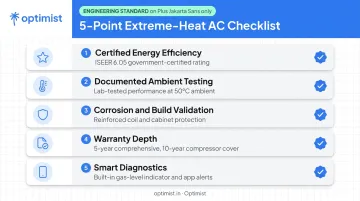
Skipping any one of these usually shows up later as a mid-summer breakdown, an inflated bill, or a "we found low gas" call from a technician you can't verify.
Conclusion
Choosing an AC for 50°C Indian summers comes down to real engineering, not the biggest tonnage number, the lowest price tag, or marketing claims of universal performance.
Before you buy, check these three things:
- Tested ambient rating — confirms the AC actually cools at 50°C, not just on the spec sheet
- Compressor warranty depth — longer coverage signals confidence in real-world durability
- Actual running cost — what you'll pay across a full summer, not just the price tag
Optimist was built around exactly this problem. Engineered from the ground up for Indian summers, it's tested to hold full cooling at 50°C. Its ISEER of 6.05 means lower bills, and the app delivers full transparency — right down to your refrigerant gas level.
Frequently Asked Questions
Which AC works in 50 degree temperature?
Most modern ACs are rated to run up to roughly 55°C ambient but start derating cooling performance beyond 43-45°C. Heat-engineered units like Optimist are specifically tested to maintain full cooling capacity at 50°C.
What temperature should I set my AC to during extreme heat (45-50°C outdoors)?
Avoid setting below 24°C; the government's Bureau of Energy Efficiency notes that raising the set point by even 1°C can cut electricity use by roughly 6%. Pair the AC with a ceiling fan to reduce compressor strain.
Can a normal AC survive prolonged use in 50°C heat?
Yes, technically, most units will keep running. But you'll likely see reduced cooling efficiency, higher electricity consumption, and faster compressor wear over repeated extreme-heat cycles.
What is ISEER rating and why does it matter for extreme heat performance?
ISEER is India's official seasonal energy efficiency metric for air conditioners. A higher ISEER, like Optimist's 6.05, generally means better performance retention and lower running costs, though it's calculated only up to 43°C ambient.
How much can electricity bills increase when running an AC in 50°C weather?
Bills typically climb because the compressor runs longer and harder to maintain the same indoor temperature. High-ISEER, heat-optimised ACs can meaningfully soften this increase: Optimist delivers 25-35% lower bills versus typical 5-star inverter ACs.
What AC capacity (tonnage) do I need for a room in extreme heat conditions?
Room size, sun exposure, and occupancy all affect tonnage needs. Rooms in extreme-heat regions, especially west-facing or top-floor spaces, often need slightly higher capacity or a turbo-boost feature to compensate for the added heat load.