
India's electricity use for space cooling rose 21% between 2019 and 2022, and cooling now accounts for nearly 10% of the country's total electricity demand, according to the International Energy Agency. A big chunk of that comes from bedroom ACs that are the wrong size, badly placed, or poorly maintained.
Common complaints: sky-high bills, uneven cooling, morning sore throats, and units that lose steam exactly when you need them most. This guide covers AC types, correct sizing, placement, health considerations, and maintenance so your bedroom actually stays comfortable through peak heat.
Key Takeaways
- Right-size your AC to room area to avoid overspending and weak cooling during heatwaves
- Height, distance from the bed, and airflow direction matter as much as the AC itself
- Higher ISEER-rated units cut electricity costs by 25-35% compared to standard 3-star models
- Sleeping at 24-26°C with AC on is safe; sore throats stem from direct airflow, not the AC
- Clean filters and scheduled servicing prevent performance drops during the hottest months
Types of Air Conditioners Best Suited for Bedrooms
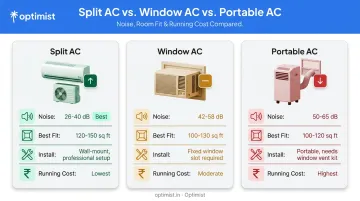
Most Indian bedrooms rely on split ACs, though window and portable units still show up in smaller rooms or rented flats. Here's how the three compare.
Split AC
Split systems keep the compressor outside, so the indoor unit stays quiet — a real advantage for sleep. Testing by Australian consumer body CHOICE found split indoor units running as low as 19-53 dB, well within comfortable sleeping range on quiet settings.
That's roughly why Optimist's 1.4 Ton split unit operates between 32-46 dB, with the lower end sitting closer to a quiet library than a running appliance. The dual-rotary inverter compressor helps here too: it modulates speed continuously instead of cycling on and off abruptly, cutting vibration and noise spikes typical of fixed-speed compressors.
Split ACs suit medium to large bedrooms and remain the standard recommendation for permanent bedroom cooling across India, particularly given their better efficiency ratings and quieter overnight operation.
Window AC
Window units cost less upfront, but the compressor and fan sit right in the room, making them noticeably noisier than splits. They're a reasonable fit for:
- Smaller bedrooms where installation space is limited
- Rented accommodations where drilling walls isn't an option
- Budget-first purchases where noise is a secondary concern
Portable AC
Portable units offer flexibility for renters or occasional cooling needs, but CHOICE testing found them running at 57-74 dB on high, loud enough to disturb sleep. They're also generally less efficient than split systems since the compressor and condenser stay indoors, working against the room's own heat load. Treat these as a backup option, not a primary bedroom solution.
How to Choose the Right AC for Your Bedroom
Picking the right unit comes down to three things: capacity, efficiency, and features that actually improve sleep.
Calculating the Right Capacity (Tonnage) for Your Room
A widely used India-market rule of thumb for sizing looks like this:
| Room Area | Recommended Tonnage |
|---|---|
| Up to 150 sq ft | 1 TR |
| 151-250 sq ft | 1.5 TR |
| 251-400 sq ft | 2 TR |
But raw area isn't the whole story. Manufacturer guidance suggests adjusting upward for:
- Strong south- or west-facing sun: add 10-20% more capacity
- Ceilings above the standard 8-9 ft: add roughly 10%
- More than two occupants: add about 0.1 TR per extra person
- Large single-glazed windows: add up to 0.5 TR
For a standard Indian bedroom in the 120-200 sq ft range, Optimist's 1.4 Ton unit fits perfectly. Its Turbo+ mode delivers 1.9-Ton effective cooling, a 135% capacity boost that pulls a 42°C room down to 25°C at top speed.
That buffer means you're not forced into a bulkier, costlier 1.5 Ton unit just to handle a hot afternoon or a peak summer week.
Why Energy Efficiency (ISEER Rating) Matters
The Indian Seasonal Energy Efficiency Ratio (ISEER) measures total seasonal cooling output divided by total seasonal energy use. A higher number means more cooling per unit of electricity, plain and simple.
BEE's star bands for split ACs (valid through December 2025):
| Star Rating | ISEER Range |
|---|---|
| 3 Star | 3.80-4.39 |
| 4 Star | 4.40-4.99 |
| 5 Star | 5.00 and above |
Optimist's unit carries an ISEER of 6.05, currently the highest rating in the Indian market and comfortably above the 5-star threshold.
The gap in running costs adds up. One manufacturer estimate for a comparable 1.5 TR unit, assuming 300 operating hours a year, put annual consumption at 450 kWh for a 3-star model versus 360 kWh for a 5-star model. That's a 90 kWh difference translating into real rupee savings depending on your tariff, and it's before factoring in an ISEER above 6.
Run the AC nightly through a Delhi or Chennai summer and that gap widens fast.
Smart Features Worth Considering for Bedroom Comfort
A few features make a genuine difference to sleep quality, not just convenience:
- Scheduling: Set the AC to turn on before you get home or before bedtime, so you're walking into a pre-cooled room instead of waiting it out
- Turbo/boost mode: Cools a hot room quickly on the worst nights without needing a physically larger, pricier unit
- Filter health tracking: Flags when the filter needs cleaning instead of leaving you to guess
- Gas-level monitoring: Optimist's app shows a live, colour-coded refrigerant gauge that catches leaks before cooling drops and stops unnecessary "top-up" service calls
None of this replaces good sizing and placement. But it does mean fewer surprises through the season.
Ideal AC Placement in Your Bedroom for Maximum Comfort
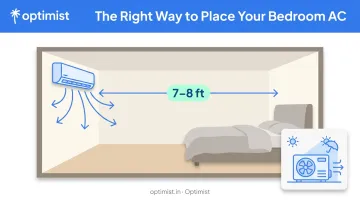
Placement affects comfort and health as much as the unit itself. The general rule: mount the indoor unit high on the wall, with a small gap from the ceiling so cool air spreads evenly across the room rather than pooling in one corner.
Positioning Relative to the Bed
Never install the indoor unit directly above the headboard. Direct airflow on a sleeping body all night is the single biggest cause of morning stiffness and dry throat, not the AC itself. A 7–8 foot gap from the bed usually solves this without slowing cooling.
- Direct airflow toward walking space, not straight at the bed
- Install along the longer wall in rectangular rooms for more even air distribution
- Angle the swing louvres to avoid a constant direct blast on the pillow area
Avoiding Heat Sources and Direct Sunlight
Keep the indoor unit away from windows with direct sun, TVs, and other electronics. Heat sources near the unit force the compressor to work harder to maintain the set temperature, which raises your electricity bill over a full summer. Even a TV a few feet away adds heat load the AC's sensor reads as room temperature.
Outdoor Unit Placement
The outdoor unit needs a shaded, well-ventilated spot, clear of enclosed spaces where hot exhaust air can recirculate back into the unit. Build quality matters a lot here: the outdoor unit takes the brunt of sun, monsoon humidity, and salt air in coastal cities.
Optimist's outdoor unit is tested for 1,000 hours of salt-spray exposure under SIGMA certification, roughly 15 times longer than the typical 72-hour market standard. No corrosion or leak issues turned up at either the 720-hour or 1,000-hour mark, which matters most if you're in Mumbai, Chennai, or Kochi.
For inland heat markets like Delhi NCR or Rajasthan, the bigger placement concern is thermal load, not salt exposure. That's why the same unit is rated for full cooling at 50°C ambient without derating.
Is It Safe to Sleep With a Bedroom AC On? Health and Comfort Considerations
Yes, it's safe, provided the temperature and airflow are set sensibly. The commonly recommended range for sleeping is 24-26°C, paired with a clean filter and airflow that isn't hitting you directly.
Sleep Foundation research points to a cooler general comfort zone, citing around 18.3°C (65°F) as preferred for sleep, though individual comfort varies quite a bit by person and season. In Indian bedrooms, 24-26°C tends to strike a better balance between comfort and energy use.
Getting the temperature right settles one common worry. Another shows up almost as often: that morning sore throat, which isn't usually caused by the AC running. Mayo Clinic notes that most sore throats trace back to viral infections, though dry indoor air can leave the throat feeling rough and irritated on its own.
Direct cold airflow all night, or a setpoint that's too aggressive, mimics those symptoms without any virus involved.
To avoid it:
- Use a sleep timer or scheduled auto-off instead of running the AC at full blast all night
- Keep the setpoint moderate rather than as low as possible
- Make sure airflow isn't pointed directly at your face or chest
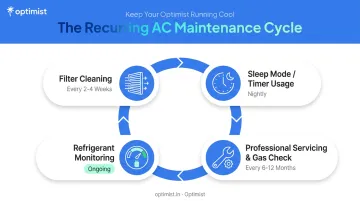
Filter cleanliness plays a quieter role here too: a dirty filter recirculates dust and reduces airflow efficiency. Optimist's app flags this with a "Needs cleaning" warning once around two months have passed. The tracking is manual: you confirm with a "Mark as cleaned" tap rather than it being auto-detected.
Bedroom AC Maintenance and Energy-Saving Tips
Consistent upkeep is what keeps a bedroom AC performing through May and June instead of fading right when you need it.
- Clean or check the filter every 2-4 weeks. LG India recommends this interval for residential units; dustier environments need more frequent cleaning.
- Use sleep mode/timers with a moderate setpoint rather than running the coldest setting all night. This alone meaningfully reduces consumption.
- Get professional servicing every 6-12 months, including a gas-level check, to catch issues before peak summer strain.
- Watch for early refrigerant loss. A built-in gas indicator, like the one on Optimist's app, flags low refrigerant before cooling actually drops, avoiding both surprise breakdowns and unnecessary top-up charges from technicians.
Optimist backs this up with a 5-year comprehensive warranty covering the outdoor unit, critical indoor components, and refrigerant gas refills at zero cost, plus a 10-year compressor warranty. Together, these warranties take most of the guesswork out of bedroom AC upkeep for a decade.
Frequently Asked Questions
Is it safe to sleep with AC on at night?
Yes, it's safe with a moderate temperature setting (24-26°C), a clean filter, and airflow that doesn't hit you directly. Avoid running it at the coldest setting with the vents pointed straight at the bed all night.
Is AC bad for a sore throat?
The AC itself doesn't cause sore throats. Direct cold airflow, very low temperatures, or dirty filters are the usual culprits, along with viral infections that have nothing to do with cooling.
Where should the AC be placed in a bedroom?
Mount it high on the wall, away from the headboard, with airflow directed toward walking space rather than straight at the bed. Keep it clear of direct sunlight and heat-generating electronics.
What is the 3-minute rule for air conditioners?
It's a short delay, typically around 3 minutes, before the compressor restarts after switching off or changing modes. This gap lets internal pressures equalise, protecting the compressor from strain.
What size AC do I need for my bedroom?
As a general guide, 1 Ton units suit rooms up to 150 sq ft, while 151-250 sq ft need around 1.5 Ton cooling, a range Optimist's 1.4 Ton with Turbo+ mode covers alone at 1.9-Ton effective cooling. Sun exposure, high ceilings, or extra occupants can still push the recommendation upward.
How can I reduce AC electricity bills in my bedroom?
Choose a higher ISEER-rated unit, keep the setpoint around 24-26°C, clean filters regularly, and use app-based scheduling to avoid running the AC longer than needed.