
The 1.5-ton split AC is where most Indian households start their search. But the 2026 buying decision is more complex than it was two years ago. The BEE revised its star-rating benchmarks, so a model that earned 5 stars in 2024 may now sit in the 4-star band. Knowing which models actually qualify under 2026 norms — and which ones perform when it matters most — is the difference between a smart purchase and an expensive regret.
Key Takeaways
- A 1.5-ton AC is suited for rooms between 120–180 sq ft — most Indian bedrooms and mid-sized living rooms
- Under 2026 BEE norms, 5-star requires ISEER 5.80 or above — not 5.00 or 5.70
- Look beyond star labels; compare actual ISEER values for real savings
- For extreme summer performance, check if the unit is tested at 45°C or higher without derating
- Optimist tops the ISEER chart at 6.05; LG, Panasonic, Daikin, and Voltas compete on price, brand reach, and specific features
Why a 1.5 Ton AC Is the Right Fit for Most Indian Homes
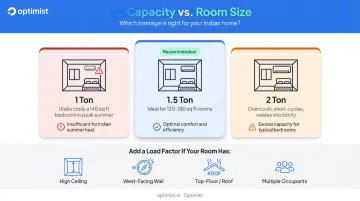
A 1.5-ton AC is generally the right starting point for rooms between 120 and 180 sq ft — covering the vast majority of Indian bedrooms, mid-sized living rooms, and home offices. A few factors can push the effective load higher:
- Ceilings above 10 feet
- South- or west-facing walls with direct afternoon sun
- Top-floor placement with a heat-absorbing roof
- More than two regular occupants
Once you account for those factors, the 1.5-ton category earns its popularity by balancing cooling power with running costs. A 1-ton unit may undercool a 140 sq ft bedroom in peak summer; a 2-ton unit overcools and burns more electricity than the room actually needs. At 1.5 tons, you get enough capacity for most real-world Indian rooms without overpaying on your electricity bill.
Sizing is only the first filter. What separates a forgettable 1.5-ton AC from one worth buying in 2026 comes down to a handful of specs that matter far more than the brand name on the front panel.
Best 1.5 Ton ACs for Home in 2026
These models were evaluated on ISEER rating against 2026 BEE benchmarks, high-ambient cooling performance, noise levels, smart features, build quality, and after-sales support.
Optimist 1.5 Ton 5 Star Inverter Split AC
Launched in January 2026, Optimist is a Gurgaon-based climate tech startup founded by Ashish Goel (ex-Urban Ladder CEO) and Pranav Chopra, backed by USD 12M from Accel, Arkam Ventures, and Sparrow Capital. Engineered at the Nalanda 1 R&D Lab with technical collaboration from IIT Delhi, Optimist holds India's highest ISEER rating of 6.05 (well above the 2026 five-star threshold).
The Optimist is positioned as a 1.5-ton category alternative: its 1.4-ton unit delivers effective 1.9-ton cooling in Turbo+ Mode (135% capacity boost), with the standard 4.85 kW rated output maintained at 50°C ambient with no cooling derating at peak summer temperatures.
Standout differentiators:
- ISEER 6.05 (India's highest), cutting electricity bills 25–35% vs. typical 5-star inverter ACs (ISEER ~5.0–5.4)
- Turbo+ Mode delivers 135% capacity on demand for extreme heat situations
- India's first built-in gas level indicator, so you know exactly what's in the refrigerant line
- Microchannel heat exchanger with 1,180 flow paths and 4× faster heat transfer vs. conventional finned coils
- 1,000-hour salt spray corrosion tested (SIGMA certified), 15× the typical 72-hour market standard
- Optimist App (iOS + Android): live energy meter, projected monthly bills, filter health tracking, intelligent diagnostics, scheduling, and remote control
| Spec | Detail |
|---|---|
| ISEER | 6.05 |
| Star Rating (2026) | 5-Star+ |
| High Ambient | Tested at 50°C, no derate |
| Warranty | 5-year all-inclusive (ODU + critical IDU components + refrigerant gas + remote); 10-year compressor |
| Annual Energy | 620.2 kWh (BEE-declared for 1.4T SKU) |
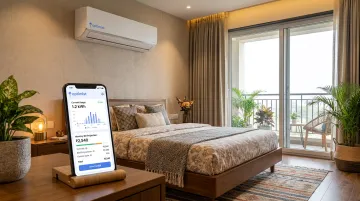
Best for: Buyers prioritising maximum energy efficiency, peak-summer performance, and full transparency through smart features. Available at optimist.in.
LG 1.5 Ton 5 Star Dual Inverter Split AC (US-Q19YNZE3)
LG is one of India's most trusted AC brands with one of its widest service networks. The US-Q19YNZE3 is LG's flagship 1.5-ton split AC, confirmed as a 5-star model with a rated capacity of 5,000W and a minimum indoor noise of 31 dB(A) (among the quietest in this segment).
Standout differentiators:
- AI+ Convertible 6-in-1 modes that auto-adjust cooling based on room occupancy
- VIRAAT Mode for 116% capacity during peak demand
- Cools effectively up to 55°C ambient (manufacturer-stated)
- Ocean Black Protection coating on copper condenser for corrosion resistance
- HD Anti-Virus filter; stabiliser-free operation across a wide voltage range
| Spec | Detail |
|---|---|
| ISEER | Not published on official page; confirmed 5-star under 2026 norms |
| Noise (min) | 31 dB(A) |
| High Ambient | Up to 55°C |
| Warranty | 1-year product + 10-year inverter compressor |
Best for: Buyers who want a proven, widely serviced brand with near-silent bedroom operation and flexible cooling modes.
Panasonic 1.5 Ton 5 Star Wi-Fi Inverter Split AC (CS/CU-NU18BKY5WX)
The Panasonic CS/CU-NU18BKY5WX is a confirmed 2026 model with ISEER 5.80 , exactly at the new 5-star threshold, and 681.01 kWh annual energy consumption per BEE data. It's the only AC in this comparison with Matter-enabled smart home integration, which makes it the only option in this segment with Matter protocol support.
Standout differentiators:
- 8-in-1 convertible cooling modes
- PM 0.1 air filtration, the finest particulate filtering in this segment
- Matter-enabled Wi-Fi via the MirAIe app (proximity control, custom sleep profiles, AQI monitoring)
- Crystal Clean self-cleaning in 15 minutes
- DustBuster outdoor unit auto-cleaning; ShieldBlu+ corrosion coating on both units
- Rated capacity: 5,100W; operates up to 55°C
| Spec | Detail |
|---|---|
| ISEER | 5.80 |
| Noise (min) | 34 dB(A) |
| High Ambient | Up to 55°C |
| Annual Energy | 681.01 kWh (BEE-declared) |
| Warranty | 12 months standard; extended PCB and compressor coverage available |
Best for: Smart home integrators who want Matter compatibility, the best-in-class air filtration, and a confirmed 2026 5-star rating.
Daikin 1.5 Ton Inverter Split AC (MTKM50XV)
Daikin's MTKM50XV is a premium choice for buyers who prioritise quiet, consistent airflow and engineering precision. Important 2026 note: its ISEER of 5.70 falls in the 4-star band under the new BEE rules (5-star now requires 5.80+). The 5-star label on this model reflects the previous rating period, not the 2026 standard.
Standout differentiators:
- Power Chill operation cools rooms ~20% faster than standard mode
- Triple LED display showing power consumption, set temperature, and error codes simultaneously
- 3D airflow with 4-way automatic swing; rated capacity 5,000W
- DNNS coating and BTA oil treatment for anti-corrosion; Blue Fin outdoor unit protection
- Minimum indoor noise: 31 dB(A); operates up to 55°C
| Spec | Detail |
|---|---|
| ISEER | 5.70 (4-star under 2026 BEE norms) |
| Noise (min) | 31 dB(A) |
| High Ambient | Up to 55°C |
| Warranty | 1-year comprehensive + 5-year PCB + 10-year compressor (labour/gas charges apply after Year 1) |
Best for: Buyers who prioritise rapid cooling and Daikin's long-term build quality; note the 2026 star-rating reclassification before comparing.
Voltas 1.5 Ton 5 Star Inverter Split AC (185V Vectra CAR)
Voltas holds approximately 19% offline market share and sold over 2.5 million AC units in FY2024-25, per its annual report , making it India's highest-volume AC brand. The 185V Vectra CAR is a mid-range pick with broad tier-2 and tier-3 city service coverage.
Note: Voltas hasn't published detailed specs for this model on official product pages. The features below are based on third-party references and Amazon listing data — confirm with Voltas directly before purchasing.
Stated differentiators:
- Super Dry Mode for humidity control during monsoon
- Anti-microbial dust filter; anti-freeze thermostat prevents coil icing
- 4-in-1 adjustable cooling; wide voltage operation
- Competitive price point (~₹35,000)
- India's most extensive service network, reaching smaller cities
| Spec | Detail |
|---|---|
| ISEER | ~5.00 (verify before purchase) |
| Noise | ~38 dB(A) (third-party referenced) |
| Warranty | 1-year product + 9-year inverter compressor (general Voltas terms) |
Best for: Budget-conscious buyers in tier-2/3 cities where Voltas's service network is the most accessible option.
What to Look for When Buying a 1.5 Ton AC in 2026
Most buyers default to brand name or price. In 2026, that's a costly shortcut. The BEE revised its benchmarks under Amendment V (S.O. 3984(E), dated August 28, 2025), and models carrying 5-star labels from previous years may now fall into the 4-star band.
The 2026 BEE ISEER Bands (Variable-Speed Split ACs)
| Star Rating | ISEER Range |
|---|---|
| 1-Star | 3.50 – 3.79 |
| 2-Star | 3.80 – 4.39 |
| 3-Star | 4.40 – 4.99 |
| 4-Star | 5.00 – 5.79 |
| 5-Star | 5.80 and above |
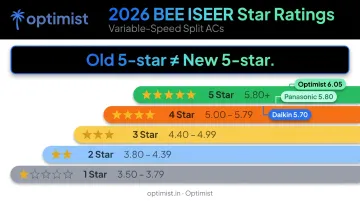
Source: BEE Notification AC_Notification.pdf
This means Daikin's MTKM50XV at ISEER 5.70 is now a 4-star model under current rules, despite earlier marketing. Panasonic at 5.80 and Optimist at 6.05 are the clear 2026 five-star benchmarks.
High Ambient Performance
The standard BEE test condition is 35°C outdoor dry-bulb — well below India's actual peak summer temperatures. Cities like Delhi, Jaipur, Ahmedabad, and Nagpur routinely breach 45°C+, with Delhi recording 46.8°C in May 2024. ACs that derate — cutting cooling output in extreme heat — only reveal the problem after installation.
Look for models explicitly tested and rated at 45°C or higher. Optimist is tested at 50°C with no derating; LG, Panasonic, and Daikin all claim operation up to 55°C.
Noise Level
Heat performance matters outdoors; what you hear indoors matters just as much. For bedrooms and home offices, target under 35 dB(A) at minimum fan speed. Reducing bedroom noise from ~40 dB to ~34 dB increased deep sleep by 16–34 minutes, per a 2016 PMC sleep study. LG and Daikin operate at 31 dB(A) minimum; Panasonic at 34 dB(A). Budget models can run at 38–45 dB(A) — a noticeable difference during sleep.
Smart Features
Beyond convenience, smart features have practical savings value:
- Live energy tracking — see real-time consumption and cut usage during expensive peak hours
- Eliminates guesswork around refrigerant top-ups: Optimist's built-in gas level indicator is the first of its kind in India
- Scheduling and pre-cooling mean you walk into a cool room without running the AC all day
- Filter health alerts notify you before clogged filters start hurting efficiency
Corrosion Resistance
Coastal and high-humidity cities — Mumbai, Chennai, Kochi, Visakhapatnam, Kolkata — accelerate condenser corrosion. Basic hydrophilic aluminium fin coatings offer minimal protection; advanced treatments matter more. Look for:
- Ocean Black Protection (LG) — black polymer coating applied directly to the copper condenser
- ShieldBlu+ (Panasonic) — anti-corrosion treatment on both indoor and outdoor units
- DNNS + BTA + Blue Fin (Daikin) — three-layer chemical treatment covering fins and coils
- 1,000-hour ASTM B368 salt spray, SIGMA certified (Optimist) — 15× the typical 72-hour market standard
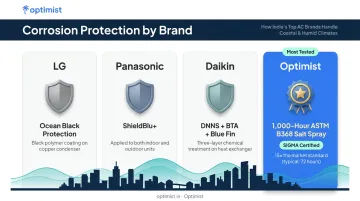
Corrosion-related failures typically surface 2–4 years post-purchase, often outside standard warranty coverage. Before buying in a coastal city, confirm whether your warranty explicitly covers condenser corrosion damage — most standard warranties exclude it.
Conclusion
The right 1.5-ton AC in 2026 comes down to what your home actually needs.
- Optimist's 1.4 Ton (ISEER 6.05) leads on energy savings — 620.2 kWh annual consumption, 25–35% lower bills, and full-rated cooling at 50°C with no derate, plus India's first built-in gas level indicator.
- Panasonic's CS/CU-NU18BKY5WX is the only Matter-enabled option in this segment, with PM 0.1 filtration included.
- Voltas is the most accessible pick in smaller cities where service proximity outweighs peak efficiency.
- LG's US-Q19YNZE3 delivers 31 dB(A) operation, a wide service network, and flexible convertible modes for varied room sizes.
Whichever unit you shortlist, compare ISEER values over star labels, and verify that the model carries a tested high-ambient performance claim. That spec tells you more about real-world summer cooling than anything printed on the box.
For maximum energy savings, explore Optimist at optimist.in or call +91 81 4748 7070.
Frequently Asked Questions
Which AC is best for a 1.5 ton home?
It depends on your priority. For maximum energy savings, Optimist (ISEER 6.05) leads; for smart home features, Panasonic; for brand trust and service reach, LG or Voltas. A 1.5-ton AC is well-matched for rooms between 120–180 sq ft under standard conditions.
Which type of AC is best for a home?
Inverter-based split ACs are the best choice for Indian homes — quieter than window units, better at distributing cooling, and significantly more efficient. If your AC runs more than 4–6 hours daily, an inverter model pays for its price premium within 2–3 summers.
Which AC is best with a 5-star energy rating?
Under 2026 BEE norms, 5-star requires ISEER 5.80 or above. Not all ACs marketed as 5-star meet this bar. Optimist leads at ISEER 6.05, followed by Panasonic at 5.80. LG carries confirmed 5-star certification, though it hasn't published its exact ISEER on its official product page.
How much electricity does a 1.5-ton AC consume per month?
Optimist's 1.4-ton unit is BEE-declared at 620.2 kWh/year; Panasonic's comparable model comes in at 681.01 kWh/year, a difference of ~61 kWh annually. Monthly variation depends on your actual usage hours and local conditions.
Is a 1.5-ton AC enough for a 150 sq ft room?
Yes — 1.5 ton handles 150 sq ft comfortably under typical conditions. Top-floor placement, direct west-facing sunlight, or ceilings above 10 feet can reduce effective coverage slightly and may warrant upsizing to 2 ton.
What is ISEER and why does it matter in 2026?
ISEER (Indian Seasonal Energy Efficiency Ratio) measures how much cooling an AC delivers per unit of electricity, calculated over 1,600 annual hours. Under revised 2026 BEE benchmarks, 5-star now starts at ISEER 5.80. A higher ISEER means lower electricity bills; comparing ISEER values gives you a clearer picture than star labels alone.