
That assumption is expensive. An undersized unit runs nonstop, straining its compressor until it fails early. An oversized one cools too fast, leaves the room feeling damp, and burns through electricity while cycling on and off all night.
This guide breaks down room size calculations, AC types, and the six factors that actually determine the right fit, so you can buy with confidence instead of guesswork.
Key Takeaways
- Match AC tonnage to room size, then adjust for sunlight and ceiling height
- Split ACs suit most bedrooms and living spaces best
- Window or portable units work only for tight budgets or short-term needs
- Star rating and ISEER value affect your bill more than price does
- Insulation, floor level, and warranty depth affect long-term satisfaction
Understanding AC Capacity: Tonnage and BTU Explained
Tonnage measures cooling output. One ton equals 12,000 BTU per hour of heat removal, a conversion confirmed by ASHRAE's residential system-sizing guidance. Match this number to your room, and you avoid both an overworked compressor and a wasteful oversized unit.
Most Indian bedrooms and living rooms fall between 0.75 ton and 2 tons, depending on floor area, sunlight, and how many people typically use the space.
Room Size to Tonnage: The Calculation
A widely used rule of thumb in the Indian market applies roughly 20 BTU per square foot as a starting estimate. Hitachi's own India sizing guidance, for instance, recommends a 1-ton unit for a 100 sq. ft. room under normal ceiling height, then flags occupancy and window area as factors that push the number higher.
Here's a quick-reference guide based on common manufacturer sizing practice:
| Room Size | Typical Recommendation |
|---|---|
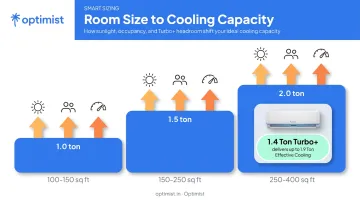
| 100-150 sq. ft. | 1 Ton |
| 150-250 sq. ft. | 1.5 Ton |
| 250-400 sq. ft. | 2 Ton |
Treat this as a starting point, not gospel. A 12x12 room (144 sq. ft.) with two occupants and average sunlight generally lands around 0.8 to 1 ton. Add a south-facing window or a third occupant, and you're closer to the top of that range.
Why Getting Tonnage Wrong Costs You
Undersizing and oversizing fail in opposite ways:
- Undersized units run continuously trying to reach the set temperature, which strains the compressor and shortens its lifespan
- Oversized units cool the air fast but shut off before removing enough humidity, leaving the room feeling clammy despite a low thermostat reading
- Both scenarios waste energy: one from constant operation, the other from frequent stop-start cycling
Inverter technology helps close this gap by modulating compressor speed rather than switching on and off. It's also why some 1.4 Ton units, like Optimist's, build in a Turbo+ mode that pushes effective cooling to 1.9 Tons — enough headroom to cover the upper end of a 1.5 Ton room without stepping up a full size. Even so, no amount of clever engineering rescues a fundamentally wrong-sized unit; getting the base calculation right still comes first.
Types of Air Conditioners for Your Room
Not every space needs the same AC format. Here's how the three main options stack up:
- Split ACs: Quiet, efficient, and the standard choice for bedrooms. The compressor sits outside, so indoor noise stays low.
- Window ACs: Budget-friendly and easier to install, but noisier since the compressor lives in the same box as the fan.
- Portable ACs: Flexible for rentals or rooms without exterior wall access, though generally less efficient per ton than a fixed split unit.
Inverter split ACs have become the default recommendation for Indian homes. Instead of switching the compressor fully on or off, they adjust speed to match cooling demand, avoiding jarring restarts and keeping the room quieter, ideal for sleeping through a Delhi summer night.
Optimist's 1.4-ton split model, for example, carries India's highest ISEER (6.05) and a Turbo+ mode that delivers up to 1.9 tons of effective cooling.
What to Consider When Choosing the Best AC for Your Room
Floor area gets you in the right ballpark, but it isn't the whole story. Orientation, occupancy, insulation quality, and local climate all shift the ideal capacity. Skip these factors, and you risk the two most common buying mistakes: paying for tonnage you don't need, or underestimating what your electricity bill will actually look like.
Room Size and Layout
Start with an accurate measurement: length times width, in square feet. Sounds obvious, but it's the step most people eyeball instead of measuring.
Irregularly shaped rooms or open layouts connecting to a hallway or kitchen area typically need slightly more capacity than the standard chart suggests, since cool air has to travel further and fights heat bleeding in from adjacent spaces.
Sunlight Exposure and Insulation
Rooms facing south or west with large windows absorb significantly more heat over the course of a day. Many installers recommend bumping cooling capacity up by 10-20% for these rooms compared to a shaded, north-facing space of the same size.
Poor wall or roof insulation compounds the problem. If heat keeps seeping in from outside, your compressor works harder just to hold steady, and that extra effort shows up directly on your monthly bill.
Occupancy and Heat-Generating Appliances
Every person in a room generates body heat, and every extra adult beyond two adds a noticeable load, particularly relevant for shared bedrooms or a living room that doubles as a family hangout space.
Appliances matter too:
- Kitchens generate substantial ambient heat from cooking, even with the AC running
- Home offices with multiple monitors, a desktop, and a printer add measurable heat load
- Rooms with a large TV or gaming console running for hours need slightly more capacity than the base calculation suggests
Energy Efficiency and Star Rating
This is where long-term cost gets decided. BEE's star rating system and the underlying ISEER value determine how much electricity an AC consumes to deliver the same cooling output. Two units with identical tonnage can have very different running costs if their ISEER values differ. Optimist's 1.4 Ton split AC, for example, carries an ISEER of 6.05, currently the highest rated in India.
Industry reporting on BEE's revised star-rating norms noted the updated five-star standard delivers roughly 10% better energy efficiency than the previous benchmark, alongside a modest price increase across the industry. Translation: a higher star rating usually costs more upfront but claws that back through lower bills over multiple summers.
Climate and Peak Heat Performance
Here's a detail most buyers never check: many standard ACs lose cooling capacity once outdoor temperatures climb past a certain threshold, exactly when you need cooling most. This is common during Indian summers when ambient temperatures regularly cross 43-45°C in states like Rajasthan, Punjab, and parts of the Delhi NCR belt.
Before buying, ask whether the unit has been tested and rated for extreme heat performance, not just standard lab conditions. A unit that "operates" at high temperatures isn't the same as one that maintains its rated cooling capacity there. Optimist's compressor, for instance, is lab-tested at 50°C with no drop in output.
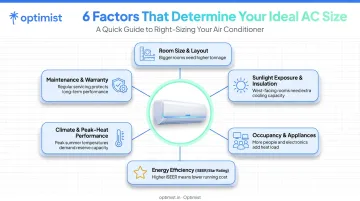
Maintenance, Warranty, and Smart Features
Compressor warranty length and how easily the unit can be serviced both affect what ownership actually costs over time, not just what you pay at checkout. A longer compressor warranty signals manufacturer confidence and reduces your exposure to a costly mid-life replacement. Optimist's 1.4 Ton AC, for reference, backs its compressor for 10 years and pairs its smart features with a built-in gas-level indicator that flags refrigerant leaks early.
Smart features add convenience without adding much cost:
- Real-time energy tracking helps you spot usage spikes before the bill arrives
- Filter health alerts prevent the slow efficiency drain that comes from a clogged filter
- App-based scheduling lets you pre-cool a room before you walk in
How Optimist Can Help You Choose Right
Room size, sunlight load, occupancy, star rating, and peak-heat reliability: these are exactly what Optimist engineered its 1.4-ton 5 Star+ Inverter Split AC to solve. The unit is built and tested for real Indian summer conditions, not average lab benchmarks.
A few specifics worth knowing:
Sizing and coverage. Optimist recommends its 1.4-ton unit for rooms between 120 and 200 sq. ft., covering standard bedrooms, study rooms, WFH setups, small living rooms, and hostel or PG rooms.
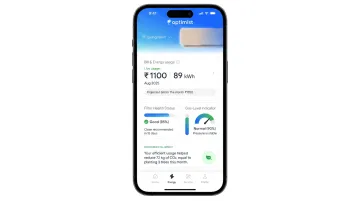
Efficiency that actually shows up on your bill. The unit carries an ISEER rating of 6.05, India's highest as of 2026, paired with a 5-star energy rating. Annual energy consumption sits at 620.2 kWh. Optimist's own app data shows bills staying under ₹1,000 for 7 out of 12 months in a typical year, with 25-35% lower running costs compared to typical 5-star inverter ACs.
Turbo+ Mode for flexibility. Rather than pushing you to buy a bigger unit for a slightly larger room, Turbo+ Mode delivers a 135% capacity boost, up to 1.9 tons of effective cooling from the same 1.4-ton unit.
A dual-rotary inverter compressor paired with a microchannel heat exchanger carrying 1,180 flow paths enables this rapid pull-down, cooling from 42°C to 25°C without needing to upsize to a 1.5-ton system.
No guessing on peak-heat reliability. The unit is tested to cool consistently at 50°C ambient temperature with no performance drop, directly addressing the derating concern covered earlier in this guide.
Transparency instead of guesswork. The Optimist app tracks live energy use, projected monthly bills, and filter health. The AC also includes India's first built-in gas-level indicator, letting you verify refrigerant levels yourself instead of relying on a technician's word. That transparency matters given how common gas top-up overcharging is in the service industry.
Backing that matches the claims. Optimist covers the unit with a 5-year comprehensive warranty and a 10-year compressor warranty, including refrigerant gas refill and repair at zero cost for five years. The AC is priced at ₹39,990, with no-cost EMI available from ₹3,333/month, plus brand-authorised installation at ₹1,499 + GST.
Conclusion
Choosing the right AC means matching capacity to your room's size, sunlight exposure, occupancy, and the climate reality where you actually live. The most popular model on a marketplace listing rarely accounts for any of that.
Get the tonnage calculation right upfront, and you avoid both discomfort and unnecessary electricity costs for years. Cooling needs shift too. A renovation, a new occupant, or an added appliance can all change your calculation, so it's worth revisiting periodically rather than treating AC buying as a one-time decision. Optimist's app flags exactly when your cooling needs outgrow the original calculation.
Frequently Asked Questions
What size air conditioner is good for a 12x12 room?
A 12x12 room (144 sq. ft.) typically needs a 0.8 to 1 ton AC for two occupants under average sunlight. Add extra people, poor insulation, or heavy sun exposure, and you'll want to size upward within that range.
How many tons of AC do I need for my room?
Multiply your room's area by roughly 70-80 BTU per sq. ft., then divide by 12,000 to get tonnage. Adjust upward for strong sunlight exposure or higher-than-average occupancy.
What is the difference between a split AC and a window AC?
Split ACs are quieter and more energy-efficient, making them better suited for bedrooms. Window ACs cost less and install faster but run noisier since the compressor sits indoors.
Does ceiling height affect the AC tonnage I need?
Yes. Rooms with ceilings noticeably taller than the standard 8-9 feet generally need somewhat higher cooling capacity to maintain comfort, since there's more air volume to cool.
Is a 5-star AC worth the extra upfront cost?
Usually. Higher star-rated ACs consume less electricity over their lifespan, often recovering the price difference through lower monthly bills within a few cooling seasons.
Can an oversized AC cause problems in a room?
Yes. Oversized units cool too quickly without properly removing humidity, leaving the room feeling damp and uncomfortable while wasting energy through frequent on-off cycling.