
Introduction
Delhi hit 49.9°C in May 2024. Rajasthan touched 50.5°C the same summer. If you've noticed your AC running non-stop yet barely cooling the room, you're not imagining it.
India logged 536 heatwave days in the summer of 2024 alone, the highest count in 15 years, with June contributing 181 of those days according to IMD data reported by Hindustan Times. Most residential ACs simply weren't built for this.
Many homeowners now ask a fair question: is my AC broken, or is this just what extreme heat does to any cooling system?
This guide breaks down why ACs struggle past a certain temperature threshold, and how to tell normal strain from real trouble. You'll also learn how to run your unit smartly through a heatwave, plus which specs matter most if you're shopping for a replacement.
Key Takeaways
- Standard ACs are rated for a 24-43°C outdoor range; performance beyond that isn't guaranteed
- A unit running nonstop in a heatwave is normal, not a fault, if it's still cooling effectively
- Pre-cooling, smart mode-switching, and fan-pairing can cut your electricity load without sacrificing comfort
- Raising your thermostat setting by just 1°C can save roughly 6% on power, per BEE guidance
- For heatwave-prone regions, prioritise ACs with a tested 50°C ambient rating over standard-rated models
Why Your AC Struggles in Extreme Heat
Cooling is really just heat removal. Your AC pulls warmth out of the room and dumps it outside through the condenser. The bigger the gap between your target indoor temperature and the outdoor air, the harder the compressor has to work to push that heat out.
This is where ambient temperature ratings come in. India's Bureau of Energy Efficiency calculates the ISEER label using outdoor temperature bins that run from 24°C to 43°C, with the rated-capacity test conducted at 35°C outdoor and 27°C indoor conditions, based on BEE's Room Air Conditioners methodology. That's the climate envelope your star rating is actually tested against.
Here's the catch: once outdoor temperatures climb past that 43°C ceiling, most standard split ACs move outside their tested comfort zone. Cooling output and efficiency both take a hit, even if the compressor doesn't fail outright.
There's no universal fixed number of degrees an AC is guaranteed to hold below outdoor ambient. On a 47-48°C day, don't expect a healthy unit to drop your room into the low 20s no matter how long it runs.
You'll also hear that older, heavier-compressor units cool better in extreme heat than newer inverter models. What's actually documented is a structural difference: fixed-speed compressors cycle fully on and off, while inverter compressors continuously vary their speed to match load.
Whether one tolerates extreme ambient better than the other depends entirely on the specific model's engineering, not the compressor category alone.
Other factors that add to the strain:
- Poor room insulation or single-pane windows
- Direct sun exposure on the AC-facing wall
- Top-floor rooms absorbing roof heat
- Ageing units with worn refrigerant seals or dirty coils
How Optimist Engineers Around This Limit
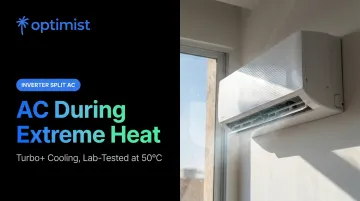
This is precisely the gap Optimist built its 1.4 Ton inverter split AC to close. The unit is government-lab tested to sustain full rated cooling at 50°C ambient, with no capacity derating past the standard 43°C threshold.
Two engineering choices make that possible:
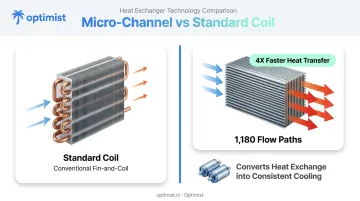
- A micro-channel heat exchanger with 1,180 flow paths, borrowed from automotive thermal engineering, that delivers roughly 4X faster heat transfer than a conventional fin-and-tube coil
- A dual-rotary inverter compressor that converts this heat-exchange advantage into consistent cooling even as outdoor temperatures push toward 50°C
Normal Strain vs a Real Problem
If your AC has been running for hours during a heatwave, that's not automatically a red flag. A unit working hard is doing exactly what it's designed to do, provided it's still blowing noticeably cool air and your room isn't gradually heating up despite the runtime.
Continuous operation during peak heat is normal system behaviour. What isn't normal is a unit that runs constantly while delivering no real cooling benefit.
Watch for these genuine warning signs instead:
- Air from the vents feels warm or barely cool
- Ice forming on the indoor coil or outdoor unit
- Short-cycling: the AC turns on and off every few minutes
- Unusual noises, rattling, or a burning smell
- Indoor temperature keeps climbing even after hours of runtime
If you spot any of these, switch the unit off and get it inspected rather than pushing it further. A struggling system forced to keep running can suffer compressor damage, turning a fixable issue into an expensive repair.
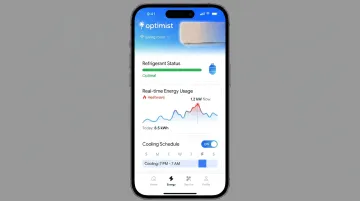
Optimist's app-based diagnostics flag issues like low refrigerant or service needs through colour-coded alerts, red for critical and yellow for maintenance. Users can select "ice formation" or "unusual noise" directly in the app to launch a guided troubleshooting flow and book a technician, typically within 24 hours.
How to Run Your AC Efficiently During a Heat Wave
Small operational habits make a measurable difference to both comfort and your electricity bill during a heatwave.
1. Pre-cool before peak heat hits Run your AC 4-6 hours before the afternoon peak so the room starts from a lower thermal baseline. This reduces the load your unit faces once outdoor temperatures spike. Optimist's app includes a "Schedule Your Cooling" feature that lets you set this automatically, so the room is already comfortable when you walk in.
2. Set the thermostat smartly BEE recommends 24-25°C as a steady-state comfort setting. Its own guidance adds that raising your set temperature by 1°C can save about 6% on electricity, according to BEE's official FAQ published via PIB. Dropping the thermostat to 18°C doesn't cool the room faster; it just makes the compressor run longer for no extra benefit.
3. Use modes intentionally
- Use Turbo or Fast Cool mode for the first 10-15 minutes to pull temperatures down quickly
- Switch to Auto or Sleep/Eco mode once the room stabilises, especially overnight
- Expect Turbo+ mode on Optimist's unit to deliver a 135% capacity boost, cooling from 42°C down to 25°C at maximum speed, before settling into normal operation
4. Pair with fans A ceiling or standing fan improves air circulation, letting you set the thermostat a couple of degrees higher while feeling just as cool. This alone can cut running costs noticeably.
5. Keep up basic maintenance
- Clean or replace filters regularly (Optimist's app tracks this and flags "needs cleaning" after roughly two months of use)
- Keep the outdoor unit's coils free of dust and debris
- Maintain clearance around the condenser for proper airflow
6. Block heat before it enters Close blinds or curtains on sun-facing windows between 10am and 4pm, and avoid running heat-generating appliances like ovens during peak hours. Less heat load means less work for your AC.

Choosing an AC Built for India's Extreme Heat
If you're shopping for a new unit, three specs matter more than anything else on the box.
1. Ambient temperature rating Most standard ACs are rated within the 24-43°C BEE seasonal bin, meaning performance above 43°C isn't something the star label promises. For heatwave-prone cities, look specifically for a 50°C ambient rating with no derating, not just a high star rating.
2. ISEER rating ISEER measures how much cooling a unit delivers per unit of electricity across a full season, calculated as Cooling Seasonal Total Load divided by Cooling Seasonal Energy Consumption. A higher ISEER means lower running costs over the summer. Optimist's 1.4 Ton unit carries an ISEER of 6.05, currently India's highest declared rating under BEE's 5 Star+ framework.
3. Inverter compressor technology Inverter units vary compressor speed with load instead of cycling fully on and off, which means smoother temperature control and less wasted energy during sustained heat. Optimist uses a dual-rotary inverter compressor engineered specifically to hold performance steady at 50°C.
Here's how the practical decision breaks down:
| What to check | Why it matters |
|---|---|
| Ambient rating | Determines if cooling holds up past 43°C |
| ISEER | Determines your long-term electricity cost |
| Compressor type | Affects smoothness and load-handling |
| Warranty depth | Determines protection when the unit is pushed hardest |
Smart features worth having during heatwaves:
- A built-in gas level indicator — India's first — lets you verify refrigerant status yourself instead of trusting a technician's "low gas" claim
- Turbo+ mode for a 135% capacity boost when you need fast relief
- Real-time energy tracking so bill shock doesn't creep up on you
- Scheduling to pre-cool rooms before you arrive home
Warranty matters most when a unit is under the most stress. Optimist backs its AC with a 5-year comprehensive warranty covering the outdoor unit, indoor PCB, sensors, and coils, plus a separate 10-year compressor warranty. Refrigerant gas refills are included at no cost for the full 5-year term.
The unit is priced at ₹39,990, with no-cost EMI available at ₹3,333/month.
Frequently Asked Questions
Does AC work in 100 degree weather?
Yes. 100°F (about 38°C) falls well within the standard 24-43°C range most ACs are rated for, so there's no inherent barrier to normal operation. Performance at this temperature mainly comes down to the specific unit's design.
Can an AC cool effectively at 45-50°C outdoor temperature?
Standard ACs rated up to 43-46°C will typically struggle and lose cooling capacity beyond that point. Units specifically tested for 50°C ambient conditions, like Optimist's split AC, maintain full rated cooling without derating.
What is the ideal AC temperature setting during a heatwave in India?
BEE (Bureau of Energy Efficiency) recommends 24-25°C as an efficient comfort range. Each degree lower increases power consumption, so use Turbo mode briefly to cool down fast, then switch to Auto for sustained comfort.
Is it normal for my AC to run continuously during extreme heat?
Yes, as long as cool air keeps coming through the vents and your room isn't gradually heating up. Continuous runtime becomes a concern only alongside warning signs like warm air, ice formation, or unusual noises.
What ambient temperature rating should I look for in an AC for Indian summers?
For heatwave-prone regions, look for a minimum 50°C ambient rating rather than the standard 43-46°C. This prevents the capacity drop that affects most standard-rated units during peak summer.
How can I reduce my AC's electricity bill during a heatwave?
Pre-cool your room before peak heat, set the thermostat to 24-25°C, pair the AC with a fan, and keep filters and coils clean. Choosing a high-ISEER inverter AC also lowers running costs across the entire season.