
The ISEER rating is the single number that predicts how much your AC will actually cost to run. This article identifies the five ACs with the highest ISEER ratings available to Indian residential buyers in 2026, what separates them technically, and what that gap means in rupees.
Key Takeaways
- The Optimist AC holds India's highest ISEER rating at 6.05, certified under BEE's 5-star framework
- ISEER measures cooling output divided by electricity consumed across 24°C–43°C seasonal temperatures
- 2026 BEE norms set the 5-star threshold at ISEER 5.6+ — older label years use different bands, so always check the number
- Always compare the ISEER number directly, not just the star count or label year
- All models on this list use variable-speed inverter compressors — a prerequisite for high ISEER performance
What Is ISEER and Why It Matters for Indian Summers
The Formula and What It Measures
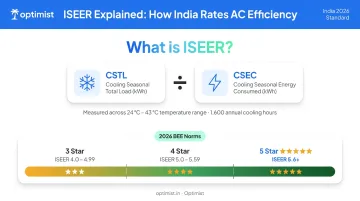
ISEER stands for Indian Seasonal Energy Efficiency Ratio. As defined by BEE, the formula is:
ISEER = Cooling Seasonal Total Load (CSTL) ÷ Cooling Seasonal Energy Consumption (CSEC)
Both values are measured in Wh, producing a Wh/Wh ratio. BEE's calculation uses temperature bins from 24°C through 43°C across 1,600 annual cooling hours — calibrated specifically to Indian seasonal conditions. A higher ISEER means more cooling output per unit of electricity consumed.
That temperature range reflects how Indian ACs actually operate — across a full spectrum of daily temperatures, not a single fixed point. An AC optimised for this range delivers its rated efficiency under conditions Indian homes actually experience.
The 2026 BEE Label Update
Under revised 2026 norms, a 5-star split inverter AC must achieve ISEER 5.6 or above. This threshold is higher than what applied under earlier label years, which means a unit rated 5-star in 2022 may now fall into a 4-star or lower band under the current standard.
Critical buying rule: Never compare models based on star count alone. Check the label validity year and the ISEER value directly. Two 5-star ACs from different label years may carry materially different efficiency ratings.
Cross-verify any model's label data at beestarlabel.com or by scanning the QR code on the BEE sticker.
ACs with the Highest ISEER Ratings in India — 2026
These five models represent the top end of residential energy efficiency available in India in 2026, ranked by ISEER from highest to lowest. All selections are based on BEE-certified ISEER values under 2026 label norms and verified manufacturer specifications.
Optimist AC — ISEER 6.05 (India's Highest)
Optimist is an India-first climate tech company founded in August 2024 and launched its first product in January 2026. Developed through the Nalanda 1 R&D Lab in Delhi with technical collaboration from IIT Delhi, the Optimist AC was engineered specifically for extreme Indian heat conditions from the ground up.
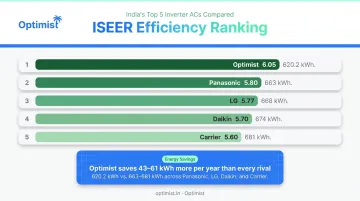
It holds India's highest ISEER rating of 6.05 — a step above every other model currently in the Indian residential market. Its annual energy consumption is 620.2 kWh, compared to 663–681 kWh for the nearest 5-star competitors.
Key engineering differentiators:
- Microchannel heat exchanger with 1,180 flow paths — 4× faster heat transfer than standard coil designs
- Tested at 50°C ambient with full rated cooling output and no derating
- Turbo+ Mode boosts capacity to 135%, delivering 1.9 tons of effective cooling from a 1.4-ton unit
- India's first built-in gas level indicator shows refrigerant status live in the Optimist App, eliminating the gas-refill scam
- 1,000-hour salt spray corrosion test (SIGMA certified, ASTM B368) — 15× more rigorous than the 72-hour market standard
- Dual-Rotary Inverter Compressor with R-32 refrigerant
- 5-year all-inclusive warranty + 10-year compressor coverage, with refrigerant gas included
| Specification | Detail |
|---|---|
| ISEER Rating | 6.05 (India's highest) |
| Annual Energy Consumption | 620.2 kWh/year |
| Key Features | Microchannel heat exchanger, Turbo+ Mode (135%), gas level indicator, 50°C tested, 1,000-hour corrosion tested |
| Warranty | 5-year all-inclusive + 10-year compressor |
Panasonic CS/CU-NU18BKY5WX — ISEER 5.80
Panasonic is one of the most established Japanese brands in India's premium AC segment. The NU18BKY5WX is its 1.5-ton 5-star inverter split AC for 2026, carrying an ISEER of 5.80 and annual energy consumption of 681.01 kWh/year.
What sets it apart:
- 8-in-1 convertible cooling modes, adjustable from 40% to full capacity
- PM 0.1 filter — the finest air filtration available in its segment
- Matter-enabled smart home integration via the MirAIe platform
- ShieldBlu+ anti-corrosion coating on both indoor and outdoor units
- Stabiliser-free operation from 100V–290V
| Specification | Detail |
|---|---|
| ISEER Rating | 5.80 |
| Annual Energy Consumption | 681.01 kWh/year |
| Key Features | 8-in-1 convertible, PM 0.1 filter, Matter/MirAIe smart home, ShieldBlu+ corrosion protection |
LG AS-Q19YNZE1 — ISEER 5.77
LG is one of India's most trusted AC brands, known for its AI Dual Inverter compressor and wide service network. The AS-Q19YNZE1 is its 2026 flagship 5-star 1.5-ton model, confirmed as a 5-star 2026 model on LG's official product page. Buyers should verify the ISEER and annual kWh figures directly via the BEE label on the unit before purchase.
Key highlights:
- AI Dual Inverter compressor with AI Convertible 6-in-1 cooling modes
- VIRAAT Mode delivers 124% cooling power for rapid room cooling
- Ocean Black Protection and Gold Fin+ corrosion coating on the condenser
- 4-way swing for even air distribution (up-down and left-right)
- Manufacturer claims cooling at ambient temperatures up to 55°C
| Specification | Detail |
|---|---|
| ISEER Rating | 5.77 |
| Key Features | AI Dual Inverter, 6-in-1 convertible, VIRAAT Mode (124%), Ocean Black Protection, 55°C ambient cooling claim |
Daikin MTKM50XV16 — ISEER 5.70
Daikin has built a strong reputation in India for compressor longevity and consistent build quality across its AC range. The MTKM50XV16MKA is its 2026 5-star 1.5-ton premium inverter model, carrying an ISEER of 5.70 and annual energy consumption of 678.92 kWh/year.
Notable specs:
- Power Chill Mode for faster initial room cooling
- Triple LED display showing real-time power consumption percentage, set temperature, and error codes
- 3D airflow with automatic horizontal and vertical swing
- Patented DNNS self-healing coating on the evaporator for long-term corrosion protection
- Auto-adjusting inverter that modulates tonnage continuously without manual convertible modes
| Specification | Detail |
|---|---|
| ISEER Rating | 5.70 |
| Annual Energy Consumption | 678.92 kWh/year |
| Key Features | Power Chill mode, triple display (power/temp/error), 3D airflow, DNNS self-healing anti-corrosive coating |
Carrier ESTER EDGE Gxi WiFi (CAI18EE5R36W0) — ISEER 5.60
Carrier has steadily expanded its presence in India's high-efficiency AC segment, with the ESTER EDGE line targeting buyers who want premium features at a competitive price. The CAI18EE5R36W0 is its 2026 5-star 1.5-ton flagship, carrying an ISEER of 5.60 and annual energy consumption of 663.31 kWh/year — the lowest annual consumption among the legacy 5-star models on this list, which makes the ISEER-vs-consumption gap worth noting before buying.
Where it stands out:
- 6-in-1 FlexiCool convertible modes for flexible capacity management
- Built-in Wi-Fi with geo-fencing — the AC starts cooling as you approach home
- Smart Energy Display on the remote for real-time consumption visibility
- PM 2.5 filter for air quality control
- Refrigerant leakage detector — a rare safety feature at this price point
| Specification | Detail |
|---|---|
| ISEER Rating | 5.60 |
| Annual Energy Consumption | 663.31 kWh/year |
| Key Features | 6-in-1 FlexiCool, geo-fencing Wi-Fi, Smart Energy Display, PM 2.5 filter, refrigerant leakage detector |
What to Look for Beyond ISEER When Buying a High-Efficiency AC
ISEER is the right starting point, but three additional factors determine whether that efficiency rating holds up over years of real use.
Performance at Extreme Ambient Temperatures
BEE's ISEER test range stops at 43°C. Many parts of India — Delhi, Rajasthan, Vidarbha — regularly see peak temperatures above 45°C in May and June. Some ACs derate at these temperatures, reducing cooling output even while drawing the same electricity.
Before buying, check the manufacturer's stated maximum ambient operating temperature. Optimist is tested at 50°C with no derating. LG and Panasonic claim operability at 55°C. These are manufacturer claims, not BEE-certified efficiency results — but they show how seriously each brand has engineered for India's peak summer reality.
Warranty Depth and Service Reach
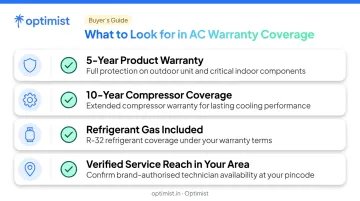
A high-ISEER AC that requires expensive repairs or has poor service coverage loses its efficiency advantage quickly. Look for:
- Minimum 5-year product warranty covering all major components
- 10-year compressor coverage — the most expensive component to replace
- Refrigerant gas included in warranty coverage (eliminates surprise refill costs)
- Verified service reach in your city or pincode
Smart Monitoring Features
Features like real-time energy tracking, gas level indicators, and filter health alerts help sustain efficiency over an AC's lifespan. BEE recommends cleaning filters every 2–4 weeks — a habit that alone can lower energy use by up to 15%. An AC that tells you when a filter clean is overdue, or displays live consumption data, turns that advice into something you'll actually act on.
How We Chose These ACs
Models on this list were selected based on:
- BEE-certified ISEER of 5.60 or above under 2026 label norms (minimum threshold for 5-star)
- Publicly available specification data from manufacturer pages, BEE label records, or verified retailer listings
- Verified feature claims — where manufacturer pages contradicted listed specifications (for example, LG's VIRAAT Mode delivers 124% cooling power, not 116%), the verified figure is used
ISEER values and annual consumption figures for Panasonic, Daikin, and Carrier are sourced from official manufacturer pages and exact retailer label listings. LG's ISEER is sourced from third-party review and comparison sources, as the official page does not display label numbers — buyers should verify directly via the BEE sticker on the unit.
Do not compare models from different label years using star count alone. A 5-star label from 2022 applied to a lower ISEER threshold. Always compare the ISEER value directly between models with the same label validity year.
Conclusion
The Optimist AC holds India's highest ISEER rating at 6.05 — with annual energy consumption of 620.2 kWh versus 663–681 kWh for the nearest alternatives. For a household running an AC 6+ hours daily across a five-month summer, that gap compounds into measurable savings every year.
Households in extreme heat zones — Delhi NCR, Rajasthan, Vidarbha — get both answers in one unit: ISEER 6.05 efficiency and verified 50°C cooling without derate. The story is different on the coast, but the outcome is the same: 1,000-hour SIGMA-certified salt-spray testing gives coastal buyers in Mumbai, Chennai, and Kochi a durability margin that standard 72-hour market testing simply doesn't match.
For homeowners seeking India's highest efficiency with full summer reliability, visit optimist.in or call +91 81 4748 7070 to explore specifications and availability.
Frequently Asked Questions
What is the highest ISEER rating for an AC in India?
As of 2026, the highest ISEER rating for a residential AC in India is 6.05, held by the Optimist AC. This exceeds the previous high of 5.80 (Panasonic NU18BKY5WX) and is BEE-certified under the 5-star framework.
What is a good ISEER rating for an AC?
Under 2026 BEE norms, 5-star split ACs require ISEER 5.6 or above. An ISEER of 5.0 is acceptable for most households, 5.6+ is excellent, and anything below 4.0 (the 3-star band) will noticeably increase electricity bills at typical Indian usage of 6+ hours daily.
What is the best ISEER rating for a 3-star AC?
Under 2026 BEE norms, the 3-star band for split inverter ACs covers ISEER values from 4.0 to 4.99. A model at ~4.9 consumes meaningfully less electricity than one at ~4.0, so compare ISEER values directly within the band rather than treating all 3-star models as equivalent.
Does a higher ISEER rating always mean lower electricity bills?
Yes — a higher ISEER directly translates to lower running costs for equivalent cooling output. However, correct tonnage matching to room size is equally important; an oversized or undersized unit will consume more electricity regardless of its ISEER rating.
How often does BEE revise ISEER thresholds?
BEE periodically revises the minimum ISEER required for each star band. The most recent revision took effect under the 2026 label norms, raising the 5-star threshold for split ACs. Always check the label validity year printed on the BEE sticker — a model's star band may have shifted under newer norms.
Is a high-ISEER AC worth the higher upfront price?
For households using an AC 6+ hours daily through a typical 5–6 month Indian summer, electricity savings from a high-ISEER model generally recover the price premium within 2–3 years. The payback period shortens further in regions with high electricity tariffs or in homes running multiple AC units.