
Wrong sizing isn't a minor inconvenience. It directly affects your electricity bills, how comfortable your room feels, humidity levels, and how long your compressor lasts before it needs repair.
This guide walks through the room-to-tonnage formula, the real-world factors that shift that number up or down, common sizing mistakes, and how modern inverter technology gives you more breathing room when your square footage falls between two categories.
Key Takeaways
- Start with 1 ton per 100-150 sq ft, scaling to 1.5-2 ton for larger halls
- Sunlight exposure, ceiling height, occupancy, and appliances all affect your ideal tonnage
- Oversized units short-cycle and trap humidity; undersized units overwork the compressor
- High-ISEER inverters, like Optimist's 1.4 Ton with Turbo+ mode, add flexibility for borderline rooms
What Is AC Tonnage and Why It Matters
Tonnage has nothing to do with how heavy your AC unit is. It's a measure of cooling capacity. As per the Bureau of Energy Efficiency's HVAC performance guide, 1 ton of refrigeration equals roughly 12,000 BTU per hour of heat removal — the same cooling effect as melting one ton of ice in 24 hours.
In the Indian market, split ACs are commonly sold in a handful of standard sizes:
- 0.8 ton
- 1 ton
- 1.2 ton
- 1.5 ton
- 2 ton
Bigger numbers don't automatically mean better cooling. A 2 ton unit crammed into a 120 sq ft bedroom will actually cool poorly, for reasons we'll get into shortly.
Room Size to AC Tonnage Chart
Manufacturers don't all agree on one universal chart. Hitachi's sizing guide uses a formula of area (sq ft) × 120 BTU/h, then divides that figure by 12,000 to get tonnage. A 180 sq ft room, for instance, works out to roughly 1.8 tons before any adjustments.
As a general reference point, here's how room size typically maps to tonnage across common Indian manufacturer guidance:
| Room Size | Typical Recommended Tonnage |
|---|---|
| Up to 120 sq ft | 0.8-1 ton |
| 120-180 sq ft | 1-1.2 ton |
| 180-200 sq ft | 1.4-1.5 ton |
| 200-250 sq ft | 1.5-2 ton |
| 250+ sq ft | 2 ton and above |
Treat this as a starting benchmark, not gospel. The real number depends on the factors covered further below.
AC Size by Room Type
Room function matters as much as room area:
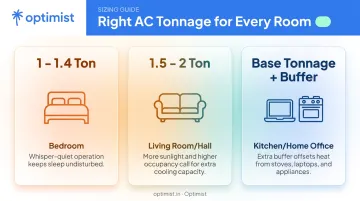
- Bedrooms: Usually need 1-1.4 ton. Quiet operation matters just as much as raw capacity here: nobody wants a compressor cycling loudly at 2 AM
- Living rooms/halls: Typically need 1.5-2 ton because of larger floor area, higher occupancy during gatherings, and frequent sunlight through bigger windows
- Kitchens/home offices: Cooking equipment, monitors, and electronics add hidden heat load, so these spaces often need an extra buffer beyond what area alone suggests
Factors That Determine the Right AC Size for Your Room
Square footage gives you a starting point, but several real-world variables can push your ideal tonnage up or down from whatever a chart tells you.
Room Layout, Sun Exposure & Occupancy
Beyond floor area, a few room-specific details change how much cooling you actually need:
- Ceiling height: Standard charts assume a 9-10 ft ceiling; taller rooms have more air volume to cool, so plan for roughly 10% additional capacity above 9 ft
- Sunlight and window size: South- or west-facing rooms with large windows trap noticeably more heat through the afternoon, often needing 10-20% more capacity than a shaded, north-facing room of the same size
- Number of occupants: A bedroom built for two needs less capacity than the same room regularly hosting four or five, and the difference matters most in frequently used common areas
- Heat-generating appliances: Kitchens, home theatres, and workspaces with TVs, computers, or cooking equipment run hotter than a plain bedroom of the same size, and usually need a buffer above base tonnage
Local Climate & AC Technology
Where you live also shapes what "right-sized" actually means, and so does the AC technology you choose:
- Dry-heat regions (Delhi, Rajasthan) often need higher raw cooling capacity to combat intense sensible heat
- Humid coastal cities (Mumbai, Chennai) need an AC that dehumidifies effectively as well as cools
- Moderate-climate cities (Bangalore, Pune) can often get by with slightly less capacity than peak-heat metros
Daikin explains that inverter compressors modulate speed and refrigerant flow rather than simply switching on and off. A nominal 1.5 ton inverter unit can vary its output well below and above that rating depending on demand, which makes it more forgiving when your room sits between two tonnage categories. Optimist's 1.4 Ton split pushes this further with a Turbo+ mode that delivers up to 1.9 tons of effective cooling, adding extra headroom for borderline rooms. Fixed-speed units don't offer that same cushion.
What Happens If You Choose the Wrong AC Size?
Getting tonnage wrong pulls your comfort and your electricity bill in opposite directions, depending on which way you err.
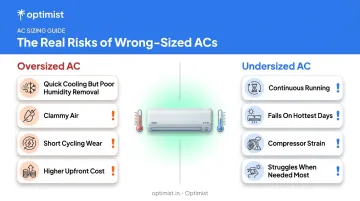
Oversized AC:
- Cools the room too quickly and shuts off before it can properly remove humidity
- Leaves the air feeling cold but clammy, not genuinely comfortable
- Cycles on and off repeatedly (short cycling), which adds wear over time
- Costs more upfront for capacity you don't need
Undersized AC:
- Runs continuously, especially during peak summer afternoons
- Fails to reach your set temperature on the hottest days
- Puts sustained strain on the compressor, shortening its working life
- Struggles most exactly when you need reliable cooling the most
Here's the part homeowners underestimate: fixing a sizing mistake after the fact costs more than getting it right at purchase. You're not just buying a new unit — you're paying for removal of the wrong one, fresh piping, and a second installation visit.
How Optimist Helps You Get Right-Sized, Efficient Cooling
Correct sizing on paper only matters if the AC actually delivers that capacity in your living room, not in a lab under ideal conditions. This is where engineering quality starts to matter as much as the tonnage number on the box.
Optimist's 1.4 Ton unit carries India's highest ISEER rating of 6.05, which translates to roughly 25-35% lower daily electricity bills compared to typical 5-star inverter ACs, even before you factor in correct sizing.
That efficiency comes from a dual-rotary inverter compressor paired with a micro-channel heat exchanger built with 1,180 flow paths for faster heat transfer.
For borderline room sizes (say, a 190 sq ft living room that sits awkwardly between 1.4 and 1.5 ton), Optimist's Turbo+ Mode delivers a 135% capacity boost, pushing the 1.4 ton unit to an effective 1.9 tons of cooling.
You get the headroom of a bigger unit without paying for one or reserving extra floor space for a larger outdoor condenser.
That headroom matters most when temperatures spike, since peak Indian summer heat is where most standard ACs begin to lose cooling capacity. Optimist's units are tested to maintain full rated cooling output at 50°C ambient temperature, a condition under which many standard ACs begin to derate well before that point.
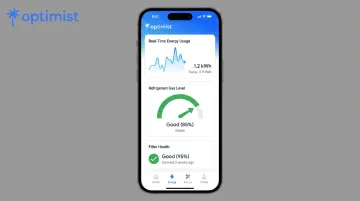
Beyond the hardware, the Optimist app gives homeowners a way to actually verify performance instead of guessing:
- Real-time energy tracking with projected monthly bills, so surprises don't show up at the end of the month
- A colour-coded gas level indicator (India's first built-in feature of its kind) that flags low refrigerant before it becomes a cooling problem
- Filter health tracking, so maintenance happens on schedule rather than after performance already drops
Every unit also ships with a 5-year comprehensive warranty and 10-year compressor coverage, with installation handled exclusively by brand-authorised technicians. Explore Optimist's 1.4 Ton Inverter Split AC if you're weighing it against a standard 1.5 ton purchase for a 120-200 sq ft room.
Conclusion
Right-sizing your AC requires more than memorising one generic rule of thumb. You need to match your room's dimensions, sunlight exposure, occupancy, and local climate to a tonnage that actually fits your space.
Revisit that decision if your room's usage changes — a home office that becomes a shared workspace, or a bedroom that gains a second occupant, both shift the ideal capacity.
Pair the correct size with an energy-efficient, high-ISEER AC, like Optimist's 1.4 Ton model with an ISEER of 6.05, for lasting comfort without watching your electricity bill climb every summer.
Frequently Asked Questions
What are the common AC sizes available in India?
Indian manufacturers typically sell 0.8, 1, 1.2, 1.4, 1.5, and 2 ton split ACs. Each size roughly matches a room bracket, from small bedrooms under 120 sq ft up to large halls beyond 250 sq ft.
What room size can a 1.5 ton AC cool?
A 1.5 ton AC typically suits rooms between 150-200 sq ft. That range can shrink to around 180 sq ft in sunny, south-facing rooms with larger windows. Optimist's 1.4 ton AC covers this same range through its Turbo+ mode, which delivers 1.9-ton effective cooling at a lower power draw.
What room size is a 1.2 ton AC suitable for?
A 1.2 ton AC generally works well for rooms between 120-150 sq ft, sitting as a middle option between compact 1 ton units and larger 1.5 ton units.
How do I calculate the exact AC tonnage for my room?
Multiply your room's area in square feet by 120 BTU/h, then divide by 12,000 to get an approximate base tonnage. Adjust upward for strong sunlight, high occupancy, or taller-than-standard ceilings.
Is it better to buy a slightly bigger AC than needed?
Not usually. Oversizing typically causes short cycling and poor humidity control, along with a higher upfront cost. Matching capacity closely, or using inverter technology with a boost mode such as Optimist's Turbo+, is the better approach.
Does an inverter AC need different sizing than a fixed-speed AC?
Inverter ACs modulate their output rather than running at one fixed speed, which gives them slightly more tolerance for borderline room sizes. A fixed-speed unit has less flexibility if your room falls between two tonnage brackets.