
This choice affects more than comfort. It shapes your electricity bill, how much installation hassle you sign up for, and whether your AC will actually hold up when temperatures cross 45°C. In this guide, we'll break down cost, efficiency, cooling performance, and give you a clear framework to pick the right one for your home.
Key Takeaways
- Portable ACs suit renters and single rooms; split ACs suit permanent homes and larger spaces
- Split ACs typically carry ISEER ratings of 4–6, versus 2.5–3 for portable units, cutting running costs significantly
- No installation is required for portable units, but they run louder and cool less consistently in extreme heat
- Room size, rental status, and daily usage hours should drive your final decision
Split AC vs Portable AC: Quick Comparison
Here's the side-by-side view most people actually search for, before the definitions.
| Factor | Portable AC | Split AC |
|---|---|---|
| Upfront cost | Lower purchase price, no installation fee | Higher purchase price plus installation |
| Installation | Self-installed window kit and hose | Professional mounting, wiring, and piping |
| Room coverage | Best for one small room | 91–250 sq ft depending on tonnage |
| Efficiency | Lower ISEER, higher running cost | Higher ISEER, especially inverter models |
| Noise | Compressor sits indoors, louder | Compressor is outdoors, quieter |
| Peak heat performance | Can weaken without proper ventilation | Engineered models hold output at extreme temperatures |
Cost & Installation: Upfront vs Ongoing
A portable unit needs no installation fee, so you save money at checkout. But that saving can flip over a season of daily use, since portable units generally run on lower efficiency ratings. Setup matches that simplicity: a plug-and-play window panel and an exhaust hose, no drilling, no technician. Consumer Reports notes the hose typically runs 5-7 feet and the unit needs at least 2 feet of clearance from walls for proper airflow.
Split ACs cost more upfront. Voltas's current 1-ton range, for instance, spans roughly ₹33,000 to ₹42,000, with 1.5-ton models running ₹35,000 to ₹53,000. Add installation, and you're looking at a bigger day-one number, but a lower cost per hour of cooling. That installation also means a technician has to:
- Mount the indoor unit on a wall
- Position the outdoor compressor unit
- Drill through the wall and run copper piping
- Wire and test the refrigerant connection
Cooling Capacity & Room Size
Here's where split ACs pull ahead for anything beyond a single small room. Voltas's official sizing guide recommends:
- 1 ton: 91–130 sq ft
- 1.5 ton: 131–190 sq ft
- 2 ton: 191–250 sq ft
That assumes a 10-foot ceiling and two occupants; south-facing rooms or heavy appliance use may need more capacity. Portable ACs don't have a comparable published India sq. ft. chart, but their design, drawing condenser air from the same room they're cooling, limits them to genuinely small spaces.
Energy Efficiency
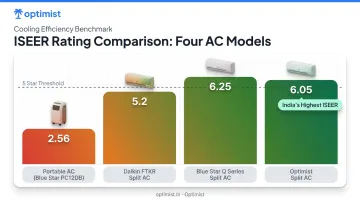
ISEER (Indian Seasonal Energy Efficiency Ratio) is the number that tells you how much cooling you get per unit of electricity. A Blue Star PC12DB portable unit lists an ISEER of 2.56, while 5-star split models run far higher.
Daikin's FTKR sits at 5.2 and Blue Star's Q Series hits 6.25. These are individual product specs, not category averages, but the gap is telling.
Optimist's own 1.4-ton split model carries an ISEER of 6.05, currently the highest declared rating on any AC sold in India, alongside an annual energy consumption of just 620.2 kWh.
Noise & Performance in Peak Summer Heat
The compressor location changes everything about how an AC sounds. A portable unit's compressor sits right in the room, and the Blue Star PC12DB measures 51-53 dB(A) during operation. Split ACs push that compressor outdoors, so indoor units run much quieter, Daikin's FTKR ranges 32-48 dB(A) across its settings.
That same indoor compressor also struggles once temperatures climb. Single-hose portable ACs pull their condenser air from the room itself, which pulls in warm replacement air from outside through doors and gaps. Dual-hose models fix part of this by drawing condenser air from outdoors instead, and testing shows they cool slightly better as a result.
Split ACs don't fight this problem the same way, since the compressor already sits outside. But not all split ACs are engineered equally for extreme heat. Most conventional units start losing capacity above 43°C. Optimist's models are tested to hold full rated cooling at 50°C, a meaningful difference if you live somewhere summer routinely blows past that mark.
What Is a Portable AC?
A portable AC packs the compressor, condenser, and fan into one movable box. It cools a room, then vents the heat outside through a flexible hose connected to a window kit. No wall drilling, no outdoor unit.
The biggest draw is commitment-free cooling. If you're renting and can't modify the property, a portable unit lets you set up in minutes and take it with you when you move. It also works well if you just need cooling for a single season.
There are two main types. Single-hose units pull air from inside the room to cool the condenser, then exhaust it outdoors. Dual-hose units draw condenser air from outside through a second duct, which improves cooling consistency slightly.
Use Cases of Portable Air Conditioners
Portable ACs work best for:
- Rented apartments where drilling isn't allowed
- Hostels, PGs, or single-room setups
- Temporary work-from-home arrangements
- Students and frequently relocating tenants in metro cities
They're a genuinely useful stopgap. Just don't expect one to comfortably cool a 200 sq ft living room through a Delhi May afternoon.
What Is a Split AC?
A split AC separates the system into two parts: an indoor evaporator unit that cools the room, and an outdoor compressor unit that expels heat outside. Because the noisy, heat-generating component sits outdoors, split ACs deliver quieter, more consistent whole-room cooling.
Standard split ACs cool reliably under normal conditions. Inverter models go a step further, adjusting compressor speed to match the room's actual cooling load instead of switching on and off at full power. That's what drives the long-term energy savings inverter ACs are known for.
Not every split AC is built the same for Indian heat, though. Heat-exchanger design matters enormously once outdoor temperatures climb past 40°C.
Optimist's 1.4-ton model, for example, uses a micro-channel heat exchanger with 1,180 flow paths, an automotive-derived design that transfers heat roughly four times faster than conventional exchangers.
Combined with its ISEER 6.05 rating, this lets it maintain full cooling capacity even at 50°C without derating, translating to roughly 25-35% lower electricity bills compared to typical 5-star inverter ACs on the market.

Use Cases of Split Air Conditioners
Split ACs make the most sense for:
- Permanent homes, especially larger bedrooms and living rooms
- Households running AC for several hours daily through summer
- Cities facing intense, sustained heat, such as Delhi NCR, Ahmedabad, and Chennai
- Anyone tired of watching their bill climb every May and June
Optimist's app-based energy tracking shows the kind of gap this makes in practice: real-world usage data recorded an Optimist AC costing ₹1,730 over a billing period against ₹6,020 for a conventional AC running the same hours, a difference of roughly 71%.
"What surprised me wasn't just the cooling. Our electricity bill was noticeably lower, even with longer usage." — Sera, Delhi-based chartered accountant, Optimist customer
Split AC vs Portable AC: Which Is Better?
There's no universal winner here. The right choice depends on four things:
- Budget – Can you absorb a higher upfront cost for lower running costs, or do you need the cheapest entry point?
- Room size – A single small room or a proper bedroom/living room?
- Rental vs owned – Are you free to install permanent equipment?
- Climate severity and usage hours – Occasional cooling, or running the AC most of the day through a brutal summer?
Choose a portable AC if you're renting short-term, cooling one small room, or only need occasional cooling.
Choose a split AC if you own your home, need to cool a medium-to-large room, run the AC for extended hours, or live somewhere summer hits extremes.
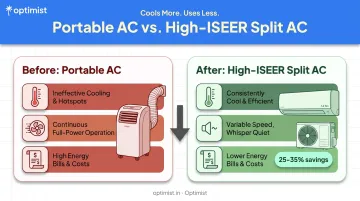
Here's a scenario that plays out constantly across North Indian households: a family buys a portable unit for their bedroom, expecting it to handle the room comfortably. By late May, as outdoor temperatures push past 45°C, the unit struggles to keep pace, running almost continuously while barely holding the room at a tolerable temperature.
The electricity bill spikes as a result. This combination of weak cooling and rising costs is usually what pushes households to switch to a proper split system.
After moving to a high-ISEER inverter split AC, the difference shows up in two places. The room stays cool even during peak afternoon heat, and the monthly bill drops noticeably, often by 25-35% for households upgrading to a genuinely efficient model like Optimist's.
If you're facing repeated heat stress and climbing bills every summer, upgrading to a dependable, high-ISEER split AC is a practical long-term fix. Check your room's cooling and savings potential before the next heatwave hits.
Conclusion
Choosing between split and portable comes down to your specific situation. A portable AC makes sense for renters, single rooms, and short-term needs where flexibility and low upfront cost matter more than peak efficiency. A split AC makes sense for permanent homes seeking stronger, quieter, more reliable cooling and lower bills over months of use.
Match the AC type to your room size, your climate, and how long you'll actually run it each day. Comfort during extreme heat and a predictable electricity bill matter more than the sticker price on day one, especially as Indian summers grow hotter each year.
Look for a high ISEER rating and heat-tested performance: Optimist's 6.05-ISEER split AC holds its cooling at 50°C.
Frequently Asked Questions
Which is better: portable AC or split AC?
Split ACs generally win for permanent homes needing consistent, larger-room cooling and better efficiency. Portable ACs suit renters and temporary, small-space cooling needs where installation isn't possible.
Can split AC run 24 hours?
Yes, split ACs, particularly inverter models, are designed for continuous operation, adjusting output to match the room's load. Regular filter cleaning and periodic servicing keep performance consistent over long runtimes.
Which AC uses less electricity, split or portable?
Split ACs, especially 5-star inverter models, typically consume noticeably less electricity per unit of cooling than portable units. Optimist's 1.4 Ton split AC, for example, carries an ISEER of 6.05 — the highest rating in India — widening that efficiency gap even further.
Is a portable AC good for a bedroom?
A portable AC can cool a small bedroom adequately, but it's noisier since the compressor sits indoors. For nightly use, a split AC usually offers quieter, more consistent comfort.
How long does a split AC last compared to a portable AC?
Well-maintained split ACs, including inverter variants, usually last 10-15 years with proper servicing, according to Carrier's maintenance guidance. Reliable lifespan data for portable ACs is harder to find, though warranty periods tend to run shorter.
Can a portable AC cool an entire house?
No, portable ACs are built for single-room cooling through one exhaust hose and window kit. They're not designed or sized to cool multiple rooms or an entire home effectively.