
This isn't a niche worry anymore. Household AC penetration in India climbed from roughly 8% to 40% in recent years, according to CEEW's technician demand analysis. That's a massive shift from a low base, and it's why "AC vs cooler electricity consumption" has become one of the most searched cooling questions in the country.
Space cooling already accounts for close to 10% of India's peak electricity demand, with the IEA projecting this could reach 45% by 2050. This comparison affects your wallet, your carbon footprint, and which appliance actually suits your climate — humid or dry, sealed bedroom or open balcony room.
Key Takeaways
- Coolers sip 0.1-0.3 units/hour; ACs draw 1.2-1.8 units/hour, a 5-10x cost gap
- ACs dehumidify and hold exact temperatures; coolers need dry, ventilated air to perform well
- High-ISEER inverter ACs, like Optimist's, cut standard AC bills by 25-35%
- Climate, room type, and budget decide the right pick for your home
AC vs Cooler: Quick Comparison
Before diving into the mechanics, here's the numbers side by side.
Power Consumption (Units per Hour)
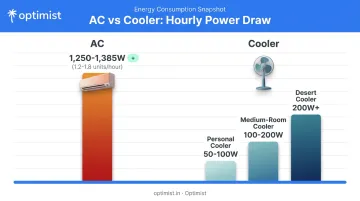
- AC: A standard 1.5-ton unit draws 1,250-1,385W, or roughly 1.2-1.8 units/hour. Fixed-speed models run higher; 5-star inverters run lower depending on load
- Cooler: Personal coolers use 50-100W, medium-room units 100-200W, and desert coolers 200W+, translating to roughly 0.05-0.2 units/hour (per manufacturer wattage guidance)
Monthly Electricity Cost (8 Hours a Day)
Running either appliance for 8 hours daily across 30 days gives a clear cost picture:
| Appliance | Approx. Monthly Units | Notes |
|---|---|---|
| Standard 3-star AC | ~280-330 units | Higher due to fixed-speed cycling |
| 5-star inverter AC | ~180-250 units | Varies by BEE label and room load |
| Desert cooler | 40-50 units | Highest cooler category |
| Personal/medium cooler | 12-48 units | Lowest running cost by far |
Star rating changes the AC number substantially. A cooler, even the largest desert variant, rarely crosses 50 units a month.
Performance, Climate Fit & Upkeep
ACs let you set an exact temperature and hold it, regardless of what's happening outside. They also pull moisture out of the air. Coolers depend entirely on how dry the outdoor air is: there's no thermostat, just a fan speed dial and a water tank.
Climate decides which appliance makes sense:
- AC: Works in any climate, but shines in humid regions and sealed, closed rooms
- Cooler: Effective only in dry climates with cross-ventilation; humid air makes coolers feel worse, not better
Cost follows a similar pattern. Coolers cost less to buy and need just occasional water refills and pad cleaning, while ACs cost more upfront and traditionally need periodic servicing, though this varies heavily by brand and warranty structure (more on that shortly).
How AC and Cooler Work
The electricity gap isn't random. It comes down to two completely different cooling technologies.
How an Air Conditioner Works
An AC uses a compressor and refrigerant to extract heat from indoor air and push it outside, acting as a heat pump. This is exactly why it consumes more power than a cooler: moving heat against its natural direction takes energy.
Inverter ACs use variable-speed compressors that adjust power draw based on room load instead of cycling fully on and off. This cuts consumption meaningfully compared to fixed-speed units, though inverter ACs still use far more electricity than any cooler.
Optimist's 1.4-ton inverter split AC shows this: its dual-rotary compressor and micro-channel heat exchanger combine for an ISEER of 6.05 and 620.2 kWh of annual consumption.

How an Air Cooler Works
A cooler pulls warm air through water-soaked pads. As the water evaporates, it lowers the air temperature, and a fan circulates that cooler air into the room. It's a simple, low-power process: mainly a fan and a small water pump, which explains the tiny electricity draw.
The catch: coolers introduce fresh outdoor air and slightly raise indoor humidity. ACs do the opposite: they recirculate and dehumidify indoor air, which is why sealed rooms feel different with each appliance.
AC vs Cooler: Which Is Better for You?
There's no single right answer here. It depends on a handful of factors:
- Climate: dry versus humid
- Room type: sealed bedroom versus semi-open living space
- Budget: upfront cost versus monthly running cost
- Priority: precise comfort versus minimising electricity bills
| Choose a Cooler if... | Choose an AC if... |
|---|---|
| You live in a dry climate | You live in a humid region |
| Your space is semi-open or well-ventilated | You need a sealed room cooled consistently |
| Lowest electricity bill matters most | You want exact temperature control regardless of outside conditions |
Here's where the debate gets more interesting. The old "AC uses way more electricity" argument isn't quite as absolute as it used to be. High-ISEER inverter ACs are now engineered specifically to close that consumption gap while still delivering full cooling capacity.
Optimist's Real AC is a case in point. It's engineered with an ISEER of 6.05, India's highest declared rating as of 2026. It's also been tested to maintain full rated cooling at 50°C ambient temperature, a threshold where most standard ACs derate above 43°C. Optimist states this translates to 25-35% lower electricity bills compared to typical 5-star inverter ACs, without sacrificing cooling power in peak summer heat.
Real-World Example: Cutting AC Electricity Costs Without Switching to a Cooler
Picture a household in Gurgaon running a standard 1.5-ton AC through May and June. Bills climb past ₹6,000 a month, cooling feels inconsistent during heatwaves, and there's a nagging worry that the compressor is derating once outdoor temperatures cross 43°C, a real limitation for most conventional units.
Switching to a cooler seems tempting on paper. But this is Delhi NCR, not Rajasthan. Humidity during pre-monsoon months makes evaporative cooling unreliable, and the family still needs a sealed, comfortable bedroom at night.
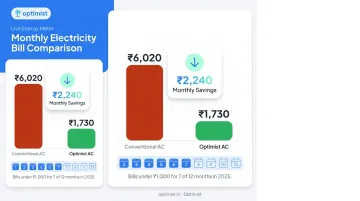
Instead of downgrading comfort, the household explores a high-efficiency AC upgrade. Optimist's app-based Live Energy Meter tracks exactly what this looks like in practice:
- Monthly Optimist AC bill: ₹1,730
- Conventional AC comparison: ₹6,020
- Monthly savings: ₹2,240
- Bills stayed under ₹1,000 for 7 of 12 months in 2025
Customer Anupam, a banker in Gurgaon, put it plainly:
"We hit 47-48°C outside and the cooling never dropped. Airflow stayed steady through the day."
That's the kind of no-derate performance a standard AC struggles to match once temperatures climb.
The takeaway: upgrading AC efficiency can get you close to cooler-like savings without sacrificing humidity control or consistent comfort. If you're unwilling to trade cooling power for a lower bill, this middle path is worth exploring. Check out Optimist's energy-efficient AC range to see if it fits your home.
Conclusion
There's no universal winner in the AC vs cooler debate. Coolers remain the most electricity-efficient option for dry climates and budget-conscious households. ACs remain essential for humid regions, sealed rooms, and anyone who wants precise, weather-independent comfort.
What's changed is the middle ground. Modern high-ISEER ACs, like Optimist's 1.4 Ton split system rated at ISEER 6.05, are narrowing the electricity gap that once made this a clear-cut choice. The right decision comes down to matching the appliance to your climate, your space, and what you're willing to trade off — lower bills or guaranteed cooling, regardless of what's happening outside.
Frequently Asked Questions
Does a cooler use more electricity than an AC?
No. A cooler uses less electricity than an AC, typically 5-10 times less, depending on the specific AC type and cooler wattage involved.
How many kilowatt-hours (kWh) does an AC use in 1 hour?
A standard 1.5-ton AC typically uses 1.25-1.4 kWh per hour at rated input. Optimist's 1.4-ton 5-star+ inverter AC, by comparison, draws just 1.07 kWh per hour (1,070W input) while delivering equivalent 1.5-ton cooling through Turbo+ mode.
What is the kW equivalent of a 1.5-ton AC?
One ton of refrigeration equals roughly 3.5 kW of cooling capacity, so a 1.5-ton AC delivers approximately 5.2 kW of cooling. This measures heat-removal capacity, not electrical input power.
What is the 3-minute rule for AC compressors?
This rule means waiting at least 3 minutes before restarting an AC compressor after switching it off. It prevents refrigerant pressure imbalance and protects the compressor from damage over time.
Can I use an AC and cooler together to save electricity?
Some households use a cooler during milder hours and switch to AC during peak heat to manage costs. Be cautious, though — running both, or a cooler in a humid room, can cause moisture buildup and discomfort.
Which is better for humid climates, AC or cooler?
AC is the better choice for humid climates since it actively removes moisture from indoor air. Coolers add humidity, which can make already-humid air feel heavier and less comfortable.