
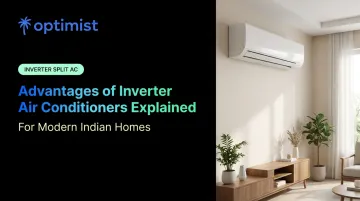
Inverter ACs are heavily marketed, but the actual performance differences are rarely explained in concrete terms. This article breaks down what inverter technology genuinely delivers for Indian homes: what the efficiency numbers mean, why temperature consistency matters in extreme heat, and how to evaluate the real cost of ownership over time.
Key Takeaways
- Inverter ACs use a variable-speed compressor that continuously adjusts output — no full on/off cycling
- A 2025 peer-reviewed India study found inverter models deliver 20–30% higher seasonal efficiency than fixed-speed units
- Expect steadier temperatures, quieter operation, and less compressor wear from day one
- Running AC 6+ hours daily? The upfront cost premium typically recovers within 1–2 years
- In India's extreme heat, with voltage swings and long daily run times, inverter ACs are the smarter long-term investment
What Is an Inverter AC?
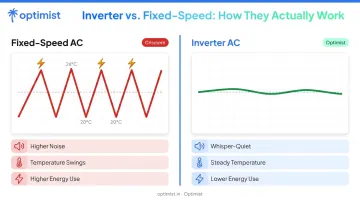
An inverter AC has a variable-speed compressor motor. Unlike a conventional fixed-speed unit that switches fully on when cooling is needed and cuts off once the target temperature is reached, an inverter compressor modulates its speed continuously — running faster when the room needs rapid cooling, slower when it just needs to maintain temperature.
This distinction matters practically in three ways:
- Electricity use — the compressor draws only the power the room actually needs, not a fixed full-power burst
- Temperature stability — the room never drifts far from the set point because the system is always running
- Mechanical stress — fewer full-power startups mean less wear on the compressor over time
Those mechanical traits translate directly to the energy ratings you see at the store. In India, inverter technology is now the standard architecture in split ACs and is what enables higher BEE star ratings. The ISEER (Indian Seasonal Energy Efficiency Ratio) score on every AC label measures seasonal heat removal per unit of electricity. Inverter compressors are what make high ISEER scores achievable in the first place.
Key Advantages of Inverter ACs
Each advantage below connects to something Indian homeowners experience directly: electricity costs, comfort during peak heat, equipment durability, and day-to-day convenience.
Energy Efficiency and Lower Electricity Bills
The efficiency gain from an inverter compressor comes from eliminating the power spike that occurs every time a fixed-speed compressor restarts. Each restart draws a surge of current — far above the unit's rated running wattage. An inverter compressor never stops, so those spikes simply don't happen.
Research published in 2025 on India's AC market found that inverter models delivered 20–30% higher seasonal efficiency than fixed-speed models, with inverters now accounting for over 75% of new room-AC sales in India.
The same study modelled a 1-ton comparison between ISEER 3.5 and ISEER 5.0 units: the higher-efficiency model saved 377 kWh and approximately ₹3,360 per year, assuming 1,250 operating hours and a tariff of ₹8.9/kWh.
What this means for a typical Indian household:
Electricity tariffs vary by state — Karnataka's BESCOM charges ₹5.80/kWh for residential consumers, while Maharashtra's MSEDCL uses slab rates starting at ₹5.56/kWh. Actual bill savings depend on local tariff, daily run hours, and the specific models compared.
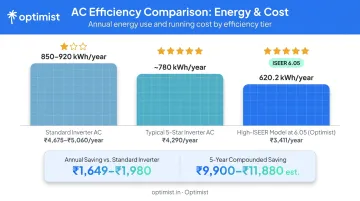
The ISEER metric makes these comparisons more meaningful. India's BEE star rating system measures seasonal efficiency across temperature bins from 24°C to 43°C — not just a single lab condition. A higher ISEER directly translates to lower annual running costs. Optimist's AC carries an ISEER of 6.05 — India's highest — with a certified annual energy consumption of 620.2 kWh, compared to 850–920 kWh for typical 5-star inverter models. At ₹5.50/unit, that difference amounts to roughly ₹1,649–₹1,980 saved per year.
For households running their AC six or more hours daily — common across urban India from March through October — that annual saving compounds quickly over a 5–10 year ownership period.
Consistent Cooling and Faster Temperature Recovery
Because the inverter compressor never fully stops, the room temperature never drifts far from the set point. The AC is always actively maintaining comfort rather than reacting to large temperature gaps after switching back on.
In practice, this works in two modes:
- Recovery mode — when a room heats up quickly from sunlight, occupants, or appliances, the compressor ramps to higher speed to pull the temperature down fast
- Maintenance mode — once the room reaches the set point, the compressor drops to a low speed and holds the temperature steady
Fixed-speed ACs create noticeable hot-cold cycles: the room overshoots cold, the compressor cuts off, the room warms again, and the cycle repeats. This is both uncomfortable and less efficient than steady-state operation.
Performance above 43°C is worth examining carefully. BEE's ISEER testing uses outdoor temperature bins only up to 43°C, which doesn't capture what happens during India's most extreme heat. In 2024, IMD recorded 51 stations reaching maximum temperatures of 45°C or above. Standard ACs rated at 43°C ambient progressively lose cooling capacity beyond that threshold.
Optimist's AC is tested for full rated cooling at 50°C ambient with zero derating — a specification validated through ground testing in Delhi NCR heatwaves where peak temperatures routinely reach 47–48°C. This is the performance gap that matters most in May and June across North India.
Longer Lifespan and Reduced Mechanical Wear
The primary source of compressor wear in a fixed-speed AC is the repeated full-power startup. Each time the motor ramps from zero to full speed, it creates three forms of stress:
- Heat build-up in the motor windings
- Load spikes on the bearings
- Pressure surges through the refrigerant circuit
An inverter compressor avoids most of this. It runs continuously at varying speeds, experiencing far fewer high-stress start cycles. The result is a compressor that accumulates less wear across its lifetime.
No authoritative India-specific study has established a precise lifespan comparison between inverter and fixed-speed split ACs with controlled data. What is clear: reduced start-stop cycling means less mechanical fatigue — and manufacturer warranty terms reflect this engineering confidence.
Optimist backs its Dual-Rotary Inverter Compressor with a 10-year compressor warranty covering parts and labour at ₹0 — double the coverage period of every other component. That warranty structure is a concrete expression of expected operational lifespan.
For households running their AC 8–10 hours daily through a six-to-eight month Indian summer, the cumulative reduction in start cycles compounds meaningfully over a 5–10 year ownership period.
Quieter Operation and Compatibility with Smart Controls
Walk into a quiet bedroom at 2am, and you'll notice whether your AC is holding temperature at low speed or kicking back on at full power. Inverter compressors modulate rather than cycle, and the noise difference during that steady-state phase is real.
WHO recommends less than 30 dB(A) in bedrooms at night for good sleep quality. Optimist's 1.4-ton unit operates across a 32–46 dB range, with the lower end corresponding to steady-state low-load operation. For reference, 32 dB is roughly the level of a quiet library — audible, but not disruptive.
Smart features are where inverter ACs create a different category of convenience:
- Live energy monitoring — see current consumption and projected monthly bill in real time
- Pre-cooling scheduling — walk into a cooled room without running the AC all day
- Remote diagnostics — identify issues before they become service calls
- Gas level monitoring — Optimist's app includes India's first built-in gas level indicator, showing refrigerant status in real time and eliminating the guesswork that enables gas top-up scams (where technicians charge ₹2,500–₹7,000 for refills regardless of actual need)
A basic on-off AC makes meaningful energy monitoring impossible. These smart capabilities only work with a system that operates continuously and intelligently.
Inverter AC vs. Regular AC: The Real Cost of Going Without
The immediate appeal of a fixed-speed AC is straightforward: it costs less to buy. But three practical consequences eat into that saving in Indian operating conditions.
- Higher electricity bills throughout summer — a 20–30% higher seasonal energy draw on a unit running 6–8 hours daily, from March through October, compounds into a significant cost gap over the ownership period
- Temperature swings that disrupt sleep — fixed-speed cycling pushes rooms between slightly too cold and noticeably warm; in Indian apartments where the AC runs overnight, this matters more than most buyers expect
- Faster compressor wear — high ambient temperatures, dusty environments, and voltage fluctuations all stress a compressor hardest in full-on/full-off mode, and Indian summers deliver plenty of those startup cycles
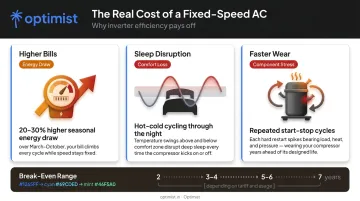
A 2020 CEEW study found that a 5-star model could cost at least ₹8,000 more than a 3-star model, with break-even modelled at seven or more years under low-tariff conditions. A 2025 study modelled break-even below two years under higher usage and tariff assumptions.
Payback depends on daily run hours, local electricity rates, and the specific models compared — but for households running their AC regularly through summer, the efficiency savings consistently close the cost gap.
How to Get the Most Out of Your Inverter AC
Getting the efficiency benefits requires a few practical choices beyond the purchase decision.
Three habits make the biggest difference:
Get the tonnage right. Oversizing causes short cycling — the compressor hits temperature and drops to minimum speed before dehumidification completes. Undersizing forces continuous high-speed operation that eliminates the efficiency advantage. For 120–150 sq. ft. bedrooms, a 1.0–1.4 ton unit fits; 150–200 sq. ft. rooms suit a 1.4 ton unit with Turbo+ capacity headroom.
Clean the filter every two months during peak season. A clogged filter makes the compressor push harder through the coil, directly eroding inverter efficiency. Mark it in your calendar or use app-based reminders to keep it consistent.
Pre-cool instead of cranking the temperature. Scheduling the AC to run before afternoon heat peaks is more efficient than turning it on at full blast once the room hits 34°C. Large manual overrides — like dropping to 16°C from a 32°C room — push the compressor to full speed for extended periods, negating inverter modulation entirely.
Tracking consumption patterns is where these habits pay off visibly. The Optimist App's projected monthly bill feature shows where your usage is headed mid-month — giving you the chance to course-correct before the bill arrives rather than after.
Frequently Asked Questions
What are the benefits of using an inverter AC?
Inverter ACs use a variable-speed compressor that avoids repeated full-power cycling. This delivers lower electricity consumption, steadier room temperatures, quieter operation during maintenance mode, and reduced mechanical wear on the compressor — all meaningful improvements over fixed-speed alternatives for daily use in Indian conditions.
Which is better — inverter AC or normal AC?
For most Indian households running their AC six or more hours daily, inverter ACs deliver better value over the ownership period despite a higher purchase price. Energy savings compound over time, and the cost gap typically closes within a few years of regular use.
How much electricity does an inverter AC save compared to a non-inverter AC?
A 2025 peer-reviewed study on India's AC market found inverter models deliver 20–30% higher seasonal efficiency than fixed-speed units. Actual savings depend on daily run hours, room size, star rating, and outdoor temperature — longer run times mean proportionally greater savings.
Does an inverter AC maintain cooling performance in very high temperatures above 45°C?
Quality inverter ACs engineered for Indian conditions are designed to maintain rated cooling capacity at high ambient temperatures. Conventional ACs are typically rated only to 43°C and lose capacity progressively above that. Optimist's AC is tested for full rated cooling at 50°C ambient with no derating — a specification relevant for peak summer conditions across North India.
Is the higher upfront cost of an inverter AC worth it?
Optimist's ISEER 6.05 model consumes 620.2 kWh annually versus 850–920 kWh for typical 5-star competitors — a saving of ₹1,649–₹1,980 per year at standard tariffs. That compounds to over ₹8,000 across five years, which more than closes the upfront cost gap.
How long does an inverter AC typically last?
Reduced start-stop cycling means less compressor fatigue over time — a direct longevity benefit of inverter technology. Optimist backs this with a 10-year compressor warranty covering parts and labour at ₹0, a concrete commitment to long-term reliability under normal residential use.