
Here's the real tension: an undersized AC runs non-stop, straining the compressor and never quite cooling the room on the hottest afternoons. An oversized one cools fast, then short-cycles, leaving the air cold but damp and uncomfortable.
Getting this right matters more than ever. India's residential cooling demand is climbing fast as summers intensify and air conditioning penetration rises across urban households, according to the International Energy Agency's analysis of India's cooling demand. Right-sizing isn't a nice-to-have anymore, it's how you avoid paying for cooling you don't need or living without cooling you do.
This guide breaks down exactly how much tonnage a 10x12 room needs, and what actually shifts that number.
Key Takeaways
- A 1-ton AC typically covers a standard 120 sq ft (10x12) room under average Indian conditions.
- Sunlight exposure, floor level, occupancy, and appliance load can push that number up to 1.2 tons.
- The BTU/sq ft formula gives a baseline figure; room-specific conditions determine the final tonnage.
- Both oversizing and undersizing hurt comfort and your electricity bill.
- Optimist's Turbo+ mode adds headroom, so you don't need a bigger unit for borderline sizing.
What Is AC Tonnage, and How Do You Calculate It for a 10x12 Room?
AC "tonnage" measures cooling capacity, not weight. One ton equals roughly 12,000 BTU/hr of heat removal, a unit borrowed from how much heat it takes to melt a ton of ice in 24 hours.
For a 10x12 bedroom or home office, you have three common AC types to choose from in India: split, window, and portable. Split ACs dominate this category, and for good reason. They're quieter, more efficient, and better suited to bedrooms and offices than window or portable units.
Core Calculation: The BTU/sq ft Method
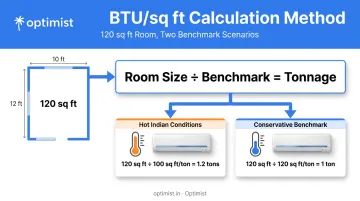
The standard Indian rule of thumb allocates 800 to 1,000 sq ft per ton in composite climates, adjusted downward for hotter regions. Here's the math for a 120 sq ft (10x12) room:
- 120 sq ft ÷ 100 sq ft per ton (a commonly used industry benchmark for hot Indian conditions) = roughly 1.2 tons
- Using a more conservative 120 sq ft per ton benchmark = close to 1 ton
Most manufacturers and industry sources land near 1 ton for a room this size under average conditions, though this figure is an industry convention rather than a fixed BEE or ISHRAE rule. It assumes:
- Standard ceiling height (around 9-10 feet)
- Moderate sunlight exposure
- Two occupants
- Average insulation
BEE mandates the ISEER (Indian Seasonal Energy Efficiency Ratio) label on every unit sold, which tells you efficiency but not room-sizing guidance directly. The rating measures performance across India's temperature range, not square-footage, so factors like room orientation, sunlight exposure, and occupancy carry more weight for sizing decisions than the label alone.
Real rooms rarely match the "average" assumptions above. A west-facing 10x12 room, or one running the AC through peak May-June heat, needs more buffer capacity than the baseline math suggests — one reason Optimist's 1.4 Ton unit delivers up to 1.9 tons of effective cooling through Turbo+ mode when conditions turn extreme.
Benefits of Right-Sizing Your AC
Getting tonnage right pays off in ways that go beyond comfort:
- Lower electricity bills: a correctly sized unit doesn't overwork or short-cycle
- Longer compressor life: steady, moderate load reduces wear
- Better humidity control: adequate runtime lets the AC pull moisture out of the air properly
- Quieter operation: no constant on-off cycling or compressor strain
A right-sized inverter AC runs longer at part-load, which sounds counterintuitive but actually improves both comfort and efficiency. Compare that to an oversized unit blasting cold air for ten minutes, shutting off, and repeating the cycle all evening.
Factors That Affect AC Tonnage for a 10x12 Room
The 1-ton baseline is just a starting point. Whether your 10x12 room needs 0.8, 1.0, or 1.2 tons depends on several key factors beyond just its square footage.
- Sunlight and Windows: West-facing rooms or those with large, single-pane windows absorb significant solar heat, pushing cooling needs up by 10-20%. Shaded rooms or those with double-glazed windows require less.
- Floor Level and Insulation: A top-floor room under an uninsulated roof bears the brunt of radiant heat during Indian summers. It will need more capacity than an identical room on a middle floor.
- Local Climate: India’s diverse climate zones matter. Humid regions like Mumbai need strong moisture removal, while hot-dry zones like Delhi prioritise raw cooling power.
- Room Occupancy: Sizing typically assumes two occupants. Each additional person adds 600-800 BTU/hr to the heat load, so a busy home office needs more power.
- Electronics and Appliances: A TV, gaming PC, and multiple lights all add measurable heat. A room filled with running electronics requires more cooling, similar to having extra occupants.
- Ceiling Height: Standard calculations assume 9-foot ceilings. Taller ceilings mean more air volume to cool, requiring 5-10% more capacity to maintain an even temperature.
Oversizing vs Undersizing: Why Precision Matters More Than "Bigger Is Better"
It's tempting to think a bigger AC is always the safer bet. It isn't.
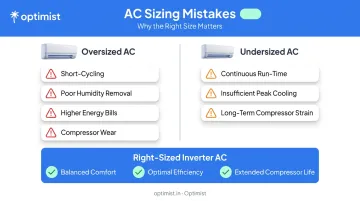
Oversizing consequences:
- Frequent short-cycling as the unit cools the room too fast and shuts off repeatedly
- Poor humidity removal, since the AC doesn't run long enough to dehumidify properly
- Higher energy bills despite the "fast cooling" feeling
- Increased compressor wear from constant start-stop cycles
One study on residential air conditioners found that oversizing can create a 10-21% energy penalty once off-cycle parasitic power is factored in, based on simulations of single-stage residential units, according to research published by the U.S. Department of Energy's Building America program. Modern inverter ACs mitigate this considerably, but the underlying physics of short-cycling still apply.
Undersizing consequences:
- Continuous run-time with the compressor never getting a break
- Insufficient cooling during peak afternoon heat, exactly when you need it most
- Long-term compressor strain from constant maximum-load operation
The safer middle path is inverter technology. Unlike fixed-tonnage units that run at full blast or not at all, inverter compressors modulate output to match real-time heat load. Optimist's Dual-Rotary Inverter Compressor puts this into practice: its Turbo+ mode pushes the 1.4-ton unit's output to a 1.9-ton equivalent on demand, so a borderline sizing call, say a slightly larger room than the standard 1.4-ton range, matters far less when the compressor can scale output up or down on its own.
How Optimist Helps You Get Reliable Cooling for Any Room Size
Optimist's 1.4-ton inverter split AC is engineered specifically for Indian heat conditions, which changes the sizing conversation entirely. Instead of agonising over 1-ton versus 1.2-ton for a borderline 10x12 room, you get built-in performance headroom.
Turbo+ Mode delivers a 135% capacity boost, letting the 1.4-ton unit push out the equivalent of 1.9 tons of cooling when a room's heat load spikes unexpectedly. Picture a west-facing room in peak May heat, TV running, three people inside. That headroom absorbs the exact variables covered above (sun exposure, occupancy, electronics) without forcing you to guess correctly upfront.
On efficiency, Optimist carries India's highest ISEER rating of 6.05, which translates to 25-35% lower electricity bills compared to typical 5-star inverter ACs, without cooling performance dropping even at 50°C ambient temperature. Most conventional units derate above 43°C. Optimist's units don't.
Efficiency claims mean little if you can't verify them at home. The Optimist app gives homeowners visibility most brands don't offer:
- Real-time energy tracking with projected monthly bills
- Gas-level monitoring that flags refrigerant issues before they cause a cooling drop
- Filter health tracking
This matters directly for sizing verification. If your consumption consistently runs high relative to the unit's rated 620.2 kWh annual benchmark, or if Turbo+ mode is kicking in constantly, that's a signal worth reviewing your room's heat load against.
Finally, Optimist backs this with meaningful long-term protection:
- 5-year comprehensive warranty and 10-year compressor coverage reduce the risk of a borderline sizing call
- ₹39,990 price point, with no-cost EMI at roughly ₹3,333/month
- 1.5-ton alternative positioning for rooms in the 120-200 sq ft range, comfortably covering a standard 10x12 room

Conclusion
Finding the right AC size for your 10x12 room comes down to matching its sunlight exposure, occupancy, floor level, and climate zone — not chasing the "most popular" tonnage.
Revisit your AC sizing if:
- More people using the room
- A new gaming or work setup
- Renovation that changes insulation
What worked for a 10x12 study with two occupants might fall short once it becomes a shared workspace for three.
Pairing the correct tonnage with an energy-efficient, inverter-based AC delivers Indian-summer comfort without a runaway electricity bill. Optimist's 1.4 Ton 5 Star+ Inverter Split AC, with Turbo+ mode's 1.9-ton effective cooling, fits that sweet spot for most 10x12 rooms.
Frequently Asked Questions
What size AC unit do I need for a 10x12 room?
A 10x12 room (120 sq ft) typically needs a 1-ton AC under standard conditions. Adjust up to 1.2 tons for high sun exposure, top-floor rooms, or 3+ occupants.
Is a 1-ton AC enough for a 10x12 room?
Yes, for most standard bedrooms or offices with average insulation and two occupants. It may fall short for west-facing rooms or spaces with heavy daily use.
How many BTUs are needed for a 120 sq ft room?
Expect a range of 10,000-14,000 BTU/hr, depending on sunlight, occupancy, and insulation. This aligns closely with a standard 1-ton unit.
Does the number of people in a room affect AC tonnage?
Yes. Each additional person beyond two adds roughly 600-800 BTU/hr to the heat load, which can push sizing into the next bracket.
Should I choose an inverter AC for a 10x12 room?
Yes. Inverter ACs offer better part-load efficiency, quieter operation, and adaptive cooling that reduces the risk of a mismatched tonnage. Optimist's Turbo+ mode, for instance, delivers up to 1.9-ton effective cooling from its 1.4-ton unit, adding extra buffer for Indian summers.
What happens if I install an oversized AC in a small room?
Oversizing causes short-cycling, poor humidity control, higher energy bills, and more noise, despite cooling the room quickly at first.