
Introduction
Buy the wrong AC in India, and you find out the hard way — usually on the one day it's 43°C outside and your "5-star" unit can barely hold 28°C indoors.
Wrong tonnage, a low ISEER rating, or weak build quality doesn't just mean discomfort. They mean higher electricity bills, more frequent repairs, and a compressor that struggles exactly when you need it most.
The stakes are only rising. India's 2024 annual mean temperature was 0.65°C warmer than the 1991–2020 average, making it the warmest year since nationwide records began in 1901, according to the IMD.
This guide breaks down what an AC actually is, how it cools your room, and the six factors that separate a reliable buy from a summer-long headache.
Key Takeaways
- Tonnage, BEE/ISEER rating, and inverter technology top the list of AC-buying factors.
- Climate resilience (ambient tolerance and voltage stability) often gets overlooked but decides real-world performance.
- Warranty depth and local service access often matter more than the spec sheet.
- Optimist's ISEER of 6.05 is referenced throughout as India's current efficiency benchmark.
What is an Air Conditioner?
An air conditioner is a climate control appliance that removes heat and humidity from indoor air using a refrigeration cycle, holding your room at a set temperature.
In India, you'll mainly find three types:
- Split AC: indoor and outdoor units separated, quieter, most common for bedrooms and living rooms
- Window AC: single unit fitted into a wall or window opening, lower upfront cost
- Portable AC: freestanding, no fixed installation, suited to renters
Inverter versus fixed-speed describes compressor technology, not a separate AC category. This choice mostly applies within the split and window types.
Core Components of an AC
Knowing these parts helps you judge build-quality claims instead of just comparing price tags on an e-commerce listing.
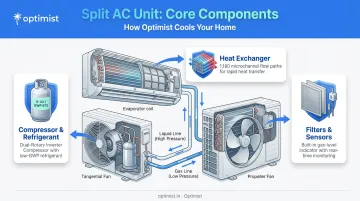
- Compressor & Refrigerant: The compressor circulates refrigerant through the system. R-32, now common, has a Global Warming Potential of 675, roughly a third of older R-410A, making it more efficient and eco-friendly.
- Indoor & Outdoor Unit (Heat Exchanger): Heat exchanger design determines how fast heat transfers in and out. Microchannel designs move heat faster than fin-and-tube coils, directly boosting cooling speed.
- Filters & Sensors: Filter quality controls air cleanliness, while sensors for gas level and temperature flag problems before they become breakdowns.
Benefits of Choosing the Right AC
Get the specs right, and the payoff shows up in your daily life, not just the brochure:
- Lower electricity bills, month after month
- Steady cooling even during 40°C+ heatwaves
- Cleaner indoor air with fewer allergens
- Fewer breakdowns and emergency technician visits
- A longer working life from the unit overall
What to Consider When Choosing the Best Air Conditioner
There's no single "best AC" — your ideal unit depends on room size, climate zone, daily usage hours, and budget. The factors below connect technical specs like tonnage and ISEER to outcomes you actually feel: your electricity bill and whether the room stays cool at 2 pm in June.
Room Size & Tonnage Calculation
An undersized AC runs non-stop without ever hitting your set temperature. An oversized one short-cycles, cools too fast, and leaves the room humid and clammy.
Manufacturers don't fully agree on the sq. ft.-to-tonnage ratio either. Voltas maps 1 ton to roughly 130 sq. ft., while Daikin extends 1 ton up to 150 sq. ft. Treat these as starting points, not final answers.
Adjust upward for:
- Top-floor rooms with direct roof exposure
- Sun-facing walls or large windows
- Higher occupancy or heat-generating appliances
- Poor insulation or high ceilings
Get this wrong, and every other spec on the unit becomes irrelevant.
Energy Efficiency – BEE Star Rating & ISEER
BEE star ratings (1 to 5) are derived from a unit's ISEER value. Simply put, ISEER = seasonal cooling output ÷ seasonal energy consumed. Higher ISEER means lower cooling cost per unit of comfort, season after season.
This single number is the biggest lever for cutting your AC's share of the monthly electricity bill (more important than brand, colour, or even tonnage choice within reason). Optimist's 1.4 Ton unit carries an ISEER of 6.05, currently India's highest-rated efficiency benchmark, translating to meaningfully lower running costs than a typical 5-star inverter AC.
Inverter vs. Fixed-Speed Compressor Technology
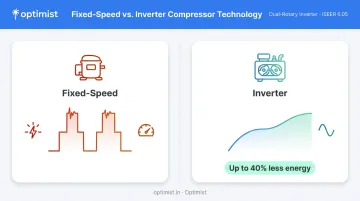
Fixed-speed compressors run at one speed and cycle on and off to maintain temperature. Every restart draws a power spike and adds wear.
Inverter compressors modulate speed to match cooling demand in real time: no hard stops, no spikes, steadier temperatures. Daikin India estimates inverter ACs can use up to 40% less energy than a comparable non-inverter unit, though actual savings vary with usage patterns and climate.
For anyone running an AC daily through an Indian summer, this isn't a nice-to-have. It's the difference between a bill you can predict and one that surprises you.
AC Type – Split vs. Window vs. Portable
Each type trades off differently:
| Factor | Split AC | Window AC | Portable AC |
|---|---|---|---|
| Noise | Quietest (compressor outside) | Louder, 45–56 dB range | Variable, generally noisier |
| Installation | Fixed, needs wall mounting | Fixed, needs window/wall opening | None required |
| Best for | Permanent homes | Small rooms, tighter budgets | Renters, temporary setups |
Split ACs cost more upfront to install but pay back in quieter operation and better long-term serviceability.
Climate Resilience – Ambient Temperature & Voltage Tolerance
Here's what most buyers only discover mid-heatwave: many ACs derate (meaning they quietly lose cooling capacity) once outdoor temperatures cross a threshold, often around 43°C. Your unit is technically running, just not cooling the way it did in the showroom.
Voltage swings are the other silent killer. India's grid sees frequent fluctuations during peak summer load, and stabiliser-free operation isn't guaranteed on every model. Check the manufacturer's tolerance range before you skip that ₹1,500 stabiliser.
This is where thermal engineering separates products on paper from products that survive July in Nagpur. Optimist's units are tested to sustain full rated cooling at 50°C ambient, a threshold most conventional split ACs don't reach without derating.
Warranty, Service Network & Smart Features
A long compressor warranty on the box means little if there's no service technician within 50 km of your pincode. Compare:
- Compressor warranty length: 5 to 10 years is the current market benchmark
- Comprehensive coverage duration: typically 1 year across most brands, with exclusions for labour, gas refills, or PCB
- Local service network reach: ask before you buy, not after it breaks down
Smart features like app-based diagnostics, filter health alerts, and gas-level monitoring aren't gimmicks — they catch small issues before they turn into a ₹6,000 repair bill.
How Optimist Can Help
Optimist was engineered specifically around the gaps most Indian buyers discover only after living through a summer with an underperforming AC: the derating, the surprise gas top-up charges, the vague warranty fine print.
Here's what differentiates it from conventional AC brands:
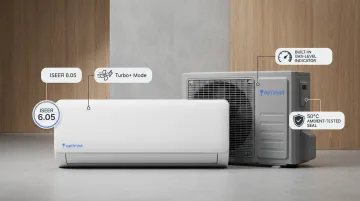
- ISEER 6.05: India's highest rated efficiency, for lower daily electricity bills
- Tested cooling at 50°C ambient: no capacity drop when it matters most
- First-ever built-in gas-level indicator: removes the guesswork (and the scam risk) around refrigerant top-ups
- Turbo+ Mode: a 135% capacity boost, giving the 1.4 Ton unit an effective 1.9-ton cooling output
- 1,000-hour salt-spray corrosion testing: 15 times the typical 72-hour market standard, built for coastal humidity
- 5-year comprehensive warranty with 10-year compressor coverage: parts and labour at ₹0
The Optimist app mirrors exactly what this guide recommends checking in the "smart features" factor above. Real-time energy tracking, projected monthly bills, filter health reminders, and remote diagnostics are all visible before a technician ever needs to visit.
Conclusion
The goal here is decision clarity, not brand popularity.
Your "best AC" is the one matched to your room size, your climate exposure, your daily usage pattern, and your budget, not necessarily the highest-rated model on a shelf. A 1.4 Ton unit with the right ISEER can outperform a poorly matched 1.5 Ton unit in the same room.
Buying right is step one. Reviewing performance each season (filter checks, gas levels, a basic service) keeps that decision paying off for years, not just one summer. Optimist's built-in gas-level indicator, for instance, turns that check into a quick app glance.
Frequently Asked Questions
How do I choose the right air conditioner?
Match tonnage to your room size, check the BEE star rating and ISEER score for efficiency, confirm it's inverter technology, and verify ambient temperature and voltage tolerance before comparing brands on price.
What is the $5000 rule for AC?
It's a US, BTU-market heuristic: multiply repair cost by unit age, and if it exceeds $5,000, replace rather than repair. Indian buyers should instead compare repair cost against tonnage-based replacement cost and remaining warranty period.
What does ISEER mean and why does it matter?
ISEER (Indian Seasonal Energy Efficiency Ratio) measures cooling output relative to electricity consumed across a season. A higher ISEER directly lowers your electricity bill for the same cooling. Optimist's 1.4 Ton split AC, for example, carries an ISEER of 6.05 — the highest currently available in the Indian market.
Is an inverter AC really better than a non-inverter AC?
Yes, for regular daily use. Inverter compressors modulate speed to match demand, cutting power draw at partial load, whereas fixed-speed units cycle fully on and off, using more power over time.
How do I calculate the right AC tonnage for my room?
As a starting point, 1 ton typically suits 130–150 sq. ft. Add capacity for top-floor rooms, sun-facing walls, large windows, or higher occupancy.
How long does a good air conditioner typically last?
A well-maintained inverter split AC with regular servicing every 6–12 months typically lasts 12–15 years — Optimist backs its unit with a 10-year compressor warranty. Budget non-inverter units, if poorly serviced, often need major repairs much sooner.