

Walk into any electronics store or scroll through an e-commerce listing, and you'll see "eco-friendly," "green," and "energy-saving" splashed across nearly every AC box. Most of these claims are marketing shorthand, not verified performance data. Separating a genuinely efficient machine from a greenwashed one requires knowing what to actually check.
This guide breaks down the ratings, refrigerants, and technology that define a real eco-friendly AC, plus practical buying and maintenance tips built for Indian conditions.
Key Takeaways
- ISEER is India's efficiency yardstick: higher numbers mean less power draw for the same cooling
- Low-GWP refrigerants, inverter compressors, and smart monitoring together cut bills and emissions
- Correct sizing and regular maintenance matter as much as the technology inside the unit
- Many "efficient" ACs lose cooling capacity past a heat threshold, wasting energy when you need it most
What Makes an Air Conditioner Eco-Friendly?
"Eco-friendly" isn't one feature you can tick off a spec sheet. It's the combination of four measurable factors: efficiency rating, refrigerant choice, compressor and coil design, and correct sizing for the room. Miss any one of these, and the others can't fully deliver.
ISEER Rating: India's Efficiency Benchmark
ISEER (Indian Seasonal Energy Efficiency Ratio) measures how much cooling a unit delivers per unit of electricity across a full Indian summer, not a single lab snapshot. It's calculated using outdoor temperature bins from 24°C to 43°C over an assumed 1,600 cooling hours a year.
This is different from the SEER2 rating used in the US, which uses American test procedures and climate assumptions. The two numbers are not interchangeable, so an imported spec sheet quoting SEER2 tells you very little about how a unit performs in Chennai or Nagpur.
BEE star ratings tighten every few years. As efficiency standards get stricter, the ISEER needed for 5-star status keeps rising. This matters because:
- Two ACs with the same star count from different label years can have meaningfully different real efficiency
- A 5-star label from several years ago doesn't guarantee the same real efficiency as a 5-star label today
- Always check the ISEER number itself, not just the star count, on the BEE label
Optimist's 1.4-ton unit carries an ISEER of 6.05, well above what most 5-star models on the market currently achieve, and comfortably ahead of even the tightening future thresholds.
Refrigerant Type and Global Warming Potential (GWP)
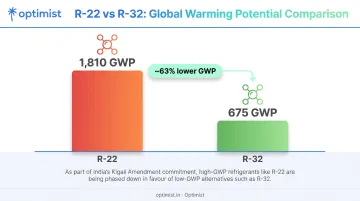
Refrigerant matters because leaks release greenhouse gases directly into the atmosphere. Older R-22 has a 100-year GWP of 1,810, while R-32, now standard in most new inverter ACs, comes in at 675, roughly 63% lower, according to Daikin's technical documentation on R-32.
Lower GWP isn't the same as zero impact. India's Kigali Amendment pathway sets a 2028 freeze on HFC production, with cumulative cuts of 10% by 2032, rising to 80% by 2047. This is nudging manufacturers steadily toward lower-GWP refrigerants like R-32, which Optimist uses across its lineup.
Compressor and Heat Exchanger Technology
A fixed-speed compressor works like an on-off switch: full blast, then a hard stop, repeated all day. That constant cycling wastes energy every time it restarts.
Inverter (variable-speed) compressors instead throttle output up or down to match the room's actual cooling demand. Less cycling means less wasted energy, especially once the room reaches your set temperature.
Heat exchanger design matters just as much. Micro-channel coils replace a handful of large copper tubes with hundreds of thin aluminium flow paths, increasing surface contact between refrigerant and air.
Optimist's design uses 1,180 flow paths in an automotive-derived aluminium alloy, contributing to what the company describes as 4x faster heat transfer versus conventional coils. Paired with a dual-rotary inverter compressor, this powers the unit's Turbo+ mode, delivering 1.9 tons of effective cooling from a 1.4-ton rated unit.
Correct Sizing for the Space
An oversized AC short-cycles and never runs efficiently. An undersized one runs flat-out constantly and still can't keep up. Either way, you waste energy regardless of the star rating on the box.
| Room size | Typical tonnage |
|---|---|
| Up to 150 sq ft | 1 ton |
| 151–250 sq ft | 1.5 ton |
| 251–400 sq ft | 2 ton |
Ceiling height, sun exposure, insulation, and occupancy all shift these numbers. Optimist positions its 1.4-ton unit for 120–200 sq ft rooms, using Turbo+ mode to match the output of a standard 1.5-ton machine while keeping the energy footprint of 1.4-ton hardware.
Benefits of Choosing an Eco-Friendly Air Conditioner
Beyond the obvious environmental angle, an efficient AC delivers four concrete, measurable benefits.
Lower Electricity Bills
According to Onida's guide to BEE star ratings, a 5-star split AC can use 35-40% less electricity than a 1-star unit of the same tonnage under standard usage assumptions. That's not a small difference over a full summer of daily use.
Optimist's high-ISEER models deliver 25-35% lower daily electricity bills compared to typical 5-star inverter ACs already on the market, a real-world benchmark that goes beyond the minimum star rating.
Reduced Carbon Footprint and Emissions
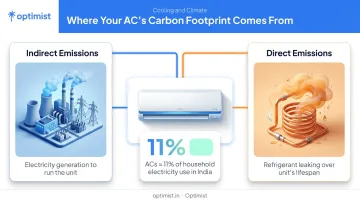
Lower bills are only half the story. Cooling's climate impact comes from two directions:
- Indirect emissions: electricity generation to power the unit
- Direct emissions: refrigerant leaking into the atmosphere over the unit's life
A 2024 household survey hosted by BEE found that ACs now account for 11% of household electricity consumption in India. As AC ownership keeps rising, the efficiency of each new unit sold matters more, not less, to national grid demand.
Reliable Performance Even in Extreme Heat
Efficiency ratings tell only part of the story, though. Here's a detail most buyers miss: cooling capacity and efficiency typically drop as outdoor temperature rises. India's own ISEER testing requires performance checks at outdoor points of 29°C and 35°C, but Indian summers routinely hit 45-50°C. A unit can look great on a label yet still derate and waste energy exactly when the heat peaks.
Optimist tests its unit at 50°C ambient temperature without capacity drop, addressing a gap that standard ISEER testing doesn't fully cover.
Improved Indoor Air Quality
Efficient systems are usually paired with better airflow management and humidity control. Optimist's app includes a Filter Health Track feature that flags when the filter needs cleaning, plus a Dry Mode for humidity control. These small additions keep both air quality and cooling performance from slipping over time.
Types of Eco-Friendly Cooling Technologies
Inverter split ACs are now the default standard for efficient cooling in Indian homes. Their variable-speed compressors adjust output continuously rather than cycling on and off, delivering steadier room temperatures and lower energy use than fixed-speed units.
Smart/connected ACs take this further with app-based control. Optimist's app, for example, displays:
- Live energy consumption and current bill amount
- A projected monthly bill based on actual usage patterns
- A gas-level indicator with a colour-coded gauge, so users spot refrigerant loss before cooling drops
- CO2 impact tracking, translating savings into equivalents like trees planted
Evaporative coolers remain a lower-cost, lower-tech option. They work well in dry climates but lose most of their effectiveness in humid regions like Mumbai or Chennai. Humid air can't absorb much additional moisture, which is a real limitation for large parts of coastal India.
How to Choose the Right Eco-Friendly AC for Indian Homes
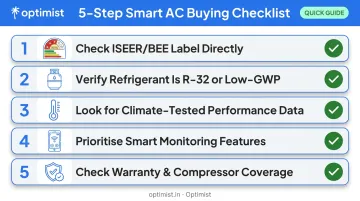
A few checks separate a genuinely efficient purchase from a marketing-driven one:
- Check the ISEER/BEE label directly on the datasheet rather than relying on words like "eco" or "green" in the ad copy
- Verify the refrigerant: it should be R-32 or another current low-GWP option, not older R-22 stock
- Look for climate-tested performance data, not just lab ratings. A unit tested and proven at 50°C without capacity drop, as with Optimist's engineering, is a stronger real-world signal than ISEER alone
- Prioritise smart monitoring features: real-time energy tracking, gas-level indicators, and filter health alerts help sustain efficiency over years rather than letting it degrade unnoticed
- Check warranty length and compressor coverage — a longer warranty, such as Optimist's 5-year comprehensive cover with 10-year compressor protection, signals durability and reduces the environmental cost of early replacement
Maintenance Tips to Sustain Efficiency
An efficient AC on paper can still waste energy in practice if it's neglected. A few habits protect the ISEER rating you paid for:
- Clean or replace filters regularly — a dirty filter restricts airflow and forces the compressor to work harder for the same cooling
- Book annual professional servicing to check refrigerant charge and clean coils, since proper maintenance keeps the ISEER rating intact
- Use the Optimist app's scheduling feature to avoid cooling empty rooms, which reinforces the savings the hardware was designed to deliver
Frequently Asked Questions
Is air conditioning eco-friendly?
Not inherently: ACs consume electricity and use refrigerants with some climate impact. Modern high-ISEER, low-GWP inverter models cut that impact well below older, fixed-speed units.
What is ISEER rating and why does it matter for eco-friendly ACs in India?
ISEER is India's seasonal efficiency metric, measuring cooling delivered per unit of electricity across a typical Indian summer. A higher ISEER means lower power consumption for the same cooling output.
Are inverter ACs more eco-friendly than fixed-speed ACs?
Generally, yes. Inverter compressors modulate speed to match cooling demand instead of cycling fully on and off, which reduces the energy wasted on repeated restarts.
What refrigerant is best for an eco-friendly AC in India?
R-32 is currently the widely used lower-GWP option, at roughly 675 GWP versus 1,810 for older R-22. It aligns with India's Kigali-linked refrigerant phase-down commitments.
Does AC size affect how eco-friendly it is?
Yes. Both undersized and oversized units waste energy regardless of their star rating, so matching tonnage to actual room size and heat load is essential for real-world efficiency.
How much can an eco-friendly AC actually save on electricity bills?
High-ISEER models can lower daily electricity bills by a meaningful margin. Optimist's units, for instance, claim 25-35% lower bills compared to typical 5-star inverter ACs on the market.