
Introduction
IMD recorded 50.5°C at Churu, Rajasthan on 28 May 2024 — the kind of temperature most air conditioners were never designed to handle. India logged 536 heatwave days across meteorological subdivisions in summer 2024 alone, according to CEEW. This isn't an anomaly. Climate projections put heatwave frequency at 3–4 times higher by the late 21st century.
Most ACs on the market were tested and rated at 35°C outdoor conditions. At 50°C, many units lose 20–40% of their cooling output or cut out entirely, even if the spec sheet claims operation up to 55°C.
This guide cuts through the marketing language. You'll learn what actually separates a 50°C-capable AC from a standard one, which specific models are built for it, and how to operate your unit without burning through your electricity budget.
Key Takeaways
- BEE's ISEER rating only measures efficiency up to 43°C — it doesn't prove 50°C performance
- Most ACs derate (lose 20–40% cooling) when outdoor temps exceed 43–45°C
- Only a few models are tested and validated for no-derating performance at 50°C
- Set your thermostat to 24–26°C, not the minimum: it reduces strain without sacrificing comfort
- Service your AC at least twice a year in extreme-heat regions
What Makes an AC Capable of Handling 50°C?
The Core Problem: Heat Rejection Gets Harder
An air conditioner works by transferring heat from inside a room to the outdoors. At 35°C outside, this process is reasonably efficient. At 50°C, the outdoor air is so hot that the condenser struggles to dump heat fast enough — the temperature difference between the refrigerant and the surrounding air shrinks, and the system has to work harder for diminishing returns.
Research quantifies this well: a 2022 review of residential AC systems found that ideal COP (coefficient of performance) drops by roughly 54% when outdoor temperature rises from 35°C to 55°C. A separate refrigerant study found R410A capacity drops 17% and COP drops 43% at 55°C versus 35°C.
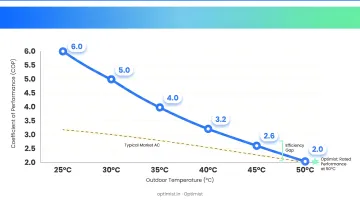
This is derating. It happens well before a unit technically "shuts down" — meaning your AC may still run at 50°C while delivering far less cooling than its rated capacity suggests.
Why ISEER Doesn't Tell the Full Story
India's BEE star rating system uses ISEER (India Seasonal Energy Efficiency Ratio) to measure AC efficiency. It's a useful metric, but BEE calculates it using outdoor temperature bins between 24°C and 43°C only.
Current BEE thresholds (2026–2027 rating period):
| Star Rating | Minimum ISEER |
|---|---|
| 3-star | 4.80 |
| 5-star | 5.50 |
A 5-star ISEER label tells you the unit is efficient under typical Indian seasonal conditions. It says nothing about what happens at 50°C.
What a Genuinely 50°C-Capable AC Needs
Four engineering factors separate real high-ambient ACs from standard ones:
- Compressor rated for high ambient operation: tested and validated beyond 43°C, not just claimed in a spec sheet
- Advanced heat exchanger design: greater surface area or microchannel technology to dissipate heat faster when outdoor air is extremely hot
- Refrigerant suited to high-pressure conditions: R32 is now common in India's premium segment, though condenser design and compressor control matter more than refrigerant choice alone
- Electronics built for thermal stress: PCBs and controls that don't fail when the outdoor unit is sitting in 50°C heat
The practical benchmark when shopping: ask for the stated maximum ambient operating temperature and verify that the rating is backed by actual test data, not just a marketing claim.
Best ACs for 50°C Temperatures in India
The models below were selected based on documented maximum ambient temperature ratings, inverter technology, energy efficiency, and manufacturer-validated (or independently tested) high-ambient performance. Where data gaps exist, they're flagged clearly.
Optimist AC
India's only AC engineered from the ground up specifically for 50°C Indian summers. Optimist was incorporated in August 2024, built its Nalanda 1 R&D Lab by November 2024, and launched its first product in January 2026 — backed by ₹100 crore (~USD 12M) from Accel, Arkam Ventures, and Sparrow Capital.
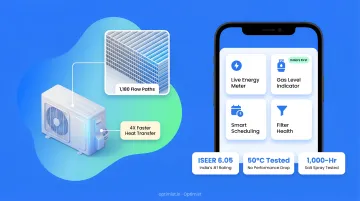
The standout claim: **verified 50°C cooling with no performance derating**. This is supported by in-house testing at the Nalanda 1 facility, with IIT Delhi's Prof. Anurag Goyal serving as Technical Advisor. The AC carries India's highest ISEER rating of 6.05 — well above the current 5-star threshold of 5.50.
Key differentiators:
- Microchannel heat exchanger — delivers 4X faster heat transfer than standard copper-fin designs, critical for heat rejection when outdoor air is at 50°C
- Turbo+ Mode — 135% capacity boost, equivalent to 1.9 tons of cooling from a 1.4-ton unit
- First-ever gas level indicator — real-time refrigerant monitoring via app, so you're not guessing whether your gas is low during peak summer
- 1,000-hour corrosion test — 15× the market standard
- Smart app — tracks energy use in real time, projects monthly bills, monitors filter health, and gives you full remote control
| Feature | Detail |
|---|---|
| ISEER / Star Rating | 6.05 / 5-star (India's highest) |
| Max Ambient Temp | Tested and proven at 50°C, no derating |
| Warranty | 5-year all-inclusive + 10-year compressor |
| Key Tech | Microchannel heat exchanger, Turbo+ Mode, gas level indicator, smart app |
Visit optimist.in or contact care@optimist.in for details.
Haier Elegante Heavy Duty Hexa Inverter Split AC (HSU19E-TXW5BN-INV)
Haier's Elegante Heavy Duty range is one of the most prominently marketed extreme-heat lines in India. The HSU19E-TXW5BN-INV (1.6 ton) carries a claimed maximum ambient temperature of 60°C — the highest declared figure among mainstream brands.
Important caveat: This 60°C claim appears on Haier India's official blog, not a product datasheet or independent lab report. No third-party validation was found during research.
| Feature | Detail |
|---|---|
| ISEER / Star Rating | 5.05 / 5-star |
| Max Ambient Temp | Claimed 60°C (manufacturer claim, not independently validated) |
| Warranty | 5-year comprehensive + 12-year compressor |
| Key Tech | Hexa Inverter, 7-in-1 Intelli Convertible Modes, Frost Self-Clean, Hyper PCB, R32 |
Daikin FTKF35U (High Ambient Series)
Daikin's official product pages confirm an ISEER of 6.3 and a declared maximum ambient temperature of 56°C for the FTKF35U — among the more precisely documented specs in this category.
The Swing Compressor is Daikin's headline differentiator: it reduces friction and vibration during operation, which matters for longevity under sustained high-ambient stress. The unit also includes built-in voltage stabiliser operation (130–285V), removing the need for an external stabiliser.
| Feature | Detail |
|---|---|
| ISEER / Star Rating | 6.3 / 5-star |
| Max Ambient Temp | 56°C (official Daikin India product page) |
| Warranty | 10-year compressor + 5-year PCB |
| Key Tech | Swing Compressor, R32, 130–285V stabiliser-free, inverter |
Voltas 185INV Vertis Elite Gold
Voltas holds approximately 19% RAC market share in India — the largest of any brand — and its Vertis Elite Gold is the model with the clearest official high-ambient claim in their residential split AC range. The 1.5-ton, 5-star unit is rated to 52°C ambient, confirmed on the official Voltas product page.
Corrosion protection is a clear strength — relevant for coastal and industrial-adjacent locations:
- Anti Corrosive Gold Fin Condenser
- Hydrophilic Gold Fin Coating on the evaporator
- Anti-corrosive coating on the indoor unit coil
Note: ISEER and voltage range were not available on the official Voltas product page during research — confirm these with the retailer or manufacturer before purchase.
| Feature | Detail |
|---|---|
| ISEER / Star Rating | Not confirmed / 5-star |
| Max Ambient Temp | 52°C (official Voltas product page) |
| Warranty | 5-year comprehensive |
| Key Tech | Gold Fin condenser, anti-corrosive indoor coil coating, inverter |
LG US-Q19BNZE (Dual Inverter, High Ambient)
LG's US-Q19BNZE (1.5 ton, 5-star) is rated to 55°C ambient per LG India's official product page and 2026 catalogue. The unit runs R32 refrigerant, operates stabiliser-free across 120V–290V, and includes both Gold Fin+ and Ocean Black Protection for corrosion resistance.
LG's Dual Inverter compressor adjusts across a wider speed range than fixed-speed units, which can reduce thermal cycling stress during sustained high-ambient operation.
Note: ISEER value and model-specific warranty terms were not clearly confirmed from extracted official LG sources — verify before purchase.
| Feature | Detail |
|---|---|
| ISEER / Star Rating | Not confirmed / 5-star |
| Max Ambient Temp | 55°C (official LG India page) |
| Warranty | Confirm with LG India directly |
| Key Tech | Dual Inverter, R32, 120–290V stabiliser-free, Gold Fin+ & Ocean Black Protection |
How We Chose These ACs
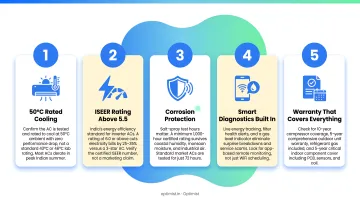
Selection was based on five criteria — applied consistently across all models:
- Documented max ambient operating temperature — preference for models with official claims of 50°C or above, from product pages or datasheets (not retailer listings)
- Inverter compressor technology — fixed-speed compressors are not suited for sustained high-ambient operation
- ISEER rating — as an efficiency proxy under Indian seasonal conditions (noting its 43°C ceiling)
- Test evidence or manufacturer validation — models where the high-ambient claim links to a testing basis ranked higher than marketing language alone; units with no-derating validation at 50°C were ranked above those with only a stated maximum
- Warranty depth — coverage for compressor, PCB, refrigerant gas, and labour matters when the unit is running through a 50°C summer
ACs marketed with vague "extreme cooling" language but no disclosed ambient temperature rating, or with ISEER below 4.0, were not considered. Always ask for the max ambient operating temperature before purchase — it's rarely on the front of the box.
Tips for Running Your AC Effectively in 50°C Heat
Set the Right Temperature
At 50°C outside, avoid setting your AC below 24°C. BEE confirms that raising your AC setting by just 1°C saves approximately 6% in electricity consumption. The 24–26°C range balances comfort with compressor load — going lower doesn't cool the room faster, it just makes the compressor work harder and drives up your electricity bill.
Use a Ceiling Fan Alongside the AC
A ceiling fan circulates cool air through the room, allowing the AC to maintain comfort at a slightly higher setpoint. Research shows that ceiling fans can allow thermostat increases of around 2°C without any reduction in perceived comfort. Running both together during peak afternoon heat reduces compressor cycles and cuts daily consumption meaningfully.
Maintenance Schedule for Extreme Summers
In regions regularly crossing 45–50°C, service your AC at least twice a year — once before peak summer and once mid-season. Each service should cover:
- Clean indoor filters and evaporator coil
- Check and top up refrigerant levels
- Inspect the outdoor unit for airflow obstructions (dust, debris, vegetation)
- Clean condenser fins
- Check electrical connections and PCB for signs of stress
Deferred maintenance under extreme thermal load is the leading cause of compressor failure. This risk is compounded when there's no way to monitor refrigerant levels. Without a gas level indicator, low refrigerant goes undetected until the compressor fails.
Conclusion
Fifty-degree summers are no longer rare in India. Choosing an AC based on brand recognition or price alone — without checking the documented max ambient operating temperature — is a real risk. The right unit for extreme Indian heat needs verified high-ambient performance, efficient energy use, and warranty support that holds when you need it.
For homeowners who want an AC built specifically for this reality, the Optimist AC offers India's highest ISEER rating (6.05), tested 50°C performance with no derating, and a 5-year all-inclusive warranty covering parts, labour, and refrigerant gas. Visit Optimist's website or reach out at care@optimist.in to learn more or book a consultation.
Frequently Asked Questions
Can I run my AC when it's 50°C outside?
Yes — most modern inverter ACs are technically rated to operate up to 52–60°C ambient, but standard models lose significant cooling output at 50°C due to derating. Set the thermostat at 24–26°C (not the minimum), run a ceiling fan alongside, and choose a unit with a verified high-ambient rating for best results.
Which AC works at 52°C temperature?
The Optimist AC is tested at 50°C with no derating. Voltas 185INV Vertis Elite Gold is rated to 52°C, LG US-Q19BNZE to 55°C, and Haier Elegante Heavy Duty claims 60°C (manufacturer claim, not independently validated). Always check whether a brand's stated max temperature is backed by actual test data, not just spec-sheet figures.
What temperature should I set my AC when it's 50°C outside?
Set your thermostat to 24–26°C. This range balances thermal comfort and compressor load. Going lower adds electricity consumption without meaningfully improving how cool the room feels.
Why does my AC cool less effectively during peak summer afternoons?
This is derating: as outdoor temperatures rise above 43–45°C, most compressors reduce output to prevent overheating. You get less cooling exactly when you need it most. ACs engineered for high-ambient operation — with reinforced compressors and advanced heat exchangers — are built to minimise this effect.
How often should I service my AC in extreme heat regions?
At least twice a year — once before peak summer and once mid-season. Priority tasks are cleaning filters and coils and checking refrigerant levels. Skipping service under sustained high-ambient loads is the most common cause of premature compressor failure.
Does a higher ISEER rating mean better performance at 50°C?
Not directly. ISEER measures seasonal efficiency across outdoor temperatures between 24°C and 43°C — useful for comparing electricity bills, but not proof of 50°C performance. Check both the ISEER rating and the manufacturer's stated maximum ambient operating temperature, and look for evidence of real-world or lab-validated performance at extreme temperatures.