
Introduction
According to India's Meteorological Department, 2024 was the country's warmest year since records began in 1901, with city-level highs reaching 50.5°C in Churu and 49.4°C in Ganganagar on a single May day. Your AC is no longer a seasonal convenience — it's critical infrastructure.
Most buyers choose an AC the wrong way. They compare tonnage and star labels, ignore what actually drives electricity bills, and skip asking how the unit performs on a 48°C afternoon in June.
This article covers both: a clear-eyed profile of the top AC brands in India, and a practical buying framework to help you choose the right unit for your room and climate.
Key Takeaways
- Voltas, Daikin, LG, Blue Star, and Samsung lead the Indian AC market by volume and brand trust
- ISEER is a more precise efficiency metric than star labels — always compare this number, not just the star tier
- Many ACs lose cooling capacity above 43–45°C; ask specifically about high-ambient performance before buying
- Smart features like gas level monitoring, filter health tracking, and energy dashboards cut running costs in measurable ways
- Optimist raises the benchmark with India-specific engineering: ISEER 6.05, full-rated cooling at 50°C, and a 5-year all-inclusive warranty
Top AC Companies in India: Who They Are and What They Stand For
Each brand below was assessed on market share, product range, energy efficiency, after-sales network, and innovation — the factors that actually determine whether an AC holds up after you've bought it.
Voltas
India's largest AC brand by volume, backed by the Tata Group. Voltas crossed 2 million AC units in FY2023–24 with 35% sales growth, and its FY2024–25 annual report puts that figure at over 2.5 million units. The brand's strengths are value pricing and a wide service network — making it a sensible default for first-time buyers and Tier 2/3 markets.
Daikin
The global AC market leader by reputation, particularly strong in inverter compressor technology. Daikin targets premium residential and commercial buyers who prioritise long-term efficiency and durability. Several of its residential split AC models are advertised to operate at ambient temperatures up to 52–55°C, which is relevant for North Indian summers.
LG
LG's Dual Inverter Technology and variable tonnage operation give it an edge in adaptive cooling. Its ThinQ app offers solid smart home integration, and the brand spans a wide price range — from budget-friendly to premium. LG also offers a 10-year compressor warranty on inverter models.
Blue Star and Samsung
Blue Star has deep commercial HVAC roots and has expanded its room AC distribution to over 900 towns through 5,000+ channel partners, targeting first-time and price-sensitive buyers in Tier 2–6 markets. Its FY2024 value share reached 13.75%.
Samsung differentiates with WindFree technology (23,000 micro air holes for draft-free cooling) and an AI Energy Mode that the brand claims reduces energy use by up to 30%. It suits buyers who want tech-forward design with strong brand familiarity behind it.
Optimist: Purpose-Built for Indian Conditions
Launched in January 2026 by Ashish Goel (ex-Urban Ladder founder, ex-McKinsey) and Pranav Chopra (Co-founder & CTO), Optimist is engineered from first principles for Indian heat — not adapted from a global platform.
Key differentiators:
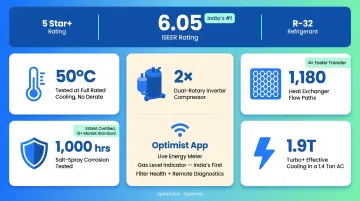
- ISEER rating of 6.05 — the highest certified in India as of 2026
- Tested to deliver full rated cooling at 50°C ambient with no performance drop
- Turbo+ mode delivers 1.9-ton effective cooling from a 1.4-ton unit (135% capacity boost)
- India's first built-in gas level indicator via the Optimist App — eliminates the common gas refill scam
- 1,000-hour salt-spray corrosion testing (SIGMA certified) — 15× the typical 72-hour market standard
- Backed by ₹100 crore (USD 12M) from Accel, Arkam Ventures, and Sparrow Capital (December 2025)
- 5-year comprehensive warranty (parts + labour + refrigerant gas at ₹0) plus 10-year compressor warranty
For buyers prioritising peak-summer reliability and long-term electricity savings, Optimist is a substantively different option — one built around Indian conditions from day one, not retrofitted for them.
Key Features That Separate Good ACs from Great Ones
Tonnage and star ratings are a starting point, not the full picture. Here's what actually determines whether your AC performs well in a real Indian summer.
Inverter Technology
Inverter compressors adjust their speed based on the cooling load — running fast when the room is hot, then slowing down once it stabilises. This produces:
- More consistent temperatures (less on/off cycling)
- Lower electricity consumption during part-load operation
- Quieter running at steady state
Fixed-speed compressors run at full power or not at all. They typically cost less upfront but are more expensive to run — especially if the AC operates 6+ hours daily.
Energy Efficiency: Star Rating vs. ISEER
BEE star ratings group ACs into broad tiers (3, 4, or 5 stars). ISEER — Indian Seasonal Energy Efficiency Ratio — is the underlying number that determines which tier a model falls into. A higher ISEER means more cooling output per unit of electricity consumed across a full Indian cooling season.
Why this matters in practice:
| BEE ISEER Thresholds (2024–2026 Schedule) | Minimum ISEER |
|---|---|
| 3-Star Split Inverter AC | 4.50 |
| 4-Star Split Inverter AC | 5.00 |
| 5-Star Split Inverter AC | 5.50 |
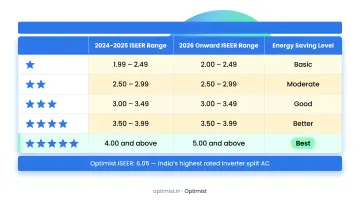
Two 5-star ACs can have very different ISEER values — one at 5.6, another at 6.05. The electricity bill difference over 5 years is real. Always ask for the ISEER number, not just the star label.
Performance Under Peak Heat (The Derating Problem)
Standard AC capacity is tested at 35°C outdoor temperature under BIS IS 1391 conditions. Most ACs also have a maximum operating test at 46°C. But there is no standard guarantee of full-rated capacity beyond that point.
In practice, many ACs progressively lose cooling output above 43–45°C — a condition called derating. This goes unreported by most brands. In cities like Delhi, Jaipur, Lucknow, or Nagpur, where peak afternoon temperatures regularly exceed 46–48°C, it's a factor that should drive your purchase decision.
Ask specifically: Does this AC deliver its full rated cooling at 50°C? Is that validated or just an operating claim?
Smart and Connected Features
Any modern AC worth considering should offer:
- Wi-Fi app control and scheduling
- Live energy usage tracking
- Projected monthly bill estimates
- Gas level monitoring (Optimist is currently the only brand offering this built-in)
- Filter health alerts
- Intelligent remote diagnostics (reduces unnecessary technician visits)
These features matter most when something goes wrong — or when you're trying to understand why your electricity bill spiked.
Warranty and After-Sales Support
Standard industry pattern: 1-year comprehensive + 10-year compressor-only (parts, no labour after year 1). Check what's actually covered:
- Compressor only after year 1 — gas, labour, PCB, and other parts are often chargeable
- All-inclusive coverage across parts, labour, and refrigerant gas for the full term is rare, and significantly more valuable
Verify authorised service centre availability in your specific city before deciding.
How to Choose the Right AC for Your Home
Step 1: Match Capacity to Room Size
Use this as a starting rule of thumb:
| Room Size | Recommended Tonnage |
|---|---|
| Up to ~120 sq ft | 1 Ton |
| 120–180 sq ft | 1.5 Ton |
| 180+ sq ft | 2 Ton |
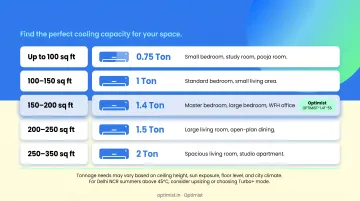
Adjust upward if the room is west-facing, has high ceilings (10 ft+), poor insulation, or large glass areas. An undersized AC runs harder, costs more to operate, and cools less effectively.
Step 2: Prioritise the Right Energy Rating for Your Usage
If you run the AC 6+ hours daily, a 5-star or high-ISEER model matters more than most buyers realise. Key things to check:
- Payback period: A premium 5-star model typically recovers its price over a 3–5-year window through electricity savings
- Annual kWh on the BEE label: Two 5-star models can differ by 15–20% in actual annual consumption — the label figure is the only fair comparison
- Benchmark example: The Optimist 1.4 Ton 5-star model consumes 620.2 kWh annually — useful as a reference when reviewing competitor BEE labels
Step 3: Choose the Right AC Type
- Split inverter AC — the right default for most Indian homes. Quieter, more efficient, suitable for rooms up to 200+ sq ft and available in 5-star+ rated variants
- Other form factors (window, portable) exist but trade off efficiency significantly — for any bedroom or living room application, a split inverter delivers better long-term value
Step 4: Check for Indian Climate Suitability
Before shortlisting a model, verify:
- High-ambient temperature performance — does it cool at 50°C or just operate at 46°C?
- Corrosion-resistant coatings — essential for coastal cities (Mumbai, Chennai, Kochi, Visakhapatnam)
- Turbo or boost mode — useful for rapid cool-down during peak afternoon heat (3–7 PM)
- Voltage stabilisation — important in areas with frequent voltage fluctuations
Step 5: Evaluate After-Sales Network and Warranty
A reliable brand with poor local service is still a bad experience. Before finalising:
- Confirm the brand has authorised service centres in your city
- Read what the warranty actually covers — not just the headline number
- Check whether labour and gas refills are included or charged separately
- Look at average service response time reviews for your area
Why Energy Efficiency Is the Most Underrated Buying Factor
Most buyers anchor on the purchase price and underweight what the AC will cost to run over 10–15 years. That's a significant financial mistake.
India's AC market is expected to reach approximately 14 million units by end-2024, per CEAMA data cited by IBEF, with the segment revenue already at ₹65,598 crore as of 2025. As adoption grows, so does the aggregate electricity cost — which is increasingly falling on individual households.
The ISEER gap in concrete terms:
Optimist's 1.4 Ton model at ISEER 6.05 consumes 620.2 kWh annually. A typical 5-star inverter AC at ISEER ~5.2 consumes approximately 800 kWh annually. At ₹8/kWh, that's roughly ₹1,440 saved per year — or ₹14,400 over a decade — from a single appliance.
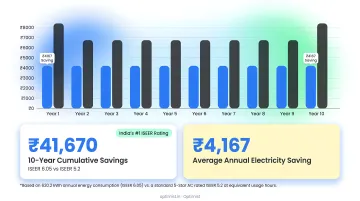
Run two ACs through a six-month North Indian summer and that gap doubles — closer to ₹28,800 saved per decade, before accounting for future electricity tariff increases.
Those household savings are only part of the story. Regulatory pressure is steadily raising the floor on what counts as acceptable efficiency.
BEE standards are tightening. The notification sequence — S.O. 4634(E) in 2021, S.O. 2794(E) in 2024, and S.O. 3984(E) in 2025 — shows a clear direction toward higher minimum efficiency thresholds. A 3-star model bought today will increasingly look expensive to run against what's available five years from now.
When comparing models, target an ISEER of 5.0 or above — anything below that will cost you at the meter every month for the next decade.
Frequently Asked Questions
What are the top five AC brands in India?
Voltas, Daikin, LG, Blue Star, and Samsung consistently lead by market share and brand trust. The right brand depends on your priorities — Voltas for value and service reach, Daikin for premium efficiency, LG for smart features, Blue Star for Tier 2/3 availability, and Samsung for tech-forward design.
Which 5-star AC is best?
Compare ISEER values within the 5-star tier (higher is better), check whether the model is tested for high-ambient temperatures, and evaluate warranty terms carefully. Two 5-star ACs from different brands can carry meaningfully different running costs.
How do I choose the right AC capacity for my room?
As a rule of thumb: 1 ton for rooms up to ~120 sq ft, 1.5 ton for 120–180 sq ft, and 2 ton for larger spaces. High ceilings, direct afternoon sunlight, and poor insulation may require sizing up by half a ton.
What is ISEER and why does it matter?
ISEER (Indian Seasonal Energy Efficiency Ratio) measures how efficiently an AC performs across a full Indian cooling season. A higher number means lower electricity bills, making it a more useful buying metric than the star tier label alone.
Is an inverter AC better than a non-inverter AC?
For regular use (6+ hours daily), yes: inverter ACs deliver lower running costs, steadier cooling, and quieter operation. Non-inverter models only make practical sense for very occasional use or when the upfront budget is extremely tight.
Which AC brand offers the best warranty and after-sales service in India?
Warranty terms vary significantly. Daikin, LG, and Blue Star offer 10-year compressor warranties with wide service networks. Optimist provides a 5-year all-inclusive warranty (parts, labour, and refrigerant gas at ₹0) plus a 10-year compressor warranty, covering more components than most standard plans.