

Introduction
Indian summers have stopped being predictable. Temperatures across Delhi NCR regularly hit 45–49°C between May and June, with Rajasthan and parts of Uttar Pradesh pushing even higher. The problem is not just the heat — it's that most ACs sold in India were never built for it.
According to IMD, 2024 was India's warmest year since records began in 1901, with annual mean temperatures running 0.65°C above the 1991–2020 average. Yet the standard cooling test for ACs in India uses an outdoor temperature of 35°C. Most units are certified to operate up to 43°C. That gap — between what the certification assumes and what Indian summers actually deliver — is where cooling fails and electricity bills spike.
That certification gap is the starting point. This guide covers the engineering features that separate a heat-ready AC from a standard one, and the selection criteria that actually matter when temperatures cross 45°C.
Key Takeaways
- An AC built for extreme Indian heat must deliver full rated cooling at 50°C ambient — most standard ACs derate 30–40% at that temperature
- ISEER is a better efficiency measure than star rating alone — it captures performance across variable conditions, not just one controlled lab result
- Tonnage must account for heat load, not just room size — sunlight, floor level, and outdoor temperature all increase demand
- Corrosion and dust resistance are critical in coastal and arid regions — not optional upgrades
- Smart features like gas level monitoring and real-time energy tracking let you catch problems before they become breakdowns — and see your electricity cost before the bill arrives
Why Most ACs Fall Short in Extreme Indian Heat
The Derating Problem
BEE certifies AC capacity and power at a standard outdoor temperature of 35°C. The ISEER calculation extends this across a range of conditions up to 43°C. What happens above that threshold is not covered by certification — and that is precisely where Indian summers spend weeks at a time.
When outdoor temperatures push past 43°C, the compressor's thermal protection activates to prevent damage. The result is reduced cooling output — not a total shutdown, but a progressive loss. Performance testing data shows how quickly that loss adds up:
| Outdoor Temperature | Typical AC Cooling Loss |
|---|---|
| Up to 43°C | None — rated capacity maintained |
| 45°C | 10–15% reduction |
| 48°C | 20–30% reduction |
| 50°C | 30–40% reduction |
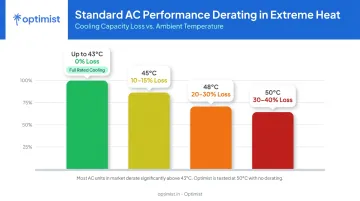
At 50°C ambient — a temperature now commonly recorded across Delhi NCR, Rajasthan, and UP — a standard AC may lose nearly half its effective output. The room never reaches the set temperature, the compressor runs continuously, and the electricity bill climbs. That 5-star rating on the box was earned at 35°C — not the 48°C your outdoor unit faces in May.
Compounding Factors in Indian Conditions
Temperature is only part of the challenge. Indian environments stress AC components in ways most standard designs aren't built to handle:
- Voltage instability in tier-2 and tier-3 cities stresses electrical components
- Fine desert dust in Rajasthan and Gujarat clogs condenser coils and restricts airflow
- Salt-laden coastal air in Mumbai, Chennai, and Kochi corrodes outdoor unit coils within a few years if untreated
- Long daily runtimes of 8–12 hours place sustained thermal load on compressors not engineered for Indian operating cycles
The cost impact is straightforward: an AC running at reduced capacity in 48°C heat consumes more electricity per unit of cooling than the same AC running efficiently at 35°C. Higher runtime, lower output — the bill goes up even as the room stays warm.
What Makes an AC Truly Built for Extreme Heat
Five engineering factors separate an AC that actually handles Indian summers from one that just carries a star label: ambient temperature performance, heat exchanger design, ISEER efficiency, corrosion resistance, and boost cooling capability. Each one has a direct effect on how well the unit performs when temperatures cross 45°C.
High-Ambient Cooling Architecture
A heat-ready AC must be engineered to deliver its full rated cooling capacity at 50°C outdoor temperature — not just survive that temperature without shutting down, but actually cool the room at rated output. This requires compressor protection systems designed for sustained extreme-heat operation, not just peak-temperature tolerance.
The distinction matters: "rated for 50°C" on a spec sheet is not the same as "tested to deliver full output at 50°C." Buyers should look for evidence of real-world performance validation at extreme temperatures, not just compliance certifications based on the 43°C ISEER framework.
Heat Exchanger Efficiency
The condenser coil is the most thermally critical component in hot weather. It transfers heat from the refrigerant to outdoor air — and when outdoor air is 48°C rather than 35°C, that transfer becomes considerably harder.
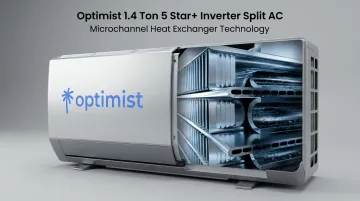
Advanced microchannel heat exchangers — such as the aluminium alloy design used in Optimist's 1.4 Ton AC with 1,180 flow paths — move heat out of the refrigerant faster than conventional copper tube-and-fin designs. That speed is what allows the system to maintain rated output at 50°C, rather than throttling performance to protect the compressor.
Energy Efficiency Under Stress (ISEER Rating)
BEE defines ISEER as total seasonal cooling output divided by total annual energy consumed, calculated across temperature bins from 24°C to 43°C over a modelled 1,600 cooling hours per year. This is a more useful metric than a single-point EER because it reflects variable load conditions — though it still does not model operation above 43°C.
For variable-speed split ACs under the schedule valid through December 2024:
| BEE Star Rating | ISEER Range |
|---|---|
| 3-Star | 3.80 – 4.39 |
| 4-Star | 4.40 – 4.99 |
| 5-Star | 5.00 and above |
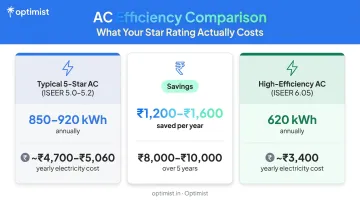
A higher ISEER means lower electricity consumption across the cooling season. The gap between a 5.0 ISEER unit and a 6.05 ISEER unit — like the Optimist — translates to annual energy consumption of roughly 850–920 kWh versus 620 kWh. At ₹5.50 per unit, that is a saving of over ₹1,200–1,600 per year, compounding over the unit's life.
Corrosion and Dust Resistance
Outdoor units face two distinct threats depending on where you live. Buyers in the following locations should treat corrosion and dust resistance as a core selection criterion — not a nice-to-have:
- Coastal cities (Mumbai, Chennai, Kochi, Visakhapatnam): salt-laden air corrodes aluminium fins and steel chassis components
- Arid regions (Rajasthan, Gujarat): desert dust physically clogs condenser coils, forcing the compressor to work harder
- Both conditions: reduce airflow and shorten unit lifespan without adequate protection
Most brands test outdoor units at around 72 hours of salt spray exposure — insufficient for a unit installed within a few kilometres of the sea.
Turbo and Boost Cooling Capability
After a west-facing room has sat at 44°C for six hours, a standard AC takes a long time to pull temperatures down to comfort. A well-designed turbo mode temporarily increases effective cooling output beyond the unit's nominal rated capacity, achieving faster temperature pulldown before transitioning to efficient steady-state operation.
The practical benefit: faster pulldown means less total runtime to reach comfort. Overall energy consumption drops — even though the turbo phase draws more power momentarily.
Key Factors to Consider When Choosing an AC for Extreme Heat
Ambient Temperature Rating
This is the most overlooked specification on an AC purchase. Buyers should verify that the unit is rated and validated to deliver its full cooling capacity at 50°C outdoor temperature — not just certified to operate without damage at that temperature.
Ask specifically: does the manufacturer publish performance data at 50°C, or only at the standard 35°C test condition? A brand confident in its extreme-heat performance will publish testing evidence. Brands that aren't will cite 43°C compliance and change the subject.
ISEER and Electricity Cost Impact
Run the numbers across a full cooling season and ISEER differences become hard to ignore. For a typical Indian bedroom AC running 8–10 hours per night through a 5–6 month summer:
- Optimist 1.4 Ton (ISEER 6.05): 620 kWh annually → ~₹3,400 at ₹5.50/unit
- Typical 5-star 1.5 Ton (ISEER 5.0–5.2): 850–920 kWh annually → ~₹4,700–₹5,060 at ₹5.50/unit
Over five years, that ISEER gap translates to roughly ₹8,000–₹10,000 in electricity savings — often exceeding the price premium of a more efficient unit.
Correct Tonnage for Indian Heat Load
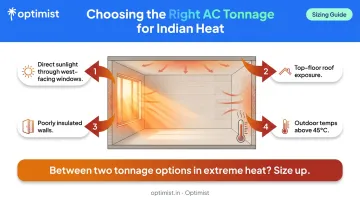
Standard tonnage charts match room area to AC capacity — but they're built for average conditions, not Indian summers. Several factors push the actual heat load well beyond what room size alone would suggest:
- Direct sunlight through large windows, especially west-facing rooms
- Top-floor placement with direct roof exposure and poor ceiling insulation
- Poorly insulated walls in older construction
- Outdoor temperatures consistently above 45°C — this alone increases the work the compressor must do, independent of room size
When in doubt between two tonnage options, size up — especially in North Indian climates. An undersized AC running flat-out without hitting the set temperature delivers no real comfort. It also burns more electricity than a correctly sized unit cycling efficiently.
Corrosion Resistance by Location
| Location Type | Primary Threat | What to Look For |
|---|---|---|
| Coastal cities (Mumbai, Chennai, Kochi) | Salt-laden air corroding coils | Named salt spray test standard, duration (hours), and pass criteria |
| Arid/desert regions (Rajasthan, Gujarat) | Dust clogging condenser coils | Fin coating quality, serviceability of outdoor unit |
| Industrial corridors | Chemical particulates in air | Chassis coating and material quality |
Ask the manufacturer for the specific test methodology, duration, and certification body — not just a claim about "corrosion-resistant coating."
Location-specific durability matters most in the outdoor unit, which bears the full force of ambient conditions year-round. Smart monitoring features can help you track when performance starts slipping — catching problems that corrosion or clogging cause before they become expensive repairs.
Smart Monitoring Features
Smart features relevant to extreme heat ownership go beyond Wi-Fi scheduling:
- Real-time energy tracking — catches abnormal consumption before the monthly bill arrives
- Refrigerant gas monitoring that detects leaks before cooling drops — and before a technician convinces you to pay for a top-up you didn't need
- Filter health alerts — a clogged filter meaningfully reduces cooling output, and most owners never notice until it's too late
- Remote diagnostics — faster, more accurate service resolution during peak summer, when technician slots are scarce
Warranty as a Performance Confidence Signal
In extreme heat, compressor wear accelerates. A warranty that covers the compressor for 10 years, with labour and parts included, signals that the manufacturer has confidence in the unit's durability under real Indian operating conditions. Read the coverage carefully — many warranties exclude labour costs or contain exclusions that make claims difficult to process in practice.
How Optimist Is Engineered for India's Real Summers
Optimist was founded in 2024 specifically to solve the problem described in this article. The company's founding observation was precise: India's summers regularly push past the 43°C threshold that standard ACs are built around, and no existing brand had engineered a residential AC to perform without compromise at 50°C.
The Core Performance Claims
The Optimist 1.4 Ton 5 Star+ Inverter Split AC is tested to deliver its full rated 4.85 kW cooling capacity at 50°C ambient with no derating. This is enabled by a microchannel heat exchanger with 1,180 flow paths in advanced aluminium alloy, delivering 4× faster heat transfer than conventional copper tube-and-fin designs. Where a standard AC loses 30–40% of cooling output at 50°C, Optimist's engineering maintains rated output.
Turbo+ Mode provides a 135% capacity boost, delivering the equivalent of 1.9 Tons of cooling from a 1.4 Ton unit. This is built for rapid pulldown in rooms that have absorbed hours of radiant heat — think a locked bedroom at 44°C when you get home at 7 PM. Turbo+ drops that to a liveable temperature in minutes, not the 30–40 minutes a standard unit would take.
Optimist holds India's highest ISEER rating of 6.05, validated through BEE's official certification framework. Annual energy consumption is 620.2 kWh — roughly 25–35% lower than typical 5-star inverter ACs in the same tonnage class.
Durability Built for Indian Environments
Performance under heat is only part of the equation. India's coastal cities add corrosion to the challenge — salt-laden air degrades standard outdoor units within 2–4 years.
The outdoor unit's aluminium alloy microchannel heat exchanger has been tested to 1,000 hours of salt spray exposure (SIGMA certified) — 15× the typical market standard of 72 hours. This design draws on automotive-derived aluminium alloy principles, developed at Optimist's Nalanda 1 R&D Lab in Delhi and validated with input from Prof. Anurag Goyal, Assistant Professor of Mechanical Engineering at IIT Delhi.
Smart Features as Ownership Tools
- Built-in gas level indicator (India's first): a colour-coded gauge in the Optimist App shows refrigerant status — green means optimal, red means refill required. This eliminates the opacity that enables gas top-up scams, which typically cost ₹2,500–7,000 per unnecessary service visit
- Live energy tracking shows cumulative kWh consumed, current bill amount in rupees, and a projected monthly figure based on your actual usage
- Filter health monitoring tracks time since last cleaning, with a manual reset after each service
- Remote diagnostics surfaces error codes, guides fault identification, and supports technician dispatch — all through the app
Warranty and Backing
Coverage includes a 5-year comprehensive warranty on the outdoor unit (parts and labour at ₹0), 10-year compressor warranty, 5-year coverage on critical indoor components (PCB, sensors, fan motor, evaporator coil), and 5-year refrigerant gas coverage. Labour is included across all warranty categories — no AMC upsell required.
Optimist raised USD 12M in December 2025 from Accel, Arkam Ventures, and Sparrow Capital, providing the runway to honour warranty obligations and scale its pan-India service infrastructure.
Conclusion
In extreme Indian heat, the right question is not how many stars an AC carries — it's what that AC actually delivers when the outdoor temperature hits 48°C.
The right AC for Indian summers maintains full cooling output when temperatures push past 45°C, does so with efficiency that keeps electricity bills controlled, and holds up physically across years of coastal humidity or desert dust. These are not luxury features. In the conditions that now define May and June across North and Central India, they are the minimum threshold for an AC that actually works.
Before buying, run three checks that filter out most of what looks impressive on a spec sheet but fails when the thermometer hits 48°C:
- Verify extreme-temperature performance — ask specifically whether the unit is tested and rated at 45°C or above, with no capacity derate
- Compare ISEER values directly — not star labels, which can mask wide efficiency gaps between models
- Read warranty terms carefully — confirm what components are covered, for how long, and whether refrigerant gas is included
Optimist's 1.4 Ton 5 Star+ Inverter Split AC was designed specifically against these criteria: tested at 50°C with no performance drop, rated at ISEER 6.05 (India's highest), and backed by a 5-year comprehensive warranty including refrigerant gas coverage.
Frequently Asked Questions
Which AC is best for very hot weather?
Look for an AC validated to deliver full cooling capacity at 50°C ambient — not just rated for operation at that temperature. High ISEER (5.5+), a heat exchanger designed for high-ambient conditions, and evidence of real-world extreme heat testing are the right benchmarks. Star labels alone do not confirm this.
Can an AC work efficiently at 50°C outdoor temperature?
Most standard ACs are not tested above 43°C and derate 30–40% at 50°C. A heat-rated AC with a high-ambient architecture — specifically tested and validated at 50°C — is a distinct category from general 5-star inverter models. Verify the claim with performance data, not just spec sheet language.
What is ISEER and how is it different from the BEE star rating?
ISEER (Indian Seasonal Energy Efficiency Ratio) measures efficiency across variable load conditions throughout the Indian cooling season. A BEE star rating groups products into bands — ISEER quantifies exactly where within or above that band a specific model sits. In practical terms: a model rated ISEER 6.05 consumes meaningfully less electricity over a full season than a model at ISEER 3.5 — even if both carry the same star label.
How do I choose the right AC tonnage for extreme heat conditions?
Room area is a starting point, not a final answer. Top-floor placement, west-facing walls, large windows, and outdoor temperatures consistently above 45°C all push the real heat load well beyond what area alone suggests. When torn between two tonnage options in extreme heat, size up — an undersized unit runs continuously and never reaches the set temperature.
Does corrosion protection matter when buying an AC in India?
For coastal cities (Mumbai, Chennai, Kochi), salt air corrodes outdoor unit coils within a few years without adequate protection. For dusty regions, clogged coils reduce airflow and compressor efficiency. Ask specifically for the salt spray test standard used, the duration in hours, and the certifying body — not just a coating claim.
What smart features actually help manage an AC better in Indian summers?
A built-in gas level indicator catches refrigerant loss before cooling drops — something most ACs leave entirely to chance. Real-time energy tracking and filter health alerts reduce breakdown risk and help resolve service issues faster, which matters most during peak summer when technician slots are scarce.