
Introduction
Summer in Delhi, Hyderabad, and Nagpur isn't just uncomfortable — it's expensive. When outdoor temperatures cross 45°C and your AC runs 8–10 hours a day, electricity bills can climb to ₹3,000–₹6,000 per month or more, making cooling one of the largest household expenses of the year.
The wrong AC makes this worse. A model with a low ISEER rating or without proper inverter technology can add ₹10,000–₹20,000 to your electricity bills over a single ownership decade compared to a well-chosen alternative.
To avoid that cost, this guide compares five of the best ACs for low electricity bills in India — all 5-star inverter models — ranked by ISEER rating, real-world performance in Indian heat, and total cost of ownership over 5–10 years. By the end, you'll know exactly which model delivers the lowest bills for your home, not just on the spec sheet.
Key Takeaways
- ISEER is the most important number — higher ISEER means lower monthly bills, year after year
- BEE estimates ~6% electricity savings for every 1°C increase in thermostat setting — usage habits drive real-world savings as much as hardware specs
- Most ACs derate above 43°C — losing 20–40% of cooling capacity exactly when you need it most
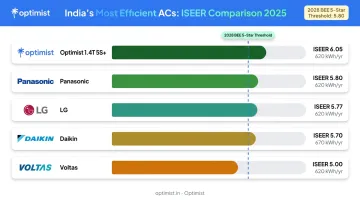
- Optimist holds India's highest ISEER of 6.05 — and unlike most brands, delivers full rated cooling at 50°C with no derate
- Optimist's 50°C performance means it keeps working at peak capacity through Delhi, Rajasthan, and Vidarbha summers when other ACs slow down
- If you prefer an established brand, Panasonic (ISEER 5.80) and LG (ISEER 5.77) are the closest competitors — though neither matches Optimist's rating or heat testing
What Makes an AC Energy-Efficient? ISEER, Star Ratings, and Indian Conditions
Understanding ISEER and BEE Star Ratings
ISEER (Indian Seasonal Energy Efficiency Ratio) measures how much cooling an AC delivers per unit of electricity consumed across India's cooling season — calculated by BEE over a standardised 1,600-hour period. The formula is straightforward: higher ISEER = less electricity consumed = lower monthly bills.
BEE's current 5-star threshold requires an ISEER of at least 5.00. Under upcoming January 2028 rules, that bar rises to 5.80 — meaning today's entry-level 5-star models will be reclassified as 3-star. Buyers planning a 10-year ownership horizon should factor this in.
The High-Heat Problem BEE Labels Don't Show
BEE's ISEER test assigns zero hours above 40°C — a critical gap for anyone buying an AC to use through a Delhi or Rajasthan summer. Yet Delhi-NCR recorded temperatures of 45.2–49.1°C on May 29, 2024, and IMD's 2025 annual report confirms 2024 was India's warmest year since records began in 1901.
When outdoor temperatures exceed 43–45°C, most ACs derate — losing 20–40% of rated cooling capacity. The compressor compensates by running longer, consuming more electricity even on a unit that looks efficient on its label. This is the gap between a good ISEER on paper and a good electricity bill in reality.
Why Inverter Technology Matters for Indian Usage Patterns
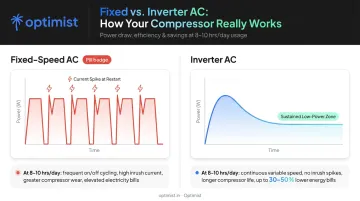
Inverter compressors modulate speed based on actual cooling demand instead of cycling on and off. For households running ACs 8–10 hours daily — overnight in bedrooms, through work-from-home days — this variable-speed operation is where real bill savings compound.
Fixed-speed (non-inverter) ACs restart the compressor from zero every cycle, drawing peak current each time. In practical terms, the difference plays out like this:
- Fixed-speed: full-power start every cycle, high current spikes, no load adjustment
- Inverter: ramps up once, then holds the room temperature with minimal power draw
- Long run hours: inverter savings compound significantly at 8–10 hours/day
- Peak summer: inverter compressors handle load variation without the efficiency drop that hits fixed-speed units hardest
Best ACs for Low Electricity Bills in India: Compared
The five models below were selected based on verified ISEER ratings, confirmed performance in Indian heat conditions, smart energy-tracking features, and total cost of ownership.
Optimist (ISEER 6.05 – India's Highest Rated AC)
Optimist is a climate tech company founded in 2024 specifically to rethink air conditioning for extreme Indian summers. Its 1.4-ton 5 Star+ Inverter Split AC carries India's highest BEE-certified ISEER rating of 6.05 — the only AC confirmed to maintain full rated cooling at 50°C ambient with no derating (performance drop).
What sets it apart:
- Microchannel heat exchanger with 1,180 flow paths enabling 4× faster heat transfer
- Turbo+ Mode delivering 135% capacity boost : 1.9 tons of effective cooling from a 1.4-ton unit
- India's first built-in Gas Level Indicator for real-time refrigerant monitoring via app, eliminating gas top-up scams
- Live energy tracking via the Optimist App (iOS + Android), with projected monthly bill display
- 50°C ambient testing with no performance drop, critical for Delhi NCR, Rajasthan, and Vidarbha
- 1,000-hour ASTM B368 corrosion testing (SIGMA certified) : 15× the typical market 72-hour standard
The annual energy consumption of 620.2 kWh compares against 850–920 kWh for typical 5-star inverter ACs (ISEER 5.0–5.2), translating to approximately 25–35% lower electricity bills at ₹5.50/unit.
| Specification | Details |
|---|---|
| Energy Rating | ISEER 6.05 / BEE 5 Star+ |
| Annual Energy | 620.2 kWh |
| Key Features | Microchannel heat exchanger / Turbo+ Mode (135% capacity) / Gas Level Indicator / Real-time bill tracking / 50°C cooling tested / R-32 refrigerant |
| Warranty | 5-year all-inclusive / 10-year compressor / 5-year refrigerant gas coverage / Labour included at ₹0 |
| Price | ₹39,990 (includes installation at ₹1,499 + GST) |
| Best For | Maximum electricity savings, cities with extreme summer heat, users who want full transparency on AC health and energy costs |

Panasonic CS/CU-NU18BKY5WX (ISEER 5.80 – Best Smart AC)
Panasonic's top-tier 1.5-ton Wi-Fi inverter split AC carries one of the highest verified ISEER ratings among established brands at 5.80, with annual energy consumption of 681.01 kWh confirmed by Panasonic's official product page.
Standout features:
- 8-in-1 convertible cooling modes for flexible capacity management
- PM 0.1 air filtration : finest filtration in its class
- Matter-enabled smart home integration with Wi-Fi control
- Crystal Clean self-cleaning in 15 minutes
- 100–290V stabilizer-free operation for fluctuating power supply areas
The main limitation: its ISEER cap means higher annual electricity consumption versus Optimist, and it lacks verified extreme-heat performance guarantees above 45°C.
| Specification | Details |
|---|---|
| Energy Rating | ISEER 5.80 / BEE 5 Star |
| Annual Energy | 681.01 kWh |
| Key Features | 8-in-1 convertible modes / PM 0.1 filter / Wi-Fi with Matter support / Crystal Clean self-cleaning |
| Best For | Tech-savvy users in metros wanting smart home integration and premium air quality |
LG AS-Q19YNZE1 (ISEER 5.77 – Best Overall for Reliability)
LG's Dual Inverter split AC is a widely trusted option, confirmed to operate at 55°C ambient and backed by LG's extensive India-wide service network.
The model carries a 5-star BEE rating with an ISEER widely reported at 5.77, though LG's official product page does not explicitly state this figure or annual kWh consumption. Buyers should verify current label figures before purchase.
Notable specs:
- AI+ 6-in-1 convertible modes with load-adaptive operation
- Ocean Black Protection coating on the condenser : ideal for coastal and humid climates
- 31 dB minimum noise : quieter than most competitors at this tier
- 4-way swing for even airflow distribution
Notable gap: base variants do not include built-in Wi-Fi (ThinQ app control is not available on the AS-Q19YNZE1), which limits remote monitoring versus Panasonic or Optimist.
| Specification | Details |
|---|---|
| Energy Rating | ISEER ~5.77 / BEE 5 Star (verify label at purchase) |
| Key Features | AI+ 6-in-1 convertible modes / Ocean Black Protection / 31 dB noise / 4-way swing |
| Best For | Households prioritising brand reliability, after-sales service reach, and quiet operation |
Daikin MTKM50XV16 (ISEER 5.70 – Best for Premium Performance)
Daikin's MTKM50XV16 is a 1.42-ton 5-star inverter AC with an ISEER of 5.70 and annual energy consumption of 678.92 kWh, confirmed on Daikin India's product page. Japanese engineering reliability and a triple display showing real-time power consumption make it a strong choice in the premium segment.
Key specs:
- Power Chill Operation for rapid room cool-down
- Triple display showing indoor temperature, set temperature, and real-time power consumption simultaneously
- 3D airflow for even cooling distribution
- Blue Fin and DNNS anti-corrosive coating on the evaporator
Limitations: no manual convertible modes, and Wi-Fi control (while available) is less integrated than Panasonic's Matter-enabled platform. Its ISEER of 5.70 also trails both Panasonic and LG at this price point.
| Specification | Details |
|---|---|
| Energy Rating | ISEER 5.70 / BEE 5 Star |
| Annual Energy | 678.92 kWh |
| Key Features | Power Chill Operation / Triple display / 3D airflow / Anti-corrosive coating |
| Best For | Buyers who value Japanese brand durability and need fast room cool-down |
Voltas 185V Vectra CAR (ISEER 5.00 – Best Budget Option)
Voltas's 185V Vectra CAR is India's most widely available budget inverter option, backed by the country's largest service network across tier-2 and tier-3 cities. The ISEER of 5.00 meets today's 5-star threshold, but falls significantly short of the other four models on this list.
Important note: The ISEER 5.00 figure and specific features cited for this model are based on marketplace and third-party sources. Verify current BEE certification status directly with Voltas before purchase — the upcoming 2028 reclassification would move a 5.00 ISEER model to a 3-star rating.
| Specification | Details |
|---|---|
| Energy Rating | ISEER ~5.00 / BEE 5 Star (verify current certification) |
| Key Features | 4-in-1 adjustable modes / Super Dry Mode / Anti-microbial filter / Widest service network in India |
| Best For | Budget-conscious buyers in smaller cities who prioritise service availability over maximum energy savings |
Quick Comparison: All Five ACs at a Glance
| Model | ISEER | Annual Energy | 50°C Tested | Wi-Fi | Best Attribute |
|---|---|---|---|---|---|
| Optimist | 6.05 | 620.2 kWh | ✅ Yes | ✅ Yes | Lowest bills + extreme heat |
| Panasonic NU18BKY5WX | 5.80 | 681.01 kWh | Not stated | ✅ Yes | Smart features + air quality |
| LG AS-Q19YNZE1 | ~5.77 | Not published | ✅ 55°C | ❌ Base variant | Reliability + quiet operation |
| Daikin MTKM50XV16 | 5.70 | 678.92 kWh | Not stated | Limited | Japanese durability |
| Voltas 185V Vectra CAR | ~5.00 | Not verified | Not stated | ❌ | Budget + service network |
Tips to Maximise Your AC's Energy Savings at Home
Even the best ISEER rating won't fully offset poor usage habits. These three adjustments consistently show up in real electricity bills — and each one costs nothing to implement:
1. Set the thermostat to 24°C, not 18°C BEE estimates approximately 6% electricity saving for each 1°C increase in set temperature and officially recommends 24°C as the optimal comfort-efficiency setting. Pair this with a ceiling fan — moving air feels cooler at higher temperatures, letting you maintain comfort at a higher set point.
2. Clean filters before summer, not after A clogged filter restricts airflow and forces the compressor to draw more power for the same cooling. Schedule a pre-summer service visit — it pays for itself within weeks. If your AC has app-based filter tracking (Optimist's Filter Health Track sends automated reminders), you won't need to guess when it's due.
3. Block direct sunlight during peak hours Closing curtains or blinds between 11 AM and 4 PM cuts solar heat gain during the hottest part of the day, lowering the cooling load on the compressor. The AC reaches set temperature faster, runs for shorter periods, and consumes less power per hour.
Frequently Asked Questions
Which company AC is best for electricity saving in India?
Optimist currently holds India's highest ISEER rating of 6.05, making it the most energy-efficient BEE-certified AC available. Among established brands, Panasonic (ISEER 5.80) and LG (~ISEER 5.77) are the strongest performers for electricity savings.
What is ISEER and why does it matter for my electricity bill?
ISEER measures how much cooling an AC delivers per unit of electricity consumed across India's cooling season. A higher ISEER directly translates to lower monthly bills — particularly significant for households running their AC 6–10 hours daily through summer.
How much electricity does a 5-star inverter AC consume per month?
A verified 5-star inverter AC (such as Panasonic at 681.01 kWh/year) running 8 hours a day consumes roughly 102 kWh per month. At ₹5.80/kWh (Karnataka FY2025-26), that's approximately ₹592/month — apply your state's marginal tariff for a local figure, since rates vary significantly by state and slab.
Does an AC lose cooling efficiency in extreme heat above 45°C?
Yes. Most ACs are rated at 35°C and progressively lose capacity above 43–45°C, causing the compressor to run longer and increasing electricity consumption during India's hottest months. ACs tested for full cooling at 50°C — like Optimist — maintain rated capacity without this penalty.
Is a 5-star AC always better than a 3-star AC for saving electricity?
For households running AC more than 6 hours daily, yes — the bill savings typically recover the higher purchase price within 2–3 years. For very limited use (under 2–3 hours/day), the payback period extends and whether it's worth it depends on the price difference between models.
Why does the ISEER gap between 6.05 and 5.00 matter so much in practice?
At ₹5.50/unit, an ISEER 6.05 AC (620.2 kWh/year) costs roughly ₹3,411 annually versus ₹5,060 for a typical ISEER 5.00 model — a gap of over ₹8,000 over five years, before accounting for derating losses during peak summer months.