
The problem isn't just that ACs consume electricity. It's that most ACs are not built for Indian conditions. Units that derate cooling output above 43°C end up running longer to reach the set temperature, quietly driving up your bill while delivering less comfort. Choosing the right AC — one with a high ISEER rating and proven performance in extreme heat — can meaningfully reduce electricity costs season after season.
This guide covers the best electricity-saving ACs in India for 2026, how BEE's updated ISEER ratings work, and exactly what to look for before buying.
Key Takeaways
- Inverter ACs with ISEER 5.5 and above deliver the most significant electricity savings for homes running ACs 6–10 hours daily
- BEE updated star rating thresholds in 2026: always check the actual ISEER value on the label, not just the star count
- Optimist holds India's highest ISEER rating of 6.05, with cooling tested at 50°C and no derating
- Match tonnage to room size before anything else — an oversized or undersized AC wastes electricity regardless of its star rating
- Total cost of ownership — energy bills, warranty, and service — matters more than purchase price for daily users
What Makes an AC Truly Energy-Efficient in India?
ISEER: The Number That Actually Matters
ISEER (Indian Seasonal Energy Efficiency Ratio) is BEE's India-specific efficiency measure. It's calculated as:
ISEER = Cooling Seasonal Total Load ÷ Cooling Seasonal Energy Consumption
BEE weights this calculation across outdoor temperature bins from 24°C to 43°C, using 1,600 annual operating hours — reflecting actual Indian seasonal conditions rather than a single laboratory test point. In practical terms, moving from an ISEER of 4.5 to 6.05 can cut annual electricity consumption by over 25% for equivalent cooling output.
The star rating (1–5 stars) is a label derived from the ISEER score. BEE revised these thresholds under Amendment V (S.O. 3984(E), dated August 2025), effective for 2026 models — an AC that qualified as 5-star under 2025 criteria may now carry a lower rating.
Always compare the raw ISEER value and annual kWh figure on the BEE label, not just the star count.
Why Indian Conditions Demand More
Most AC efficiency ratings are based on a 43°C ambient standard. But in Delhi, Rajasthan, and parts of UP, peak summer temperatures regularly push past that. As outdoor temperature rises, compressor efficiency drops. A 2022 peer-reviewed study found COP can fall roughly 54% as ambient temperature climbs from 35°C to 55°C under ideal-cycle estimates — real systems vary, but the direction is clear.
An AC that derates above 43°C reduces its cooling output automatically, so it runs longer to reach your set temperature — consuming more electricity precisely when demand is highest.
Three Engineering Factors That Determine Real-World Efficiency
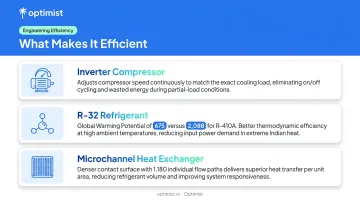
- Inverter compressor — adjusts speed to match load rather than cycling on/off, reducing energy waste
- R-32 refrigerant — GWP of ~675 versus ~2,088 for R-410A, and better thermodynamic efficiency at high ambient temperatures
- Heat exchanger design — microchannel designs offer denser contact surface for heat transfer compared to conventional fin-and-tube configurations
Best ACs to Save Electricity in India 2026
Models below are ranked by ISEER value, with verified cooling performance at Indian ambient temperatures as a secondary criterion. Annual energy consumption (kWh) from BEE labels is shown alongside ISEER because a slightly lower ISEER model can sometimes consume fewer kWh depending on tonnage.
Optimist (1.4 Ton, 5-Star+ Inverter Split AC)
Optimist is India's newest climate tech brand, founded in 2024 and launched in January 2026 after two years of R&D at its Nalanda Lab in Delhi, with technical collaboration from IIT Delhi. Its flagship 1.4 Ton split AC carries a brand-claimed ISEER of 6.05 — the highest declared ISEER rating in the Indian market — at cooling tested at 50°C ambient and no output derating.
What sets it apart from the rest of this list:
- Microchannel heat exchanger with 1,180 flow paths for higher heat transfer density than conventional fin-and-tube designs
- Turbo+ Mode that boosts effective cooling to 1.9-ton equivalent output in a 1.4-ton unit
- India's first built-in Gas Level Indicator showing refrigerant status in real time via app, eliminating unverified gas top-up charges (typically ₹2,500–₹7,000 per incident)
- Optimist App with live energy meter, projected monthly bill tracking, filter health monitoring, and remote diagnostics
- 1,000-hour SIGMA-certified salt-spray corrosion test — significantly above the typical market standard
- R-32 refrigerant with lower GWP and better thermodynamic efficiency
The 620.2 kWh annual energy consumption (at standard rated conditions) is well below typical 5-star 1.5-ton competitors consuming 850–920 kWh — a gap rooted in the ISEER difference. At ₹6/unit, that's a potential annual saving of ₹1,380–₹1,800 versus a standard 5-star model.
| Spec | Detail |
|---|---|
| ISEER | 6.05 (brand-claimed) |
| Capacity | 1.4 Ton (Turbo+ = 1.9T equivalent) |
| Star Rating | 5 Star+ |
| Annual Energy | 620.2 kWh |
| Tested Ambient | Up to 50°C, no derate |
| Refrigerant | R-32 |
| Corrosion Test | 1,000 hours (SIGMA certified) |
| Warranty | 5-year comprehensive + 10-year compressor |
| Gas Coverage | 5-year, ₹0 in all cases |
Best for: Buyers in North India or coastal cities who want the lowest electricity bill, extreme-heat performance, and full refrigerant transparency.
Panasonic CS/CU-NU18BKY5WX (1.5 Ton, 5-Star Wi-Fi Inverter Split AC)
Panasonic's NU18BKY5WX is among the most feature-complete 1.5-ton inverter ACs from a legacy brand, with an officially listed ISEER of 5.80 and India's first Matter-enabled room AC with full MirAIe smart home integration.
Key features that separate it from other legacy-brand options:
- 8-in-1 convertible modes covering 40–100%+ of cooling range
- PM 0.1 air filtration, the finest particle filtering in this category
- DustBuster outdoor unit auto-cleaning
- ShieldBlu+ corrosion coating on both indoor and outdoor units
- Operates up to 55°C ambient
At high fan speeds, the indoor unit reaches 46 dB, which light sleepers may notice.
| Spec | Detail |
|---|---|
| ISEER | 5.80 |
| Cooling Capacity | 5,100W |
| Noise (night mode) | 30 dB |
| Smart Features | Matter, Wi-Fi, MirAIe |
| Air Quality | PM 0.1 filter |
Best for: Smart home users who want top-tier efficiency and advanced air quality features from a legacy brand.
Daikin MTKM50XV16 (1.5 Ton, 5-Star Inverter Split AC)
Daikin's MTKM50XV16 carries an ISEER of 5.70 with a 2026 BEE label, 678.92 kWh annual consumption, and a maximum cooling capacity of 5.9 kW — the highest max output among legacy brands in this comparison. The Power Chill mode runs compressor and fans simultaneously at full capacity, cooling rooms faster.
Notable specs worth knowing:
- Triple LED display showing power consumption, set temperature, and error codes in real time
- 3D airflow with 4-way automatic swing
- DNNS/BTA/Blue Fin corrosion treatments
- Operates up to 55°C ambient
- Minimum indoor noise: 31 dB
Wi-Fi and manual convertible modes are absent; Daikin handles tonnage adjustment automatically.
| Spec | Detail |
|---|---|
| ISEER | 5.70 |
| Annual Energy | 678.92 kWh |
| Cooling Capacity | 5.0 kW rated / 5.9 kW max |
| Noise | 31 dB minimum |
| Voltage Range | 130–285V |
Best for: Buyers who want a trusted brand with transparent power monitoring and fast cooling.
Carrier ESTER EDGE Gxi Wi-Fi (1.5 Ton, 5-Star Inverter Split AC)
Among the established-brand models here, the Carrier ESTER EDGE Gxi records the lowest official annual energy consumption: 663.31 kWh/year at an ISEER of 5.60. For buyers focused purely on running costs, that kWh figure is what to watch.
What it brings to the smart-home buyer:
- 6-in-1 FlexiCool convertible modes covering 40–120% of cooling range
- Geo-fencing for automatic on/off based on location
- Smart Energy Display on the remote control
- Refrigerant leakage detector
- "My Mode" saves 3 personalised presets
Trade-offs: indoor unit noise runs 38–44 dB, and the stabiliser-free range (135–280V) is narrower than some competitors.
| Spec | Detail |
|---|---|
| ISEER | 5.60 |
| Annual Energy | 663.31 kWh |
| Smart Features | Wi-Fi, geo-fencing, leakage detector |
| Noise | 38–44 dB |
Best for: Energy-conscious buyers who want smart automation and the lowest verified annual kWh from a legacy brand.
How We Chose These ACs
Selection Criteria
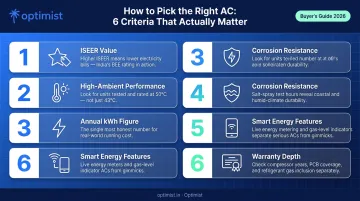
Each model was evaluated on:
- ISEER value — per BEE 2026 label standards, not marketing descriptions
- High-ambient performance — whether the unit confirms operation at 50°C or 55°C (note: operating at high ambient doesn't guarantee full rated output there — check manufacturer specifications)
- Annual kWh figure — shown alongside ISEER, since a slightly lower ISEER on a smaller unit can sometimes mean lower total consumption
- Corrosion resistance — relevant for coastal cities like Mumbai, Chennai, and Kochi
- Smart features tied to electricity savings — real-time energy tracking, convertible modes, scheduling
- Warranty depth — covers parts, labour, gas, and duration
A common buyer mistake is comparing only star labels without checking the actual ISEER number or whether the label was issued under 2025 or 2026 BEE criteria. The label's valid-through date tells you which standard applies.
Why Each Factor Has a Real-World Impact
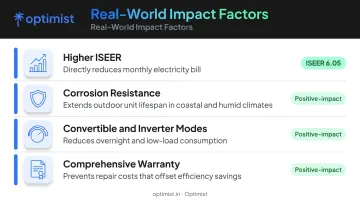
- A higher ISEER directly cuts your monthly electricity bill at equivalent usage
- Corrosion resistance extends outdoor unit life in humid or coastal environments, protecting your investment over time
- Convertible and inverter modes let the compressor run at reduced capacity during cooler evenings, cutting overnight consumption
- A comprehensive warranty prevents repair costs that chip away at the savings a high-efficiency unit delivers
Tonnage Guide for Indian Rooms
Before comparing brands, get the tonnage right for your room. An oversized AC short-cycles (cools too fast, shuts off, restarts), while an undersized unit runs continuously. Either way, you're paying more than you should.
| Room Size | Recommended Tonnage |
|---|---|
| Up to ~120 sq ft | 1 Ton |
| 120–170 sq ft | 1.5 Ton |
| 170–250 sq ft | 2 Ton |
Caveat: Top-floor rooms with direct sun exposure, west-facing rooms, rooms with high occupancy, or spaces with poor insulation generate more heat load. Consider going one step up or getting a heat-load assessment before buying.
Conclusion
India's summers are getting longer and electricity tariffs are not going down. For anyone running an AC six or more hours a day through a four-to-five month summer, the ISEER rating on the BEE label is the single most important number to compare — it directly determines your electricity bill, compounded across years of use.
An AC that loses cooling output above 43°C ends up being expensive and uncomfortable when temperatures peak. Verified high-ambient performance isn't a marketing claim worth ignoring.
Beyond the upfront price, look at annual kWh consumption (on the BEE label), warranty scope including gas and labour, and whether the AC gives you tools — like real-time energy tracking — to stay in control of consumption year after year.
If those are your benchmarks, Optimist's flagship AC delivers all four in a single unit:
- India's highest declared ISEER at 6.05
- Cooling tested at 50°C with no performance drop
- Built-in gas level monitoring (India's first)
- 5-year comprehensive warranty with zero-cost refrigerant coverage
Visit optimist.in to check availability in your city.
Frequently Asked Questions
Which air conditioner saves the most electricity?
Inverter ACs with ISEER ratings of 5.5 and above deliver the most meaningful savings. Optimist carries India's highest declared ISEER of 6.05, translating to roughly 25–34% lower annual energy consumption compared to typical 5-star competitors.
How much does 7 hours of AC cost per day?
A 1.5-ton 5-star inverter AC consumes roughly 1.0–1.3 units (kWh) per hour under typical conditions. At an average tariff of ₹6–8 per unit, 7 hours costs approximately ₹42–73 per day. An ISEER 6.05 unit like Optimist, with 620.2 kWh annual consumption, would sit toward the lower end of that range compared to lower-rated models.
What is ISEER and how is it different from a star rating?
ISEER (Indian Seasonal Energy Efficiency Ratio) is the actual efficiency number BEE calculates to reflect real-world Indian seasonal conditions — it measures how much cooling you get per unit of electricity across a full season. The star rating (1–5) is a simplified label derived from the ISEER score. BEE revised ISEER thresholds in 2026, so the same unit may carry a lower star rating than it did in 2025.
What is the right AC tonnage for my room?
Use these sizing guidelines: up to 120 sq ft → 1 Ton; 120–170 sq ft → 1.5 Ton; 170–250 sq ft → 2 Ton. Add one step for top-floor rooms, west-facing spaces, or high-occupancy rooms. An undersized AC runs continuously and consumes more electricity than a correctly sized unit with a lower star rating.
Is a 5-star inverter AC worth the higher upfront cost?
For households running the AC 6+ hours daily across a 4–6 month summer, yes. Electricity savings versus a 3-star non-inverter model typically recover the price premium within 1–2 seasons. The exact payback depends on your local tariff, daily usage hours, and the specific ISEER values being compared.
What temperature should I set my AC to save electricity?
BEE recommends 24°C as the default setting, estimating approximately 6% electricity saving for each 1°C increase above that. A 24–26°C range is practical for most Indian homes, especially with ceiling fan support. Using sleep mode at night, which gradually raises the set point by 1–2°C, further reduces overnight consumption without affecting comfort.