
Introduction
IMD recorded temperatures of 49.4°C in Ganganagar and 49.0°C in Jhansi during 2024, and West Rajasthan logged up to 20 heatwave days in a single month in May 2025. India's summers aren't just getting hotter — they're outpacing the equipment most people have installed.
Standard ACs rated for 35°C test conditions can lose 30–40% of their cooling output at 50°C ambient. Your "1.5-ton 5-star" AC may stop performing exactly when you need it most.
Picking the wrong split AC in 2026 means two things: sweating through June and July, or watching electricity bills climb while the room still doesn't cool down.
This guide covers the five best split ACs for Indian homes in 2026 — selected on ISEER rating, verified high-ambient performance, warranty depth, smart features, and real value for Indian buyers. It also explains what the 2026 BEE star rating revision means for your purchase decision, and what to check before you buy.
Key Takeaways
- ISEER is the number that matters — not just the star count, especially after BEE revised benchmarks in 2026
- High-ambient performance (45°C and above) separates capable ACs from ones that derate in peak summer
- Optimist leads on ISEER at 6.05 — India's highest — with tested 50°C cooling and the first built-in gas level indicator
- LG leads on smart features, Panasonic on build quality, Daikin on reliability, and Voltas on service reach — each worth considering depending on your priority
- Check the label year before buying — a 2025 five-star model may now carry four stars under the revised 2026 scale
What Makes a Split AC Ideal for Indian Homes
The High-Ambient Cooling Problem
Most split ACs globally are tested at 35°C outdoor ambient — a comfortable spring afternoon in most of India, but nowhere near a June afternoon in Delhi or Nagpur. At 45°C, typical inverter ACs begin losing cooling output. At 50°C, that output loss can reach 30–40%, leaving rooms inadequately cooled even as the compressor runs at full load.
High-ambient cooling performance refers to a unit's ability to maintain its rated cooling capacity at elevated outdoor temperatures, ideally 45°C and above. For homes in North India, central India, and Rajasthan, a unit that cannot hold its rated output at peak summer temperatures is simply undersized when it matters most.
ISEER and the 2026 BEE Revision
ISEER (Indian Seasonal Energy Efficiency Ratio) measures how efficiently an AC uses electricity across a full Indian cooling season , using temperature bins from 24°C to 43°C and approximately 1,600 annual cooling hours across 54 Indian cities, not just a single-point test. A higher ISEER directly means lower electricity bills over the season.
BEE revised its star rating benchmarks effective 2026. The previous official schedule's 5-star threshold for variable-speed split ACs was 5.00 ISEER ; the new thresholds are stricter. A model that earned five stars in 2025 may now carry four stars under the updated scale, even if nothing changed about its actual efficiency.
So always check the ISEER number directly on the BEE label, not just the star count.
Key Buying Factors for Indian Homes
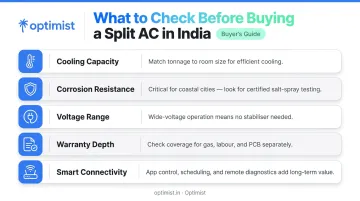
Beyond ISEER and ambient performance, these specs matter specifically for India:
- Cooling capacity vs. room size — 1.5 ton suits 110–170 sq ft; high-heat-load rooms (top floor, west-facing) may need more
- Corrosion resistance — critical for Mumbai, Chennai, Kochi, and Visakhapatnam where salt-laden air degrades outdoor units
- Voltage operating range — stabiliser-free operation protects against fluctuations common in Tier-2 and Tier-3 grids
- Warranty depth — check what's actually covered after Year 1; gas, labour, and PCB coverage vary significantly between brands
- Smart connectivity — app control, scheduling, and energy monitoring are increasingly relevant for households running ACs 8–12 hours daily
Best Split ACs for Indian Homes in 2026
These five models were selected based on ISEER rating, verified high-ambient cooling performance, smart features, warranty terms, and overall value. Each covers a distinct profile.
Optimist
Launched in January 2026, Optimist was purpose-built for Indian heat from the ground up — engineered with IIT Delhi technical collaboration and backed by USD 12M from Accel, Arkam Ventures, and Sparrow Capital.
Optimist's 1.4 Ton 5 Star+ Inverter Split AC holds India's highest ISEER rating of 6.05 and is tested to deliver full rated cooling (4.85 kW) at 50°C ambient with no derating. The Turbo+ Mode delivers an effective 1.9-ton output — a 135% capacity boost — for rapid cool-down from 42°C to 25°C in high-heat-load rooms.
Three engineering features separate it from the field:
- Microchannel heat exchanger with 1,180 flow paths delivers 4× faster heat transfer than conventional designs
- 1,000-hour corrosion testing via ASTM B368 Acetic Acid Salt Spray (SIGMA certified) — 15× the typical 72-hour market standard
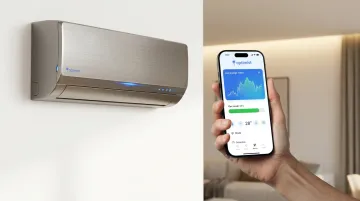
- Optimist App with live energy meter, projected monthly bills, filter health tracking, and India's first built-in gas level indicator that shows real-time refrigerant status, eliminating the gas top-up scam
| Spec | Detail |
|---|---|
| ISEER / Star Rating | 6.05 / 5 Star+ (India's highest) |
| Key Features | Turbo+ Mode (1.9T effective), Gas Level Indicator, Microchannel HX, Smart App with live energy tracking, 50°C verified cooling |
| Warranty | 5-year comprehensive (ODU + critical indoor components + refrigerant gas) + 10-year compressor |
Best for: Buyers who want maximum energy efficiency, extreme-heat verified performance, and full transparency through smart features.
LG
LG is among India's highest-volume split AC brands, with a pan-India service network and consistent product iteration. The AS-Q20JWZE 1.5-ton 5-star model (2026) features a Dual Inverter Compressor, AI Convertible 6-in-1 cooling modes, and rated operation up to 55°C. Ocean Black Protection on 100% copper tubes provides corrosion resistance for coastal installations.
ISEER for this model is not published directly on LG's official product page — LG's official page for the AS-Q20JWZE confirms 5-star 2026 classification but does not list the ISEER value. Noise levels range from 32–47 dB. Warranty is 1 year product + 9 additional compressor years; PCB, motor, and capacitor coverage is 6 months, so check exclusions carefully.
| Spec | Detail |
|---|---|
| ISEER / Star Rating | 5-star 2026 (ISEER not published on official page) |
| Key Features | Dual Inverter, AI Convertible 6-in-1, Ocean Black copper, 55°C operation claim |
| Warranty | 1-year product + 9-year additional compressor; PCB/motor limited to 6 months |
Best for: Buyers who prioritise brand recognition, service network density, and smart convertible modes.
Panasonic
Panasonic's CS/CU-NU18BKY5WX holds the highest published ISEER among established brands at 5.80, with 681.01 kWh annual consumption declared on its official page. The 8-in-1 (Converti8) convertible mode spans 40% to above 100% capacity. PM 0.1 filtration is the finest particle filtration in the residential segment. DustBuster automatically reverses the outdoor fan for 3 minutes every 8 hours to clear the condenser coil.
The MirAIe app supports Matter and Wi-Fi connectivity with proximity control — notifications across a configurable 100m–35km geofence. Voltage range runs 100V–290V, enabling stabiliser-free operation. Manufacturer claims operation up to 55°C.
| Spec | Detail |
|---|---|
| ISEER / Star Rating | 5.80 / 5-star 2026 |
| Key Features | Converti8 (8-in-1), PM 0.1 Filter, Matter/Wi-Fi, DustBuster ODU auto-clean, 100–290V range |
| Warranty | 1-year product + 9-year additional compressor + 4-year additional PCB (subject to purchase-period terms) |
Best for: Smart home users who want the highest verified ISEER among established brands combined with best-in-segment air filtration.
Daikin
Daikin's GTKM50XV is a Japanese-engineered premium model rated at 5,000W (5.9–5,900W range), with ISEER 5.70 and 678.92 kWh annual consumption. Power Chill operation enables rapid cool-down; 3D Airflow with a 22-metre air throw covers larger rooms effectively. The outdoor unit uses DNNS coating, BTA oil treatment, and Blue Fin treatment for multi-layer corrosion resistance.
Note that Daikin markets this as a 1.42-ton unit, not a full 1.5-ton nominal. ISEER and annual kWh are published on the official Daikin India product page. Warranty is 1-year product + 9-year additional compressor + 4-year additional PCB, with labour, gas, and transport excluded after Year 1.
| Spec | Detail |
|---|---|
| ISEER / Star Rating | 5.70 / 5-star 2026 |
| Key Features | Power Chill, 3D Airflow, 22m throw, DNNS/BTA/Blue Fin anti-corrosion, Triple Display |
| Warranty | 1-year product + 9-year additional compressor + 4-year additional PCB (labour/gas excluded post Year 1) |
Best for: Buyers who prioritise build quality, cooling power, and long-term reliability over smart features.
Voltas
No brand reaches further into India's smaller cities than Voltas. The Tata-backed brand operates 45 direct service centres, 1,750+ franchisee centres, and 17,500+ service engineers with coverage extending to Tier-3 and Tier-4 locations. The 185INV Vertis Elite Gold offers 6-step adjustable cooling and anti-microbial filtration. Manufacturer claims operation up to 52°C.
ISEER for this model is not published on Voltas's official product page. The 2026 label confirms 5-star classification. Warranty is 1-year product + 9-year additional compressor; PCB coverage duration is not stated on the warranty page.
| Spec | Detail |
|---|---|
| ISEER / Star Rating | 5-star 2026 (ISEER not published on official page) |
| Key Features | 6-step adjustable cooling, anti-microbial filter, 52°C operation claim |
| Warranty | 1-year product + 9-year additional compressor (PCB duration not stated) |
Best for: Buyers in smaller cities who prioritise service accessibility and total cost of ownership.
How We Chose the Best Split ACs for Indian Homes
Evaluation Framework
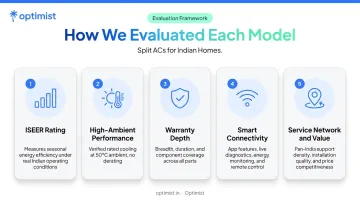
Each model was assessed against five criteria, weighted for Indian residential buyers:
- ISEER rating — verified from official brand pages or BEE label data, not retailer listings
- High-ambient cooling performance — at 45°C and above; all major brands publish 52–55°C operating claims, but few publish independent capacity-retention data at those temperatures
- Warranty depth — total coverage years matter less than what's actually covered; ask specifically what's covered for gas, labour, and PCB after Year 1 before buying
- Smart connectivity — app control, energy monitoring, and diagnostics
- Service network and price-to-value — especially relevant for Tier-2 and Tier-3 buyers
These five criteria cut through the noise that trips up most buyers.
A Common Mistake to Avoid
Many buyers compare only price and star count. The star count alone doesn't tell you:
- Whether the AC maintains output at 45°C or derates significantly
- What ISEER value sits behind the star label
- Whether the warranty covers gas and labour after Year 1
One 2026 pitfall: a model that carried five stars in 2025 may now show four on a 2026 label, even though its actual efficiency hasn't changed. BEE raised the ISEER threshold required for each star tier — so always read the ISEER number directly, not just the stars.
You can verify any model's label data directly at BEE's star label portal using the brand name and model number.
Conclusion
Choosing a split AC for an Indian home in 2026 means matching the product to your specific conditions: ambient temperatures your city actually reaches, your room's heat load, how many hours a day the AC runs, and what post-purchase support looks like.
Each spec on a product page answers a different question worth asking:
- ISEER rating — how efficiently it runs day-to-day
- High-ambient cooling specs — whether it holds rated output when temperatures peak
- Warranty terms — what protection you actually have beyond Year 1
- Smart features — how much visibility you get into your own energy use
For buyers who want India's highest-rated energy efficiency, cooling that's been tested at 50°C with no derating, and live visibility into energy use and refrigerant levels through a built-in gas level indicator and live energy meter, Optimist's 2026 split AC was built specifically for these conditions. Explore Optimist's product at optimist.in and compare it directly against your current shortlist.
Frequently Asked Questions
What is the best split AC brand for Indian homes in 2026?
Each brand has a clear strength. Optimist leads on ISEER (6.05) and verified 50°C performance; Panasonic and LG stand out for smart features and overall efficiency; Daikin is the pick for build quality and cooling power; Voltas offers the widest service network across India.
What is ISEER and why does it matter when buying an AC in India?
ISEER (Indian Seasonal Energy Efficiency Ratio) measures how efficiently an AC uses electricity across a full Indian cooling season — not just at a single test condition. A higher ISEER means lower monthly electricity bills, so checking this number is more reliable than relying on the star rating alone.
Which split AC has the highest ISEER rating in India in 2026?
Optimist holds India's highest ISEER at 6.05 as of 2026, ahead of Panasonic (5.80) and Daikin (5.70). At typical Indian usage of 8–10 hours a day through a long summer season, that gap translates to roughly 25–35% lower annual electricity bills compared to less efficient models.
What size split AC is best for a room of around 150 sq ft in India?
A 1.5-ton AC generally suits 110–170 sq ft under standard conditions. Rooms with heavy heat loads — top-floor exposure, west-facing windows, or kitchen adjacency — benefit from a model with a strong Turbo or boost mode that can temporarily exceed rated capacity for rapid cool-down.
Do the 2026 BEE star ratings differ from 2025?
Yes. BEE raised the ISEER benchmarks required for each star tier in 2026, meaning some models that held a five-star rating in 2025 now fall to four stars — even though their actual energy performance is unchanged. Always verify the ISEER number directly on the label rather than relying on the star count alone.
Is an inverter split AC worth the extra cost over a fixed-speed AC for Indian homes?
Inverter ACs adjust compressor speed continuously, using far less electricity during partial-load operation. In India, where ACs run 8–12 hours daily through peak summer, the higher upfront cost typically recovers within a few seasons — making inverter models the practical standard choice at every budget level.