
Introduction
Indian summers in 2026 are no longer what they used to be. Cities across Rajasthan, Delhi NCR, and central India regularly breach 45°C, and IMD recorded 50°C at Phalodi, Rajasthan in May 2024 — with West Rajasthan logging 11–20 heatwave days in May 2025 alone. An AC is no longer a comfort purchase; for millions of Indian households, it's a health necessity.
The challenge is real: with dozens of brands and hundreds of models on the market, the wrong choice either leaves you sweating through peak summer when your AC throttles output, or paying sky-high electricity bills every month for the next 7 years.
This guide covers the best home AC units in India for 2026, what to prioritise before buying, and which specs actually matter when temperatures push past 45°C.
Key Takeaways
- AC ownership in India hit 13.3% in 2024, up from 10% in 2022 — with 11.47 million room AC registrations in FY2023-24
- A 5-star inverter split AC (1.4–1.5 ton) offers the best balance of cooling and energy savings for most Indian bedrooms
- ISEER rating directly determines your electricity bill — a higher ISEER means lower monthly costs, compounding over years
- For Delhi NCR, Rajasthan, and central India: choose an AC rated to deliver full cooling capacity at 45°C+ — many models derate significantly above that threshold
- Smart features like gas monitoring, energy tracking, and scheduling deliver real, measurable savings — not just convenience
What to Look for Before Buying a Home AC in India
Tonnage and Room Size
Undersizing means poor cooling; oversizing wastes electricity and increases humidity. Use this as a starting filter:
| Room Size | Recommended Tonnage |
|---|---|
| Up to ~120 sq ft | 1 Ton |
| ~120–200 sq ft | 1.4–1.5 Ton |
| ~200–300 sq ft | 1.5–2 Ton |
| 300+ sq ft | 2 Ton+ |
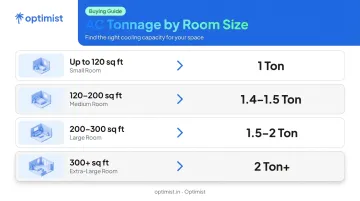
Important caveat: No current BEE or ISHRAE source endorses a universal square-foot-per-ton rule. Top-floor rooms, west-facing walls, high ceilings, and large windows all increase heat load beyond what room area alone suggests. Use the table as a first filter, then factor in your specific room conditions.
ISEER vs BEE Star Rating
ISEER (Indian Seasonal Energy Efficiency Ratio) measures how efficiently an AC performs across India's actual cooling season — factoring in part-load operation and variable outdoor temperatures. EER, by contrast, is a single-condition snapshot. They're not interchangeable.
A higher ISEER means lower electricity consumption per unit of cooling — and lower monthly bills.
BEE updated its star rating standards through Ministry of Power notification S.O. 3984(E) (August 2025). If you're comparing models, check that the ISEER and star rating are based on 2026 BEE label standards — older inventory may carry pre-revision ratings.
India-Specific Performance Factors Most Guides Ignore
Efficiency ratings tell part of the story. These three factors tell the rest — and most spec sheets won't surface them:
- High-ambient cooling performance — Does the AC maintain full rated capacity at 45–50°C, or does it throttle output? "Operates up to 55°C" is not the same as "delivers full capacity at 45°C." Check the manufacturer's published spec sheet for rated capacity at 43°C or above before committing.
- Corrosion resistance — Coastal cities like Mumbai, Chennai, Kochi, and Visakhapatnam expose AC units to salt-laden, humid air. Standard ACs are tested for 72 hours of salt spray; look for models with significantly higher corrosion resistance ratings.
- Voltage fluctuation tolerance — Common in Tier 2/3 cities. Confirm the AC's operating voltage range before purchase.
Best AC Units for Home in India 2026
This list prioritises home-use performance, energy efficiency, after-sales reliability, and value for the Indian climate — not just brand popularity or marketing spend.
Optimist
Optimist launched in January 2026 as India's first AC engineered specifically for extreme Indian heat conditions. Founded in August 2024 by Ashish Goel (ex-Urban Ladder founder) and Pranav Chopra (CTO), the company raised ₹~100 crore (USD 12M) from Accel and Arkam Ventures and built its product at Nalanda I Lab in Delhi in collaboration with IIT Delhi.
The specs back it up. The headline number: ISEER 6.05 — India's highest rated home AC as of 2026, with 620.2 kWh annual energy consumption. At ₹6/unit electricity, that's roughly ₹3,700/year — well below typical 5-star competitors.
What sets it apart beyond efficiency:
- 50°C cooling with no capacity derating — tested and validated, not just an operating limit claim
- Turbo+ Mode delivering 1.9-ton effective cooling from a 1.4-ton unit (135% capacity boost for rapid room pull-down)
- Microchannel heat exchanger with 1,180 flow paths for faster heat transfer
- India's first built-in gas level indicator — sensor-based (not algorithmic), visible live in the Optimist App; eliminates the common gas top-up scam
- 1,000-hour salt-spray corrosion testing (SIGMA certified) — 15× the typical market standard of 72 hours
- Optimist App (iOS + Android): live energy meter, projected monthly bills, filter health tracking, intelligent diagnostics, scheduling, and remote control
- 5-year comprehensive warranty on the outdoor unit, critical indoor components (PCB, sensors, fan motor, evaporator coil), and refrigerant gas — plus a 10-year compressor warranty
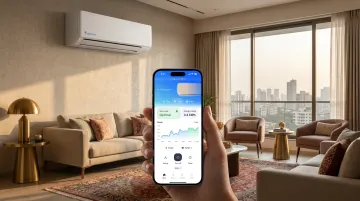
Customer Anupam (Banker, Gurgaon) noted: "We hit 47–48°C outside and the cooling never dropped. Airflow stayed steady through the day."
| Details | |
|---|---|
| Key Specs | ISEER 6.05 (India's highest), 5 Star BEE rated, 1.4 Ton inverter split, R-32, 620.2 kWh/year |
| Standout Features | 50°C no-derate cooling · Gas Level Indicator · Turbo+ Mode (1.9T effective) · Real-time energy tracking · 5-year all-inclusive warranty + 10-year compressor |
| Best For | Extreme heat zones (Delhi NCR, Rajasthan, Punjab, MP) and coastal regions; homeowners prioritising energy savings and smart control |
| Price | ₹39,990 (38% off from ₹65,000 MRP) at optimist.in; installation ₹1,499 + GST |
Daikin
Daikin, headquartered in Haryana, is one of India's most trusted premium AC brands. Its 2026 residential lineup — including the FTKF50XV — is compliant with BEE 2026 star-rating standards and leads the sampled market on ISEER at 6.30 for its top model.
| Details | |
|---|---|
| Key Specs | FTKF50XV: 1.42 ton, 5 Star, ISEER 6.30, R-32; related FTKM50XV model listed at ₹62,700 |
| Standout Features | Cooling operation stated to 55°C · Power Chill mode · Dew Clean self-cleaning · Coanda airflow technology · AI/IoT-enabled models |
| Best For | Premium buyers prioritising brand trust and high ISEER; large rooms and extended daily use |
| Price | ~₹62,700 for the 1.42-ton 5-star model (Daikin official store snapshot — confirm current pricing at daikinindia.com) |
LG
LG's 2026 Essential Series positions itself with a "Made for India" angle, led by the AS-Q20JWZE — a 5-star, ~1.5-ton model with 744.99 kWh/year annual energy consumption. Dual Inverter Compressor technology and deep ThinQ smart home integration make it a strong choice for tech-forward buyers.
| Details | |
|---|---|
| Key Specs | AS-Q20JWZE: ~1.5 ton (6.3 kW), 5 Star, 744.99 kWh/year, R-32; catalogue states cooling to 55°C |
| Standout Features | AI Convertible 6-in-1 variable tonnage · Dual Inverter Compressor · Energy Manager+ usage tracking · ThinQ Wi-Fi (Alexa + Google Assistant) |
| Best For | Tech-savvy buyers, smart home setups, medium-sized rooms; strong after-sales network |
| Price | Check lg.com/in for current pricing |
Voltas
Voltas, a Tata Group company and India's market-share leader, sold over 2 million AC units in FY2023-24 — a 35% year-on-year increase. Its 2026 Vertis AI platform (launched February 2026) introduces geofencing and adaptive AI cooling for Indian conditions.
| Details | |
|---|---|
| Key Specs | 185INV Vertis AI Zest Gold: 1.5 ton, 5 Star, 751.28 kWh/year; ISEER unconfirmed — verify at voltas.com |
| Standout Features | AI adaptive cooling · Geofencing (auto pre-cools before you arrive) · Connected smart controls · Broad non-metro service network |
| Best For | First-time buyers, value-focused households, non-metro markets; strong pan-India service reach |
| Price | MRP ₹77,990; offer price ₹49,500 (Voltas official site snapshot — verify current pricing at voltas.com) |
Blue Star
Blue Star launched nearly 125 smart Wi-Fi-enabled residential AC models in its 2026 lineup, including heavy-duty, anti-virus, and premium variants. Its 2026 D Series explicitly claims full cooling capacity at 43°C, which is among the more specific high-ambient performance claims in the market.
| Details | |
|---|---|
| Key Specs | IA518DXU D Series: 1.5 ton, 5 Star, ISEER 5.70, operation stated to 54°C; 2026 BEE label |
| Standout Features | Claimed full capacity at 43°C · Smart app connectivity · Nano BluProtect coating · Anti-virus filter variants · Heavy-duty cooling lineup |
| Best For | Hot, humid regions (coastal and interior); buyers prioritising robust cooling and durability |
| Price | Sale price ₹47,990 (Blue Star official site snapshot; verify at consumer.bluestarindia.com) |
How We Chose the Best AC for Home in India
Most people pick an AC on brand name or sticker price. The real cost is electricity over 5–7 years. A unit priced ₹5,000 cheaper with a lower ISEER can easily cost more in the long run.
Representative estimate: A 1.5-ton 5-star inverter AC with ~750 kWh/year annual consumption (per BEE's standardised test basis) runs approximately 113 kWh/month across a 6-month Indian summer (8 hours/day). At ₹8/kWh, that's ~₹900/month, or ~₹5,400/season.
Optimist's 620.2 kWh/year translates to roughly 93 kWh/month under the same assumptions — ~130 kWh/year less, savings that compound over the AC's 7-year lifespan.
Evaluation Criteria Applied
- ISEER and annual energy consumption — The primary determinant of long-term cost
- Proven high-ambient performance at 45°C+ — Stated operating limits vs. actual capacity retention are not the same. ACs that derate output at high ambient temperatures are unsuitable for most Indian households, regardless of rated tonnage or star rating.
- Smart features for Indian use — Scheduling, energy tracking, gas monitoring, remote diagnostics
- After-sales service and warranty depth — Labour, parts, and refrigerant coverage matter as much as the headline warranty period
- Corrosion resistance — Relevant for coastal India, often ignored by buyers
- BEE 2026 compliance — Confirms the rating is current, not from a pre-revision label cycle
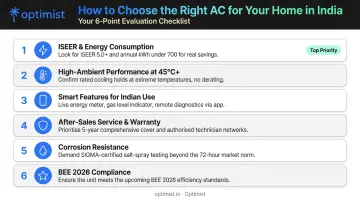
Of these criteria, performance consistency during May–June carries the most weight. That's when grid stress peaks and temperatures push past 45°C — the exact conditions where many ACs quietly drop their cooling output.
Conclusion
Choosing the best home AC in India in 2026 comes down to matching your room size, climate zone, and usage pattern to a unit that performs through extreme summers without punishing your electricity bill.
Three things matter most when evaluating any AC on this list. First, prioritise ISEER over sticker price — a higher rating pays back in lower monthly bills, every month. Second, verify high-ambient performance claims: ask for rated capacity at 43°C or above, not just the maximum operating temperature. Third, read warranty terms carefully — labour, refrigerant gas, and indoor components should all be covered, not just the compressor.
If those three criteria matter to you, Optimist checks all of them. Built specifically for Indian heat conditions — with proven cooling at 50°C — it carries India's highest ISEER rating of 6.05, a sensor-based gas level indicator, and a 5-year all-inclusive warranty with 10-year compressor coverage.
Frequently Asked Questions
Which home AC unit is the best?
The best AC depends on your room size, climate zone, and budget. For energy efficiency and extreme heat performance in India, prioritise units with a high ISEER rating (5-star or above) and verified high-ambient cooling — not just a stated operating limit. Optimist currently holds India's highest ISEER at 6.05 with tested 50°C no-derate performance.
Which AC has a 5-star rating?
Multiple brands offer 5-star BEE-rated ACs in India in 2026, including Daikin, LG, Voltas, Blue Star, and Optimist. Within 5-star models, ISEER scores still vary significantly — from roughly 5.0 to 6.05 in the verified models above — and a higher ISEER directly translates to lower monthly bills.
Which AC is best for a home bedroom?
For most Indian bedrooms up to 150–200 sq ft, a 1–1.5 ton 5-star inverter split AC is the right choice. Low noise levels (32–40 dB) and smart scheduling for pre-cooling before bedtime are the most practical bedroom-specific features to look for.
What is ISEER rating and why does it matter for Indian homes?
ISEER (Indian Seasonal Energy Efficiency Ratio) measures AC efficiency across India's actual cooling season — accounting for variable temperatures and part-load operation. A higher ISEER means lower electricity consumption per unit of cooling, directly reducing your monthly bill.
What tonnage AC is suitable for a 12×12 bedroom in India?
A 12×12 room (approximately 144 sq ft) typically requires a 1 to 1.5 ton AC. Ceiling height above 9 feet, top-floor placement, west-facing walls, and multiple occupants can shift the requirement slightly upward — so treat the floor area as a starting point, not a final answer.
How much electricity does a 5-star inverter AC consume per month in India?
A 1.5-ton 5-star inverter AC with ~751 kWh/year annual consumption (per BEE standardised testing) uses approximately 113 kWh/month when run 8 hours/day across a 6-month summer. At ₹6–10/kWh depending on your state DISCOM slab, that's roughly ₹676–₹1,130/month — with higher ISEER units like Optimist (620.2 kWh/year) consuming measurably less under identical usage.