
Introduction
Indian summers have stopped being polite about it. IMD recorded temperatures of 45–48°C across Delhi on 30 May 2024, with Rajasthan's Ganganagar hitting 49.4°C during the same month. These aren't freak events anymore — they're what June looks like now in large parts of North and Central India.
The problem is that most ACs aren't built for this. Standard inverter ACs are tested at 35°C outdoor temperature. Push them to 45°C or beyond, and performance falls off: the room stays warm, the compressor runs constantly, and your electricity bill climbs.
The inverter label alone doesn't guarantee performance in these conditions. Not all inverter ACs are built the same — and the gap shows on the hottest days. This guide covers the top inverter ACs for India in 2025–26, what the specs actually mean, and how to choose without overpaying for features that won't hold up when it matters.
Key Takeaways
- ISEER is the number that matters — not just the star rating. Within 5-star ACs, ISEER ranges from ~5.0 to 6.05; higher means lower bills.
- The 2026–27 BEE 5-star floor is ISEER ≥5.60 — older 5-star models may not meet this threshold.
- Most ACs are tested at 35°C — if your city hits 45–50°C, only buy models with verified high-ambient performance data.
- Top picks for India: Daikin, LG, Blue Star, Samsung, and Optimist — compared across efficiency, heat performance, and price.
- Optimist holds India's highest ISEER of 6.05 and is validated to cool at 50°C with no performance drop.
Why Inverter ACs Are the Right Choice for Indian Homes
A conventional AC compressor runs at full power until the target temperature is reached, then shuts off entirely. When the room warms again, it restarts — full power, every time. That startup cycle wastes energy, and in a home running the AC for 8–12 hours daily through an Indian summer, those surges add up.
An inverter compressor works differently. It runs continuously at variable speeds — slowing down when the room is cool, ramping up when heat spikes. No startup surges, no hard stops. The result is more consistent cooling and meaningfully lower electricity consumption over a full season.
What ISEER Means for Your Electricity Bill
ISEER (Indian Seasonal Energy Efficiency Ratio) is India's official seasonal efficiency metric for ACs, set by BEE. It replaces the simpler EER and accounts for varying load conditions across the cooling season — making it a more accurate predictor of real-world electricity costs than a plain star count.
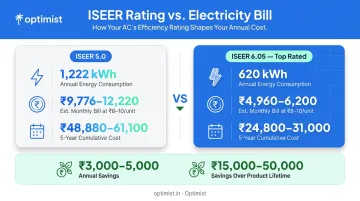
The current BEE 5-star threshold (effective 2026–27) requires ISEER ≥5.60. Within 5-star models, the range runs from around 5.0 (older certifications) up to 6.05 — a spread that directly translates to hundreds of rupees difference on your monthly bill. Optimist's 1.4 Ton model, for instance, sits at the top of this range at ISEER 6.05, the highest-rated AC in India.
What that range means in practice:
- Higher ISEER = fewer units consumed per hour of cooling
- Moving from ISEER 5.0 to 6.05 can cut annual energy consumption by 15–20%
- At ₹8–10/unit tariffs across Delhi NCR, UP, and Maharashtra, that gap adds up to ₹3,000–5,000+ annually
- Over a 5–10 year product life, the difference between a mid-range and top-rated model runs into tens of thousands of rupees
With residential AC penetration still under 10% nationally but growing fast and power tariffs rising each year, choosing the right ISEER rating at purchase is one of the highest-leverage decisions a homeowner can make.
Best Inverter ACs in India for Extreme Heat and Savings
The five models below were shortlisted on six criteria:
- ISEER rating and BEE star compliance
- High-ambient temperature performance (45°C+)
- Build quality for Indian heat, humidity, and coastal conditions
- Smart features and app integration
- Warranty coverage depth
- Value for money at the 1.5 Ton segment price point
Daikin 1.5 Ton 5-Star Inverter Split AC (FTKM50UV16U)
Daikin's reputation for compressor longevity is well-earned. The FTKM series uses a Neo Swing compressor that reduces vibration and extends operational life — relevant when the unit is running 10+ hours daily through a long North Indian summer.
| Spec | Detail |
|---|---|
| ISEER / Star Rating | 5.20 / 5 Star |
| Max Ambient Temp | Rated to cool at 54°C; 100% cooling capacity at 46°C |
| Annual Energy (label) | 785.67 kWh |
| Standout Feature | Neo Swing compressor + Econo Mode (capped power draw) + Coanda airflow |
Note: ISEER 5.20 is below the current 2026–27 BEE 5-star floor of 5.60. Verify label year and compliance status before purchase.
Best for: Buyers prioritising quiet operation and compressor durability, with moderate energy savings expectations.
LG 1.5 Ton 5-Star AI Dual Inverter Split AC (US-Q19YNZE1)
LG's dual rotary compressor delivers faster cooling and better part-load efficiency than a single-rotary design. The 6-in-1 convertible mode — adjustable from 40% to 110% capacity — is well-suited in Indian households where occupancy and heat load shift through the day.
| Spec | Detail |
|---|---|
| ISEER / Star Rating | 5 Star (exact ISEER not published on checked page) |
| Max Ambient Temp | Claimed cooling at 55°C |
| Standout Feature | 6-in-1 AI convertible cooling + dual rotary inverter + ThinQ Wi-Fi |
The anti-virus protection filter and ThinQ app integration add everyday convenience. LG's after-sales network across India is one of the strongest in the market.
Best for: Buyers who want smart home integration and flexible capacity for varying room loads.
Blue Star 1.5 Ton 5-Star Inverter Split AC (IC718QCUS / IC718DCUHD)
Blue Star is the most India-specific brand on this list — built for commercial and residential use in hot, humid, and coastal Indian conditions. Their Q Series carries an ISEER of 5.85 with a 56°C ambient claim, which is among the strongest in the mainstream market.
| Spec | Detail |
|---|---|
| ISEER / Star Rating | 5.85 (Q Series) / 5.41 (D Series with iFeel) / 5 Star |
| Max Ambient Temp | 56°C (claimed) |
| Annual Energy (label) | 674.91 kWh (Q Series) |
| Standout Feature | Anti-corrosive gold fin coils + Smart iFeel remote thermostat |
The Smart iFeel feature uses the remote as a temperature sensor — it reads the temperature where you're sitting, not just near the wall unit. For coastal cities like Mumbai and Chennai, the gold fin anti-corrosion coating on the heat exchanger directly extends the unit's lifespan in salt-laden air.
Best for: Coastal city buyers, and those prioritising high ISEER within established brands.
Samsung 1.5 Ton 5-Star WindFree Inverter Split AC (AR60H18D1ZW)
Samsung's WindFree technology disperses cool air through 23,000 micro-holes rather than a direct airflow vent — eliminating the cold draught that makes direct AC airflow uncomfortable during extended use. Room temperature stays consistent without anyone sitting in the blast zone.
| Spec | Detail |
|---|---|
| ISEER / Star Rating | 5.77 / 5 Star (2026 label) |
| Max Ambient Temp | Claimed cooling at 58°C |
| Annual Energy (label) | Not confirmed on checked page |
| Standout Feature | WindFree micro-hole diffusion + Freeze Wash auto-clean heat exchanger |
The Freeze Wash function auto-cleans the heat exchanger by cycling the system through a controlled freeze-thaw sequence. In India's dust conditions, coil particulate buildup degrades efficiency season over season — Freeze Wash clears it without a manual service visit.
Samsung's 2026 model also has the clearest current-year ISEER compliance of the mainstream brands reviewed, at 5.77.
Best for: Comfort-focused buyers who want even temperature distribution and self-maintaining efficiency.
Optimist 1.4 Ton 5-Star+ Inverter Split AC
Optimist is a purpose-built Indian climate tech brand — founded in 2024, launched in January 2026, and engineered specifically for the thermal reality of Indian summers. It holds India's highest ISEER rating of 6.05 and has been tested and validated for full-rated cooling at ambient temperatures up to 50°C with no performance drop.
| Spec | Detail |
|---|---|
| ISEER / Star Rating | 6.05 — India's highest / 5 Star+ |
| Max Ambient Temp | Tested and validated at 50°C — no derate |
| Annual Energy (label) | 620.2 kWh |
| Cooling Capacity | 4.85 kW rated; 1.9-Ton effective via Turbo+ Mode |
| Standout Features | Turbo+ Mode (135% capacity boost) + India's first built-in gas level indicator + microchannel heat exchanger |
Six features work together to separate Optimist from the mainstream options above:
- Microchannel heat exchanger with 1,180 flow paths, delivering 4× faster heat transfer
- Turbo+ Mode that boosts effective cooling capacity to 1.9 Tons on demand — useful for rapid cooldown in extreme afternoon heat
- India's first built-in gas level indicator, visible live in the Optimist App — eliminates the gas top-up scam where technicians charge ₹2,500–7,000 for unverifiable refills
- 1,000-hour SIGMA-certified corrosion resistance — 15× beyond the market standard, with independent third-party test certification
- 5-year comprehensive warranty covering the outdoor unit, critical indoor components (PCB, sensors, fan motor, evaporator coil), and refrigerant gas — plus a 10-year compressor warranty
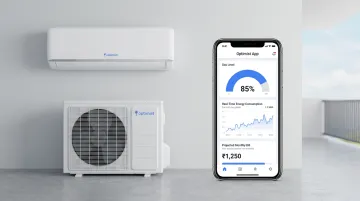
- Real-time energy tracking, projected monthly bills, and intelligent diagnostics through the Optimist App (iOS and Android)
Early users confirm the performance: Anupam, a banker from Gurgaon, noted: "We hit 47–48°C outside and the cooling never dropped. Airflow stayed steady through the day." Sera, a CA from Delhi, added: "Our electricity bill was noticeably lower, even with longer usage."
Best for: North Indian buyers in extreme-heat cities, coastal market buyers who need corrosion durability, and anyone prioritising the lowest electricity bills over a full season.
How to Choose the Right Inverter AC for India
Choosing by brand name or star count alone is how buyers end up overpaying on electricity. Here's what determines value:
ISEER Rating — The Real Efficiency Benchmark
Star ratings are bands, not precise measures. Two 5-star ACs can have very different ISEER values with very different running costs. The current BEE 5-star floor sits at ISEER ≥5.60 for 2026–27, with a future floor of ≥5.80 coming in 2028–29.
When comparing models, check the ISEER value on the BEE label, not just the star count. The range across 5-star models reviewed here spans 5.20 to 6.05 — a gap that adds up meaningfully over a season of daily use.
Ambient Temperature Performance
BIS tests rated cooling capacity at 35°C outdoor dry-bulb temperature. That's not what Indian summers look like in Delhi, Rajasthan, Nagpur, or Ahmedabad.
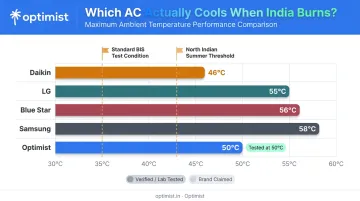
Most manufacturers publish a maximum ambient operating temperature. Look for this number and specifically for models with verified performance data at 43°C and above, not just a label claim. Daikin specifies 100% capacity at 46°C; Samsung and Blue Star claim up to 56–58°C; Optimist is validated at 50°C with no derate.
Build Quality for Indian Conditions
Generic global AC ratings don't capture India-specific durability requirements:
- Corrosion resistance — Critical for coastal cities. Look for anti-corrosion coated fins (gold fin, blue fin, or microchannel aluminium with certified salt-spray testing)
- Voltage tolerance — Indian grid voltage fluctuates; stabilizer-free operation range varies significantly by model
- Dust filtration — PM2.5 levels in Indian cities routinely exceed NAAQS standards; filter quality matters for sustained efficiency
- Warranty depth — Check what's actually covered: compressor, refrigerant gas, PCB, and indoor components are the key items
Smart Features and Transparency
As electricity costs rise, knowing exactly what your AC is consuming — in rupees — has real financial value. Features worth prioritising:
- Real-time energy monitoring with rupee-value tracking
- Projected monthly bill estimates
- App-based scheduling and remote control
- Filter health alerts
- Intelligent diagnostics for remote fault identification
Optimist is the only brand currently offering a built-in gas level indicator that shows refrigerant status live in the app. For Indian households who've been charged for unnecessary gas top-ups, it removes the guesswork entirely.
Conclusion
The right inverter AC for an Indian summer holds its performance when temperatures go extreme and keeps electricity costs under control through every month it runs.
Evaluate based on your city's peak summer temperature, your room size, and your daily usage hours:
- ISEER above 5.60 should be your floor — anything lower costs more to run year after year
- High-ambient performance data (43°C and above) matters most in North and Central India
- Corrosion resistance is non-negotiable for coastal cities
For homeowners who want India's most energy-efficient AC — with proven 50°C performance, the country's highest ISEER of 6.05, and live energy tracking, built-in gas level monitoring, and projected monthly bills through the Optimist App — explore Optimist at optimist.in or reach out at care@optimist.in.
Frequently Asked Questions
Which is the best inverter AC in India?
There's no single answer — the right choice depends on your city's peak temperatures, room size, ISEER rating, and how many hours daily the AC runs. For extreme heat and maximum savings, models with ISEER above 5.60 and verified high-ambient performance (43°C–50°C) are the most reliable options.
Which is the best 1.5 Ton inverter AC for Indian homes?
A 1.5-Ton inverter AC suits rooms between 150–180 sq ft. Top options — Daikin, LG, Blue Star, and Samsung — vary by priority. Among branded options, Blue Star's Q Series (ISEER 5.85) leads on efficiency. Optimist's 1.4 Ton — which delivers 1.9-Ton effective cooling via Turbo+ mode — is the strongest alternative for buyers who want 1.5 Ton performance with higher efficiency (ISEER 6.05) and validated 50°C cooling.
What is ISEER and why does it matter?
ISEER (Indian Seasonal Energy Efficiency Ratio) is BEE's official efficiency metric for ACs in India. A higher ISEER means more cooling per unit of electricity — directly cutting your monthly bills. The current 5-star threshold is ISEER ≥5.60; Optimist leads the market at 6.05.
Do inverter ACs really perform at 45°C–50°C in Indian summers?
Most standard inverter ACs are tested at 35°C outdoor temperature and lose cooling capacity above 43°C. Only ACs with published, verified high-ambient data — such as Daikin's 46°C capacity claim or Optimist's validated 50°C performance — can deliver full rated cooling in peak Indian summer conditions.
Is a 5-star inverter AC worth the higher upfront cost in India?
For households running an AC 6–10 hours daily through a long Indian summer, yes. The payback period varies by tariff and usage, but a high-ISEER 5-star model typically recovers its price premium within 2–3 seasons through lower electricity bills.
What features should I look for when buying an inverter AC in India?
Prioritise these when comparing models: ISEER rating (≥5.60 minimum), verified high-ambient performance (43°C+), anti-corrosion coating for coastal cities, voltage tolerance range, warranty depth (especially gas and compressor coverage), and smart features like real-time energy tracking, app control, and filter health monitoring.