

Introduction
When temperatures in Rajasthan hit 48.3°C and IMD recorded 45–48°C across Delhi, Haryana, UP, and Vidarbha on 30 May 2024, air conditioning stopped being a luxury purchase and became a survival decision. The problem? Running the wrong AC during a 6-month Indian summer can cost you tens of thousands of rupees in electricity — money that never shows up on a spec sheet.
Those bills add up fast — yet India's AC market is approaching 14 million annual sales with most buyers still choosing on sticker price and brand name alone. The metric that actually determines your monthly bill — the ISEER score — rarely gets a second look at the showroom.
This guide covers the best power-saving ACs for Indian homes in 2026, how energy efficiency ratings work, and what to look for beyond the star label.
Key Takeaways
- ISEER, not stars, determines your electricity bill — always check the actual number, not just the label
- A 5-star AC can save approximately ₹208/month over a 3-star unit running 8 hours/day
- Inverter compressors are standard in all top picks — they modulate speed instead of cycling on/off
- Most ACs are tested at 35°C — but large parts of India hit 45–50°C, where real efficiency losses kick in
- Pick an AC on ISEER score, high-ambient performance, warranty depth, and total 5-year cost — not just the sticker price
Why Energy Efficiency Matters More Than Ever for Indian Homes
What ISEER Actually Measures
ISEER (Indian Seasonal Energy Efficiency Ratio) is BEE's formula for measuring how much cooling an AC delivers per unit of electricity consumed across a full Indian season. Unlike a simple EER test at a single temperature, ISEER aggregates performance across outdoor temperature bins from 24°C to 43°C over 1,600 annual cooling hours — making it far more relevant to real-world Indian use than global efficiency ratings.
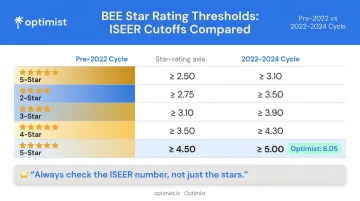
BEE assigns 1–5 star ratings based on ISEER thresholds. The bar has risen sharply: under the 2022–2024 schedule, a 5-star rating required ISEER ≥ 5.00, up from just 4.50 in the previous cycle. A unit that was 5-star in 2022 may qualify as only 3-star today under tightened standards. Always check the ISEER number printed on the label, not just the stars.
The Real Cost Gap Between 3-Star and 5-Star
That ISEER difference translates directly into money. Using matched Panasonic 2026 model data and UPERC's urban tariff of ₹6/kWh:
| Model | Star Rating | Annual kWh | Monthly Cost (8 hrs/day) |
|---|---|---|---|
| Panasonic 1.5T Inverter | 3-star (ISEER 4.50) | 908.45 kWh | Higher |
| Panasonic 1.5T Inverter | 5-star (ISEER 5.80) | 681.01 kWh | ~₹208 less |
The calculation: (908.45 − 681.01) × (2,920/1,600) × ₹6 ÷ 12 = ₹208/month in electricity savings. Over five years, that adds up to over ₹12,480 in savings — and ACs with ISEER ratings above 5.80 save even more.
The 45°C Problem Nobody Talks About
BEE's standard test point is 35°C outdoor temperature. Its seasonal bins end at 43°C. Yet IMD data shows temperatures of 45–48°C across multiple northern and central regions during peak summer.
According to ASHRAE's guidance on air conditioning systems, reduced ability to reject heat at the outdoor condenser can reduce system cooling capacity. Many ACs derate at extreme heat — they lose cooling output precisely when you need it most, rooms stop cooling, and the unit runs longer, burning more electricity.
Buyers should specifically check whether an AC has been tested and verified at 45–50°C ambient, not just at the standard 35°C test point. Few manufacturers publish this data; fewer still test for it at all.
Best Power Saving ACs for Indian Homes in 2026
These picks were shortlisted based on ISEER score, verified or stated high-ambient performance, smart features, warranty, and real-world value for Indian households.
Optimist — India's Highest ISEER Rating
Optimist is India's newest climate tech company, founded in August 2024 with a singular focus: engineering ACs specifically for extreme Indian summers. Backed by USD 12M from Accel, Arkam Ventures, and Sparrow Capital, developed through the Nalanda 1 R&D Lab in Delhi with IIT Delhi collaboration, Optimist launched its first AC in January 2026.
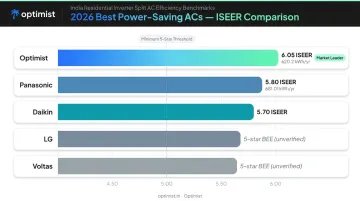
The 1.4 Ton 5 Star+ Inverter Split AC holds India's highest ISEER rating of 6.05, consuming only 620.2 kWh annually — compared to 850–920 kWh for typical 5-star competitors.
At ₹5.50/unit, that translates to annual running costs of approximately ₹3,411, versus ₹4,675–₹5,060 for most 5-star alternatives.
What sets it apart technically:
- 50°C verified cooling — full rated capacity with no derating at peak Indian temperatures
- Microchannel heat exchanger — 1,180 flow paths for 4× faster heat transfer
- Turbo+ Mode — delivers 1.9 Ton of effective cooling from a 1.4 Ton unit (135% capacity boost) for rapid room cool-down
- India's first built-in gas level indicator — live refrigerant monitoring via app eliminates the gas refill scam
- 1,000-hour SIGMA-certified salt-spray corrosion testing — 15× the typical 72-hour market standard, purpose-built for coastal cities like Mumbai, Chennai, and Kochi
- Optimist App — live energy meter, projected monthly bills, filter health tracking, and intelligent remote diagnostics
| Specification | Details |
|---|---|
| ISEER / Star Rating | 6.05 / 5-Star BEE (India's highest) |
| Annual Energy Consumption | 620.2 kWh |
| Key Features | Turbo+ Mode, Gas Level Indicator, Microchannel Heat Exchanger, App-based bill tracking, 50°C performance verified |
| Warranty | 5-year all-inclusive (parts, labour, gas) + 10-year compressor |
| Where to Buy | optimist.in |

Daikin — Reliable Inverter Technology
Daikin is a Japanese HVAC brand with a strong India service network, known for consistent inverter compressor reliability. Its flagship 5-star model — the FTKM50XV — carries an ISEER of 5.70.
Key features include DRED (Daikin Refrigerant Electronic Device) for precise capacity modulation, a PM 2.5 filter for urban air quality, and Wi-Fi control on select variants.
Note: the FTKM50XV is listed as a 1.42 Ton unit on Daikin's official India page, not a direct 1.5 Ton match. Verify the exact model specification against your room size before purchasing.
| Specification | Details |
|---|---|
| ISEER / Star Rating | 5.70 / 5-Star BEE |
| Key Features | Inverter compressor, PM 2.5 filter, DRED capacity control, Wi-Fi (select models) |
| Approx. Price | ₹45,990–₹52,790 (varies by SKU and retailer) |
LG — Dual Inverter with Ocean Black Protection
LG is one of India's top-selling AC brands. Its Dual Inverter Compressor — a twin rotary motor design — reduces vibration, improves efficiency, and cools faster than single-rotary alternatives. The flagship model (AS-Q20JWZE) holds 5-star BEE status under the 2026 rating cycle.
The exact ISEER figure was not independently verified at the time of writing — check the BEE energy label on the unit before purchasing.
- Ocean Black Protection coating resists corrosion — relevant for coastal buyers
- AI-based cooling adjustment through LG ThinQ app
- 6-in-1 convertible modes for flexible capacity management
| Specification | Details |
|---|---|
| ISEER / Star Rating | 5-star BEE (exact ISEER not independently verified — check label) |
| Key Features | Dual Inverter Compressor, Ocean Black Protection, 4-way swing, Wi-Fi ThinQ |
| Approx. Price | Not independently verified — check current listings |
Voltas — India's Largest AC Brand
Voltas, a Tata Group company, leads India's AC market by volume and offers inverter models calibrated for Indian climate zones. Its 185INV Vectra Elegant (5-star, 2026 model) supports operation at high ambient temperatures and features the Maha Adjustable inverter range — users can dial down capacity during milder weather to save energy, then scale back up during peak summer.
The exact ISEER for the Vectra Elegant was not independently confirmed in current research — check the BEE label at purchase.
| Specification | Details |
|---|---|
| ISEER / Star Rating | 5-star BEE (exact ISEER not independently verified — check label) |
| Key Features | Adjustable Inverter capacity, high ambient operation, auto-clean, Wi-Fi (select models) |
| Approx. Price | ~₹46,000 (observed, subject to change) |
Panasonic — Strongest Verified 5-Star ISEER Among Japanese Brands
Panasonic's 5-star 1.5 Ton model (CS/CU-NU18BKY5WX) holds an ISEER of 5.80 with annual label consumption of 681.01 kWh — the best independently verified ISEER figure among traditional brands in this comparison.
Its inverter compressor adjusts output based on room conditions, and select 2026 models include Wi-Fi control and multi-mode convertible operation.
Note: the ECONAVI sensor designation was not confirmed for this specific SKU in current research. Verify features against the product page before purchasing.
| Specification | Details |
|---|---|
| ISEER / Star Rating | 5.80 / 5-Star BEE |
| Annual Energy Consumption | 681.01 kWh |
| Key Features | Inverter compressor, Wi-Fi control (select models), multi-mode operation |
| Approx. Price | ₹47,990 (observed) |
How We Chose the Best Power Saving ACs
The most common mistake buyers make is picking an AC based on star count alone — without checking the ISEER number behind the stars, whether the unit has been tested at Indian ambient temperatures, or what the total 5-year ownership cost looks like.
Evaluation Criteria
1. ISEER score (primary metric) The ISEER number, not the star count, determines how much electricity your AC will consume. Two 5-star ACs can have ISEER scores of 5.00 and 5.80 respectively — that gap is significant over a full season.
2. High-ambient performance Does the AC maintain rated cooling capacity at 45°C+? Most brands test at 35°C and do not publish derating data for extreme heat. Buyers in Delhi NCR, Rajasthan, Vidarbha, and similar regions should prioritise models tested and rated at 45°C or above.
3. Smart features and energy visibility Real-time energy tracking, monthly bill projections, and filter health monitoring help households manage consumption actively rather than discovering high bills after the fact.
4. Warranty depth A 5-year warranty that covers parts and labour but not refrigerant gas is very different from a truly all-inclusive warranty. Check what is explicitly included before treating warranty periods as equivalent.
5. Price-to-performance over 5 years A unit that costs ₹5,000 more upfront but saves ₹1,500/year in electricity pays for itself in under four years. Total cost of ownership, not purchase price, is the right frame.
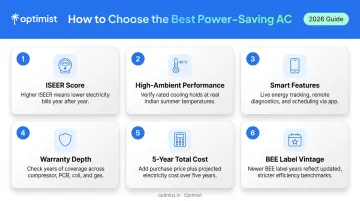
6. BEE star label vintage The minimum ISEER for 5-star certification rose from 4.50 (pre-2022) to 5.00 (2022–2024). BEE had not published final 2025–2026 thresholds at the time of writing, but the trend is clear — the bar keeps rising. A 5-star label from 2022 may no longer represent the same standard today. Always read the ISEER number on the label, not just the star count.
Conclusion
Indian summers are getting hotter and longer. Running a low-efficiency AC for 8–10 hours a day across 5–6 months generates a substantial electricity bill — and the gap between a mediocre ISEER score and an excellent one translates directly into thousands of rupees saved or lost each year.
Before finalising any purchase, factor in three things beyond the price tag: five-year electricity costs at your local tariff, warranty coverage (what is actually included, not just the headline years), and whether the unit has been tested to perform at real Indian ambient temperatures.
For buyers who want the highest energy efficiency without sacrificing performance in Indian heat, Optimist is built specifically for this reality. With India's highest ISEER rating of 6.05, full-rated cooling tested at 50°C, and a 5-year warranty that covers parts, refrigerant gas, and the compressor, it addresses each of the three purchase factors above.
Explore Optimist's AC at optimist.in.
Frequently Asked Questions
Which AC brand is best for electricity saving?
The best electricity-saving ACs are those with the highest ISEER scores. As of 2026, Optimist holds India's highest ISEER of 6.05, consuming just 620.2 kWh annually. Among traditional brands, Panasonic (ISEER 5.80) and Daikin (ISEER 5.70) offer the strongest verified scores in the 5-star segment.
Which 5-star AC has the lowest power consumption?
Among 5-star ACs, the unit with the highest ISEER consumes the least electricity — higher ISEER means more cooling per unit of power consumed. Compare ISEER values directly rather than assuming all 5-star models consume equally; scores in the current market range from 5.00 to 6.05.
Which AC is best for low maintenance?
Look for an auto-clean coil, app-based filter health monitoring, remote diagnostics, and a warranty that covers labour and refrigerant gas. Optimist's built-in gas level indicator, app-based remote diagnostics, and 5-year all-inclusive warranty (parts, labour, and refrigerant included) set a practical benchmark for low-maintenance ownership.
What is ISEER rating and why does it matter for Indian homes?
ISEER (Indian Seasonal Energy Efficiency Ratio) is BEE's efficiency metric for ACs, calculated across a full Indian season from 24°C to 43°C over 1,600 hours. A higher ISEER means more cooling per unit of electricity consumed — directly cutting monthly bills in India's high-usage summer climate.
How much can a 5-star AC save on electricity bills compared to a 3-star AC?
Using matched 2026 Panasonic model data at ₹6/kWh (UPERC urban tariff), a 5-star unit (681 kWh/year) saves approximately ₹208/month over a 3-star unit (908 kWh/year) running 8 hours/day. Actual savings vary with your local tariff slab and usage hours.
Does a higher-rated AC still perform well in extreme Indian heat above 45°C?
Most ACs are tested and rated at 35°C outdoor temperature — above that, many units lose cooling capacity (called derating), running longer and consuming more electricity. Buyers in northern and central India should specifically look for ACs tested and verified at 45–50°C ambient, as Optimist has done with its 50°C-verified cooling architecture.