
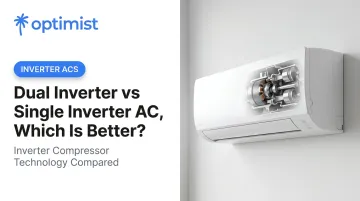
This matters because the compressor inside your AC decides three things you'll live with for the next decade — your electricity bill, how much noise leaks into your bedroom at 2 AM, and whether your cooling actually holds up when Delhi hits 45°C in June.
This guide breaks down both technologies, looks at what the data actually supports, and helps you pick based on your room size, usage hours, and budget — not marketing labels.
Key Takeaways
- Dual inverter ACs use twin rotary compressors for smoother speed control and quieter operation
- Single inverter ACs use one variable-speed compressor — more affordable and ideal for moderate use
- ISEER rating and heat exchanger design often matter more for savings than compressor count alone
- Match your choice to usage hours, room size, budget, and how extreme your local summer gets
Dual Inverter vs Single Inverter AC: Quick Comparison
Dual Inverter vs Single Inverter AC: Key Differences at a Glance
Here's how the two technologies stack up on paper:
| Factor | Dual Inverter | Single Inverter |
|---|---|---|
| Compressor | Twin rotary, dual cylinder | Single rotary compressor |
| Speed Control | Wider frequency range for finer adjustments | Effective, but with a narrower speed range |
| Noise & Vibration | Generally lower due to balanced load | Slightly more vibration during speed changes |
| Efficiency | Higher efficiency, especially at part-load | Good, but can be less efficient at part-load |
| Price | Higher initial cost | Lower initial cost |
Compressor Type and Speed Range
A single inverter AC uses one rotary compressor that adjusts its speed based on cooling demand. A dual inverter AC, however, divides the workload between two compressors. This balanced approach, as noted in Croma's guide to inverter ACs, reduces vibration and wear by not concentrating stress on a single moving part.
Neither brands nor BEE publish a standardised Hz range comparing the two setups model-to-model, so treat any specific frequency claim you see as brand-specific, not an industry standard.
Noise Levels
Twin-cylinder load sharing tends to produce steadier vibration patterns than a single compressor cycling hard through speed changes. Real-world noise numbers vary a lot by brand and model, so always check the specific decibel rating on the product page rather than assuming "dual" automatically means quieter.
Energy Efficiency and Price
The "dual inverter" label doesn't automatically guarantee lower electricity bills. While the technology is generally more efficient, the true measure of an AC's performance is its ISEER (Indian Seasonal Energy Efficiency Ratio) rating. A higher price tag should be justified by a higher ISEER rating, not just the compressor type. We'll unpack this properly in the "Which Is Better" section below.
What is a Dual Inverter AC?
A dual inverter AC uses two rotary compressor cylinders that adjust speed together, or independently, to match the room's cooling demand. Instead of one motor doing all the work, the load gets shared, which cuts down on the frequent full on-off cycling that older ACs are known for.
The practical payoff for an Indian household:
- Smoother temperature holding — less overshoot and undershoot around your set point
- Lower electricity bills over a full cooling season versus fixed-speed units
- Reduced mechanical strain on the compressor across years of continuous summer use
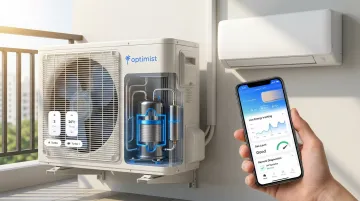
Not every "dual inverter" badge means the same thing, either. Some brands use it strictly for the twin-rotary hardware. Others bundle it with extras like Wi-Fi control, self-diagnostics, or app-based monitoring, features that add convenience but aren't technically part of the compressor itself.
Take Optimist's 1.4 Ton 5 Star+ Split AC as an example. It pairs a dual-rotary inverter compressor with a micro-channel heat exchanger built from 1,180 flow paths.
On top of that mechanical setup, its app adds live energy tracking, a built-in gas-level indicator, and remote diagnostics. The compressor handles the cooling; the app handles visibility into what you're actually spending.
Use Cases of Dual Inverter AC
Dual inverter compressors earn their price premium in specific situations:
- Larger rooms where sustained cooling load is higher
- 8+ hour daily usage — bedrooms, home offices, or living rooms in constant use
- Extreme peak-heat regions where consistent performance matters more than saving a few thousand rupees upfront
Most ACs sold in India start losing cooling capacity once outdoor temperatures cross 43°C, a threshold hit routinely across Delhi NCR, Rajasthan, and Vidarbha through May and June.
Optimist's 1.4 Ton unit, for instance, is government-lab tested to hold full rated cooling at 50°C ambient, with its Turbo+ mode delivering a 135% capacity boost, effectively 1.9-ton cooling from a 1.4-ton unit. Customer reviews from Gurgaon describe cooling that held steady even at 47-48°C outside.
The real argument for dual inverter tech comes down to one question: can the compressor and heat exchanger combination handle Indian summer extremes without derating? The badge alone won't tell you that.
What is a Single Inverter AC?
A single inverter AC runs on one variable-speed compressor that ramps output up or down based on how far the room temperature is from your set point. This works differently from a non-inverter AC, which just switches fully on or fully off at a fixed speed.
Compared to non-inverter units, single inverter ACs deliver solid, proven savings. Voltas notes that inverter technology can cut monthly electricity bills by 30-40% versus non-inverter models under regular household use. That's a meaningful jump, and it comes at a lower upfront cost than dual inverter alternatives.
Use Cases of Single Inverter AC
Single inverter remains the practical pick for:
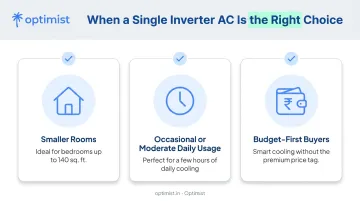
- Smaller rooms where cooling load is modest to begin with
- Occasional or moderate daily usage: a few hours in the evening, not round-the-clock
- Budget-first buyers who'd rather save upfront than chase incremental efficiency gains
Single-rotary compressors still dominate India's mid-range AC segment, largely because they hit the sweet spot between affordability and genuine efficiency gains over old-school fixed-speed units. If your AC runs 3-4 hours a night in a 100 sq ft room, the extra cost of dual inverter tech may never fully pay itself back.
Dual Inverter vs Single Inverter AC: Which Is Better?
There's no universal winner here. The right answer depends on usage hours, room size, local climate severity, and how much you're willing to spend upfront.
Choose dual inverter if:
- You run your AC 8+ hours daily
- You live somewhere summer temperatures regularly cross 40-45°C
- Quiet, stable cooling matters, especially in bedrooms
Choose single inverter if:
- Usage is occasional or moderate
- Budget is the priority over incremental efficiency
- Your room is small enough that a wider compressor speed range won't add real-world benefit
Here's the part most buying guides skip: compressor count is not the whole story. BEE's own efficiency framework, ISEER, measures the entire system's seasonal performance: heat removed divided by electricity consumed over 1,600 annual cooling hours across India's 24-43°C temperature bins. It has nothing to do with how many rotors sit inside the compressor.
That's why a well-engineered single inverter system with a strong heat exchanger can sometimes outperform a poorly optimised dual inverter model on paper efficiency. Thermal engineering (the heat exchanger design, refrigerant flow, insulation quality) often decides real-world savings more than the compressor label on the box.
This is the exact gap Optimist has tried to engineer around. Rather than lead with "dual inverter" as a standalone selling point, the company pairs its twin-rotary compressor with a micro-channel heat exchanger to hit an ISEER of 6.05, currently India's highest.
It also validates cooling performance at 50°C ambient, well past where most competing units start derating. The result: a 1.4-ton unit priced at ₹39,990 that's positioned to outperform typical 1.5-ton competitors on both cooling output and running cost.
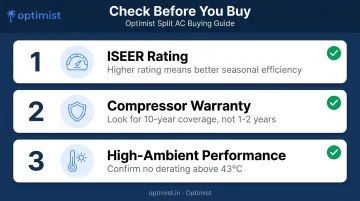
Before you buy anything, check these three things regardless of compressor type:
- ISEER rating: higher means better seasonal efficiency, full stop
- Compressor warranty length: a 10-year compressor warranty signals real confidence; 1-2 years doesn't
- Tested performance at high ambient temperatures: ask specifically whether the unit derates above 43°C
Conclusion
Dual inverter ACs generally deliver quieter, more precise cooling with better efficiency, a strong fit for heavy daily use and extreme heat. Single inverter ACs remain a genuinely solid, budget-friendly choice for moderate, occasional use.
Optimist's own AC proves the point: a Dual-Rotary compressor rated ISEER 6.05, holding steady cooling at 50°C ambient.
But don't let the compressor label do all the deciding. Match your choice to your usage pattern, room size, local climate, and budget. Then verify the ISEER rating, warranty terms, and real-world heat performance before you commit. That combination reveals more about long-term value than "dual" versus "single" ever will.
Frequently Asked Questions
Which is better, a single inverter or a dual inverter AC?
Both outperform non-inverter ACs on efficiency. Dual inverter models generally offer smoother cooling, lower noise, and better part-load efficiency, while single inverter remains a solid, more affordable option for moderate use.
Is dual inverter AC worth buying?
It's worth the extra upfront cost if you run your AC 8+ hours daily or face extreme summer heat. The price premium typically gets recovered through electricity savings within a few years.
How much more does a dual inverter AC cost than a single inverter model?
The gap varies widely by brand, capacity, and star rating. There's no fixed industry-wide premium, so compare specific models rather than assuming a standard price difference.
Does a dual inverter AC consume less electricity than a single inverter AC?
Not automatically. It depends on the model's ISEER rating and heat exchanger design, not just compressor count. Your actual usage hours matter more than the label for real savings.
Which lasts longer, a dual inverter or single inverter AC compressor?
Dual-rotary compressors often face less mechanical stress per cycle due to load sharing, which can support a longer working life. Both types are durable when properly maintained and serviced.
Is ISEER rating more important than choosing between dual and single inverter?
Yes, largely. ISEER and tested performance at high ambient temperatures reflect real-world efficiency far more accurately than the inverter type alone.