
The AC market is full of star ratings, ISEER numbers, tonnage charts, and Wi-Fi badges. Some of these specs define real-world performance. Others are marketing add-ons that sound impressive but change nothing about whether your room actually cools down at 4 PM in May.
This guide breaks down exactly which features matter — and why — before you buy.
Key Takeaways
- Tonnage first: An undersized or oversized AC is the most common and most expensive buying mistake.
- ISEER over star count: The ISEER number on the BEE label determines your monthly bill — compare it directly, not just the star tier.
- Inverter technology is non-negotiable: Fixed-speed ACs cost less upfront but significantly more to run.
- Lab ratings stop at 43°C: For North Indian summers, verify that the AC is tested for high ambient performance, not just standard conditions.
- Smart features matter only with strong hardware: WiFi controls and energy tracking are useful when the underlying cooling performance is already proven.
What to Look for in a Good Air Conditioner
AC buying decisions vary based on room size, climate zone, usage patterns, and budget. But there are six core features that determine whether an AC performs well across all these variables. Each connects directly to measurable outcomes: electricity costs, comfort during peak heat, and long-term durability.
Energy Efficiency Rating (ISEER and BEE Star Rating)
The BEE star label and ISEER (Indian Seasonal Energy Efficiency Ratio) are the two primary metrics for measuring how efficiently an AC uses electricity in Indian conditions.
ISEER is calculated as:
ISEER = Cooling Seasonal Total Load ÷ Cooling Seasonal Energy Consumption
It accounts for temperature variation and operating hours across the Indian season — making it a more meaningful number than a single-condition efficiency reading. A higher ISEER means the unit delivers the same cooling for fewer units of electricity consumed.
The most reliable way to compare two ACs on cost is to check the **annual kWh figure on the BEE label** and multiply by your electricity tariff. For example, Optimist's 1.4 Ton 5 Star+ AC consumes 620.2 kWh annually — compared to 850–920 kWh for a typical 5-star inverter AC of similar tonnage. At ₹5.50 per unit, that gap translates to roughly ₹1,265–₹1,650 in annual savings, adding up to over ₹8,000 across five years.
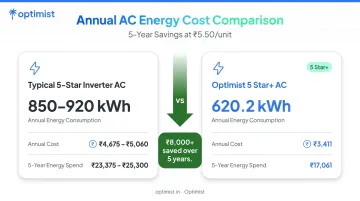
A star count alone can be misleading after a BEE schedule change. Always read the ISEER value and annual kWh figure together.
Cooling Capacity and Room Size Match (Tonnage)
"Tonnage" refers to how much heat an AC can remove per hour. The wrong size — too small or too large — leads to either insufficient cooling or short-cycling that wastes energy.
A commonly used sizing guideline for Indian homes:
| Room Size | Recommended Tonnage |
|---|---|
| Up to 120 sq. ft. | 1 Ton |
| 120–180 sq. ft. | 1.5 Ton |
| 180–260 sq. ft. | 2 Ton |
These ranges assume a standard 10 ft ceiling. Adjust upward if your room has:
- High ceilings (above 10 ft)
- Direct afternoon or west-facing sun exposure
- Top-floor placement with roof heat load
- Three or more regular occupants
For boundary cases, a proper heat load calculation is more reliable than moving up one tonnage step automatically.
One practical note: Optimist's 1.4 Ton AC is officially recommended for rooms up to 200 sq. ft., backed by its Turbo+ Mode delivering 1.9-Ton effective cooling on demand — which makes it a credible alternative to standard 1.5 Ton units for buyers with larger rooms or higher heat loads.
Inverter Technology
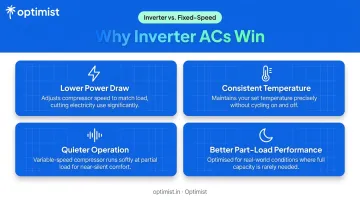
Inverter ACs adjust compressor speed continuously based on real-time cooling demand. A fixed-speed (non-inverter) AC can only run at full power or switch off entirely — cycling on and off repeatedly, which drives up power consumption and creates temperature swings.
The difference shows up clearly in market adoption: variable-speed room AC market share in India rose from 1% in 2015–16 to 77% in 2022–23, driven precisely by the efficiency and comfort advantages of inverter technology.
Key practical benefits of inverter ACs:
- Lower average power draw — the compressor runs at reduced speed once the room reaches the set temperature
- More consistent temperatures — no cold-warm cycling
- Quieter operation — slower compressor speeds generate less noise
- Better performance at part-load — especially relevant for Indian nights when outdoor temperatures drop
Non-inverter ACs are cheaper upfront but cost meaningfully more to operate, particularly in climates with 6–8 hours of daily AC use for 6+ months of the year.
Smart Controls and Connectivity
Wi-Fi connectivity and app control add genuine convenience when implemented well. The features that create real value:
- Scheduling — pre-cool a room before you arrive, or set auto-off timers at night
- Real-time energy tracking — see live kWh consumption and projected monthly bills, not just star ratings
- Filter health monitoring — alerts when cleaning is due, preventing cooling drops from clogged filters
- Remote diagnostics — identify error codes and troubleshoot without waiting for a service visit
- Gas level monitoring — a newer feature that shows refrigerant levels in real time, catching issues before they cause performance loss
The Optimist App (iOS and Android) covers all six of these features, including India's first built-in gas level indicator — a practical safeguard in a market where refrigerant-related service calls are both common and frequently unnecessary.
What to watch for: a "Wi-Fi" label on a spec sheet often means only basic on/off control. Check whether the app provides monitoring depth — not just remote switching.
Air Quality Features: Filtration and Dehumidification
A good AC manages indoor air quality alongside temperature. Two mechanisms matter most:
Filtration removes dust, allergens, and pollutants from circulated air. Filter quality varies widely — look for washable filters (to avoid recurring replacement costs) and check whether the AC carries a rated filtration standard rather than a marketing name alone. Filter health monitoring, available through apps like Optimist's, ensures the filter is actually cleaned regularly enough to remain effective.
Dehumidification matters during monsoon months. High indoor humidity causes discomfort independent of temperature, and sustained dampness creates conditions for mould. ACs with effective dehumidification modes manage this without simply overcooling.
Build Quality, Warranty, and After-Sales Support
The durability of an AC depends on the quality of its heat exchanger, casing materials, and protection against rust and corrosion — factors that determine performance not over months, but over years.
When evaluating warranty terms, look for:
- Compressor coverage — the compressor is the most expensive component to replace; a 10-year warranty signals real confidence
- Labour and service call inclusion — parts-only warranties shift significant costs to the buyer
- Refrigerant gas coverage — gas refills are a frequent and often opaque service charge; coverage here eliminates both the cost and the guesswork
- Critical indoor component coverage — PCB, sensors, fan motor, and evaporator coil all matter
Optimist's warranty covers all of this: 5-year comprehensive outdoor unit coverage, 10-year compressor warranty, 5-year coverage on critical indoor components (PCB, sensors, fan motor, swing motor, evaporator coil), and 5-year refrigerant gas coverage — all at ₹0 for parts and labour.
Beyond the Spec Sheet: Features That Matter for Indian Summers
Standard AC specifications are measured under controlled lab conditions. Indian summers are not. IMD recorded 50.5°C at Churu, Rajasthan, in May 2024 — a temperature well above what most ACs are rated for. The three features below separate ACs built for Indian reality from those built for the lab.
High Ambient Temperature Performance (Derating)
BEE's ISEER rating uses outdoor temperature bins from 24°C to 43°C. This means the efficiency label tells you nothing about how the AC performs above 43°C — the conditions you actually face in peak summer.
Many ACs progressively lose cooling capacity as outdoor temperatures climb:
- At 45°C: 10–15% capacity loss typical
- At 48°C: 20–30% loss
- At 50°C: up to 40% loss in some units
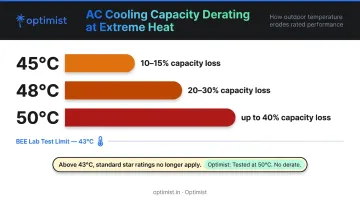
An AC that derates under these conditions runs continuously, fails to hit the set temperature, and drives up your electricity bill simultaneously.
When buying for North Indian cities (Delhi NCR, Rajasthan, UP, Punjab, MP), specifically check whether the model is tested to maintain full rated capacity at 48–50°C, not just "operates up to" that temperature. Operating and maintaining rated capacity are different claims.
Optimist's ACs are tested for full rated cooling at 50°C with no capacity drop, grounded in the company's founding brief to build ACs specifically for the realities of extreme Indian summers.
Corrosion Resistance
In coastal cities (Mumbai, Chennai, Kochi, Visakhapatnam), salt-laden air accelerates corrosion of the outdoor unit's fins and coils. This leads to refrigerant leaks, reduced efficiency, and premature failure, often within 3–5 years.
The typical market standard for corrosion testing is 72 hours of salt spray exposure. Optimist's outdoor unit heat exchanger has been tested to 1,000 hours under ASTM B368 (Acetic Acid Salt Spray test), certified by SIGMA Test & Research Centre — approximately 15× the typical market standard.
When comparing ACs for coastal use, ask for the test method, certifying body, and duration, not just a coating description.
Refrigerant (Gas Level) Transparency
Most AC owners have no way to know whether their refrigerant levels are low until cooling noticeably drops. This creates a service vulnerability: technicians can claim gas refills are needed without any verifiable measurement, with charges typically ranging from ₹2,500–₹7,000 per visit.
ACs with built-in gas level monitoring close this gap. Key advantages:
- Shows refrigerant status in real time, visible directly in the app
- Sends clear alerts when a refill is actually needed
- Catches issues early before cooling drops noticeably
- Removes the guesswork that makes gas-related service charges hard to dispute
How Optimist Is Engineered Around What Matters Most
Optimist was founded in 2024 with one mandate: build an AC that performs in real Indian summers. The company's first product platform launched in January 2026, delivering India's highest ISEER rating at 6.05 — a 5 Star+ classification that goes beyond even the standard 5-star plus threshold.
Core performance differentiators:
- Full rated cooling at 50°C — tested with no capacity drop, verified against real Delhi NCR heatwave conditions
- Microchannel heat exchanger — 4× faster heat transfer with 1,180 flow paths in advanced aluminium alloy
- Turbo+ Mode — 135% capacity boost delivering 1.9-Ton effective cooling from a 1.4 Ton unit, for rapid room pull-down on peak heat days
- Dual-Rotary Inverter Compressor — drives the 620.2 kWh annual consumption figure, one of the lowest in its class
- 1,000-hour corrosion testing (ASTM B368, SIGMA certified) — 15× the typical 72-hour market standard
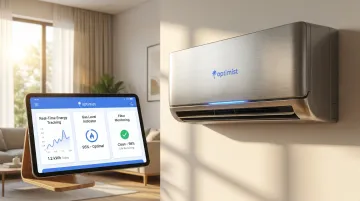
The engineering edge translates directly into the ownership experience — every smart feature is designed to give you visibility and control that most ACs simply don't offer.
Smart ownership experience:
- India's first built-in gas level indicator — visible live in the Optimist App
- Real-time energy tracking and projected monthly bills
- Filter health monitoring with maintenance reminders
- Intelligent diagnostics with remote service support
- Scheduling and remote control (iOS and Android)
That smart experience is backed by warranty coverage built to match the product's lifespan.
Warranty structure:
- 5-year comprehensive outdoor unit warranty
- 10-year compressor warranty
- 5-year critical indoor component coverage
- 5-year refrigerant gas coverage — all at ₹0 (parts + labour)
Getting started is straightforward: brand-authorised installation costs ₹1,499 + GST, with delivery and installation completed within 48 hours of order across serviceable pincodes pan-India.
Conclusion
Choosing a good air conditioner comes down to matching features to real-world conditions — not ticking boxes on a spec sheet. Energy efficiency, correct tonnage, inverter technology, and durability for Indian heat are the features that determine your daily comfort and monthly bills. Brand name and launch-price discounts won't tell you how the unit performs at 47°C in May — the spec sheet will.
An AC is a 10–15 year purchase. Performance should hold up over years of use, not just the first summer. Warranty terms, smart monitoring tools, and service support are as important as the initial specification — an AC that costs ₹5,000 less upfront but runs 20% less efficiently will cost you far more by year three.
Frequently Asked Questions
What to look for in a good air conditioner?
Prioritise correct tonnage for your room size, a high ISEER rating (check the BEE label's actual kWh figure), inverter technology, and solid build quality. For Indian buyers, also verify whether the AC is tested to maintain full cooling capacity above 43°C — the lab limit where most standard ratings stop.
Which AC is better for allergies?
ACs with washable filters and filter health monitoring are more effective for allergy sufferers, because clean filters are the baseline requirement. Multi-stage or anti-bacterial filtration layers offer additional benefit — ask for the specific test standard the filter is rated to (such as HEPA H13 or EN 1822), not just the marketing name.
Is AC good for high blood pressure?
Well-regulated cooling reduces heat-induced stress and helps maintain stable body temperature. WHO's general heat guidance recommends 27°C during heat events. Avoid very cold settings — a consistent, moderate temperature is better for cardiovascular comfort.
What is a good ISEER rating for an AC in India?
ISEER measures seasonal efficiency across Indian climate conditions. A 5-star AC typically carries an ISEER above 5.0; 5-star plus units reach 5.5 and above. Optimist's 1.4 Ton AC carries an ISEER of 6.05 — currently India's highest — translating directly into lower annual electricity bills.
Does an inverter AC really save electricity compared to a fixed-speed AC?
Yes. Inverter ACs modulate compressor speed to match actual cooling demand, avoiding the repeated high-power spikes of a fixed-speed AC cycling on and off. The Ministry of Power's data shows inverter AC market share rising from 1% to 77% over seven years — driven largely by this efficiency advantage in real-world Indian conditions.