

The problem is that buying an AC in India has never been more confusing. Dozens of brands, shifting BEE star thresholds, jargon like ISEER and dual-rotary compressors, and marketing claims that rarely reflect real-world Indian conditions — most buyers end up choosing by brand familiarity alone.
This guide cuts through that. You will get a plain-language explanation of inverter AC technology, the six most important selection criteria for Indian conditions, and a clear framework for making the right call.
Key Takeaways
- Inverter ACs adjust compressor speed continuously — they use significantly less electricity than fixed-speed units and last longer
- ISEER is the single most important number on the spec sheet; target 5.0+ for good efficiency, 5.5+ for heavy daily use
- Match tonnage to room size first — an undersized or oversized AC will always underperform regardless of star rating
- For Indian peak summers, confirm the AC delivers full rated cooling at 45°C or above — not just "operates up to" that temperature
- Corrosion resistance, warranty depth, and smart transparency features matter more in India than most buyers expect
What Is an Inverter AC and How Does It Work?
A conventional fixed-speed AC runs its compressor at one speed — fully on or fully off. It blasts cold air until the room hits the target temperature, shuts down, then restarts when things warm up again. That constant cycling wastes energy and puts repeated stress on the compressor.
An inverter AC uses a variable-frequency drive to continuously adjust compressor speed. When a room is hot, the compressor runs fast. As the room approaches the set temperature, it slows down rather than stopping. The result is a system that maintains temperature steadily without the energy spikes of on-off cycling.
Core Benefits of Inverter Technology
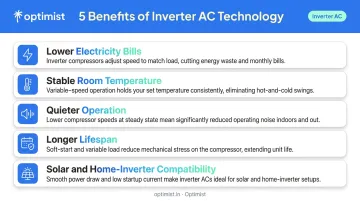
- Lower electricity bills — no repeated high-draw startups; the compressor runs at reduced load most of the time
- Stable room temperature — no temperature swings between too cold and too warm
- Quieter operation — a compressor running at partial load is far quieter than one cycling on and off
- Longer lifespan — fewer start-stop stress cycles means less mechanical wear over time
- Solar and home-inverter compatibility — steady, lower power draw works better with alternative energy sources
Those energy savings aren't guesswork — the BEE star label is how you measure them before you buy.
The BEE Star Rating and ISEER Explained
Every AC sold in India carries a BEE (Bureau of Energy Efficiency) label showing a star rating (1–5) and the underlying ISEER value — Indian Seasonal Energy Efficiency Ratio.
ISEER measures how much cooling the AC delivers per unit of electricity consumed across a full Indian cooling season. BEE models this over 1,600 seasonal hours across outdoor temperature conditions from 24°C to 43°C. A higher ISEER means fewer units consumed annually — and a lower electricity bill every month.
What to Consider When Choosing the Best Inverter AC in India
Brand reputation is a starting point, not the full selection criteria. The six factors below translate spec-sheet numbers into real-world performance for Indian homes.
Energy Efficiency: ISEER Rating and Star Label
ISEER is the most actionable number on any AC spec sheet. To put the difference in concrete terms: two 2025 Panasonic models of the same 1.5-ton class showed annual energy consumption of 977 kWh for a 3-star unit versus 759 kWh for a 5-star unit — a gap of 217 kWh per year. At typical Indian residential tariffs, that difference compounds into real savings over a five-to-ten year ownership period.
Within the 5-star band, ISEER values still vary. A unit rated ISEER 5.0 and one rated ISEER 6.05 both carry 5-star labels, but their annual consumption differs significantly. Always compare the actual ISEER figure, not just the star count.
Practical guidance:
- Good efficiency: ISEER 5.0+
- High-use scenarios (8+ hours daily): ISEER 5.5+
- India's current benchmark: ISEER 6.05
Cooling Capacity: Matching Tonnage to Room Size
Tonnage determines how much heat the unit can remove per hour. Getting this wrong in either direction raises costs and reduces comfort.
- An undersized AC runs continuously at full load — defeating the efficiency gains of inverter technology
- An oversized AC short-cycles, fails to dehumidify properly, and still consumes more power than needed
Use this as a baseline reference:
| Room Size | Recommended Tonnage |
|---|---|
| Up to 100 sq. ft | 0.8 ton |
| Up to 150 sq. ft | 1.0 ton |
| Up to 250 sq. ft | 1.5 ton |
| Up to 400 sq. ft | 2.0 ton |
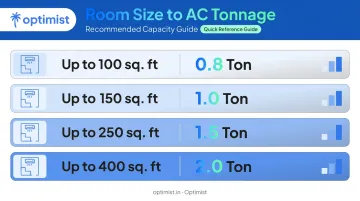
Rooms with high sun exposure, top-floor placement, poor insulation, or more than two regular occupants will need additional cooling capacity beyond what the floor area alone suggests.
High Ambient Temperature Performance
This is the most underreported issue for Indian buyers. Standard BEE testing uses 35°C as the outdoor temperature — a figure that represents mild spring weather in most of North India, not peak summer.
When ambient temperatures climb to 45°C or beyond, many ACs "derate" — they reduce cooling output to protect the compressor. An AC that "operates up to 52°C" and one that "maintains rated cooling capacity at 52°C" are very different products: the first won't trip; the second will actually cool your room.
For buyers in Delhi, Rajasthan, UP, Punjab, or Vidarbha — anywhere that regularly crosses 43°C in May and June — this distinction is critical. Ask specifically whether a model maintains rated cooling capacity at peak ambient temperatures, or derates. As a reference point, Optimist's 1.4 Ton AC is tested to deliver full rated cooling at 50°C with no performance drop.
Corrosion Resistance and Build Quality
India's coastal cities, monsoon humidity, and urban air pollution all accelerate corrosion of the outdoor unit's condenser coils. Corroded coils reduce heat exchange efficiency, raise electricity consumption, and shorten the unit's lifespan.
Anti-corrosive coatings — marketed as Blue Fin, Gold Fin, Ocean Black Protection, and similar names — are a meaningful functional specification for Indian conditions, particularly in:
- Coastal cities: Mumbai, Chennai, Kochi, Visakhapatnam
- High-humidity zones during monsoon months
- Urban environments with industrial pollutant exposure
When evaluating corrosion protection, look beyond the coating name. Check whether the manufacturer publishes actual salt-spray test duration. Most market-standard coatings are tested at around 72 hours. For context, Optimist's outdoor unit is SIGMA-certified to 1,000 hours of salt-spray testing — 15× the typical market standard — which illustrates what genuinely durable corrosion protection looks like.

Smart Features and Operational Transparency
Not all smart features are equal. The genuinely useful ones give you visibility into what your AC is actually doing:
- Refrigerant (gas) level indicator — alerts you when levels drop before cooling degrades; undetected gas leakage is one of the most common reasons for poor cooling in Indian homes (Optimist's app is India's first to include a built-in gas level indicator)
- Real-time energy monitoring that shows current consumption and projects your monthly bill
- Filter health alerts that flag when cleaning is overdue, directly affecting air quality and cooling efficiency
- Scheduling that lets you pre-cool a room before you arrive, rather than walking into a 45°C space
Features that add Wi-Fi connectivity without these underlying transparency functions add cost without proportionate value.
Warranty Coverage and After-Sales Service
The warranty structure reveals how confident a manufacturer is in their product. Here is what to look for:
| Component | Baseline | Strong Coverage |
|---|---|---|
| Comprehensive warranty | 1 year | 5 years |
| PCB / electronics | 1 year | 5 years |
| Compressor | 5 years | 10 years |
| Refrigerant gas | Rarely covered | 5 years |
Beyond the paperwork, check the brand's actual service network in your specific city or town. A 10-year compressor warranty from a brand with one authorized technician in your district is less useful than a 5-year warranty from a brand with strong local coverage.
For buyers outside major metros, this is often the deciding factor between two otherwise comparable models.
Why Optimist Is Engineered for Real Indian Summers
Most ACs sold in India were originally designed for global markets and adapted for local conditions. Optimist was founded in 2024 specifically to solve India's extreme heat problem — R&D at the Nalanda 1 Lab in Delhi, engineering validated at 50°C ambient, with no performance derating.
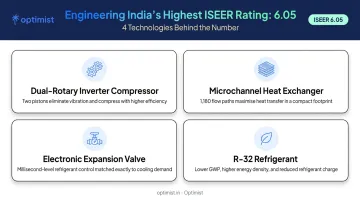
India's Highest ISEER Rating: 6.05
The Optimist 1.4 Ton 5 Star+ Inverter Split AC carries an ISEER of 6.05 — the highest declared seasonal energy efficiency ratio in India as of 2026. Its BEE label shows annual energy consumption of 620.2 kWh, compared to 850–920 kWh for typical 5-star competitors. At ₹5.50 per unit, that difference translates to roughly ₹1,300–₹1,600 in annual savings — compounding significantly over a decade of ownership.
The efficiency comes from four core engineering choices:
- Dual-rotary inverter compressor for sustained low-power operation
- Microchannel heat exchanger with 1,180 flow paths delivering 4× faster heat transfer
- Electronic expansion valve for precise refrigerant metering
- R-32 refrigerant, which carries a lower global warming potential than R-410A
50°C Testing with No Derating
Most competing ACs are rated at 43°C standard ambient. When temperatures exceed that, they progressively reduce cooling output — exactly when Indian homes need cooling most.
Optimist's units are tested to deliver their full rated 4.85 kW cooling capacity at 50°C ambient, with zero derating. For Delhi NCR, Rajasthan, Punjab, and other North Indian markets where May and June routinely push past 45°C, this is the specification that determines whether your AC will actually work during a heatwave.
The Turbo+ Mode extends this further: it delivers the cooling equivalent of a 1.9-ton system on demand — a 135% capacity boost from the 1.4-ton unit — specifically designed for rapidly pulling down a room that has reached 42–50°C after sitting closed through peak afternoon heat.
Transparency-First Smart Features
Optimist's app includes the features that actually matter for Indian AC owners:
- India's first built-in gas level indicator — a real-time colour-coded gauge that shows refrigerant level before cooling performance drops, removing the guesswork (and the service scam risk) from every technician visit
- Live energy meter with projected monthly bills — users see current kWh consumption and estimated month-end cost in real time
- Filter health tracking — time-based reminders for cleaning, with manual confirmation when done
- Intelligent diagnostics — error codes, ODU/IDU health monitoring, and technician booking within 24 hours
Engineering Credentials and Warranty
Performance specs matter. So does long-term durability — especially in India's coastal cities.
Optimist's corrosion protection is certified to 1,000 hours of salt-spray testing under ASTM B368 by SIGMA Test & Research Centre. That is 15 times the typical 72-hour market standard, which makes a concrete difference for buyers in Mumbai, Chennai, and Kochi.
The warranty structure:
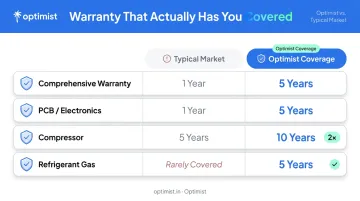
- 5-year comprehensive warranty on outdoor unit components
- 5-year warranty on critical indoor components (PCB, sensors, fan motor, swing motor, evaporator coil)
- 10-year compressor warranty
- 5-year refrigerant gas coverage — parts and labour at ₹0, backed by the built-in gas level indicator
Optimist raised USD 12M in December 2025 from Accel, Arkam Ventures, and Sparrow Capital. For buyers, that means a well-funded service network and a warranty structure backed by a company built to last — not a first-year startup selling on thin margins.
Conclusion
The best inverter AC for an Indian home is not the most heavily advertised one. It is the unit that cools reliably at actual Indian peak temperatures, carries a high ISEER that reflects genuine seasonal efficiency, fits the room correctly, and gives the owner transparent data about what the system is doing.
Indian summers are intensifying, and the gap between an AC designed for these conditions and one that was not will keep growing. Choosing on the right criteria — ISEER rating, ambient performance ceiling, corrosion resistance, and warranty depth — means years of lower electricity bills and reliable cooling through every heatwave. When temperatures cross 48°C in June, the AC you chose in February either holds its rated output or it does not.
Optimist's 1.4 Ton 5 Star+ Inverter AC is built around exactly these criteria: India's highest ISEER rating of 6.05, full rated cooling tested at 50°C with no derate, 1,000-hour salt-spray corrosion certification, and a 10-year compressor warranty. If the buying framework in this guide makes sense to you, it is worth a look at optimist.in.
Frequently Asked Questions
Which is the best 1.5 ton inverter AC in India?
The best 1.5-ton inverter AC depends on your room size, usage hours, and city. For energy efficiency, look for ISEER above 5.5 with a 5-star BEE rating. For extreme-heat cities like Delhi, Nagpur, or Hyderabad, prioritise models that maintain full cooling capacity at 45°C or above, not just units that list an ambient operating range on spec sheets.
Which is the best 5 star inverter AC in India?
Within the 5-star category, ISEER values vary from around 5.0 to 6.05 as of 2026. Always compare the actual ISEER number rather than stopping at the star label. A higher ISEER within the same star band directly translates to lower annual electricity consumption and better long-term savings.
Which company is best for inverter AC?
Established brands like LG, Panasonic, Daikin, and Voltas have strong service networks and reliable products. Newer climate-tech entrants like Optimist offer India's highest ISEER rating (6.05) and engineering tested for 50°C ambient heat. The right choice depends on whether you prioritise service network breadth, energy efficiency, or extreme-heat performance.
Which AC is best for allergies?
Look for inverter ACs with PM 2.5 or finer filtration (some premium models offer PM 0.1 filters). Self-cleaning coil features prevent mould and bacterial growth inside the indoor unit, and filter health monitoring that alerts you when cleaning is overdue keeps airflow consistently clean.
What is a good ISEER rating for an inverter AC in India?
Target ISEER 5.0 or above for good efficiency, and ISEER 5.5 or above for heavy daily use (8+ hours). India's current highest benchmark is ISEER 6.05. The 5-star minimum ISEER threshold has been revised upward over successive BEE cycles, so check the live BEE schedule before purchasing.
How much electricity does an inverter AC use per month?
Monthly consumption depends on ISEER, tonnage, daily hours, set temperature, and outdoor heat. A high-efficiency 1.4-ton AC with ISEER 6.05 consumes around 620 kWh annually, roughly 52 kWh per month on average, though peak summer months run higher. A typical 1.5-ton 5-star unit with ISEER around 5.2 uses closer to 760 kWh annually, about 63 kWh per month.