

The cost of a bad choice compounds over years. According to a BEE household survey, ACs account for 11% of aggregate residential electricity consumption in India, with the country selling 11.47 million room ACs in 2023–24 alone. Efficiency choices made at the point of purchase echo through every electricity bill for the next decade.
This guide covers the decisions in sequence — AC type, room sizing, and the six technical factors every Indian buyer must verify before purchasing.
Key Takeaways
- For most Indian homes, a 5-star BEE-rated inverter split AC with a 52°C ambient temperature rating and stabilizer-free voltage operation is the right baseline
- Pick tonnage first — start with 1 ton per 100–150 sq. ft., then adjust up for top-floor rooms, south/west-facing walls, or high ceilings
- A higher ISEER score directly lowers electricity bills — compare ISEER values, not just star labels
- Inverter ACs cut power consumption significantly at partial load; worth the premium for households running AC 5+ hours daily
- Before buying, confirm compressor warranty length, R-32 refrigerant, and whether authorized service covers your city
Types of Air Conditioners for Indian Homes
For most permanent Indian households, a split inverter AC offers the best combination of efficiency, noise levels, and cooling performance. Here's how all three types compare — so you know exactly what you're choosing and why.
Split AC
A split AC separates the noisy compressor outdoors, keeping the indoor unit quiet — a significant advantage for bedrooms and living rooms. Inverter split ACs are available in 1T, 1.5T, and common configurations suited to most Indian room sizes.
Best suited for:
- Bedrooms and living rooms
- Study rooms and WFH spaces
- Any room where you'll run the AC regularly through a long cooling season
Window AC
A single-unit solution that fits in a wall or window opening. Suited to small rooms under 150 sq. ft. or situations where wall drilling isn't feasible. Downsides: higher noise, fewer 5-star options, and lower energy efficiency than comparable split models.
Portable AC
Plug-and-use units that require no permanent installation — relevant for renters or temporary setups. Portable ACs are the least efficient of the three types and carry no BEE rating in India, making efficiency comparisons impossible. For anyone running an AC regularly through Indian summers, the operating costs add up fast.
How to Calculate the Right AC Capacity for Your Room
AC capacity (measured in tons) determines how much heat the unit removes per hour. Getting this wrong in either direction is costly:
- Undersized AC: Runs continuously at full load, never reaching target temperature on the hottest days, and wears out faster
- Oversized AC: Cools too quickly without adequate dehumidification, leaving rooms feeling damp and clammy
The Indian Sizing Formula
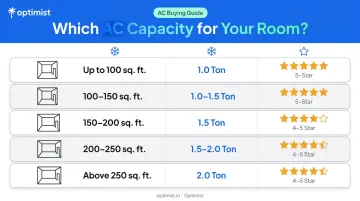
The standard Indian sizing heuristic is 1 ton per 100–150 sq. ft. of room area:
| Room Size | Recommended Tonnage | BEE Rating to Target |
|---|---|---|
| Up to 100 sq. ft. | 1.0 ton | 5-star |
| 100–150 sq. ft. | 1.0–1.5 ton | 5-star |
| 150–200 sq. ft. | 1.5 ton | 4 or 5-star |
| 200–250 sq. ft. | 1.5–2.0 ton | 4 or 5-star |
| Above 250 sq. ft. | 2.0 ton | 4 or 5-star |
India-Specific Adjustment Factors
Standard room size isn't the whole story. Upgrade your tonnage estimate when:
- Top-floor room: Rooftop heat absorption is significant — add 0.5T
- South- or west-facing walls: Direct afternoon sun increases heat load — add 0.25–0.5T
- Ceiling above 10 feet: Add approximately 10% to capacity estimate
- More than two regular occupants: Each person generates body heat — add capacity for larger groups
The 1.5-ton inverter split AC is the most common choice for Indian bedrooms (120–180 sq. ft.). For top-floor rooms, open-plan layouts above 200 sq. ft., or rooms with heavy solar exposure, you'd typically look at 2 tons — though some 1.4T inverter ACs with high-capacity Turbo modes (like Optimist's Turbo+ delivering effective 1.9-ton cooling) can handle these conditions without stepping up to a full 2-ton unit.
A common mistake is buying a smaller unit to save on purchase price. An undersized AC runs at 100% load constantly, failing to cool adequately during peak heat and consuming more electricity in the process. The upfront saving disappears within a season or two of higher electricity bills.
Key Factors to Consider When Choosing an AC in India
Room sizing gets you to the right tonnage. These six factors determine whether the AC actually performs in real Indian conditions — extreme heat, voltage instability, coastal humidity, and long cooling seasons make each one decisive.
Energy Efficiency: BEE Star Rating and ISEER Score
India's BEE (Bureau of Energy Efficiency) rates room ACs on a 1–5 star scale. The underlying metric is ISEER — Indian Seasonal Energy Efficiency Ratio — calculated as cooling load delivered over a season divided by energy consumed.
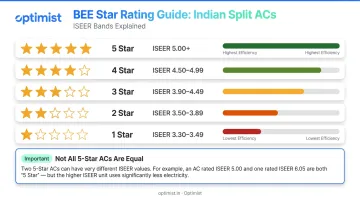
The verified BEE split-AC ISEER bands (as of the 2022–2024 schedule) are:
| Star Rating | ISEER Range |
|---|---|
| 1 Star | 3.30–3.49 |
| 2 Star | 3.50–3.79 |
| 3 Star | 3.80–4.39 |
| 4 Star | 4.40–4.99 |
| 5 Star | 5.00 and above |
A critical practical point: **two 5-star ACs can have meaningfully different ISEER values** within that band. An AC with ISEER 5.1 and one with ISEER 6.0 both carry 5-star labels, but the latter will deliver significantly lower electricity consumption across a 180-day Indian cooling season. Compare ISEER figures directly, not just star labels.
To put the gap in numbers: BEE's modelling shows that raising ISEER from 3.10 to 3.74 reduces annual consumption by approximately 267 kWh for a typical load profile — and the gap between a 3-star and a high 5-star unit is larger still. India's highest ISEER-rated AC currently holds a rating of 6.05 (Optimist), offering the lowest electricity bills of any BEE-rated unit in the country.
Inverter vs. Non-Inverter Technology
An inverter compressor continuously varies its speed to match cooling demand. A non-inverter (fixed-speed) compressor has only two states: fully on or fully off, always drawing maximum power when running.
Mint's reporting of BEE data shows inverter AC share grew from 1% in 2015–16 to 99% in 2022–23 — the Indian market has effectively made this choice already.
The efficiency advantage of inverter technology is clearest at partial load: once a room reaches target temperature, an inverter AC maintains it at a fraction of full power rather than cycling on and off repeatedly. This matters especially during the long nighttime hours when rooms need maintenance cooling rather than full pull-down.
For any household running the AC 5 or more hours daily, inverter is the right choice. Non-inverter ACs are only worth considering for very light usage under 4 hours a day.
Ambient Temperature Rating: Performance in Peak Indian Heat
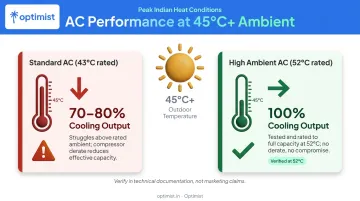
Most ACs are tested and rated for a maximum outdoor operating temperature of 43°C. When outdoor temperatures exceed this — a regular occurrence across northern and central India — many units derate: they automatically reduce cooling output to protect the compressor.
The practical impact: on the hottest afternoon of the year, when you need full cooling power, an under-rated unit may be running at 70–80% of its stated capacity.
For most Indian states, look for a minimum 52°C ambient temperature rating verified in the product's technical documentation. Don't rely on marketing claims alone — request the specific standard, test condition, retained capacity percentage, and model-specific test report. As a reference point, Optimist's units are tested at 50°C with full rated output and no derate, which illustrates what verified performance documentation actually looks like.
Voltage Tolerance: Stabilizer-Free Operation
Voltage fluctuations affect supply quality across many Indian cities and towns. ACs without adequate tolerance either need a separate stabilizer — adding cost and a failure point — or risk compressor damage over time.
Look for ACs that operate stabilizer-free across a voltage range of at least 140V to 280V. This feature is standard in most inverter split ACs today but varies by model — manufacturer examples range from 120–290V (LG) to 160–280V (Voltas). Always verify the specific model datasheet; don't assume.
Refrigerant Type and Coastal Durability
R-32 is the preferred refrigerant for new Indian AC purchases. Compared to the older R-410A:
| Attribute | R-32 | R-410A |
|---|---|---|
| 100-year GWP (IPCC AR4) | 675 | 2,088 |
| Safety class | A2L | A1 |
| Efficiency | Better than R-410A equivalents | Baseline |
R-32's significantly lower global warming potential and better thermodynamic performance make it the right choice environmentally and operationally. Verify that any shortlisted model uses R-32.
Beyond refrigerant type, the outdoor unit's physical durability is a separate concern — especially for coastal buyers. In coastal cities — Mumbai, Chennai, Kolkata, Kochi, Visakhapatnam — salt air corrodes outdoor heat exchangers over time if they lack adequate protection. Look for units with anti-corrosion coatings and ask specifically about salt spray testing duration and the certification body. The market standard is typically 72 hours; premium units go significantly further.
Optimist's outdoor unit heat exchanger, for example, undergoes 1,000 hours of ASTM B368 acetic acid salt spray testing, certified by SIGMA Test & Research Centre — roughly 14–15 times more rigorous than the typical market standard. The test was conducted on the actual aluminium microchannel heat exchanger with zero corrosion or functional degradation detected.
Warranty Coverage and After-Sales Service
Warranty terms vary considerably. Look for:
- At least 1-year comprehensive coverage including parts and labour
- At least 5-year compressor warranty as a baseline
- Gas/refrigerant coverage confirmed in writing — often excluded in standard terms
Read the exclusions carefully. Many warranty claims that cover the compressor still charge the customer for labour, gas, and transport. The headline number of years means less than what's actually covered.
Service network availability matters more than specs on paper. An AC with an excellent 10-year warranty but no authorized service center in your city becomes a problem at the first maintenance need. Confirm service center availability in your specific city before purchasing.
Why Optimist Is the Right AC for India's Real Summers
Optimist is a climate tech company founded specifically to address extreme Indian heat — its AC is engineered from the ground up for Indian conditions, not adapted from global specifications. Designed and validated at the Nalanda I Lab in Delhi with technical collaboration from IIT Delhi, it launched in January 2026 as India's highest ISEER-rated AC.
Key specifications relevant to this buying guide:
- ISEER 6.05 — certified 5-star+ rating, with annual energy consumption of just 620.2 kWh
- Tested at 50°C ambient — full rated cooling with no derating, validated at the Nalanda I Lab
- R-32 refrigerant with dual-rotary inverter compressor
- Microchannel heat exchanger with 1,180 flow paths and 4× faster heat transfer vs. conventional ACs
- 1,000-hour salt spray corrosion testing (SIGMA certified, 15× the typical 72-hour market standard)
- Turbo+ Mode — 135% capacity boost delivering 1.9 tons of effective cooling on demand, ideal for walking into a room at 42°C after an afternoon of Delhi heat
- India's first built-in gas level indicator — shows live refrigerant levels in the Optimist App, eliminating the gas top-up scam
- Real-time energy tracking and projected monthly bills via the Optimist App (iOS + Android)
- Intelligent remote diagnostics — error code identification and remote fault diagnosis without a technician visit

Warranty coverage:
- 5-year all-inclusive warranty on outdoor unit components
- 5-year coverage on critical indoor components (PCB, sensors, fan motor, evaporator coil)
- 5-year refrigerant gas coverage
- 10-year compressor warranty
Optimist currently serves Delhi NCR, Bengaluru, Mumbai, Pune, Hyderabad, Chennai, Kolkata, Ahmedabad, and a growing list of Tier-2 cities. Explore Optimist at optimist.in.
Conclusion
Choosing the right AC is a multi-year financial and comfort decision. The unit you buy today will determine how well your rooms cool on the worst days of summer 2026, 2027, and beyond — and how large your electricity bills are every month for the next decade.
The four non-negotiables for Indian buyers:
- Correct tonnage for your specific room, adjusted for floor, orientation, and occupancy
- 4- or 5-star BEE rating with a verified ISEER score — compare the number, not just the label
- Inverter technology for anyone running the AC more than 4–5 hours daily
- Minimum 50°C ambient temperature rating — verified in technical documentation, not marketing material
Refrigerant type, voltage range, corrosion testing, and warranty depth build on this foundation. Optimist's 1.4 Ton 5 Star+ Inverter Split AC was built around exactly this framework — ISEER 6.05, tested at 50°C with no performance drop, and 1,000-hour corrosion certified.
One more thing: AC performance deserves a check-in every year. Before each summer:
- Compare your actual electricity consumption against the model's rated annual kWh
- Schedule pre-summer servicing before peak heat arrives
- Track filter health — a clogged filter quietly erodes efficiency
- Reassess cooling output as occupancy or usage patterns shift
Frequently Asked Questions
How to choose the best AC for home in India?
The best AC for most Indian homes is a 5-star BEE-rated inverter split AC with correct tonnage for the room, a 50°C ambient temperature rating, and stabilizer-free voltage operation.
Which is better, 1.5 ton or 2 ton AC?
A 1.5-ton AC suits most Indian bedrooms (120–180 sq. ft.), while a 2-ton unit is recommended for rooms above 200 sq. ft., top-floor rooms, or spaces with west- or south-facing walls. Choosing the larger size for a small room wastes electricity without improving comfort.
Is AC good for BP patients?
Air conditioning can support comfort for people with blood pressure conditions by reducing heat stress. A moderate temperature setting of 24–26°C is generally advised rather than excessively low temperatures. Consult a physician for personalized medical guidance.
What is the ideal BEE star rating for an AC in India?
A 4- or 5-star rating is the right target for households using the AC 5 or more hours daily. The higher ISEER score translates to meaningful electricity savings across a 180-day Indian cooling season; in most cases, the price premium pays for itself within 2–3 years.
Should I buy an inverter AC or a non-inverter AC?
Inverter ACs are the better choice for most Indian households: lower power consumption at partial load, quieter operation, and longer compressor lifespan. Non-inverter ACs are worth considering only for very light usage under 4 hours daily or highly budget-constrained purchases.