

The wrong split AC in these conditions doesn't just underperform. It runs continuously without cooling the room, spikes your electricity bill, and degrades faster. The right one needs to handle voltage fluctuations, humidity, roof-heat gain, and outdoor temperatures that standard lab tests don't simulate.
This guide covers the six factors that separate a genuinely suitable AC from one that looks good on paper but struggles on your worst summer days.
Key Takeaways
- A 1.5-ton 5-star inverter split AC suits most Indian bedrooms (150–180 sq ft) — go higher for top-floor rooms or high-heat states.
- ISEER, not just the star count, determines actual running costs — compare ISEER values directly between models.
- Verify the ambient temperature rating: your AC must cool at 50°C, not just the lab standard of 35°C.
- Smart features like gas level monitoring and real-time energy tracking prevent expensive surprises.
- Five-year total cost of ownership matters far more than the sticker price.
What Is a Split AC?
A split AC is a two-unit system. The indoor unit — containing the air handler and evaporator coil — mounts on your wall. The outdoor unit — compressor, condenser, and fan — sits outside. The two are connected by refrigerant piping and electrical cables.
This separation keeps compressor noise and heat outside the room, which is why split ACs are significantly quieter than window ACs during operation.
Types Available in India
Indian buyers typically encounter three variants:
- Inverter split AC — variable-speed compressor that adjusts to cooling demand; best energy efficiency for daily use
- Fixed-speed split AC — on/off compressor with lower upfront cost, but electricity bills run higher over time
- Multi-split systems — one outdoor unit serving multiple indoor units, suited for larger homes
For most Indian bedrooms and living rooms, a single-unit inverter split AC is the right call — and that's what this guide covers.
Why Split ACs Are Preferred
Split ACs consistently outperform window and portable units on the factors that matter most to homeowners:
- Quieter operation (compressor stays outdoors)
- Better energy efficiency — 5-star inverter models can cut electricity bills by 25–35% versus fixed-speed units
- Flexible indoor placement — not limited to window openings
- Cleaner look for a fixed home setup
How to Choose the Best Split AC for Your Home
Six factors determine whether a split AC actually works in Indian conditions — not just whether it has impressive specs on the box.
Factor 1: Room Size and Correct Tonnage
Tonnage is the most consequential decision. An undersized AC runs non-stop without reaching target temperature. An oversized one short-cycles, leaving the room feeling damp and never fully dehumidifying.
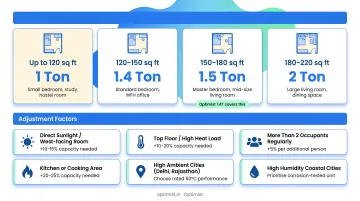
A widely used retail thumb rule in India is roughly 1 ton per 150 sq ft:
| Room Size | Starting Tonnage |
|---|---|
| ~100 sq ft | 1 ton |
| ~150 sq ft | 1.5 ton |
| ~200 sq ft | 1.5–2 ton |
| 250+ sq ft | 2 ton |
These are starting points, not fixed rules. Indian-specific adjustments most buyers miss:
- Top-floor rooms — add 0.5 ton for roof heat gain
- West- or south-facing walls — add 0.25–0.5 ton for solar load
- Ceilings above 10 feet — add roughly 10% to tonnage
- More than two regular occupants — add for higher body heat load
If your room has two or more of these factors, treat sizing as a heat-load calculation, not a formula.
Factor 2: Energy Efficiency — ISEER and BEE Star Rating
ISEER (Indian Seasonal Energy Efficiency Ratio) measures the ratio of total seasonal cooling output to total energy consumed across a typical Indian cooling season — calculated over 1,600 cooling hours per year, per BEE's label framework. Unlike a single lab test point, it reflects actual seasonal use patterns.
The BEE star rating threshold for split ACs currently stands at ISEER 5.00 and above for 5-star (per the official BEE table). But two models can both be 5-star with meaningfully different ISEER values — and that difference shows up directly in your electricity bill.
How to use this practically:
- Pull the ISEER value off the BEE energy label on the unit
- Multiply annual BEE label units (kWh) by your state's per-unit tariff to estimate running costs
- Compare models by ISEER number, not just star count
Only 14% of Indian households have purchased 4- or 5-star ACs, with 93% citing upfront cost as the barrier. Over a full 5–7 month cooling season, the efficiency gap between a 3-star and 5-star model adds up significantly — calculate it against your specific state tariff before deciding.
Factor 3: Inverter vs Fixed-Speed Compressor
A fixed-speed compressor runs at full power and switches on/off to maintain temperature. An inverter compressor continuously varies its speed to match actual cooling demand — staying on at low power when the room is near target temperature, ramping up only when needed.
The practical difference in hot climates is measurable. A peer-reviewed study found inverter AC annual consumption at 3,471 kWh versus 6,230 kWh for non-inverter — roughly 44% lower. Most of your cooling season is partial-load operation, not peak demand, and inverter compressors handle that far more efficiently.
For Indian users running their AC 6+ hours daily across a long summer, the advantages compound:
- Lower electricity consumption during the majority of operating hours
- Quieter during steady-state operation (compressor runs slower)
- Fewer hard start-stop cycles, which reduces mechanical stress
The trade-off: inverter ACs cost more upfront and include PCB electronics that require good service support. Check PCB warranty terms, not just compressor warranty.
Factor 4: High Ambient Temperature Performance
Most buyers never check this spec — and pay for it in peak summer. Standard BEE star ratings are calculated under lab conditions with an outdoor temperature of 35°C dry bulb. The Indian seasonal model uses an outdoor bin range up to 43°C. But peak summer temperatures in Rajasthan, Delhi, UP, MP, and parts of Telangana regularly exceed 45°C — sometimes reaching 48°C.
At these temperatures, many ACs "derate" — they drop cooling output or trip entirely. The result: your AC stops working hardest exactly when you need it most.
What to check on the spec sheet:
- Look for a maximum outdoor operating temperature of 50°C or higher
- Ask specifically whether the unit maintains rated capacity at 50°C, or merely survives (doesn't trip) at that temperature — these are very different claims
- An AC that operates at 50°C but delivers only 70% of rated cooling still leaves you short on the worst days
This spec is rarely highlighted by retailers. Ask for it directly.
Factor 5: Smart Features and Connectivity
Smart features are not luxury add-ons in Indian conditions — several solve real problems that affect running costs and appliance life.
Features that add genuine value:
- Real-time electricity consumption tracking — eliminates bill shock; lets you see daily kWh and projected monthly cost in rupees
- Gas level indicator — refrigerant leaks are common in Indian conditions and often go undetected for months; an indicator that flags low gas prevents the compressor damage that follows
- Filter health alerts — especially important in dusty Indian cities; dirty filters reduce cooling and increase energy use
- Wi-Fi/app control with scheduling — lets you pre-cool a room before you arrive rather than waiting 20–30 minutes
Beyond energy management, a few features address comfort problems specific to Indian seasons and climates.
Features that improve comfort in specific Indian conditions:
- Turbo/Quick Cool mode — rapid cool-down when entering a hot room
- Dry/Dehumidification mode — useful during monsoon season and in coastal cities
- Sleep mode or scheduling — manages overnight temperature without running at full capacity all night
Factor 6: Warranty, Service Network, and Long-Term Support
Warranty terms are a financial decision. A compressor replacement in India typically costs ₹8,500–₹13,000 in parts plus ₹4,500 in labour (based on Urban Company service pricing for a 1.5-ton unit) — outside warranty, that's a significant expense in year 3 or 4.
What to look for:
- Minimum 5-year compressor warranty; 10-year is available from several brands including Daikin, LG, and Blue Star
- Understand whether "comprehensive" covers refrigerant recharges, PCB/electronics, and labour — not just parts
- Check AMC (Annual Maintenance Contract) availability for years after the standard warranty
A strong warranty means little if a technician can't reach you within a reasonable timeframe.
Service network check: Before buying, verify that the brand has authorised service in your city. Search for the brand's service locator, check response time reviews, and confirm availability of spare parts locally. A technically superior AC with poor local service support becomes a liability when something goes wrong.
Split AC Features That Actually Matter for Indian Homes
Refrigerant Type: R-32
R-32 has become the preferred refrigerant for Indian split ACs, replacing older R-22 and R-410A. Key reasons:
- Lower GWP: R-32 has a 100-year GWP of 675, versus 2,088 for R-410A and 1,810 for R-22
- India's HCFC phase-out is already underway — R-22 systems face a 100% phase-out by 2030; HFC phase-down will affect R-410A starting 2032
- Better performance at high ambient temperatures
Confirm R-32 on the spec sheet before buying. Avoid any new unit still using R-22.
Corrosion Resistance
In coastal cities and high-humidity regions, the outdoor unit's heat exchanger corrodes over time from salt air and moisture. This degrades heat transfer efficiency gradually — meaning the AC seems to run, but delivers noticeably less cooling per unit of electricity.
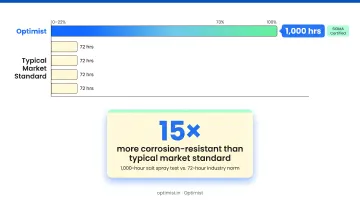
Ask brands what corrosion testing their outdoor units undergo. Standard market testing is typically 65–70 hours of salt spray. Some manufacturers test at 1,000 hours or more — roughly 15× that baseline — which makes a real difference in coastal and high-humidity regions.
Voltage Tolerance
Voltage fluctuations remain common in smaller Indian cities and during peak grid load. An AC with a wide operating range — 140V–280V — eliminates the need for an external stabiliser (which costs approximately ₹2,500–₹4,500) and protects the compressor from damage during fluctuations.
Check the operating voltage range on the spec sheet. If it requires a stabiliser, factor that into the total purchase cost.
How Optimist AC Is Built for India's Real Summers
Optimist is an AC brand built from first principles specifically for Indian heat conditions, not adapted from global specifications. Developed at the Nalanda 1 R&D Lab with IIT Delhi advisory support, the engineering focus was on the performance gaps that standard ACs expose during Indian peak summer.
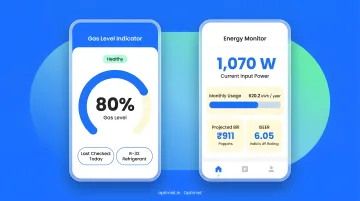
Energy efficiency: Optimist claims an ISEER of 6.05 — above the official BEE 5-star threshold of 5.00. The company positions this as India's highest ISEER-rated AC, which translates to electricity savings of 25–35% compared to standard units — verifiable through the app's real-time kWh tracking, projected monthly bills in rupees, and year-on-year comparisons.
50°C performance: The unit is tested to maintain its rated cooling capacity at 50°C outdoor temperatures without derating. This directly addresses the most common failure point of standard ACs — the performance drop that happens precisely on India's hottest days. A microchannel heat exchanger delivers 4× faster heat transfer, enabling sustained output even when temperatures outside are at their worst.
That performance edge extends to day-to-day ownership. Optimist includes what it describes as India's first gas level indicator — a feature that flags refrigerant loss before it causes compressor damage. The app also covers filter health tracking, energy monitoring with monthly bill projections, and scheduling for pre-cooling.
On reliability and ownership, the terms are specific:
- Outdoor unit: 1,000 hours of corrosion testing — 15× the typical market standard
- Warranty: 5 years all-inclusive on outdoor unit components, 10-year compressor coverage
- Refrigerant gas: covered at ₹0 for 5 years
- Installation: performed exclusively by authorized Optimist technicians, maintaining warranty eligibility from day one
Conclusion
Choosing the right split AC for an Indian home comes down to four verifiable factors: correct tonnage for your actual room conditions, a high ISEER value (not just a star label), confirmed cooling performance at 50°C ambient, and warranty terms you've actually read.
An AC purchase here is a 5–10 year commitment. The specifications that matter are the ones that hold up on the hottest afternoon of May, not in a showroom at 25°C. Match the spec sheet to your real conditions — top floor, city heat, daily usage hours — and you'll have a short list fast.
If you want a reference point for what those specs look like in practice, Optimist's split AC carries India's highest ISEER rating (6.05), is tested to perform at 50°C without derating, and comes with a 10-year compressor warranty — built specifically for the conditions this guide describes.
Frequently Asked Questions
What tonnage split AC do I need for a 150 sq ft room in India?
A 1.5-ton inverter split AC is the standard recommendation for 150 sq ft. If the room is on the top floor, has west-facing walls, or is in a high-ambient region like Rajasthan or Delhi, move up to 2 ton to avoid the AC running continuously without reaching target temperature.
What is a good ISEER rating for a split AC?
ISEER 5.00 and above qualifies as 5-star under the current BEE standard. Higher ISEER values translate directly to lower electricity bills — two 5-star models can have different ISEER numbers, and that gap compounds across a 5–7 month cooling season. Always compare the actual ISEER value rather than relying on the star label alone.
Is a 5-star inverter split AC worth the extra cost?
For households using their AC 6+ hours daily over a long Indian summer, the electricity savings from a 5-star model recover the price premium within 2–3 seasons. The longer your daily usage, the faster the payback.
What does ambient temperature rating mean for a split AC?
Ambient temperature rating is the maximum outdoor temperature at which the AC can maintain its rated cooling capacity. Look for 50°C or higher — many standard ACs begin derating above 43°C, losing cooling output exactly when Indian summers peak.
How often does a split AC need servicing in India?
Plan for professional servicing at least once before summer and once after the season. In dusty cities, clean filters every 4–6 weeks. ACs with app-based filter health alerts and automated diagnostics make it easier to stay on schedule.
What is the difference between inverter and fixed-speed split AC?
An inverter AC adjusts compressor speed continuously to match cooling demand, making it more efficient, quieter, and easier on the compressor. A fixed-speed unit runs at full power and cycles on/off — it costs less upfront, but draws more electricity for typical Indian usage patterns.