
Introduction
Summers in India keep getting longer, hotter, and harder on electricity bills. In 2024, India recorded its warmest year since 1901, with average temperatures running 0.65°C above the 1991-2020 baseline.
As a result, "what is an inverter AC" has become one of the most searched questions among Indian homebuyers upgrading their cooling systems.
Many shoppers walk into this decision confused. Sellers throw around terms like variable-speed compressor, ISEER, and star ratings without context, and that confusion often leads to picking the wrong AC for the room, the budget, or the climate.
This guide breaks down what an inverter AC actually means and how it works. You'll also learn how it differs from a fixed-speed unit and what to check before buying one that can handle a real Indian summer.
Key Takeaways
- Inverter ACs use a variable-speed compressor that adjusts output instead of switching on and off
- They run quieter, hold steadier temperatures, and consume less electricity over a cooling season
- ISEER rating, not star rating alone, is the clearest indicator of real-world efficiency
- Room size, ambient heat tolerance, and warranty terms matter as much as compressor type
What is an Inverter AC?
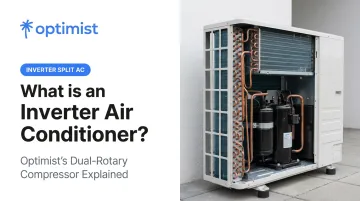
An inverter AC is a cooling system built around a variable-speed compressor. Instead of running at one fixed power level and shutting off completely, it continuously adjusts its motor frequency to match how much cooling the room actually needs at that moment.
The compressor is the heart of any air conditioner. In an inverter unit, a Variable Frequency Drive (VFD) regulates the electrical frequency supplied to the compressor motor, letting it speed up during heavy heat load and slow down once the room nears the set temperature. This is the core mechanical difference from older AC designs.
Understanding the Split System
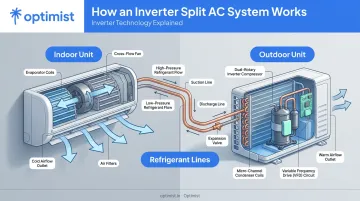
Most inverter ACs sold in India are inverter split ACs, a two-part setup:
- Indoor unit: distributes cooled air into the room
- Outdoor unit: houses the inverter-controlled compressor and condenser coils
- Refrigerant lines: copper piping that carries coolant between the two units
One clarification worth making upfront: "inverter" here has nothing to do with a home power-backup inverter or battery. It refers purely to how the compressor motor is controlled, not to any electricity storage device.
Why ISEER Matters More Than the Star Alone
Better inverter engineering shows up as a higher ISEER (Indian Seasonal Energy Efficiency Ratio) score. The Bureau of Energy Efficiency defines ISEER using 1,600 cooling hours per year as the standardised basis for the label, meaning it reflects a full cooling season, not just a lab snapshot.
For the current rating period, a 5-star split AC needs an ISEER of 5.00 or above, with no upper cap. Optimist's 1.4 Ton Inverter Split AC carries an ISEER of 6.05, currently India's highest. That gap exists because the same variable-speed control makes strong ISEER scores possible.
How Does an Inverter AC Work?
The Dimmer Switch vs Light Switch Analogy
Think of a non-inverter AC as a light switch: fully on, or fully off. There's no in-between.
An inverter AC behaves more like a dimmer switch. It continuously modulates its output, running exactly as hard as the room requires at any given moment, rather than snapping between two extremes.
Step-by-Step Working Mechanism
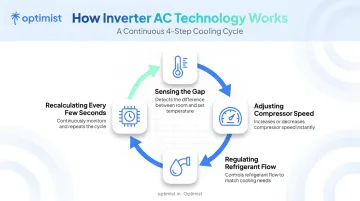
Here's what actually happens inside the unit:
- Sensing the gap — Internal sensors constantly measure the difference between the current room temperature and the temperature you've set.
- Adjusting compressor speed — When that gap is large (say, walking into a room at 38°C), the compressor speeds up to cool faster. As the room nears the target, it slows down.
- Regulating refrigerant flow — Refrigerant circulation adjusts in tandem with compressor speed: more flow during high-speed cooling, less during steady-state maintenance.
- Recalculating every few seconds — A microprocessor control board reassesses the required output repeatedly, keeping the system stable instead of overshooting or undershooting the set temperature.
There's a real efficiency reason behind all this modulation. Mitsubishi Electric notes that inverter compressors use a soft start with very low rush current, compared to the sudden current spike a conventional compressor pulls every time it restarts.
Because an inverter compressor rarely needs a full restart, it avoids that repeated stress altogether. That's one reason inverter units tend to run smoother over years of use.
Optimist's approach layers onto this same principle. Its Dual-Rotary Inverter Compressor pairs with a micro-channel heat exchanger built on 1,180 flow paths, engineered for roughly 4× faster heat transfer than a conventional coil.
That efficient heat transfer is part of what powers Turbo+ mode, which can pull a 42°C room down to 25°C quickly, without relying on brute fixed-speed power.
Inverter AC vs Non-Inverter AC: What's the Difference?
The compressor is where everything else stems from.
| Factor | Non-Inverter AC | Inverter AC |
|---|---|---|
| Compressor type | Fixed-speed; full power, then off | Variable-speed; continuous modulation |
| Energy use | Higher, driven by repeated full-power cycles | Model-specific, generally lower over a season |
| Temperature stability | Noticeable swings between cycles | Narrower, steadier band |
| Noise | Louder at each restart | Quieter most of the time |
| Wear on components | More stress from frequent on-off cycling | Smoother load reduces cycling stress |
Compressor behaviour drives every other difference in the table above. A non-inverter unit runs at one fixed power level until the room hits the set temperature, then shuts off entirely, only to restart at full power again once the room warms up. An inverter compressor never needs that repeated full restart; it just throttles down.
Energy consumption comparisons work best model-to-model, using each unit's BEE-labelled annual kWh figure rather than a blanket industry percentage. No single verified India-wide savings number applies uniformly across brands and capacities.
Optimist's 1.4 Ton unit, for reference, is rated at 620.2 kWh annual consumption against a 4.85 kW cooling output, a figure worth comparing directly against any non-inverter alternative you're considering.
Temperature consistency and noise follow naturally from the compressor difference. Fixed-speed units cool the room, cut off, let it drift warmer, then blast back on, producing swings you can feel and hear. Inverter units hover closer to your set point continuously.
Cost trade-off: inverter ACs usually cost more upfront. That difference gets recovered over time through lower running costs, a period commonly called the payback period. The exact number of years depends on:
- Your daily usage hours
- Your local electricity tariff
- The specific models being compared
There's no universal payback figure worth quoting; it's a calculation you run with your own numbers.
Key Benefits of Choosing an Inverter AC
- Lower electricity bills: The compressor rarely runs at full blast, so long summer runtimes cost less than on a fixed-speed unit. Optimist's app shows live kWh usage and a projected monthly bill, turning an abstract "efficiency" claim into a number homeowners can see — for example, a mid-month reading of 82 kWh (₹986 accrued) forecasts the full month's cost.
- Wider voltage tolerance: Many inverter models keep running through the voltage dips and surges common on Indian household grids, rather than tripping out or underperforming.
- Better dehumidification: Continuous low-speed operation pulls moisture out of the air more evenly than a unit that's cycling fully on and off, which is why humid-region users often notice less "sticky" cooling.
- Eco-friendly refrigerants: Most modern inverter models, including Optimist's, use R-32, a refrigerant with a lower Global Warming Potential than older options like R-22. India's HFC phase-down schedule targets an 85% reduction from baseline by 2047, so choosing a lower-GWP refrigerant now is a reasonable long-term hedge, even though R-32 isn't zero-impact.
How to Choose the Right Inverter AC for Your Home
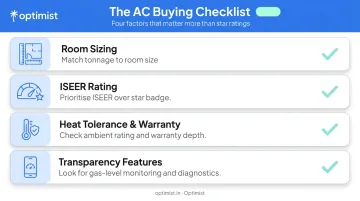
Choosing the right inverter AC comes down to four often-overlooked factors that matter for most homes: correct sizing, verified efficiency, heat resilience, and ownership transparency. Here's what actually matters when comparing units:
- Match tonnage to your actual room, not just its square footage. Sunlight exposure, insulation, and occupancy affect real cooling load — oversized units short-cycle, undersized ones run flat-out. Optimist's 1.4 Ton unit suits 120–200 sq. ft. rooms, and its Turbo+ mode pushes output to roughly 1.9 tons, positioning it as a 1.5 Ton alternative.
- Prioritise ISEER over the star badge alone. Two 5-star ACs can have meaningfully different ISEER numbers. Optimist's 6.05 rating points to superior real-world efficiency, not just a passing lab grade.
- Check heat tolerance and warranty depth. Many ACs derate — quietly cooling less — once ambient temperatures cross 43°C. Optimist is government-lab tested to hold its rated capacity at 50°C ambient, which matters directly for North Indian summers, and backs the unit with a 5-year comprehensive warranty plus 10-year compressor coverage.
- Look for transparency features that simplify ownership. Gas-level monitoring, scheduling, and app-based diagnostics turn guesswork into visibility. Optimist's built-in gas-level indicator shows refrigerant status directly in the app, closing the door on the common "your gas is low, pay for a refill" scam many Indian AC owners have faced.
Frequently Asked Questions
Is an inverter AC better than a regular AC?
Inverter ACs generally run more efficiently and more quietly than fixed-speed models, with steadier cooling throughout the day. They do cost more upfront, but that gap typically closes over time through lower running costs.
Which inverter AC is best for a home?
It depends on your room size and the model's ISEER rating, with warranty support as an added factor. Prioritise high-ISEER models tested for your local climate rather than choosing on price alone.
What is an inverter AC?
An inverter AC is a cooling system with a variable-speed compressor that adjusts its output to match the room's actual cooling demand, rather than cycling fully on and off like a fixed-speed unit.
Are inverter ACs safe?
Certified inverter ACs sold in India must meet BIS electrical safety standards under IS 1391 (Part 2), covering leakage current and high-voltage testing among other checks. Many also include wide voltage tolerance for added stability.
How much electricity can an inverter AC save compared to a non-inverter AC?
Savings vary by model and usage pattern, plus your local climate, so comparing each unit's BEE-labelled annual kWh figure is more reliable than a generic percentage. Optimist's ISEER 6.05 model is built to use noticeably less power than typical 5-star units.
Do inverter ACs work well during power fluctuations?
Most inverter ACs are designed with a wider voltage operating range than older fixed-speed units, helping them function more reliably during common household voltage swings. Always check the specific model's rated voltage tolerance before buying.