
Introduction
If you're searching for a 1.5 ton inverter split AC for a 200 sqft room, you're in good company. This is one of the most common AC-buying combinations in India, and it's also one of the easiest to get wrong.
Buy too big, and you'll deal with a clammy room and a short-cycling compressor. Buy too small, and your AC will run flat-out all summer, pushing your bills up and your compressor to its limits.
Add rising electricity tariffs and unpredictable 45°C+ heatwaves into the mix, and the stakes of picking the right AC feel higher than ever.
This review walks through capacity fit, why inverter tech matters, and the features worth paying for. It also takes a detailed look at Optimist's 1.4 ton inverter split AC as a 1.5 ton alternative, with real running cost math for a 200 sqft room.
Key Takeaways
- A 200 sqft room sits squarely in the 1.5 ton capacity zone per most Indian sizing charts
- High-ISEER inverter ACs can cut electricity bills by 25-35% versus standard 5-star models
- ISEER rating, coil material, and warranty length matter more than tonnage alone
- Optimist's 1.4 Ton AC carries India's highest ISEER of 6.05, with Turbo+ mode boosting cooling to 1.9 Tons, tested at 50°C ambient
Is 1.5 Ton the Right AC Capacity for a 200 Sqft Room?
AC capacity is measured in tons of refrigeration. 1 ton equals 12,000 BTU/h, roughly 3,517 watts of cooling output. Bigger rooms need more tonnage to remove heat fast enough to keep temperatures stable.
Indian manufacturers publish area-based sizing charts to simplify this decision. Here's a typical one:
| Room Area | Suggested Capacity |
|---|---|
| Up to 150 sqft | 1 Ton |
| 151–250 sqft | 1.5 Ton |
| 251–400 sqft | 2 Ton |
Based on this, Haier's sizing guide places a 200 sqft room comfortably in the 1.5 ton band, assuming standard 8-9 ft ceilings.
That said, not every manufacturer agrees. Panasonic's own sizing recommendation for its 1.5 ton model tops out around 170 sqft, which means your specific room conditions matter more than the chart alone.
Factors That Shift the Right Tonnage
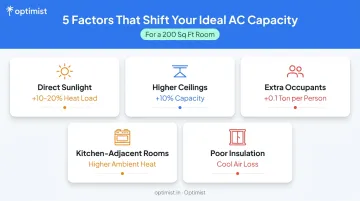
Even at exactly 200 sqft, several things can push your ideal capacity up or down:
- Direct sunlight on south- or west-facing walls can raise heat load by 10-20%
- Higher ceilings (above 9 ft) typically need roughly 10% more capacity
- Extra occupants beyond two people add heat, roughly 0.1 ton each
- Kitchen-adjacent rooms run hotter due to shared walls and ambient heat
- Poor window/door insulation lets cool air escape faster than it should
Common Sizing Mistakes to Avoid
Oversizing feels like the "safe" choice, but it isn't. An oversized unit cools the room too quickly, shuts off before properly removing humidity, then switches back on, leaving the room cold but sticky.
Undersizing is worse for the machine itself: the compressor runs at maximum output nonstop, straining components and inflating your bill.
Here's the good news for 200 sqft buyers: inverter compressors modulate speed instead of switching on and off, giving them far more tolerance for slight over- or undersizing than fixed-speed units.
Optimist takes this a step further. Its 1.4 Ton unit ships with Turbo+ mode, pushing cooling output to an effective 1.9 tons on demand and matching a standard 1.5 ton AC's cooling power in a 200 sqft room, then settling back to run on India's highest ISEER rating of 6.05 once the space cools.
Why Inverter Technology Is a Must-Have for 200 Sqft Cooling
The core difference between inverter and non-inverter ACs comes down to compressor behaviour. Non-inverter compressors run at one fixed speed, switching fully on and fully off to hold temperature. Inverter compressors instead vary their speed continuously, ramping up when the room's hot and easing off once it's cool.
For a 200 sqft room, this translates into:
- Steadier temperatures with no repeated hot-cold swings through the afternoon
- Lower start-up power draw, since the compressor doesn't slam to full load every cycle
- Quieter operation once the room reaches setpoint and the unit throttles down
Understanding ISEER
ISEER stands for Indian Seasonal Energy Efficiency Ratio. It's BEE's standardised method for measuring how much cooling a unit delivers per unit of energy consumed across a full Indian cooling season, using 1,600 operating hours and outdoor temperature bins from 24°C to 43°C. A higher ISEER means the same room gets cooled using less electricity over the season.
Under BEE's 2022-2024 rating bands, 5-star split ACs carry an ISEER of 5.00 or higher, while 3-star models sit around 3.80-4.39. In practice, current 2025 model listings show 5-star units labelled anywhere from about 5.20 upward, so it pays to check the exact ISEER figure, not just the star count.
| Factor | Inverter AC | Non-Inverter AC |
|---|---|---|
| Compressor type | Variable speed | Fixed speed, on/off |
| Energy consumption | Lower for same cooling | Higher for same cooling |
| Noise levels | Quieter after setpoint | Louder, constant cycling |
| Temperature stability | Consistent | Fluctuates between cycles |
| Typical lifespan | Longer, less start-stop stress | Shorter under heavy daily use |
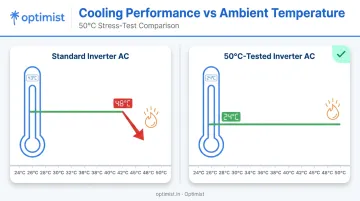
One key caveat: most standard inverter ACs are only tested up to 43°C under BEE's method, and many reduce cooling capacity once ambient temperatures climb past that. This matters a lot for North Indian summers, where 45-48°C afternoons are common. Only a handful of models are specifically engineered and tested to hold full capacity beyond that threshold — Optimist's 1.4 Ton inverter split AC, for instance, is government-lab tested at 50°C with no drop in output, a relevant benchmark for exactly these conditions.
Key Features to Check Before Buying Your 1.5 Ton Inverter AC
Tonnage gets a room's cooling started, but these three factors decide whether the AC actually holds up over five or ten summers.
Star rating and ISEER value. If your 200 sqft room sees more than four hours of daily AC use, a 5-star model with an ISEER above 5.0 is worth the extra upfront cost. The seasonal savings compound quickly over a full summer of daily running.
Condenser coil material. Copper tube coils resist corrosion better than plain aluminium fins, particularly in coastal or high-humidity cities. Bi-metal copper-aluminium builds carry some galvanic corrosion risk at the joints, so check whether the coil has additional anti-corrosion treatment, not just "copper" on the spec sheet.
Warranty coverage and after-sales network. A longer compressor warranty is one of the clearest signals of how much confidence a manufacturer has in its own build. Look for:
- Compressor warranty length (10 years is now a strong benchmark)
- Whether refrigerant gas top-ups are included, not billed separately
- Availability of brand-authorised technicians in your city
Optimist's 1.4-ton model, positioned as a 1.5-ton alternative, hits all three: a 6.05 ISEER rating, corrosion-tested copper coils, and a 10-year compressor warranty.
Optimist 1.5 Ton Inverter Split AC Review: Built for 200 Sqft Indian Summers
Optimist is a Gurugram-based climate-tech company founded in August 2024 by Ashish Goel, former CEO of Urban Ladder, alongside CTO Pranav Chopra and HVAC veteran Manjunath Rao, who previously worked at Hitachi's air conditioning division. Accel, Arkam Ventures, and Sparrow Capital backed the company with $12 million (~₹100 crore), a round that closed in December 2025.
A quick clarification before we go further: Optimist's flagship unit is a 1.4 ton AC, not a standalone 1.5 ton model. It's engineered specifically as an alternative for the 120-200 sqft range that buyers typically shop 1.5 ton units for, and it earns that comparison through what happens when you switch on Turbo+ mode.
Standout Spec: ISEER 6.05
The unit carries an ISEER of 6.05, currently India's highest, with a declared annual energy consumption of just 620.2 kWh. It's also government-lab tested to deliver full rated cooling at 50°C ambient, a temperature at which many competing inverter ACs start derating capacity once they pass 43°C.
Turbo+ Mode: 1.4 Ton Feels Like 1.9 Ton
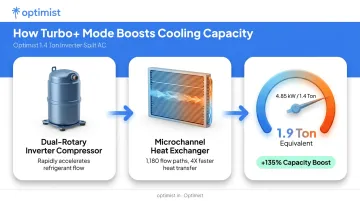
Here's the mechanism behind the 1.5 ton comparison. The AC uses a dual-rotary inverter compressor paired with a microchannel heat exchanger carrying 1,180 flow paths, delivering roughly 4X faster heat transfer than conventional coils.
Together, these push the base 4.85 kW (1.4 ton) output to an effective 1.9-ton equivalent when Turbo+ engages, a 135% capacity boost.
Practically, this means the unit can pull a room from 42°C down to 25°C at its fastest setting, which is exactly the kind of quick recovery you want after walking into a hot 200 sqft bedroom after a commute.
Smart Features for Everyday Use
The Optimist app adds a layer of control most 1.5 ton buyers don't get elsewhere:
- Live energy tracking: real-time kWh usage, projected monthly bills, and cost comparisons against a standard AC
- Filter health alerts with a manual "mark as cleaned" reminder cycle
- Scheduling to auto-start cooling before you walk in, so the room is pre-cooled
- Built-in gas level indicator (India's first): a red-to-green gauge showing refrigerant status, removing the guesswork behind unnecessary "low gas" top-up calls
Build Quality and Warranty
Cooling power and smart controls mean little without durability behind them. SIGMA Test & Research Centre salt-spray tested the condenser for 1,000 hours under ASTM B368, around 15 times the typical 72-hour market standard, a difference that matters for coastal cities like Mumbai, Chennai, and Kochi.
Backing all this is a 5-year comprehensive warranty with 10-year compressor coverage, including refrigerant gas. That's noticeably longer than the 1+5 or 1+10 year structures common across comparable models. One important condition: this coverage is only valid with brand-authorised installation (₹1,499 + GST); using a third-party technician voids it entirely, even for genuine manufacturing defects.
The unit is priced at ₹39,990, with no-cost EMI options bringing it to roughly ₹3,333/month.
Running Costs & Electricity Bill Savings for 200 Sqft Cooling
Running cost depends heavily on your local tariff. As per CEA's March 2025 tariff comparison, average residential rates for a standard 2 kW connection vary widely by state:
| City/Utility | Rate (₹/kWh) |
|---|---|
| TANGEDCO, Tamil Nadu | 2.90 |
| BRPL, Delhi | 6.90 |
| TSSPDCL, Telangana | 6.00 |
| BESCOM, Bengaluru | 7.00 |
| Tata Power, Mumbai | 8.88 |
| MSEDCL, Maharashtra | 10.80 |
For a 1.5 ton inverter AC used 8 hours a day in a 200 sqft room, monthly consumption typically lands somewhere in the 110-160 kWh range. The exact figure depends on the model's ISEER, setpoint, and how hot the ambient temperature runs. At Delhi's average rate of roughly ₹6.90/kWh, that works out to approximately ₹760-₹1,100 a month, before factoring in fan speed, insulation, and how often the door opens.
Star Rating Makes a Real Difference
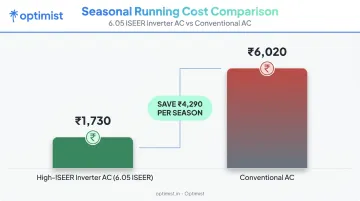
A 5-star inverter AC with a high ISEER consistently uses noticeably less energy than a 3-star model delivering the same cooling. Optimist's own energy tracking data illustrates this: its 1.4 Ton unit (ISEER 6.05, with Turbo+ 1.9-Ton effective cooling) cost ₹1,730 over a period where a conventional AC cost ₹6,020. That gap adds up fast across a four-month Indian summer.
Habits That Stretch Your Savings Further
- Set 24°C as your default, per BEE's mandated setting; every degree lower can add 6% more power draw
- Run a ceiling fan alongside the AC to circulate cool air and let you raise the setpoint slightly
- Clean or check filters monthly — a clogged filter forces the compressor to work harder for the same output
Frequently Asked Questions
Is an inverter AC worth buying?
For daily or extended use, yes. The upfront premium over a non-inverter model is typically recovered within a few months through lower electricity bills, especially in a 200 sqft room used through a full summer.
Which is better, an inverter AC or a normal AC?
Inverter ACs win on efficiency, noise, and comfort for regular use. Non-inverter units may still suit occasional, budget-constrained use where daily hours are low.
What size AC is needed for a 200 sqft room?
A 1.5 ton inverter AC is the standard recommendation for 200 sqft per most Indian sizing charts, adjusted slightly for sun exposure or occupancy.
Is 1.5 ton too big for a 200 sqft room?
No, 1.5 ton is appropriately sized, not oversized, for 200 sqft. Inverter technology further reduces any short-cycling risk from marginal oversizing.
How much electricity does a 1.5 ton inverter AC use per month?
Expect roughly 110-160 kWh a month for 8 hours of daily use, depending on ISEER rating. Higher-ISEER models consume noticeably less for the same cooling output.
What ISEER rating should I look for in a 1.5 ton AC?
Prioritise 5-star rated models with ISEER above 5.0. Optimist's 1.4 Ton unit, rated at India's highest ISEER of 6.05, uses Turbo+ mode to deliver 1.9-Ton effective cooling, making it a stronger, more efficient alternative to a standard 1.5 ton AC for a 200 sqft room.