
Introduction
Walk into any electronics store in India, and you'll see ACs tagged as "Split AC" or "Inverter AC" like they're rival categories. Salespeople rarely clarify the confusion, and buyers end up guessing.
Here's the catch: these aren't competing terms. One describes the AC's physical build, while the other describes the compressor inside it. Mixing them up can mean overpaying, or worse, ending up with a unit that can't handle a Delhi summer afternoon.
The stakes are real. Inverter-based room ACs jumped from just 1% of India's market in FY2015-16 to 77% by FY2022-23, according to a Power Ministry statement reported by Economic Times.
This guide breaks down exactly what separates a split AC from an inverter AC, and which one actually fits your home.
Key Takeaways
- "Split AC" describes the two-unit design, while "inverter" describes the compressor tech inside it
- Non-inverter split ACs cycle on/off at full power, but inverter models adjust speed continuously
- Inverter models cost more upfront but typically cost 15-30% less to run over years of daily use
- Occasional users in smaller rooms can still save money with a non-inverter split AC
- Room size, daily usage hours, and your city's peak summer heat should drive the final call
Split AC vs Inverter AC: Quick Comparison
Before going deeper, here's how the two compressor types stack up across the factors that matter most for Indian homes.
| Factor | Non-Inverter Split AC | Inverter Split AC |
|---|---|---|
| Compressor Technology | Fixed-speed compressor — it's either running flat-out or completely off | Variable-speed compressor that dials output up or down to match the room's real-time cooling demand |
| Energy Efficiency | Draws more power overall, since full-power restarts happening dozens of times a day are energy-hungry | Uses noticeably less electricity. An Economic Times report cites expert estimates that 3-star inverter units run 7-15% more efficiently than fixed-speed equivalents, with some manufacturers claiming savings as high as 30-50% |
| Upfront vs Long-Term Cost | Lower sticker price, but bills add up over years of use | Higher purchase price, offset over time through lower monthly electricity costs |
| Cooling Consistency | Room temperature swings as the compressor cycles between full blast and complete shutoff | Steady output holds a stable room temperature without noticeable dips or spikes |
| Noise Levels | Louder, especially during restarts when the compressor kicks back to full power | Quieter across most operating conditions, since the compressor rarely makes abrupt speed jumps |
| Maintenance & Lifespan | Simpler mechanically, but constant on-off cycling adds wear over time | Less mechanical stress usually means a longer-lasting compressor, though electronic components can be pricier to fix if something goes wrong |
These differences in compressor behavior explain why inverter models now dominate premium AC sales in India.
What is a Split AC?
A split AC is a two-piece cooling system: an indoor unit (the evaporator, mounted on your wall) paired with an outdoor unit (the compressor and condenser). This design is why split ACs dominate Indian homes over window units — they're quieter, don't require a wall cutout, and cool more efficiently for the same tonnage.
Here's where the confusion starts: the term "split AC" only describes the shape. It says nothing about efficiency.
Inside that outdoor unit sits a compressor, and it can be either fixed-speed (non-inverter), which switches on at full power then shuts off, or variable-speed (inverter), which continuously modulates its output.
Non-inverter split ACs haven't disappeared. They remain common in budget and low-usage segments purely because of the lower price tag at checkout.
Use Cases of Split AC (Non-Inverter)
Non-inverter split ACs still make sense for specific situations:
- Guest rooms or occasional-use spaces where the AC runs for a few hours, a few times a week
- Rental accommodations where tenants don't want to sink money into a unit they'll leave behind
- First-time AC buyers prioritising a lower upfront cost over years of electricity savings
The price gap is the real deciding factor here. Entry-level non-inverter 1.5-ton split ACs in India typically retail between ₹25,000 and ₹32,000, while comparable 5-star inverter models often start closer to ₹35,000-40,000.
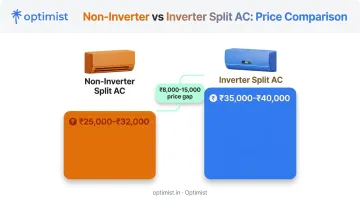
If your AC sits idle most days, that ₹8,000-15,000 gap might never get recovered through bill savings.
What is an Inverter AC?
An inverter AC (almost always sold in split form these days) uses a variable-frequency drive to adjust compressor speed based on how much cooling the room actually needs at that moment.
Instead of blasting cold air and then shutting off completely, it settles into a steady output once the room reaches the set temperature.
This matters more in India than in milder climates, simply because cooling seasons here stretch on for months, not weeks.
Why this design works better for long-hour use:
- Avoids full-power restarts, which cuts energy waste
- Reduces mechanical stress on the compressor over years of operation
- Runs quieter since it's not lurching between "off" and "full blast"
Here's the part most buyers miss: not every inverter AC performs the same way. The real benchmark isn't the word "inverter" on the box; it's the ISEER (Indian Seasonal Energy Efficiency Ratio) rating, which measures actual seasonal efficiency under Indian conditions.
Two inverter ACs can carry wildly different ISEER scores. Optimist's 1.4-ton split AC, for example, carries an ISEER of 6.05, India's highest as of 2026, a useful reference point for how far inverter engineering can be pushed.
Use Cases of Inverter AC
Inverter split ACs are the better fit when:
- Daily usage crosses 6+ hours, particularly in cities with long, punishing summers like Delhi, Ahmedabad, or Chennai
- Bedrooms and living rooms where quiet, steady cooling matters for sleep and comfort
- Multi-room homes running several units where cumulative electricity costs add up fast
The savings can be substantial at scale. Carbon Brief's analysis, based on research from UC Berkeley's India Energy and Climate Center, estimated that switching from a 2-star fixed-speed AC to a 5-star inverter AC could save an affected Indian household roughly ₹4,600 a year, assuming 1,600 operating hours annually.
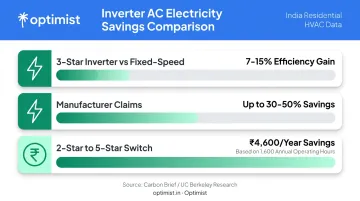
Multiply that across households running an AC daily through a five-month summer, and the case for inverter tech gets hard to ignore.
Split AC vs Inverter AC: Which One Should You Choose?
Strip away the marketing, and the decision comes down to five factors:
- Daily usage hours : occasional or daily, long-hour running?
- Room size : a small guest room has different needs than a primary bedroom
- Local climate severity : Chennai's humidity differs from Delhi's dry heat
- Budget : upfront cost versus what you're willing to pay over years
- Electricity cost tolerance : how much do rising bills actually bother you?
The situational answer:
- Choose a non-inverter split AC if usage is occasional and the purchase price is your top concern
- Choose an inverter split AC if the unit runs daily for extended hours and lower bills matter more than the sticker price
There's a pitfall worth flagging here, and it's specific to India. Many inverter ACs lose cooling capacity (a process called "derating") once outdoor temperatures cross the 40-45°C range. That's precisely when you need full cooling power the most, during a Delhi or Nagpur heatwave in May.
This is why the ISEER/BEE star rating deserves as much attention as the inverter label itself. Under the current gazette notification, 5-star split ACs need an ISEER of 5.60 or higher, while 3-star models range between 4.30 and 4.99. Two "5-star inverter" ACs from different brands can still perform very differently once the mercury climbs.
Higher-ISEER models tested specifically for extreme heat close this gap. Optimist's split AC, with an ISEER of 6.05, is engineered and lab-tested to hold full cooling output at 50°C ambient temperature, a scenario where many standard inverter units start to fall short.
For buyers in extreme-heat regions, that's the real inverter benefit: not just lower bills on a mild day, but reliable cooling on the worst one.
Real-World Example: Choosing the Right AC for Indian Summers
Picture a household in a high-heat city like Jaipur, still running a 7-year-old fixed-speed split AC. Every summer, the pattern repeats:
- The compressor cycles on and off constantly through peak afternoon heat
- The room never quite reaches a comfortable temperature between 2 PM and 6 PM
- Monthly electricity bills keep climbing, year over year
By May, with outdoor temperatures regularly hitting 45°C, the family faces a familiar dilemma: the AC runs non-stop, yet the room stays warm. High bills and unreliable cooling are what finally push households to look for something genuinely efficient, not just another "inverter" label that sounds the same as their old unit.
Switching to a high-ISEER inverter split AC, like Optimist's, engineered to sustain full cooling capacity at 50°C without dropping output, changes the equation. The claimed impact:
- 25-35% lower monthly electricity bills compared to typical 5-star inverter ACs
- Consistent cooling through the hottest afternoon hours, without the temperature creep that plagued the old unit
- Real-time visibility into energy use and projected bills through the Optimist app, so there are no end-of-month surprises
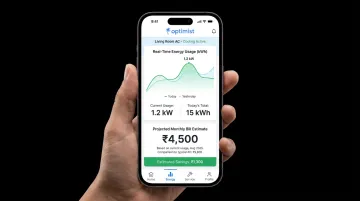
For households in truly extreme-heat regions, the real question isn't split versus inverter. It comes down to how reliable the inverter technology stays once your city hits its peak temperature. If you're weighing that question right now, Optimist's high-ISEER inverter AC is built specifically for Indian summers that don't stop at 40°C.
Frequently Asked Questions
Which is better, inverter AC or split AC?
Inverter isn't a separate product — it's a compressor technology found inside split ACs. Inverter split ACs suit daily, long-hour use with lower bills and steadier cooling, while non-inverter split ACs suit occasional use on a tighter budget.
Is split air conditioner an inverter?
Not necessarily. A split AC can run either a fixed-speed (non-inverter) or variable-speed (inverter) compressor. Always check the spec sheet before assuming.
Can a split AC be non-inverter?
Yes. Many budget split AC models still use fixed-speed compressors, and they remain a sensible choice for households using their AC only a few hours a week.
How much electricity can I save with an inverter AC over a non-inverter split AC?
Estimates range from 7-15% for scoped 3-star comparisons up to 30-50% in broader manufacturer claims. Actual savings depend heavily on usage hours, room size, and the specific ISEER rating.
Is inverter AC good for extreme heat like Indian summers?
Yes, though performance can drop once temperatures cross 40-45°C unless the unit is specifically engineered for high-ambient conditions. High-ISEER models tested at 50°C, such as Optimist's 5 Star+ split AC, avoid this drop.
What star rating should I choose along with inverter technology?
Pair inverter technology with the highest available BEE star/ISEER rating you can afford, especially if you're running the AC daily through long summers. The rating tells you far more about real-world savings than the word "inverter" alone.