
ISEER (Indian Seasonal Energy Efficiency Ratio) is the metric that determines how efficiently your AC converts electricity into cooling across a full Indian summer. BEE introduced mandatory ISEER labelling for inverter split ACs in January 2018, replacing the older single-point EER rating that tested at just 35°C — useless for a country where summer regularly exceeds 45°C.
This guide covers what ISEER actually means, what rating qualifies as genuinely good for different usage patterns, and the factors that determine whether a high ISEER on paper translates to real savings at home.
Key Takeaways
- Higher ISEER = lower electricity bills — the ratio measures cooling output per unit of electricity consumed across a full Indian season
- For 6+ hours of daily use, a minimum ISEER of 5.0–5.6 is the practical threshold worth targeting
- Always compare ISEER numbers directly, not just star counts — label years shift thresholds, making star ratings across years incomparable
- The highest ISEER-rated AC in India carries a rating of 6.05 (Optimist), consuming just 620.2 kWh annually
- ISEER alone isn't enough — match it to your room size, daily usage hours, and local climate
What is ISEER Rating in an AC?
ISEER stands for Indian Seasonal Energy Efficiency Ratio. The Bureau of Energy Efficiency (BEE) developed it specifically to measure AC efficiency across real Indian conditions — not just at a single lab temperature.
The Formula and Why It Matters
ISEER = Total Seasonal Cooling Output (CSTL) ÷ Total Seasonal Energy Input (CSEC)
The key word is seasonal. According to BEE's original scheme documentation, ISEER is calculated across outdoor temperature bins from 24°C to 43°C, derived from weather data across 54 Indian cities, assuming 1,600 cooling hours per year.
The older EER rating tested AC efficiency at a fixed outdoor temperature of 35°C. An AC that performs well at 35°C can be significantly less efficient at 40°C or 43°C — temperatures that are entirely normal across Delhi NCR, Rajasthan, and Telangana. ISEER accounts for this full range of conditions; EER measures only a single point on that curve.
How BEE Star Ratings Map to ISEER
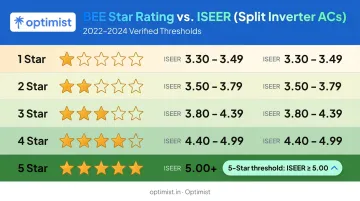
BEE assigns star ratings based on ISEER thresholds that it revises periodically. The previously verified cycle (valid 1 July 2022 to 31 December 2024) for split inverter ACs was:
| Star Rating | ISEER Range |
|---|---|
| 1-Star | 3.30 – 3.49 |
| 2-Star | 3.50 – 3.79 |
| 3-Star | 3.80 – 4.39 |
| 4-Star | 4.40 – 4.99 |
| 5-Star | 5.00 and above |
BEE notified Amendment V (S.O. 3984(E), dated 28 August 2025) with updated thresholds effective January 2026, raising the minimum bar for each star tier. Always verify the exact values against the current BEE label on the product, since star ratings issued under different label years are not directly comparable.
Which ISEER Rating is Considered Good for an AC?
The right ISEER depends on how many hours you run the AC daily — and in India's climate, that number matters more than most buyers realise.
The Practical Benchmarks
- ISEER 4.5 and above — considered good for moderate residential use
- ISEER 5.0+ — recommended for households running AC 5–6 hours daily
- ISEER 5.6+ — the 5-star benchmark under updated 2026 norms, ideal for heavy daily use
- ISEER 6.05 — the current ceiling in India's residential AC market, explored in detail below
3-Star vs. 5-Star: Does the Difference Pay Off?
Under the 2022–2024 verified thresholds, a 3-star inverter split AC carried an ISEER of 3.80–4.39, while 5-star required 5.00 and above. The annual energy consumption difference between these tiers is meaningful.
To estimate your savings:
- Check the annual energy consumption (kWh) printed on the BEE label of each model you're comparing
- Subtract the 5-star model's figure from the 3-star model's figure
- Multiply the difference by your local electricity rate (₹/unit)
CEA's 2025 edition reports domestic tariffs ranging from ₹3.35/kWh in Delhi to ₹8.31/kWh in Maharashtra — so the financial impact of a higher ISEER varies significantly by state. A household in Maharashtra running a 3-star AC at ₹8.31/unit will save considerably more by upgrading than a Delhi household on ₹3.35/unit.
The Label Year Trap
Two ACs can carry identical star counts but very different ISEER values if their BEE labels are from different periods. An ISEER of 4.50 qualified as 5-star under the 2018–2022 thresholds but falls into the 4-star band under the 2022–2024 table.
The rule: always read the ISEER number on the label, not just the stars. The number doesn't change with threshold revisions — the star assignment does.
The Current Ceiling: ISEER 6.05
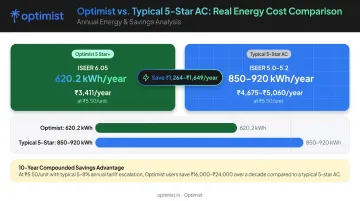
Optimist's 1.4 Ton 5 Star+ Inverter Split AC carries an ISEER of 6.05, India's highest certified rating as of 2026, with annual energy consumption of 620.2 kWh.
For comparison, a typical competing 5-star inverter AC (ISEER ~5.0–5.2) consumes 850–920 kWh annually. At ₹5.50/unit, that works out to roughly ₹3,411 vs. ₹4,675–₹5,060 per year — a gap of ₹1,264–₹1,649 annually, compounding across the AC's full lifespan.
Key Factors to Consider When Choosing an AC Based on ISEER Rating
ISEER alone doesn't determine the right AC. It needs to be evaluated alongside several practical factors.
Usage Hours Per Day
The payback on a higher-ISEER model depends heavily on daily runtime. Running an AC 6–8 hours daily through a 5–6 month Indian summer accumulates roughly 900–1,440 operating hours per year. At that intensity, the electricity cost gap between a 3-star and 5-star model adds up quickly — often recovering the price premium within 2–3 years.
For users running the AC just 2–3 hours daily (a guest bedroom, for instance), the payback period stretches considerably. A 3-star model at a lower purchase price may be the more rational choice in that scenario.
Room Size and Capacity Matching
Choosing the wrong tonnage undermines ISEER gains entirely:
- Running undersized: The unit stays at full load constantly, driving up consumption regardless of the ISEER rating
- Running oversized: The unit short-cycles, fails to dehumidify effectively, and wears out the compressor faster
Optimist recommends its 1.4 Ton model for 120–200 square feet — standard bedrooms, studies, and WFH spaces. For west-facing rooms or rooms with heavy afternoon sun, the unit's Turbo+ Mode delivers 1.9-Ton effective cooling to handle peak heat loads without needing to oversize the AC.
A practical sizing note: rooms on top floors, those facing west, or spaces with large unshaded windows typically carry higher heat loads and may need extra cooling capacity or a model with a burst-mode capability.
Climate and Ambient Temperature
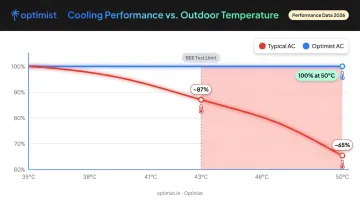
ISEER is tested up to 43°C under BEE protocols. But IMD data from May 2024 recorded 45–48°C across Haryana-Chandigarh-Delhi and 48°C at Barmer, Rajasthan. These are real operating conditions, not outliers.
At temperatures above 43°C, most ACs begin to derate: losing 10–15% cooling capacity at 45°C and up to 30–40% at 50°C. A high ISEER doesn't automatically guarantee sustained performance in this range.
Buyers in Delhi NCR, Rajasthan, Punjab, or Vidarbha should specifically verify whether the model they're considering is rated and tested to cool without derating above 43°C — not just check the ISEER score.
That distinction matters in practice. Optimist's AC is tested and verified for full-rated cooling at 50°C ambient with no performance drop, directly addressing this gap.
Inverter Technology
Most high-ISEER ACs use inverter compressor technology, which modulates compressor speed based on cooling demand rather than running at fixed full power. This variable operation produces a consistently high ISEER across an entire season, not just at one test condition.
Inverter-based RAC market share rose from under 1% in 2015 to 77% in 2022–23, according to Ministry of Power data — reflecting how thoroughly inverter technology has become the default for energy-efficient residential cooling.
Corrosion Resistance and Long-Term Efficiency
An AC's real-world ISEER degrades over time if the condenser or evaporator coils corrode. Corroded coils reduce heat transfer efficiency, forcing the compressor to work harder and consume more power, effectively lowering the unit's practical ISEER year after year.
This matters most in:
- Coastal cities (Mumbai, Chennai, Kochi, Visakhapatnam) with salt-laden air
- High-humidity regions
- Urban areas with poor air quality
When evaluating an AC, check whether the manufacturer provides documented corrosion testing data — not just marketing language. Optimist's outdoor unit is tested to 1,000 hours of salt-spray exposure (SIGMA certified), compared to a typical market standard of 72 hours. That's roughly 14–15 times more rigorous, validated by an independent testing body.
How Optimist Sets the Standard for ISEER in India
Optimist launched in January 2026 with a specific engineering brief: build an AC for Indian conditions, not laboratory conditions. The result is India's highest ISEER-rated residential AC at 6.05, with an annual energy consumption of 620.2 kWh.
What Enables ISEER 6.05
Several engineering choices combine to produce this rating:
- Microchannel heat exchanger with 1,180 flow paths — delivers 4× faster heat transfer than conventional coil designs
- Dual-Rotary Inverter Compressor that modulates precisely across a wide load range, maintaining efficiency at partial and peak loads
- R-32 refrigerant — lower GWP than R-410A, with a direct contribution to higher efficiency performance
- Turbo+ Mode delivers 135% of rated capacity (1.9-Ton effective cooling from a 1.4-Ton unit) for rapid cool-down without sustained high power draw
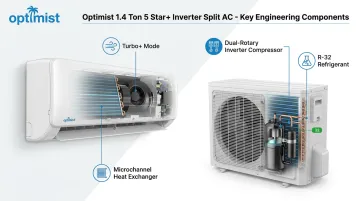
The 50°C no-derate performance is documented in Optimist's technical specifications and validated through on-ground testing in Delhi NCR heatwave conditions.
Transparency Features That Sustain Efficiency
Optimist's approach to long-term efficiency goes beyond the hardware:
- Live energy meter and projected monthly bill — the Optimist App shows real-time kWh consumption and forecasts your bill before it arrives, available on iOS and Android
- India's first built-in gas level indicator — eliminates the gas top-up scam by showing refrigerant levels in real time; gas refills are covered under the 5-year warranty at ₹0
- Filter health tracking — proactive reminders before filter condition affects airflow or efficiency
- 5-year all-inclusive warranty with 10-year compressor coverage — covering outdoor unit, critical indoor components (PCB, sensors, fan motor, swing motor, evaporator coil), and refrigerant gas
Most ACs lose real-world efficiency through three routes: heat-stress derating, refrigerant depletion, and dirty filters. Optimist's hardware specs, gas monitoring, and filter tracking are each engineered to close one of those gaps.
Conclusion
Match the ISEER to how you actually use the AC. For households running it 6+ hours daily through a 5–6 month Indian summer, a minimum ISEER of 5.0–5.6 is the practical threshold where electricity savings offset the higher upfront cost. Above 5.6 — and particularly at 6.0+ — the annual savings become substantial enough to matter over a 5–7 year ownership cycle.
As electricity tariffs rise and summers push harder, that efficiency gap widens each year. When comparing models, read the ISEER number directly — not just the star rating — and benchmark against 2026 BEE norms. Older labelled models can carry the same star count at a lower ISEER, which means higher bills. For context, Optimist's 1.4 Ton 5 Star+ Inverter Split AC holds an ISEER of 6.05, currently the highest-rated AC in India — a useful ceiling benchmark when evaluating any model on the market.
Frequently Asked Questions
How much ISEER rating is good for a 3-star AC?
Under the 2022–2024 BEE verified thresholds, a 3-star split inverter AC required an ISEER of 3.80–4.39. This is sufficient for moderate use — 2–4 hours daily in occasionally used rooms.
Is a higher ISEER rating better?
Yes — a higher ISEER always means more cooling output per unit of electricity consumed. The benefit is most significant for users running the AC heavily (6+ hours daily). ISEER still needs to be paired with correct AC sizing; even a high-ISEER unit will consume excess power if undersized for the room.
What is the highest ISEER rating for AC in India?
The highest ISEER rating currently available in India is 6.05, achieved by Optimist's 1.4 Ton 5 Star+ Inverter Split AC, with an annual energy consumption of 620.2 kWh.
What is the difference between ISEER and EER?
EER measures AC efficiency at a single test point — 35°C outdoor temperature. ISEER measures efficiency across a full Indian cooling season, using temperature bins from 24°C to 43°C derived from 54 cities. ISEER is a far more accurate predictor of real-world electricity bills in India.
Does a high ISEER AC perform better in extreme heat above 45°C?
Not automatically. ISEER testing stops at 43°C under BEE protocols, so a high ISEER score doesn't certify performance above that threshold. Buyers in Delhi NCR, Rajasthan, or other extreme-heat regions should specifically verify whether the model is rated and tested to cool without derating at 45°C and above.
How often does BEE update the ISEER star rating thresholds?
BEE revises thresholds periodically — the most recent update (Amendment V, effective January 2026) raises the bar across all star levels. A 5-star model from a prior label cycle may now carry fewer stars under the updated standards. Always check the label validity year when comparing models from different purchase periods.