
Introduction
Buying an air conditioner in India used to be simple: check the star rating, match the tonnage to your room, done. That approach doesn't hold up anymore.
India's summers keep breaking records. The India Meteorological Department's January 2025 climate review confirmed 2024 as the country's warmest year since 1901, with Churu in Rajasthan touching 50.5°C in May. Many buyers don't realise their existing AC starts losing cooling power well before temperatures hit that mark.
This guide breaks down what's genuinely new in 2026: smarter connected systems, sharply higher energy-efficiency ratings, engineering built for extreme heat, cleaner refrigerants, and air-quality features that now factor into buying decisions. We'll also cover what's driving these shifts and what comes next.
Key Takeaways
- Live energy tracking and app control are now standard, not premium extras
- Optimist's 6.05 ISEER rating cuts electricity bills by 25-35%
- Extreme-heat engineering, not star ratings, keeps cooling steady at 50°C
- Low-GWP refrigerants and corrosion-tested materials replace unfit components
- Self-clean and filter-health tracking now matter as much as price
Key Technology Trends Shaping AC in India for 2026
2026's AC innovations aren't cosmetic. They centre on five things: intelligence, efficiency, resilience, durability, and air quality, all engineered specifically for Indian conditions.
AI-Powered & Smart Connected ACs
Modern split ACs now run IoT sensors and AI algorithms that learn how a household actually uses cooling, what time rooms get occupied, preferred temperatures, even how outdoor weather shifts usage patterns. The AC adjusts fan speed and compressor output automatically instead of running on fixed settings.
App ecosystems have caught up too:
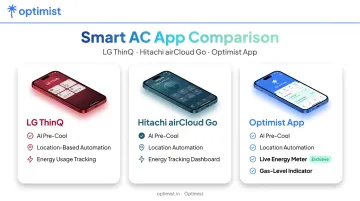
- LG ThinQ offers AI Pre-Cool based on phone location, remote start/stop, and Energy Manager+ consumption tracking
- Hitachi airCloud Go adds Smart-Fence location automation, weekly timers, and an energy-cost estimator on select models
- Optimist's app shows a Live Energy Meter with current bill accrued, kWh consumed, and a projected month-end bill, so there's no waiting for a shocking electricity bill to know usage got out of hand
Optimist takes connectivity a step further with what it calls India's first built-in gas-level indicator. A sensor inside the unit tracks refrigerant levels continuously and shows a colour-coded gauge in the app, red for critical, green for optimal.
That matters because the "your gas is low, needs a refill" call from a technician has long been a common way customers get overcharged. With the level visible on your phone, you can check before agreeing to pay for anything.
India's Highest-Ever Energy Efficiency (ISEER Innovations)
BEE replaced the old flat star-rating system with ISEER, India Seasonal Energy Efficiency Ratio, because a single star number couldn't capture how an AC performs across an entire cooling season. ISEER is calculated as total annual heat removed divided by total annual energy consumed, reflecting real seasonal performance rather than a one-off lab test.
Newer inverter architecture is pushing ISEER numbers higher than most buyers realise is possible. Optimist's 1.4-ton split AC carries an ISEER of 6.05, positioned as India's highest-rated unit, with annual energy consumption of just 620.2 kWh against a 1,070W input. The company's real-world claim: 25-35% lower electricity bills versus a typical 5-star inverter AC, achieved through:
- A dual-rotary inverter compressor that ramps output up or down rather than cycling on/off
- A micro-channel heat exchanger with 1,180 flow paths for faster heat transfer
BEE's labelling periods run in cycles, and each revision typically demands greater efficiency to earn the same star count. An old 5-star AC bought a few years ago may barely qualify for 3 stars under current rules. That, combined with rising electricity tariffs across metro cities, is exactly why efficiency is now a purchase priority rather than an afterthought.
Extreme-Heat Engineering for Real Indian Summers
Most conventional split ACs are tested and rated only up to around 43-45°C ambient temperature. Push past that, and cooling capacity starts falling, a problem known as derating.
Independent lab testing by the Centre for Science and Environment found cooling capacity in typical 5-star split ACs dropping by an average of 1.4% for every 1°C rise in outdoor temperature. That adds up fast once you're standing in a 47-48°C Delhi afternoon.
That gap between lab conditions and street-level heat is exactly what extreme-heat engineering targets. Optimist's Turbo+ Mode pushes the compressor and heat exchanger together to deliver what the company describes as 135% of rated capacity, effectively 1.9 tons of cooling from a 1.4-ton unit.
The unit is reportedly government-lab tested at 50°C ambient without the performance drop typical of standard units, pulling a room down from 42°C to 25°C at top speed.
- Dual-rotary compressor ramps output beyond standard limits during heat spikes
- Micro-channel heat exchanger clears heat 4x faster, preventing thermal saturation
- Validated at Optimist's Nalanda 1 R&D Lab in Delhi, built with IIT Delhi
IMD's 2024 readings, several cities crossing 46-50°C, show this isn't a rare desert-town event anymore. It's becoming a mainstream summer condition across north and central India, which is why testing at real ambient extremes matters more than a star sticker.
Eco-Friendly Refrigerants & Durable, Corrosion-Resistant Materials
Older refrigerants like R-22 and R-410A carry a high Global Warming Potential. India's Kigali Amendment commitments mean HFC consumption gets phased down in stages, a 10% cut by 2032, rising to 85% by 2047, and that timeline is pushing manufacturers toward lower-GWP alternatives well ahead of any hard deadline.
- R-32: the most widely adopted alternative, lower GWP than R-410A, used in most new split ACs including Optimist's 1.4-ton unit
- R-290 (propane): even lower GWP, but needs extra safety engineering due to flammability
- Both are compliant with India's Ozone Depleting Substances Rules
Refrigerant choice is only half the durability story. India's dust, coastal salt air, and pollution wear down outdoor units over years, which is why corrosion-resistant construction has become a real spec to check.
Optimist's heat exchanger uses an automotive-derived aluminium alloy, tested to 1,000 hours of salt-spray corrosion exposure under the ASTM B368 standard, roughly 15 times longer than the 72-hour benchmark common across the market. That kind of testing targets coastal cities like Mumbai, Chennai, and Kochi, where salt-laden humidity eats through cheaper components within a few seasons.
Advanced Air Purification & Self-Cleaning Systems
Indoor air quality has become a real purchase factor, especially in cities where outdoor pollution seeps indoors. A 2019-2020 study monitoring Delhi buildings found PM2.5 levels running far above WHO limits, part of why buyers now ask about filtration alongside cooling capacity.
- LG's Plasmaster Ionizer++ claims removal of up to 99.9% of adhering bacteria plus deodorisation, generating over 8 million ions per cycle
- Hitachi's FrostWash freezes moisture on the heat exchanger, then melts and flushes it away, with Hitachi citing 99% bacteria and virus reduction after a single cycle
- Smart filter-health tracking, offered across several brands' apps, flags when a filter needs cleaning before airflow and cooling both suffer
These are manufacturer-reported results under specific lab conditions, not independent room-wide certifications. For households dealing with allergies or respiratory sensitivity, though, these features have moved from a bonus spec to something actively compared before buying.
What's Driving These AC Technology Trends in India
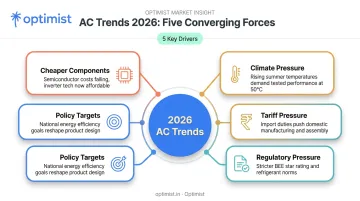
These shifts aren't arriving in isolation. Five forces are converging at once: technology, climate, cost, regulation, and policy.
- Cheaper components: IoT sensors and AI chips that once fit only premium ACs have dropped enough in cost to appear in mid-range units too
- Climate pressure: worsening heatwaves push demand toward cooling that performs. ICRA projects India's room-AC market at 12-12.5 million units for FY2025, up 20-25% year-on-year
- Tariff pressure: rising electricity slabs across metro cities have turned energy efficiency into a genuine purchase filter, not a nice-to-have
- Regulatory pressure: BEE's revised star-labelling cycles and the Kigali-linked refrigerant phase-down are forcing faster innovation on efficiency and refrigerants
- Policy targets: India's Cooling Action Plan aims to cut cooling-energy demand 25-40% by 2037-38 against a 2017-18 baseline, adding long-term pressure on manufacturers
Put together, these forces explain why a 2026 buyer sees smart features, high ISEER numbers, and heat-specific engineering bundled into the same product rather than sold as separate premium options.
How These Trends Are Impacting Indian Households and the AC Industry
The result shows up in three places: household bills, manufacturer strategy, and the environment.
Consumer impact looks like lower monthly bills and no month-end surprise, since app-based tracking projects the bill before it's due. Fewer breakdowns follow too, as gas-level and filter-health monitoring catch issues early instead of after a failure.
"Noticeably lower, even with longer usage." — A Delhi-based chartered accountant, on her bill after switching to an Optimist AC
Industry impact is visible in how R&D spend is shifting from cosmetic redesigns toward efficiency and climate-resilience engineering. This work is happening at labs like Optimist's Nalanda 1 facility, run in collaboration with IIT Delhi. Competition among brands is intensifying around ISEER numbers and heat-testing claims rather than just tonnage and price.
Environmental impact ties back to India's Cooling Action Plan target of cutting cooling-related energy demand 25-40% by 2037-38 against 2017-18 levels. At the household level, apps translate this into something tangible: Optimist's dashboard shows CO2 savings in real time, equating a typical month's efficient usage to planting roughly three trees.
Future Signals for AC Technology in India Beyond 2026
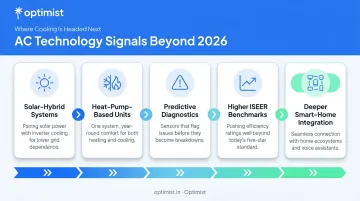
2026 isn't the finish line. A few early signals point toward where AC technology in India goes next.
- Solar-hybrid systems: interest is growing, though a verified, mainstream residential solar-hybrid split AC hasn't yet reached the Indian market at scale
- Heat-pump-based units: hot-and-cold inverter models, already sold by LG and Hitachi, signal broader adoption for year-round climate control, not just summer cooling
- Predictive diagnostics: apps already log error codes and usage patterns; the next step is flagging failures before they happen rather than after
- Higher ISEER benchmarks: BEE's periodic label revisions have historically pushed efficiency higher each cycle, and that pattern looks unlikely to reverse
- Deeper smart-home integration: expect ACs to sync more tightly with broader home ecosystems instead of operating as standalone connected devices
Government policy is likely to accelerate all of this. Between the Cooling Action Plan's efficiency targets and the ongoing refrigerant phase-down, manufacturers have a fairly clear runway telling them which direction to keep building in.
Conclusion
2026's AC technology in India comes down to four things holding together: intelligence, efficiency, durability, and heat resilience built for conditions most global AC designs were never tested against. None of these are optional add-ons anymore; they're becoming the baseline.
If you're shopping this year, prioritise ISEER numbers over star ratings alone, ask for verified high-ambient testing data, and check whether smart features translate into usable savings rather than just convenience.
That shift is already underway. Companies building specifically for Indian summers, rather than adapting global designs afterward, are where this market is heading. Optimist's approach — extreme-heat testing at 50°C, an ISEER of 6.05, and transparent app-based monitoring — reflects that direction rather than an exception to it.
Frequently Asked Questions
What is the latest technology in air conditioning?
2026's leading technologies include AI-based smart controls, ultra-high ISEER-rated inverter systems, extreme-heat engineering for 45-50°C performance, and eco-friendly low-GWP refrigerants like R-32.
What does ISEER rating mean and why does it matter for Indian ACs?
ISEER (India Seasonal Energy Efficiency Ratio) measures real-world cooling efficiency across an Indian cooling season, not a single lab test. Higher ratings mean genuinely lower electricity consumption, and Optimist's 6.05 ISEER currently leads the Indian market.
Which refrigerant is best for ACs in India in 2026?
R-32 is currently the most widely used low-GWP option, balancing environmental compliance with manageable safety requirements. R-290 offers even lower GWP but needs added flammability safeguards.
Do smart ACs actually reduce electricity bills in India?
Yes, when paired with high-ISEER hardware. AI-based usage learning, scheduling, and real-time energy tracking help users spot and correct wasteful patterns before they show up on the bill.
Can new AC technology maintain cooling during extreme heat waves in India?
Select new-generation ACs, engineered and government-lab tested specifically for 45-50°C conditions, now avoid the derating that standard units experience beyond 43°C. Optimist's split AC, for example, is tested at 50°C with zero performance drop.
What star rating or ISEER AC is best for Indian summers?
Prioritise the highest available ISEER rating alongside verified high-ambient testing data. Star rating alone doesn't confirm how a unit performs once temperatures cross 45°C.