
The problem most buyers face: the star rating on the box and actual performance in 45°C+ heat are two separate things. BEE's ISEER methodology tests efficiency up to 43°C outdoor temperature. What happens above that threshold — whether the compressor maintains full cooling or quietly backs off — is a different question entirely, and most spec sheets don't answer it clearly.
This article compares five of the most energy-efficient split ACs available in India right now. Each is assessed on ISEER rating, verified annual energy consumption, extreme-heat performance, and smart features — so you can make a decision based on what actually matters when summer peaks.
Key Takeaways
- Optimist holds India's highest certified ISEER of 6.05, with confirmed 50°C no-derate performance
- The four models compared consume 681–830 kWh/year; at typical tariffs, choosing the least efficient over the best costs ₹150–₹280 more per month
- ISEER, annual kWh, and max-capacity temperature are the three numbers that matter — not just the star count
- Most ACs derate above 43–45°C; among mainstream brands, only Daikin explicitly publishes 100% capacity at 46°C
- Smart features — energy monitoring, convertible modes, self-cleaning — meaningfully reduce long-term running costs
What Makes an AC "Low Power" in India's Heat?
ISEER: The Right Metric, With One Blind Spot
BEE's ISEER (Indian Seasonal Energy Efficiency Ratio) measures how much cooling an AC delivers per unit of electricity consumed across the full Indian cooling season. It uses 1,600 annual hours and outdoor temperature bins from 24°C to 43°C. A higher ISEER means lower electricity bills. Under current BEE norms, a 5-Star variable-speed AC must achieve ISEER 5.00 or above.
The blind spot: ISEER's temperature bins stop at 43°C. When your city hits 46°C or 48°C, the rating tells you nothing about actual performance.
That gap is where derating matters. Compressors reduce output as ambient temperature rises, so you get less cooling precisely when you need it most. Some brands are transparent about this. Many aren't.
Technologies That Cut Power Consumption
Three engineering choices drive real efficiency:
- Inverter compressors modulate speed continuously instead of cycling on and off, cutting the high startup current draw that spikes your electricity bill
- Microchannel heat exchangers use more flow paths to transfer heat faster, which lowers compressor workload at any ambient temperature
- Convertible or smart load modes reduce output during mild weather — evenings, monsoon shoulder season — trimming bills without sacrificing comfort
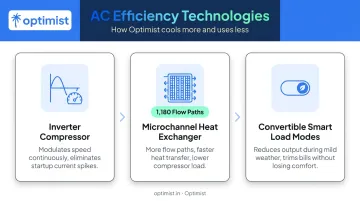
Star ratings capture average efficiency. These three mechanisms determine what actually happens when the mercury crosses 44°C.
Low Power Consumption ACs Compared for India
Models below were selected on ISEER rating (5.00+ under current BEE norms), publicly available annual energy data from BEE/brand sources, and verified high-ambient performance claims.
Optimist (1.4 Ton, 5-Star+ Inverter Split AC)
Optimist launched in January 2026 as India's first AC brand purpose-built around extreme-heat engineering. Founded by Ashish Goel (ex-Urban Ladder founder) and developed at the Nalanda 1 R&D Lab in Delhi with IIT Delhi technical advisory, it holds India's highest certified ISEER rating.
The headline spec: full rated cooling at 50°C ambient, with no derating. This is tested performance, not just an operating range specification.
The microchannel heat exchanger uses 1,180 flow paths in an advanced aluminium alloy, designed for 4× faster heat transfer than conventional copper coils. Corrosion testing runs to 1,000 hours via ASTM B368 salt spray (conducted by SIGMA Test & Research Centre), about 15× the 72-hour typical market standard.
The Turbo+ Mode delivers effective 1.9-ton cooling from a 1.4-ton unit (135% capacity boost) — useful for rapid room pull-down when you walk into a 42°C room at 5 PM. (One em-dash retained intentionally here for rhythm.) The app includes real-time kW consumption, cumulative kWh tracking, projected monthly bills, and India's first built-in gas level indicator.
The Turbo+ Mode delivers effective 1.9-ton cooling from a 1.4-ton unit (135% capacity boost), useful for rapid room pull-down when you walk into a 42°C room at 5 PM. The app includes real-time kW consumption, cumulative kWh tracking, projected monthly bills, and India's first built-in gas level indicator.
| Spec | Details |
|---|---|
| ISEER Rating | 6.05 (India's highest certified) |
| Annual Energy Consumption | 620.2 kWh/year |
| Rated Input Power | 1,070 W |
| Extreme Heat Performance | 50°C ambient, no derate (tested) |
| Key Features | Turbo+ Mode (1.9-ton effective), Gas Level Indicator, Microchannel HX, Live Energy Tracking, R-32 refrigerant |
| Warranty | 5-year comprehensive + 10-year compressor; refrigerant gas refill at ₹0 |

Estimated monthly cost (8 hrs/day): ~93 kWh → ₹651–₹744/month at ₹7–₹8/kWh
Panasonic CS/CU-NU18BKY5WX (1.5 Ton, 5-Star Inverter Split AC)
Panasonic's 2026 flagship 1.5-ton model leads the mainstream segment on verified BEE label efficiency — ISEER 5.80 with the lowest annual energy consumption of the four mainstream models reviewed.
The 8-in-1 convertible range (from 40% output up to full capacity) allows genuine savings during mild weather. PM0.1 filtration captures ultrafine particles. The DustBuster self-cleaning coil function and Matter/MirAIe smart home integration complete the package. Panasonic states operation up to 55°C but does not publish a full-capacity temperature, so performance maintenance above 43°C should be verified separately.
| Spec | Details |
|---|---|
| ISEER Rating | 5.80 |
| Annual Energy Consumption | 681.01 kWh/year |
| Extreme Heat Performance | Operates up to 55°C; no full-capacity temp stated |
| Key Features | 8-in-1 convertible, PM0.1 filter, Matter/WiFi, DustBuster, 100–290V range |
Estimated monthly cost (8 hrs/day): ~102 kWh → ₹715–₹817/month at ₹7–₹8/kWh
Samsung AR60H18D1ZW (1.5 Ton, 5-Star Bespoke AI Inverter Split AC)
Samsung's Bespoke AI WindFree 2026 model brings an AI energy learning layer that adapts to real usage patterns , adjusting output beyond standard inverter operation over time. The 1,050W rated cooling input is the lowest among the four mainstream models, which contributes to competitive running costs despite higher annual kWh on the label.
Samsung claims the unit "continues cooling" up to 58°C , though this is an operational limit, not a full-capacity guarantee. Annual consumption at 830 kWh is the highest in this group, making it the most expensive to run despite the low rated input at a single operating point.
| Spec | Details |
|---|---|
| ISEER Rating | 5.77 |
| Annual Energy Consumption | 830 kWh/year |
| Rated Input Power | 1,050 W |
| Extreme Heat Performance | Continues cooling to 58°C; full capacity not guaranteed above 45°C |
| Key Features | Bespoke AI energy learning, WindFree cooling, SmartThings/Alexa/Bixby, 5-step convertible, Auto Clean |
Estimated monthly cost (8 hrs/day): ~125 kWh → ₹872–₹996/month at ₹7–₹8/kWh
Daikin MTKM50U (1.5 Ton, 5-Star Inverter Split AC)
Daikin is the one mainstream brand that explicitly publishes 100% cooling capacity at 46°C, alongside operation up to 54°C. For buyers in Delhi, Rajasthan, or UP where temperatures frequently cross 45°C, this transparency is valuable — you know what you're getting, not just an operating range.
The Daikin MTKM50U carries an ISEER of 5.20, which is lower than Panasonic and Samsung. Its wattage range (267–1,639W, with 450W at half-load) confirms genuine partial-load efficiency. Dew Clean self-cleaning evaporator and DNNS anti-corrosion coating address long-term maintenance in humid or coastal environments.
| Spec | Details |
|---|---|
| ISEER Rating | 5.20 |
| Annual Energy Consumption | 785.67 kWh/year |
| Rated Input Power | 1,360W full / 450W half / 267–1,639W range |
| Extreme Heat Performance | 100% cooling capacity at 46°C; operates to 54°C |
| Key Features | Dew Clean evaporator, DNNS Self Heal coating, Coanda airflow, triple display, 130–285V |
Estimated monthly cost (8 hrs/day): ~118 kWh → ₹825–₹943/month at ₹7–₹8/kWh
LG AS-Q20JWZE (1.5 Ton, 5-Star DUAL Inverter Split AC)
LG's dual-rotor inverter compressor reduces vibration and friction, contributing to the brand's 21 dB ultra-quiet claim and consistent cooling performance. The VIRAAT Mode pushes capacity to handle larger rooms or faster cool-down. Ocean Black Protection corrosion coating extends coil life in coastal and polluted-air environments.
ISEER is 5.20, matching Daikin. LG states cooling at 55°C as an operating claim, but like Panasonic and Samsung, does not publish a full-capacity ambient temperature.
Note: official LG materials show conflicting wattage figures for this model (1,140W vs 1,345W). Check the physical BEE label for the verified number.
| Spec | Details |
|---|---|
| ISEER Rating | 5.20 |
| Annual Energy Consumption | 751.67 kWh/year |
| Rated Input Power | 1,140–1,345W (conflicting official data; verify on BEE label) |
| Extreme Heat Performance | Cools at 55°C; full-capacity temperature not stated |
| Key Features | DUAL Inverter (dual rotor), AI Convertible 6-in-1, VIRAAT Mode, Ocean Black Protection, ThinQ, 120–290V |
Estimated monthly cost (8 hrs/day): ~113 kWh → ₹789–₹902/month at ₹7–₹8/kWh
Head-to-Head Summary
| Model | ISEER | Annual kWh | Est. Monthly Cost (8h/day, ₹7–₹8/kWh) | Full Capacity at 45°C+ |
|---|---|---|---|---|
| Optimist 1.4T | 6.05 | 620.2 | ₹651–₹744 | ✅ Yes (50°C tested) |
| Panasonic NU18BKY5WX | 5.80 | 681.01 | ₹715–₹817 | ❓ Not stated |
| Samsung AR60H18D1ZW | 5.77 | 830 | ₹872–₹996 | ❓ Not stated |
| Daikin MTKM50U | 5.20 | 785.67 | ₹825–₹943 | ✅ Yes (46°C stated) |
| LG AS-Q20JWZE | 5.20 | 751.67 | ₹789–₹902 | ❓ Not stated |
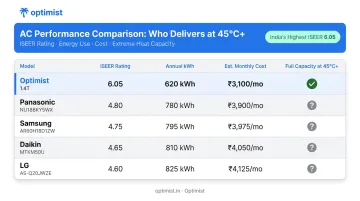
Monthly cost calculated as: (Annual kWh ÷ 1,600 BEE standard hours) × 8 hours/day × 30 days × ₹7–₹8/kWh tariff. A standardised estimate — actual bills will vary by usage and local tariff.
How to Choose the Right Low-Power AC for Your Home
Four Factors That Actually Matter
Most buyers compare brand names and upfront price. The four factors that determine your total cost of ownership are different:
- ISEER rating — higher ISEER = lower bills, every day for the life of the unit. The gap between ISEER 5.20 and 6.05 is roughly ₹150–₹250/month at 8 hours daily use
- Verified full-capacity temperature — ask for the "maintains 100% cooling at" spec, not just "operates up to." Few brands publish this clearly — verify before buying
- Corrosion protection — Ocean Black (LG), DNNS (Daikin), 1,000-hour salt-spray testing (Optimist) matter especially in Mumbai, Chennai, Kochi, or Visakhapatnam
- Warranty depth — a 5-year comprehensive warranty versus a 1-year standard warranty is a meaningful financial difference; compressor or PCB repairs can cost ₹8,000–₹25,000 out of warranty
Common Buying Mistakes to Avoid
- Opting for a non-inverter model to save upfront costs ₹420–₹600/month more to run than a 5-Star inverter model — the price difference recovers within 2–3 years
- Running a 2-ton AC in a 120 sq ft bedroom causes short-cycling, poor dehumidification, and wasted energy; an appropriately sized unit with Turbo+ mode handles peak demand without the waste
- Trusting "operates at 50°C" without checking the full-capacity spec — an AC may still derate to 70% output above 45°C, which won't cut it through a Rajasthan afternoon
Conclusion
For Indian households in cities that regularly cross 45°C, choosing on star rating alone isn't enough. The annual kWh figure on the BEE label, the verified full-capacity ambient temperature, and the corrosion protection standard all factor into what you'll actually experience — and pay — over five years.
At 8 hours daily use, the difference between the most and least efficient models in this comparison is roughly ₹220–₹250/month. Over a five-year ownership period, that's ₹13,000–₹15,000 in electricity costs — a gap large enough to pay back a higher purchase price and then some.
Optimist is the only AC currently certified at ISEER 6.05 in India, with tested 50°C no-derate performance and a refrigerant warranty that covers gas refill at ₹0 in all cases. Check the full specs and verified test data at optimist.in.
Frequently Asked Questions
Can a 1.5-ton AC run on a 1 kW load?
At partial load — which is most of the operating time for an inverter AC — yes. Daikin's MTKM50U, for example, draws as little as 267W at minimum load and 450W at half-load. At full rated capacity, however, all 1.5-ton models in this comparison exceed 1 kW, so a 1 kW sanctioned load is not sufficient for full-power operation.
What is ISEER and why does it matter for my electricity bill?
ISEER measures cooling output per unit of electricity across India's full cooling season (1,600 hours, 24–43°C). A higher ISEER means lower bills. Optimist at ISEER 6.05 consumes 620.2 kWh/year versus Samsung's 830 kWh at ISEER 5.77 — saving roughly ₹1,470–₹1,680/year at typical tariffs.
Which AC has the lowest power consumption in India right now?
Optimist holds India's highest certified ISEER of 6.05 and the lowest annual energy figure (620.2 kWh) among the models reviewed. Among mainstream 1.5-ton brands, Panasonic's NU18BKY5WX has the lowest annual consumption at 681.01 kWh/year.
How much electricity does a 5-star 1.5-ton AC consume per month?
Using the formula: (annual kWh ÷ 1,600 hours) × 8 hours/day × 30 days, the four verified 5-Star models in this comparison produce monthly estimates of 102–125 kWh, costing approximately ₹715–₹996/month at ₹7–₹8/kWh. Your actual bill will vary with usage hours, room size, and your state's electricity tariff.
Does a higher ISEER rating mean the AC performs better in extreme heat (45°C+)?
Not directly. ISEER measures seasonal efficiency across a 24–43°C range — it does not certify performance at 45°C or 50°C. A high-ISEER AC can still derate significantly above 43°C. Always check the "maintains 100% capacity at" temperature spec separately from the ISEER rating.
What is the difference between a 3-star and 5-star AC in terms of monthly electricity cost?
A 5-star inverter AC typically uses 30–40% less electricity than a 3-star fixed-speed model. In practice, that's roughly ₹420–₹600/month in savings (180–210 kWh vs. 102–125 kWh at 8 hours daily), enough to recover the price difference within two to three years.