
Introduction
Indian summers have grown measurably hotter over the past decade. During May 2024, IMD recorded temperatures of 45–48°C across parts of Rajasthan, Punjab, Haryana, and Delhi — with Sri Ganganagar hitting 48.2°C. For households running an AC 8–10 hours daily through a five-month summer, electricity bills are no longer a minor concern.
What makes buying more complicated today: BEE revised its star rating norms effective January 2026. An AC that earned a 5-star label under 2025 standards may now qualify for fewer stars under the updated thresholds. This means the star label on packaging can mislead buyers unless they look at the underlying number (ISEER — Indian Seasonal Energy Efficiency Ratio) directly.
That's the gap this guide fills. Each AC here is ranked on four criteria:
- ISEER score — the actual efficiency number, not the star label
- Ambient temperature performance — how the unit holds up in peak Indian heat
- Build quality — materials, corrosion resistance, and long-term durability
- Warranty coverage — what's actually protected and for how long
Key Takeaways
- ISEER is the only reliable efficiency metric — star labels shift when BEE revises thresholds; ISEER values don't
- Top 1.5 ton models in 2026 range from ISEER 5.60 to 6.05 — a gap that meaningfully affects annual electricity consumption
- ACs tested only at 35°C can lose 20–30% of rated cooling capacity on 45°C+ summer days — the days you need cooling most
- Corrosion resistance and warranty depth matter as much as efficiency for long-term ownership costs
- Optimist, Panasonic, LG, Daikin, and Carrier lead the category — differentiated on ISEER rating, heat tolerance, corrosion protection, and warranty depth
What Makes a 1.5 Ton AC Truly Energy Efficient in India?
ISEER: The Number That Actually Matters
ISEER stands for Indian Seasonal Energy Efficiency Ratio. It measures the total cooling delivered across a seasonal temperature cycle divided by the total electricity consumed — using outdoor temperature bins from 24°C to 43°C and a reference of 1,600 cooling hours per year.
A higher ISEER means the AC delivers the same amount of cooling using less electricity. For an identical seasonal cooling load, an ISEER 5.8 unit uses roughly 13.8% less energy than an ISEER 5.0 unit. Across an 8-hour daily summer season, that gap adds up to a real difference in your monthly bill.
BEE's Amendment V (S.O. 3984(E), August 2025) and the new labelling regulations effective January 2026 have raised the thresholds for each star band. A model that qualified as 5-star under the old norms may now fall into 4-star territory — without any change to the product itself. Always verify the ISEER value directly, not just the star count on the box.
Why Inverter Technology Is the Starting Point
Inverter compressors modulate speed continuously to match the room's real-time cooling load. Fixed-speed compressors switch fully on and off, consuming a surge of energy each time they restart. The result: inverter models avoid those energy spikes, maintain more stable temperatures, and consistently score higher ISEER ratings than fixed-speed equivalents — often by a full star band or more. That difference is exactly what ISEER is designed to capture.
The Ambient Temperature Gap Most Buyers Miss
ISEER calculations extend to 43°C — but that's where the standard stops, not where Indian summers do. North and Central India regularly breach 45°C, and as IMD data confirms, readings above 48°C are not uncommon.
Beyond their rated conditions, most ACs derate: cooling output drops as outdoor temperatures climb. A 1.5 ton model rated at 5.2 kW at 43°C may deliver only 3.1–3.6 kW of effective cooling at 50°C — a 30–40% capacity loss at the exact moment you need it most. The practical checklist for buyers in high-heat regions:
- Check for 45°C+ test data — not just the ISEER rating measured at 43°C
- Look for published 50°C performance figures — few brands test at this threshold; fewer publish results
- Prioritise models with no-derate specifications for Delhi NCR, Rajasthan, UP, MP, and Vidarbha
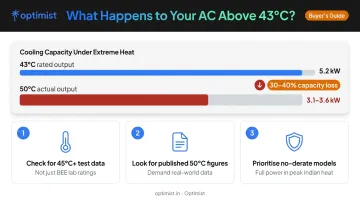
The distinction between a rated ISEER and actual field performance in a 48°C heatwave is real, and most spec sheets won't tell you which side of that line your AC sits on.
Most Energy Efficient 1.5 Ton AC Options in India
These five models were selected based on ISEER rating, cooling performance at high ambient temperatures, build quality, and real-world usability for Indian households.
Optimist 1.5 Ton 5 Star Inverter Split AC
Optimist launched in January 2026 after two years of R&D at its Nalanda 1 Lab in Delhi — purpose-built to solve one problem: reliable cooling in extreme Indian heat.
Note on capacity: Optimist's current product carries a nominal rating of 1.4 ton (4.85 kW cooling capacity). The brand positions this as a direct alternative to standard 1.5 ton ACs — its Turbo+ Mode boosts effective cooling to 1.9 tons, and at ISEER 6.05, it uses less electricity per unit of cooling than any other BEE-rated AC in India.
Standout specs and features:
- ISEER 6.05 — India's highest declared rating as of 2026, with annual energy consumption of 620.2 kWh
- 50°C ambient testing — rated to deliver full cooling output with zero derating at 50°C (manufacturer claim; internal and customer-validated at Nalanda 1 Lab and Delhi NCR field conditions)
- Microchannel heat exchanger with 1,180 flow paths in advanced aluminium alloy — enabling faster heat transfer than conventional fin-and-tube designs
- India's first built-in gas level indicator — visible live in the Optimist App, letting owners verify whether refrigerant is actually low before paying for a refill
- Real-time energy monitoring via app, including live consumption and projected monthly bills in rupees
- 1,000-hour salt-spray corrosion testing (SIGMA certified) — 15× the typical market standard of 72 hours
- 5-year all-inclusive warranty covering PCB, evaporator coil, fan motor, swing motor, gas refill, and labour at ₹0; 10-year compressor coverage
| Spec | Detail |
|---|---|
| ISEER & Star Rating | 6.05 | 5 Star+ (India's highest declared) |
| Annual Energy Consumption | 620.2 kWh |
| Key Features | 50°C tested | Microchannel heat exchanger | Gas level indicator | Turbo+ Mode | Real-time energy monitoring app | 1,000-hour corrosion tested |
| Warranty | 5-year all-inclusive (parts + labour + gas) | 10-year compressor |
Panasonic 1.5 Ton 5 Star Wi-Fi Inverter Split AC (CS/CU-NU18BKY5WX)
Panasonic is one of Japan's most established appliance brands with strong India distribution. The CS/CU-NU18BKY5WX is its 2026 flagship 1.5 ton model, holding an ISEER of 5.80 with a declared annual consumption of 681.01 kWh/year — the highest verified ISEER among conventional mass-market 1.5 ton models.
Where it stands out:
- 8-in-1 convertible modes from 40% to full-capacity output
- PM 0.1 air filtration — the finest particulate filter in its class
- Matter-enabled Wi-Fi via MirAIe — India's first Matter-compatible room AC
- Crystal Clean self-cleaning completes in 15 minutes
- Stabiliser-free operation from 100V–290V — widest voltage range on this list
- Manufacturer claims operation up to 55°C ambient (operating claim; no published degradation curve)
- Indoor noise reaches 46 dB at high fan speed — worth noting for bedroom use
| Spec | Detail |
|---|---|
| ISEER & Star Rating | 5.80 | 5 Star |
| Annual Energy Consumption | 681.01 kWh (BEE-declared) |
| Key Features | 8-in-1 convertible | PM 0.1 filter | Matter-enabled Wi-Fi | Crystal Clean self-clean | Stabiliser-free 100V–290V |
| Warranty | 1-year product | 5-year PCB | 10-year compressor |
LG 1.5 Ton 5 Star Dual Inverter Split AC (AS-Q19YNZE1)
LG runs one of the widest AC service networks in India — useful for buyers outside metro areas where branded service centres are sparse. The AS-Q19YNZE1 carries a reported ISEER of 5.77 and is frequently cited for cooling consistency and long-term build reliability across independent review platforms.
Notable specs:
- AI+ Convertible 6-in-1 modes including VIRAAT mode at 116% capacity for rapid room cooldown
- Dual inverter compressor for faster initial pull-down and quieter sustained operation
- Ocean Black Protection and Gold Fin+ anti-corrosion coating on the condenser
- 4-way air swing for even distribution
- Stabiliser-free operation from 120V–290V
- Does not include built-in Wi-Fi — a gap versus Panasonic and Carrier at similar price points
Note: The ISEER of 5.77 is widely reported across retail and review sources; independent BEE registry verification for this exact model code was not completed at time of writing — verify before purchase.
| Spec | Detail |
|---|---|
| ISEER & Star Rating | 5.77 | 5 Star (verify on BEE registry) |
| Key Features | AI+ 6-in-1 convertible | VIRAAT mode (116% capacity) | Dual inverter | Ocean Black Protection | 4-way swing | No built-in Wi-Fi |
| Warranty | 1-year product | 5-year PCB | 10-year compressor (verify current terms) |
Daikin 1.5 Ton 5 Star Inverter Split AC (MTKM50XV)
Daikin's engineering reputation in India is built on airflow design and reliability. The MTKM50XV series carries a reported ISEER of 5.70 and offers the highest raw cooling capacity on this list at 5,000W full load — making it a strong choice for larger or poorly insulated rooms.
What makes it worth considering:
- Power Chill Operation for fast initial cooldown
- 3D airflow with 4-way automatic swing
- Triple LED display showing real-time power consumption, temperature, and error codes simultaneously
- Self-healing transparent anti-corrosive coating on evaporator coils
- Econo mode caps power draw when multiple appliances run together
- No manual convertible modes and no built-in Wi-Fi

Note: Daikin's official page lists this product at approximately 1.42 ton (5.00 kW). The ISEER of 5.70 is widely cited in retail listings; verify against the BEE label before purchase.
| Spec | Detail |
|---|---|
| ISEER & Star Rating | 5.70 | 5 Star (verify on BEE registry) |
| Key Features | Power Chill mode | 3D airflow | Triple display (power/temp/errors) | Self-healing anti-corrosive coating | 5,000W cooling capacity |
| Warranty | 1-year product | 5-year PCB | 10-year compressor (verify current terms) |
Carrier 1.5 Ton 5 Star Wi-Fi Inverter Split AC (ESTER EDGE Gxi – CAI18EE5R36W0)
Carrier is a globally recognised cooling brand with a growing India footprint. The Ester Edge Gxi carries a reported ISEER of 5.60 and stands out for a set of smart features that are rare at its price point.
Key specs:
- 6-in-1 FlexiCool modes from 40% to 120% capacity
- Smart Energy Display on the remote showing real-time power draw in kW — no app required for basic energy monitoring
- Geo-fencing via the app for automatic on/off based on location
- Refrigerant leakage detection — uncommon at this price range
- My Mode personalised preset storage and a 42-minute deep auto-clean cycle
- Stabiliser-free voltage range is narrower than LG and Panasonic — check compatibility for locations with frequent voltage fluctuations
Note: The ISEER of 5.60 appears across retail listings for this model family; confirm against the current BEE label before purchase.
| Spec | Detail |
|---|---|
| ISEER & Star Rating | 5.60 | 5 Star (verify on BEE registry) |
| Key Features | 6-in-1 FlexiCool | Smart Energy Display on remote | Geo-fencing Wi-Fi | Refrigerant leakage detector | Real-time power monitoring |
| Warranty | 1-year product | 5-year PCB | 10-year compressor (verify current terms) |
How to Choose the Most Energy Efficient 1.5 Ton AC
ISEER Value: Your Primary Filter
The most common mistake buyers make: choosing an AC based on the star label without checking the underlying ISEER score. BEE's 2026 revision means a model's star count can drop without the product itself changing — making the label an unreliable shortcut.
ISEER is the reliable metric. Here's why the difference matters in practice:
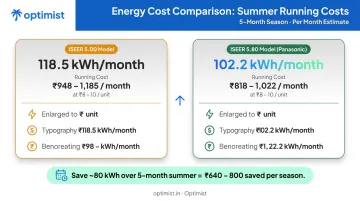
Using Panasonic's BEE-declared 681.01 kWh/year as a baseline (ISEER 5.80), a model with ISEER 5.00 would consume approximately 118.5 kWh/month versus 102.2 kWh/month for the same seasonal cooling load, a gap of around 16 kWh per month.
Across a five-month summer, that adds up to roughly 80 kWh of additional consumption. At ₹8–10/unit (typical Indian residential tariff), the higher-ISEER model saves ₹640–800 per season — enough to recover a meaningful price premium within 3–4 years of use.
Ambient Temperature Performance
Standard efficiency tests are conducted at 35°C outdoor ambient. ISEER calculations extend to 43°C. But as IMD has documented, temperatures across North and Central India regularly exceed 45°C during peak summer. An AC that isn't validated beyond 43°C may lose 10–30% of its rated cooling output precisely when you need it most.
Buyers in Delhi NCR, Rajasthan, UP, MP, and Vidarbha should prioritise models with explicit high-ambient claims — ideally with third-party-verified performance at 50°C. Optimist, for instance, publishes verified cooling data at 50°C with no performance derate — the kind of specific, testable claim worth asking any brand to match.
Corrosion Resistance and Build Quality
Indian conditions are tough on outdoor units — coastal salt air, monsoon humidity, and urban pollution all accelerate condenser and evaporator degradation. Corrosion damage is one of the primary causes of efficiency loss and compressor failure over an AC's lifetime.
Look for:
- Anti-corrosion coatings on both indoor and outdoor units
- Independent third-party corrosion test certification (not just a brand claim)
- Hydrophilic or self-cleaning coatings on evaporator coils
Look for:
- Anti-corrosion coatings on both indoor and outdoor units
- Independent third-party corrosion test certification (not just a brand claim)
- Hydrophilic or self-cleaning coatings on evaporator coils
The market standard for salt-spray testing is 72 hours. Optimist's SIGMA-certified 1,000-hour test — 15× that baseline — is a useful benchmark for what rigorous third-party corrosion validation actually looks like.
Warranty Depth and Serviceability
The 10-year compressor warranty is now standard across most brands. What actually differentiates warranties:
- PCB coverage — some brands offer 1 year, others 5 years
- Gas refill coverage — refrigerant top-ups typically cost ₹2,500–₹7,000 per visit out of warranty
- Labour charges — check whether warranty repairs include labour or bill it separately
- Service network — brand service density matters most in Tier 2 and Tier 3 cities
As a point of reference, Optimist includes 5-year PCB and refrigerant gas coverage in its standard warranty — the kind of terms worth using as a baseline when comparing other brands' fine print.
Conclusion
The best energy efficient 1.5 ton AC for an Indian household is the one that delivers a high ISEER score, maintains that performance at real-world ambient temperatures above 43°C, resists corrosion over years of use, and comes backed by a warranty that doesn't leave you with surprise bills.
Star labels are a starting point, not a conclusion. With BEE's 2026 revisions reshuffling the ratings, the ISEER number printed on the energy label is the only figure worth comparing.
Three options stand out across different buyer priorities:
- Best overall efficiency: Optimist's inverter split AC (ISEER 6.05) — tested at 50°C, includes built-in gas level monitoring, and covers parts, refrigerant, and labour under a 5-year all-inclusive warranty
- Best conventional brand pick: Panasonic at ISEER 5.80 — strong service network, verified efficiency numbers
- Runner-up conventional: LG at ISEER 5.77 — wide availability and an established track record
Calculate your expected daily usage hours, check the ISEER value directly on the BEE label, and match the model to your city's peak summer conditions before you decide.
Frequently Asked Questions
Which 1.5 ton AC is most energy efficient?
As of 2026, the Optimist inverter split AC holds India's highest declared ISEER of 6.05, followed by the Panasonic CS/CU-NU18BKY5WX at 5.80 and LG AS-Q19YNZE1 at 5.77. ISEER — not the star count — is the reliable efficiency measure, since BEE periodically revises the thresholds that determine each star band.
Which inverter 1.5 ton AC is best for a home?
The best choice depends on room size, local climate, and daily usage hours. For buyers in the 1.5 Ton category, the Optimist 1.4 Ton — with its Turbo+ mode delivering 1.9 Tons of effective cooling — matches or exceeds typical 1.5 Ton output at India's highest ISEER of 6.05. Panasonic and LG are strong alternatives with wider offline service reach.
What is ISEER and how does it affect electricity bills?
ISEER (Indian Seasonal Energy Efficiency Ratio) measures how many units of cooling an AC delivers per unit of electricity consumed across a full seasonal temperature cycle. A higher ISEER means lower electricity consumption for the same amount of cooling — directly translating to lower monthly bills.
How much electricity does a 1.5 ton 5 star AC consume per month?
A 1.5 ton 5-star AC running 8 hours daily consumes roughly 102 kWh per month, based on Panasonic's BEE-declared annual figure of 681.01 kWh. The Optimist 1.4 Ton, with a declared 620.2 kWh annually, works out to approximately 93 kWh/month under the same conditions. An ISEER 5.0 model would consume 118–120 kWh/month — about 16–27 kWh more each month depending on the unit.
Is a 1.5 ton AC enough for a 150 sq ft room?
A 1.5 ton AC suits rooms between 120–170 sq ft, with 150 sq ft as a practical midpoint. Ceiling height above 10 feet, direct western sun exposure, a top-floor location, and multiple occupants can all push the actual cooling load higher than the size alone suggests.
How has BEE's 2026 star rating revision affected AC choices?
BEE revised its ISEER thresholds for each star band effective January 2026 (Amendment V, S.O. 3984(E)). ACs that earned 5-star status under 2025 norms may now carry fewer stars under the updated bands, even though the product itself hasn't changed. Always check the ISEER value on the current BEE star label rather than trusting older packaging or retailer listings.