
The frustrating part? Most of that cost is avoidable. Families in Delhi, Ahmedabad, and Hyderabad — where summer temperatures regularly cross 44°C — aren't just paying more because it's hot. They're paying more because of buying decisions made years ago, habits practiced daily, and room conditions nobody thought to fix.
This article examines three distinct layers where savings exist: buying and setup decisions, daily usage habits, and room-level environmental factors. You can apply strategies from any layer regardless of which AC you currently own.
Key Takeaways
- ACs account for 11% of annual household electricity use — and consumption spikes sharply through summer months
- BEE confirms that each 1°C increase in thermostat setting saves around 6% in electricity consumed
- Higher ISEER-rated inverter ACs consistently use less power — and that gap shows up directly on your electricity bill
- Pair your AC with a ceiling fan to raise the thermostat 1–2°C without any loss of comfort
- Dirty filters, unsealed rooms, and direct sunlight increase your AC's cooling load — and your bill — before a single degree of cooling is delivered
How AC Electricity Costs Build Up in Indian Homes
AC bills don't arrive as one large charge. They accumulate gradually across four to five months of summer — invisible until the bill lands.
The compressor running just one extra hour daily across a five-month summer adds up to roughly 150 additional hours of peak-load operation. Multiply that by your AC's wattage and your per-unit tariff, and you're looking at hundreds of rupees in annual costs that accumulated without a single deliberate choice.
What makes this worse in Indian homes is that cost drivers stack on each other:
- A poorly sealed room forces the AC to continuously cool fresh hot air entering from outside
- A clogged filter restricts airflow, making the unit work harder to deliver the same cooling
- A thermostat set to 18°C instead of 24°C keeps the compressor running far longer than necessary
Each factor amplifies the others. The bill you see at the end of the month is rarely the result of one bad habit — it's usually three or four compounding simultaneously.
Indian summer conditions intensify this further. Cities like Delhi's Najafgarh recorded 47.4°C in May 2024, Ahmedabad hit 44.8°C in April 2026, and Hyderabad reached 44.2°C in May 2024. At these temperatures, ACs work much harder than their lab-rated specifications suggest. That gap between lab ratings and real-world heat is exactly why summer bills routinely exceed what the star label promises.
Strategies to Reduce Your AC Electricity Bill
Effective cost reduction requires targeting all three layers: what you decided when buying and installing, what you do while using the AC, and what the room environment looks like before you even switch it on.
Buying and Setup Decisions
Prioritise ISEER over star rating alone
BEE's star ratings are revised periodically, so a 5-star label from three years ago may carry a lower ISEER than a 4-star unit from a more recent label cycle. ISEER (Indian Seasonal Energy Efficiency Ratio) is the actual efficiency number — the higher it is, the less electricity the AC consumes per unit of cooling.
To put this concretely: AEEE's analysis of 1.5-ton ACs found approximately 1,591 kWh/year for a 3-star unit versus around 1,041 kWh/year for a super-efficient unit with ISEER 5.4. That gap translates directly into hundreds of rupees monthly.
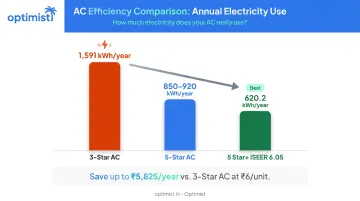
Optimist's 1.4 Ton 5 Star+ Inverter Split AC carries India's highest ISEER rating of 6.05 — well above the 5 Star+ threshold of 5.5. Compared to typical 5-star inverter ACs with ISEER ratings of 5.0–5.4, the Optimist consumes just 620.2 kWh annually, versus 850–920 kWh for competitors. At ₹6/unit, that's roughly ₹1,400–₹1,800 saved every year, before any behavioural changes.
Choose inverter over fixed-speed
Inverter compressors modulate speed continuously to match the room's actual cooling demand, rather than switching on and off at full load. LBNL's engineering analysis estimates a 20–24.8% efficiency improvement from variable-speed drives over single-speed compressors. For households running ACs six or more hours daily, this compounds significantly across a summer.
Match tonnage to room size
An undersized AC runs continuously without reaching the set temperature — wasting electricity while failing to cool. An oversized AC short-cycles, fails to dehumidify properly, and also wastes energy. A practical sizing guide for Indian homes:
| Room Size | Recommended Capacity |
|---|---|
| Up to ~120 sq ft | 1 Ton inverter |
| 120–200 sq ft | Optimist 1.4 Ton with Turbo+ (1.9-Ton effective cooling) |
| 200+ sq ft | 2 Ton with zone consideration |
Position the outdoor unit correctly
The condenser unit placed in direct sunlight or a poorly ventilated enclosure struggles to expel heat, forcing higher electricity consumption continuously. Placing it in shade with adequate clearance on all sides is a one-time decision that delivers savings every hour the AC runs.
Smarter Daily Usage Habits
Set the thermostat to 24°C
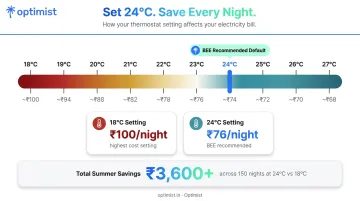
BEE made 24°C the mandatory default setting for all star-labelled room ACs from 1 January 2020 — and for good reason. Every 1°C increase in your setting saves approximately 6% in electricity consumed, according to the Ministry of Power. Moving from 18°C to 24°C has the potential to save around 24% on running costs alone.
At ₹7/unit, running a 1.5-ton AC at 18°C for 8 hours versus 24°C for 8 hours is the difference between ₹100 and ₹76 per night. Across a 150-night summer, that's over ₹3,600 — from one setting change.
Use the AC's built-in timer and scheduling features
Most modern ACs have timer and auto-shutoff functions that prevent unnecessary runtime after you fall asleep or leave the room. The Optimist App (iOS and Android) goes further:
- Live energy meter showing real-time kWh consumption and current bill
- Projected monthly bill estimates so you can course-correct before the bill arrives
- Auto-OFF and scheduled shutdown features to prevent overnight overconsumption
- Filter health tracking with alerts when cleaning is overdue
One app user in August 2025 tracked a monthly bill of just ₹986 — a fraction of what a conventional AC running similar hours would have cost.
Pair AC use with a ceiling fan
U.S. DOE data confirms that ceiling fans allow the thermostat to be set approximately 4°F (about 2°C) higher without any reduction in perceived comfort. In an Indian context, this means running at 26°C instead of 24°C while feeling equally cool, saving roughly 12% in compressor runtime. The fan uses a fraction of what the AC draws.
Clean filters every two to four weeks during peak summer
Clogged air filters restrict airflow and force the AC to run longer and harder. The U.S. DOE reports that routine filter cleaning or replacement can lower AC energy consumption by 5–15%. It's free, takes five minutes, and is one of the highest-return maintenance tasks you can do.
The Optimist App includes a filter health indicator that tracks time since the last clean and displays a yellow warning when maintenance is due, removing the guesswork entirely.
Optimising Your Room Environment
Seal the room before switching on
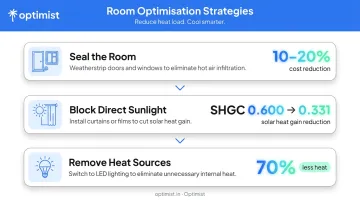
Gaps under doors, poorly fitted window frames, and open adjacent rooms force the AC to continuously cool fresh hot air entering from outside. Weather stripping, door seals, and simply keeping the bedroom door closed are low-cost fixes. The U.S. DOE estimates that sealing household air leaks can reduce heating and cooling costs by 10–20% — even a fraction of that benefit in a single room translates into shorter compressor runtime.
Block direct sunlight during peak afternoon hours
South- and west-facing windows in Indian homes absorb intense afternoon sunlight that significantly raises room temperature before the AC even starts. BEE's Eco-Niwas Samhita 2024 building code illustrates that proper external shading can reduce the Solar Heat Gain Coefficient of a window from 0.600 to approximately 0.331, cutting solar heat gain nearly in half.
Practical options:
- Thick curtains or blackout blinds during 12 PM–5 PM
- Solar window films (one-time installation, lasting benefit)
- External overhangs or chajjas on west-facing windows
Remove unnecessary heat sources from air-conditioned rooms
Incandescent bulbs, desktop computers, and older appliances raise the room's ambient temperature, directly increasing the AC's workload. The U.S. DOE notes that LED fixtures produce approximately 70% less heat than incandescent bulbs while using significantly less electricity.
Switching to LEDs and avoiding ironing or cooking in air-conditioned rooms during peak hours reduces the baseline heat load the AC must offset.
Conclusion
Reducing your AC electricity bill in India comes down to addressing costs at every layer — the unit you buy, how you install it, and how you use it daily. Each layer contributes. Together, they compound.
Some of these are one-time decisions: choosing a high-ISEER inverter AC, positioning the outdoor unit correctly, installing blackout blinds. Others are ongoing habits: setting 24°C consistently, cleaning filters regularly, using the ceiling fan alongside the AC. The one-time decisions set your baseline. The habits protect it.
For households considering a new AC, the efficiency of the unit itself — specifically its ISEER rating — is the single biggest decision you can make. An AC with India's highest ISEER of 6.05 like Optimist's 1.4 Ton 5 Star+ unit consumes 620.2 kWh annually, versus 850–920 kWh for typical 5-star competitors. That difference shows up on every monthly bill, summer after summer, without any behavioural change required.
Frequently Asked Questions
What is the bill of AC for 1 hour?
Multiply the AC's wattage in kW by your electricity rate. A 1.5-ton 5-star inverter AC typically draws around 1.2–1.4 kW — at ₹7/unit, that's approximately ₹8–10 per hour. A 3-star non-inverter of the same capacity may draw 1.6–1.8 kW, costing ₹11–13 per hour; over 8 hours nightly, the difference adds up to ₹600–₹1,200 across a month.
Can we use AC at 27°C?
Yes — 27°C is a perfectly effective setting, especially when paired with a ceiling fan. It's approximately 18% more energy-efficient than 24°C, based on BEE's 6%-per-degree guidance. Running 26–27°C with a fan is a practical, comfortable alternative to BEE's recommended default of 24°C.
What is the 3-minute rule for AC?
The 3-minute rule advises waiting at least 3 minutes before restarting an AC after switching it off. Daikin's and Panasonic's service documentation both confirm a built-in 3–4 minute compressor restart delay. This protects the compressor from pressure imbalance that can cause mechanical stress or excess current draw on startup.
What is 40/60/80 mode in AC?
These refer to "convertible" or adjustable capacity modes offered by some AC brands — allowing the unit to run at 40%, 60%, or 80% of its rated capacity on milder days. This reduces power consumption when full cooling isn't needed. Note that inverter ACs already modulate compressor speed continuously and automatically, making discrete convertible modes redundant in well-designed inverter ACs.
Which AC consumes less electricity — inverter or non-inverter?
Inverter ACs consume significantly less electricity. LBNL's engineering analysis estimates a 20–24.8% efficiency improvement from variable-speed over single-speed compressors. For households using AC more than 6 hours daily through a long summer, the cumulative savings over three to four years typically offset the higher upfront purchase price of an inverter model.