
Introduction
Standing in an electronics store, staring at a wall of split ACs, most buyers freeze at the same question: 1 ton, 1.5 ton, or something in between?
Get it wrong and the fallout is immediate. An undersized AC runs almost non-stop and still struggles to cool the room. An oversized one blasts cold air, shuts off too soon, and leaves the space clammy instead of comfortable.
Both mistakes carry a cost beyond comfort. Air conditioners already rank among the biggest electricity draws in Indian homes, so the size you pick directly shapes your monthly bill. This guide gives you a room-size chart, the calculation formula, and the real-world factors, such as heat, sunlight, and occupancy, that Indian buyers actually need to weigh before purchasing.
TL;DR
- Room area sets tonnage: roughly 1 ton per 100-120 sq. ft.
- Undersized and oversized ACs both waste electricity and shorten appliance lifespan
- Indian summers often hit 45-50°C, so extreme-heat regions may need to size up
- Occupancy, sun exposure, ceiling height, and insulation shift the baseline number
- High-ISEER inverter tech can offset minor sizing gaps but never replaces correct sizing
What is AC Tonnage and BTU? Understanding Cooling Capacity
Tonnage and BTU measure the same thing from two angles: how much heat an AC can pull out of a room every hour. That heat-removal rate determines whether a unit can keep a 10x12 ft bedroom cool or whether it's fighting a losing battle in a 200 sq. ft. living room.
Indian retailers typically stock ACs from 0.75 ton up to 2.5 ton, with 1, 1.5, and 2 ton units covering most homes. Each capacity is built for a specific room-size range, which is exactly why sizing charts exist.
Three numbers matter when you're comparing units:
- Tonnage: India's standard capacity measure. 1 ton = 12,000 BTU/hr, the baseline figure every sizing chart is built around
- BTU (British Thermal Unit): the technical unit used on spec sheets to compare cooling output across brands, independent of tonnage labelling
- ISEER/EER rating: measures how efficiently the AC turns electricity into cooling, which affects your running cost as much as tonnage does
Getting this number right shapes more than comfort. A correctly sized AC affects:
- Cooling speed: the room reaches setpoint temperature faster and stays even
- Electricity bills: no wasted power from overworking or short-cycling
- Humidity control: proper run cycles remove moisture, since oversized units don't run long enough to dehumidify
- Compressor wear: right-sized units cycle normally instead of straining or stopping abruptly
- Appliance lifespan: less mechanical stress means fewer breakdowns over the years
AC Size Chart: How Much Tonnage Do You Need for Your Room?
The basic formula is simple: multiply room length x width to get square footage, then match that number against a tonnage chart.
Here's a generic baseline chart, assuming a standard 10 ft ceiling and two occupants:
| Room Size (sq. ft.) | Recommended Tonnage |
|---|---|
| Up to 120 sq. ft. | 0.75 - 1 ton |
| 120 - 180 sq. ft. | 1 - 1.5 ton |
| 180 - 250 sq. ft. | 1.5 - 2 ton |
| 250+ sq. ft. | 2 - 2.5 ton |
Worked Example: A 12x14 ft Bedroom
Let's calculate for a typical Indian bedroom:
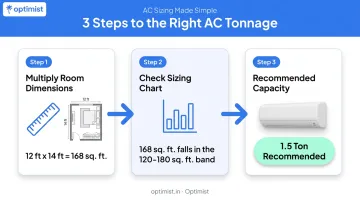
- Multiply dimensions: 12 ft x 14 ft = 168 sq. ft.
- Check the chart: 168 sq. ft. falls in the 120-180 sq. ft. band
- Recommended capacity: a 1.5 ton unit (or a well-boosted 1.4 ton with a Turbo mode) fits comfortably
The Quick Shortcut (And Its Limits)
Many buyers simply divide room area by 100-120 to estimate tonnage. Hitachi India's formula uses 120 BTU/hr per sq. ft., which lands at roughly 1 ton per 100 sq. ft., while Voltas' published chart uses slightly different boundaries.
This shortcut works fine for a standard bedroom with average sun and two occupants. It breaks down fast in rooms with high ceilings, heavy sun exposure, poor insulation, or extra occupants. The next section covers how to adjust your tonnage for each of these factors.
For irregular layouts, such as an open-plan living-dining space or a room with an attached balcony, add up the total connected floor area first. Then apply the chart to that combined number rather than sizing each zone separately.
Factors That Affect the Right AC Size for Your Room
The chart above is a starting point, not a final answer. These factors translate raw square footage into a tonnage decision that actually holds up during Indian peak summer.
Room-Specific Factors to Check
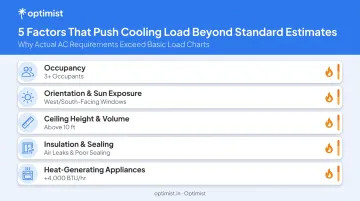
Several room characteristics push the effective cooling load above what a simple area chart suggests:
- Occupancy: Bedrooms or living rooms regularly used by three or more people (standard charts assume two) generate noticeably more body heat, raising the cooling load.
- Orientation and sun exposure: Rooms facing west or south, or with large windows catching direct afternoon sun, absorb more heat through the day and typically need one size up.
- Ceiling height and volume: Charts assume roughly 10 ft ceilings. Taller ceilings or open-concept spaces mean more cubic feet of air to cool, not just more floor space.
- Insulation and sealing: Poor sealing around windows and doors lets cool air leak out continuously, forcing even a correctly sized AC to work harder than its rating suggests.
- Heat-generating appliances: Kitchens and electronics-heavy rooms add real thermal load. As a screening rule, add roughly 4,000 BTU/hr for a kitchen-adjacent space before finalising capacity.
Local Climate and City-Specific Heat Levels
Peak summer temperatures vary sharply across India. Rajasthan's Churu recorded 50.5°C in 2024, which the Financial Express reported as one of the highest temperatures recorded nationally that year, while Bengaluru and Pune typically see far more moderate peaks.
Buyers in Delhi NCR, Rajasthan, Punjab, and UP should size up, or choose an AC specifically tested for high-ambient performance, rather than relying on a chart built for milder climates. Optimist's 1.4 Ton model, for instance, is government-lab tested to hold full cooling capacity at 50°C ambient temperatures, making it a fit for these regions.
How Optimist Helps You Get the Most Out of the Right AC Size
Here's the catch most sizing charts miss: a correctly sized AC still underperforms if it derates in extreme heat, exactly when your household needs it most. Most standard ACs begin losing capacity above 43°C, which is precisely when Delhi, Rajasthan, and much of North India are hitting their hardest days.
Optimist's 1.4 Ton 5 Star+ Inverter Split AC is government-lab tested to hold full rated cooling at 50°C ambient temperature, with no performance drop.
That reliability is backed by a few specific engineering choices:
- India's highest ISEER rating of 6.05, meaning more cooling delivered per unit of power consumed, which matters as much as tonnage for your electricity bill
- Turbo+ Mode delivers a 135% capacity boost, pushing the 1.4 ton unit to an effective 1.9 tons for genuine headroom on borderline room sizes between 1.4 and 1.5 ton categories
- Real-time energy tracking via the Optimist App, showing live kWh usage, projected monthly bills, and cost comparisons against a conventional AC
- 5-year comprehensive warranty with 10-year compressor coverage, protecting the component most prone to wear from oversized cycling stress or undersized overwork

For a room in the 120-200 sq. ft. bracket, such as a bedroom, study, or WFH office, this combination means you're not gambling on borderline sizing decisions during peak summer.
Conclusion
Right-sizing an AC means matching capacity to your room's dimensions, occupancy, sunlight, and local climate, not chasing the biggest tonnage you can afford or copying what everyone else bought.
Use the chart as your starting point, apply the adjustment factors honestly, and get a professional installer to confirm the calculation before you buy — especially for irregular layouts or extreme-heat cities.
AC sizing isn't a one-time decision, either. As room usage changes, occupancy grows, or insulation ages, revisit your cooling needs and track actual performance. Tools like Optimist's Live Energy Meter make it easy to catch when consumption drifts from what you expected.
Frequently Asked Questions
Which AC size is best for a room?
A rough baseline is 1 ton per 100-120 sq. ft. of floor area. Occupancy, direct sunlight, and poor insulation can all push you a size higher than the chart suggests.
What size room is a 1.5 ton AC suited for?
A 1.5 ton AC generally suits rooms between 130-190 sq. ft., such as a 12x14 ft or 13x15 ft bedroom. This is also the range where a boosted 1.4 ton unit with Turbo+ mode can work as an alternative.
How do I calculate BTU for AC sizing?
Multiply your room's area in sq. ft. by roughly 100-120 BTU/hr, then divide by 12,000 to convert to tonnage. For example, 168 sq. ft. x 120 = 20,160 BTU/hr, close to 1.7 tons.
Is a bigger AC always better for faster cooling?
No. Oversized units cool too quickly, shut off before dehumidifying properly, and short-cycle repeatedly. This wastes electricity and leaves the room feeling damp rather than comfortable.
Does an inverter AC change the tonnage I need?
No. Inverter technology improves efficiency and modulates output smoothly, but the base tonnage decision still follows the same room-size rules as a fixed-speed unit.
How much does wrong AC sizing affect my electricity bill?
Both undersized and oversized units run inefficiently: one overworks constantly, the other cycles on and off excessively. Both patterns raise electricity consumption compared to a correctly sized unit.