
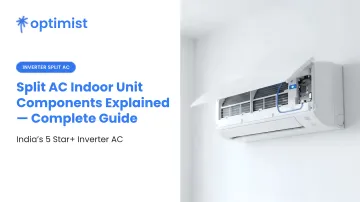
The indoor unit (technically called the evaporator unit) is where all the occupant-facing work happens: air quality, temperature accuracy, noise, and airflow all originate here. India's summers are getting harder — IMD recorded Churu at 50.5°C in May 2024, with multiple North Indian stations crossing 47°C — which means the components inside your indoor unit are under real stress for months every year.
This guide names each indoor unit component, explains what it does, and connects it to real cooling performance.
Key Takeaways
- Eight core components make up the indoor unit: evaporator coil, blower fan, air filter, drain pan, drain pipe, thermostat sensor, control board, and louvers
- Evaporator coil is the most critical part — it pulls heat out of room air and transfers it to the refrigerant
- A clogged air filter degrades both cooling output and air quality — clean it every two weeks during heavy use
- Control board and thermostat sensor work together to determine temperature accuracy and energy efficiency
- Knowing what each component does helps you spot early warning signs and avoid costly repairs
What Is the Split AC Indoor Unit?
The indoor unit is the wall-mounted, evaporator-side half of a split air conditioner — the component installed inside the room being cooled. Its job is to absorb heat from the room air and return cooled air back in.
The outdoor unit manages compression and heat rejection. Inside your room, the indoor unit takes over — absorbing heat from the air and circulating cooled air back into the space. As Carrier's split system documentation explains, the two sides are distinct assemblies connected by refrigerant piping, a drain hose, and electrical cables — neither unit functions independently.
The indoor unit's job in the refrigeration cycle:
- Receive low-pressure, cold liquid refrigerant from the outdoor unit
- Pass warm room air across the evaporator coil, transferring heat from the air into the refrigerant
- Return cooled, drier air to the room
- Send the now-heated gaseous refrigerant back to the outdoor unit to complete the cycle
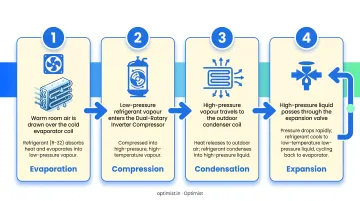
Cooling speed, air quality, temperature consistency, and noise levels all trace back to how well the indoor unit's components work together.
Core Components of a Split AC Indoor Unit Explained
Evaporator Coil
The evaporator coil is a network of metal tubes surrounded by thin aluminium fins. Cold refrigerant flows through these tubes. When warm room air passes over the coil surface, heat transfers from the air into the refrigerant, causing the refrigerant to evaporate from liquid into gas. That's exactly why it's called an evaporator. The air leaving the coil is cooler and slightly drier.
Conventional coils use copper tubes with aluminium fins (RTPF — round tube plate fin). Newer microchannel heat exchangers (MCHX) use flat aluminium alloy tubes with a much higher refrigerant-side surface area. A Purdue University study on residential R410A systems found that a microchannel evaporator delivered up to 10.6% higher cooling capacity and 13.1% higher COP at identical compressor speeds, while also requiring 13.4% less refrigerant charge.
Optimist's indoor unit uses a microchannel heat exchanger with what the company describes as 4X faster heat transfer, achieved through 1,180 flow paths in an advanced aluminium alloy construction. For coastal or humid Indian environments, coil coating matters too — aluminium fins are susceptible to pitting corrosion from chloride aerosols, which is why Optimist tests its coils to 1,000 hours of corrosion resistance (15 times more than typical market standards).
Air Filter
The air filter is a mesh screen positioned in front of the evaporator coil. Its job is to trap dust, pollen, pet dander, and particulates before they reach the coil surface.
A dust layer on the evaporator coil acts as insulation — it physically blocks heat transfer between air and refrigerant. Research from LBNL found that coil fouling over time can cause measurable efficiency and capacity degradation, with larger penalties in marginal or high-load systems. In Indian conditions, where CPCB ambient PM10 standards allow up to 100 μg/m³ over 24 hours, filters load faster than in cleaner climates.
Both LG and Daikin India recommend cleaning split AC filters once every two weeks during use. This isn't a conservative guideline — it's what the manufacturers specify for normal Indian conditions.
Optimist's mobile app includes filter health tracking, which surfaces maintenance reminders based on usage and time elapsed since last cleaning, removing the guesswork from this maintenance task.
Blower Fan
The blower fan draws warm room air in through the front grille and pushes cooled air back out. In high-wall split ACs, this is typically a cross-flow (tangential) fan — a drum-like rotor with forward-curved blades that produces wide, even airflow across the outlet.
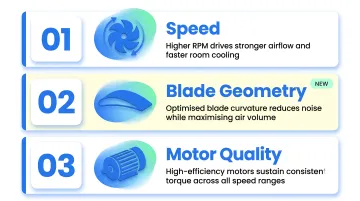
Three factors determine how well a blower fan performs in practice:
- Fan speed — controls how quickly the room reaches the target temperature; multiple speed settings exist for this reason
- Blade geometry — shapes airflow volume and distribution across the room
- Motor quality — determines noise output; a poorly designed fan can move adequate air but at a level that makes the room uncomfortable
Optimist's fan and fan motor are covered under the 5-year comprehensive warranty, alongside the indoor PCB and sensors.
Drain Pan and Drain Pipe
As warm, humid air contacts the cold evaporator coil, moisture condenses on the coil surface — the same physics as condensation forming on a cold glass in summer. This water drips into the drain pan below the coil, which channels it out through the drain pipe to an external drainage point.
A properly functioning drain system matters for two reasons beyond just avoiding water on the floor. ASHRAE's condensate pan standard requires pans to self-drain to prevent microbial slime buildup, and WHO guidelines link indoor dampness and mould to respiratory symptoms, allergies, and asthma.
A clogged or cracked drain pan is one of the most common causes of water leakage from split ACs. Checking the drain line during routine servicing prevents this from becoming a larger problem.
Thermostat Sensor and Control Board
The thermostat sensor is a small temperature probe (typically a thermistor) positioned near the evaporator. It continuously reads incoming air temperature and sends that data to the control board.
The control board — the PCB (printed circuit board), the unit's electronic brain — processes sensor readings along with commands from the remote or app. It decides when to signal the compressor to modulate or cycle, what fan speed to run, and which operational mode is active.
Sensor accuracy directly affects temperature consistency. A sensor that reads 1–2°C off will cause the system to overshoot or undershoot the set point — resulting in either overcooling (wasted electricity) or undercooling (discomfort).
India's grid voltage fluctuations add stress to PCBs. Indian Electricity Rules allow up to ±6% variation at the supply point, and real-world conditions can be worse. Robust PCB design accounts for this.
Optimist's intelligent diagnostics system monitors indoor PCB performance and sensor readings in real time, flagging error codes (such as E301 or E350) through the mobile app before a problem becomes a breakdown.
Louvers and Swing Flaps
Louvers are the adjustable fins at the air outlet that direct cooled airflow horizontally and vertically. In modern split ACs, louvers are motorised and can be set to auto-swing through the remote or app.
Correct louver positioning makes a real difference to room comfort. Pointing louvers slightly upward during cooling allows cold air to mix with warmer room air as it descends, producing more even temperature distribution rather than a cold zone directly below the unit and warm air near the ceiling. Optimist's app includes swing control as part of its air distribution management.
How the Indoor Unit Works — From Warm Air In to Cool Air Out
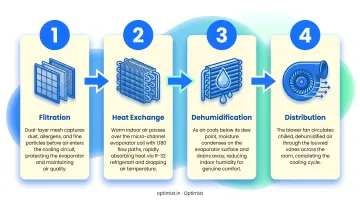
The indoor unit handles three jobs at once: absorbing heat, removing moisture, and circulating cooled air back into the room. The four steps below show how it does all three in sequence.
Step 1: Filtration The blower creates negative pressure that pulls room air through the front grille and across the filter. Dust and particles are trapped here. Filter condition controls everything downstream — reduced airflow means less heat transfer, less dehumidification, and slower room cooling.
Step 2: Heat Exchange Warm air contacts the cold evaporator coil surface. Heat moves from the higher-energy air into the lower-energy refrigerant, causing the refrigerant to evaporate. Air temperature at this point typically drops 8–12°C in a single pass.
At Indian peak summer conditions — outdoor temperatures pushing 44–50°C — maintaining that temperature differential requires adequate refrigerant charge and a coil designed to handle the full thermal load.
Step 3: Dehumidification As air cools below its dew point while passing over the coil, water vapour condenses on the coil surface and drips into the drain pan. This is how an AC dehumidifies — a critical function in humid Indian conditions, where humidity compounds thermal discomfort well beyond what temperature alone suggests.
Step 4: Distribution The blower pushes cooled, drier air through the outlet grille, directed by the louvers. The thermostat sensor monitors room temperature; when the target is reached, the control board signals the compressor to modulate or stop.
How Component Quality Affects Real-World Cooling Performance
Two ACs with identical 1.5-ton capacity ratings can perform very differently. The variables that matter:
| Component | Quality Variable | Performance Impact |
|---|---|---|
| Evaporator coil | Material, surface area, coating | Heat transfer rate, corrosion resistance |
| Blower fan | Blade design, motor type | Airflow volume, noise level |
| Thermostat sensor | Accuracy | Temperature consistency, energy waste |
| Control board | Build quality, voltage tolerance | Reliability under grid fluctuations |
| Air filter | Maintenance frequency | Airflow and cooling output over time |
Indian conditions stress indoor unit components in ways that standard lab tests may not fully capture. BEE's ISEER efficiency metric uses outdoor temperature bins from 24°C to 43°C over 1,600 cooling hours — a seasonal benchmark, but one that doesn't fully reflect peak summer performance in North and Central India where temperatures regularly exceed 45°C.
ISEER explained: ISEER (Indian Seasonal Energy Efficiency Ratio) is India's efficiency standard for room ACs, calculated as the ratio of total seasonal cooling delivered to total seasonal energy consumed. Under the BEE threshold table (valid January 2021 to December 2023), a 5-star rating required an ISEER of 5.00 or above.
Optimist's AC carries an ISEER of 6.05, the highest in India at the time of launch, meaning more cooling delivered per unit of electricity than any 5-star unit on the market. In practice, a higher ISEER directly lowers monthly electricity bills. At Indian summer usage rates, the gap between a 3-star and 5-star AC is already meaningful over a season; at 6.05 ISEER, those savings go further still.
Common Misconceptions About the Indoor Unit
"The indoor unit produces cold air."
The indoor unit doesn't generate cold — it removes heat. Room air loses energy to the refrigerant, which carries that heat to the outdoor unit to be released outside. When cooling performance drops, the cause is usually impaired heat removal (dirty coil, low refrigerant charge, blocked airflow) — not a unit that has "run out of cooling power."
"The indoor unit is the main unit — the outdoor unit is just support."
Both units are equal halves of one refrigeration cycle. The indoor unit can only absorb heat; it cannot release it. Without the outdoor unit completing the cycle, the indoor unit cannot function at all. This is why refrigerant leaks — which are a system-wide issue — immediately affect indoor cooling performance.
"Water dripping from the indoor unit just needs wiping."
Water leakage from a split AC indoor unit is almost always a symptom of an underlying fault — not a surface problem. Common causes include:
- Blocked or clogged drain pipe preventing condensate from draining
- Cracked or misaligned drain pan allowing water to spill
- Ice forming on the evaporator coil due to low refrigerant charge or severely restricted airflow
Left unaddressed, it leads to water damage, mould growth on the coil, and degraded air quality. LG India's support documentation lists these as causes requiring actual service, not DIY fixes.
Frequently Asked Questions
What are the parts of an indoor AC unit?
The main indoor unit components are the evaporator coil, blower fan, air filter, drain pan, drain pipe, thermostat sensor, control board (PCB), and louvers/swing flaps. The coil absorbs heat, the fan circulates air, the filter protects air quality, and the control board manages cooling delivery.
What is the inside part of a split system air conditioner called?
The indoor unit of a split AC is commonly called the evaporator unit or air handler. Its central component is the evaporator coil, which works with the blower fan and air filter to cool, dehumidify, and circulate room air.
How does the evaporator coil in a split AC work?
The evaporator coil carries cold refrigerant from the outdoor unit. Warm room air passes over it, transferring heat into the refrigerant — cooling the air and converting the refrigerant into gas. That gas travels to the outdoor unit, where the absorbed heat is released outside.
Why is the air filter in a split AC important?
The air filter stops dust from coating the evaporator coil, which would reduce heat transfer efficiency and cooling output. It also improves the air quality circulated back into the room. Most manufacturers recommend cleaning it every two weeks during regular use — more often in high-dust environments.
What causes water leakage from a split AC indoor unit?
The three most common causes are:
- A blocked drain pipe preventing condensation from draining
- A misaligned or cracked drain pan
- Ice on the evaporator coil from low refrigerant or restricted airflow
All three need a professional service call — a technician will flush the drain, inspect the pan, and check refrigerant levels.
How often should the indoor unit components be serviced?
Clean air filters every two weeks during heavy use. A full professional service — including coil cleaning, drain pipe flushing, and refrigerant check — should be done once a year, or more frequently in high-dust or coastal environments where component degradation happens faster.