
Introduction
Split ACs now cool the majority of Indian bedrooms and living rooms, yet most homeowners only think about servicing once the unit stops cooling properly. That's a costly habit.
Skipping regular maintenance leads to weak cooling, musty odours, and mould in the vents. Electricity bills also creep up month after month, often right as peak summer heat sets in.
A dirty filter alone forces your compressor to work harder just to maintain the same temperature, according to LG India's guidance on air conditioner efficiency.
This guide walks through exactly what you can service yourself at home, the warning signs that mean servicing is overdue, what needs a certified technician, and how often each task should happen.
Key Takeaways
- DIY tasks like filter cleaning, dusting, and vent checks should happen every 2-4 weeks
- Refrigerant and electrical work always require a licensed technician
- Weak cooling, odd noises, water leaks, or rising bills signal servicing is overdue
- A steady servicing routine protects efficiency, warranty validity, and unit lifespan
- Smart ACs with built-in gas and filter monitoring, like Optimist, catch problems early
Step-by-Step DIY Split AC Servicing Guide at Home
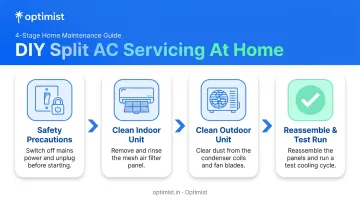
Safety Precautions & Tools You'll Need
Before touching a single panel, switch off the AC at the isolator switch or breaker, not just the remote. Live electrical components inside the indoor unit can shock you, and cleaning near a powered unit risks damaging sensitive parts like the PCB. Skip any refrigerant line or gas-related checks entirely. These require a licensed technician, since mishandling them can be dangerous.
Keep these basics ready:
- Screwdriver (for panel screws, if applicable)
- Soft-bristle brush or vacuum with a brush attachment
- Mild detergent and clean water
- A soft, lint-free cloth
- Gloves and, ideally, a step stool for the indoor unit
Cleaning the Indoor Unit
Open the front panel and slide out the air filters. Hold them up to light. If you see a visible layer of dust, they need cleaning.
For light dust: vacuum gently or tap out debris. For heavy soiling: rinse under running water with mild detergent, then air-dry completely in shade before reinserting. LG India recommends cleaning split AC filters roughly once every two weeks during regular use, though this varies with how often you run the unit. If you own an Optimist AC, the companion app's Filter Health tracker flags exactly when a clean is due, so you're not left guessing.
While the filters dry, use your soft brush or vacuum to clean the front grille and any visible coil fins. Go gently here — fins bend easily, and bent fins restrict airflow.
Finally, check the condensate drain tray and line for clogs. A blocked drain is one of the most common causes of water dripping from an indoor unit, since backed-up condensate simply overflows the tray.
Cleaning the Outdoor Unit
Outdoor condensers collect leaves, dust, and debris fast, especially if yours sits close to trees or a busy street. Clear the area around and inside the unit first.
Then:
- Rinse the condenser fins with a low-pressure hose, working from the inside out
- Keep water well away from electrical connections and the control box
- Inspect the fins for bending; a fin comb can straighten them if airflow looks restricted
Reassembly and Test Run
Make sure every filter and panel is fully dry before putting things back together. Reassembling a damp unit invites mould growth and, in worse cases, electrical shorts.
Once dry, restore power and run the AC for 15-20 minutes. Listen for unusual noise, check that cool air is flowing evenly, and confirm the room actually cools at the expected rate.
Signs Your Split AC Needs Servicing
Some problems announce themselves right away. Others build slowly until your bill jumps for no obvious reason.
Watch for:
- Weak or slow cooling: takes noticeably longer to cool the room, usually tied to dirty filters, blocked coils, or low refrigerant
- Unusual noises or vibration: rattling, buzzing, or grinding from either unit often points to loose parts or a failing fan
- Water leakage or musty smell: usually a clogged drain line; ice buildup on the indoor coil can also cause overflow once it melts
- Rising electricity bills: same usage habits but higher costs signal declining efficiency somewhere in the system
A dirty condenser coil, in particular, can steadily reduce efficiency for months. Carrier notes that a dirty coil reduces cooling capacity and can eventually contribute to compressor damage if left unaddressed. If you're seeing two or more of these signs together, don't wait for peak summer to book a service visit.
DIY vs Professional Servicing: Know Your Limits
Not everything on a split AC is safe, or safe for your warranty, for a homeowner to touch.
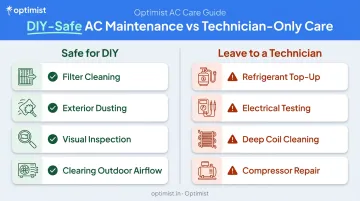
Safe for DIY:
- Filter cleaning and drying
- Exterior dusting of both units
- Visual inspection for leaks, ice, or debris
- Clearing outdoor unit airflow and vents
Leave to a certified technician:
- Refrigerant or gas top-up
- Electrical component testing (capacitor, PCB)
- Deep chemical coil cleaning
- Compressor inspection or repair
These tasks involve pressurised refrigerant lines and live electrical circuits. Modern refrigerants like R-32 are classified as mildly flammable, and handling them safely requires trained technicians and specific tools, not a garden hose and a screwdriver.
Basic professional servicing across Indian cities typically runs ₹500-900, though the exact cost depends on your city, AC model, and how complex the job is. That's a small price against the risk of voiding a warranty or damaging a compressor through DIY guesswork.
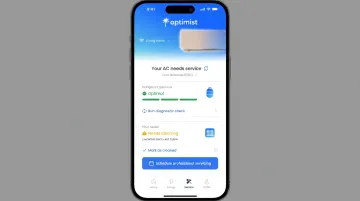
Smart ACs change this equation. Optimist's app-based Filter Health Track flags when cleaning is due and lets you mark it complete once done.
The built-in gas-level indicator, a feature LG, Daikin, and most competitors don't offer, shows refrigerant status on a simple green-to-red scale. A critical alert and error code (like E301) appears if levels drop, so instead of guessing whether your AC needs gas, you know before it fails on you.
DIY attempts on gas lines or electrical parts can void your warranty outright. Optimist's terms are explicit: unauthorised repairs, tampering, or non-genuine parts void both the 5-year comprehensive warranty and the 10-year compressor warranty. Always check your manufacturer's terms before reaching for a screwdriver on anything beyond the filter.
How Often Should You Service a Split AC?
Frequency depends on the task, the season, and how hard your unit is working.
- Filters: check and clean every 2-4 weeks during peak summer, monthly during moderate use
- Coil cleaning (indoor and outdoor): clean thoroughly every 3-4 months during the cooling season
- Professional servicing: schedule at least once or twice a year, ideally pre- and post-summer, and more often if you're in a dusty or coastal area
Here's the same schedule broken down by responsibility:
| Task | Who does it | Frequency |
|---|---|---|
| Filter check/clean | Homeowner | Every 2-4 weeks (summer) |
| Exterior dusting | Homeowner | Monthly |
| Indoor/outdoor coil clean | Homeowner or technician | Every 3-4 months |
| Full professional service | Technician | 1-2 times a year |
Professional servicing is usually the hardest of these to book at short notice. If you own an Optimist unit, servicing is booked directly through the app, website, or call centre, and the request goes straight to a brand-authorised technician. That removes the usual back-and-forth of finding an available "AC mechanic" during the first heatwave of the year, when everyone else is calling too.
Conclusion
Regular servicing isn't a nice-to-have. It directly shapes how well your AC cools, how much you pay on electricity, and how many years you get out of the unit before it needs replacing.
Simple DIY tasks between professional visits (filter cleaning, exterior dusting, drain checks) keep the system running well without adding to your costs. Save the refrigerant and electrical work for certified hands.
Choosing a unit engineered for lower maintenance overhead helps too. Optimist's smart diagnostics, gas-level indicator, and app-based filter tracking take much of the guesswork out of ownership. A 5-year comprehensive warranty and 10-year compressor cover protect you even if something does go wrong.
Frequently Asked Questions
What maintenance is required on a split AC unit?
Routine maintenance includes filter cleaning, indoor and outdoor coil cleaning, drain line clearing, and periodic refrigerant or electrical checks. The first three are DIY-friendly; the last needs a professional.
How often does a split AC need to be serviced?
Check filters every 2-4 weeks during summer, and do a deeper coil clean every 3-4 months. Book professional servicing once or twice a year, ideally before and after peak season.
Can I service my split AC myself without calling a technician?
Basic cleaning (filters, exterior dusting, visual checks) is safe to DIY. Refrigerant handling and electrical component work should always go to a certified technician.
How do I clean the filter of a split AC at home?
Remove the filter, rinse it with mild detergent if soiled, and let it air-dry completely in shade. Reinsert only once fully dry, then switch the unit back on.
Does a split AC need gas refilling during every service?
No. Gas refilling is only needed if there's a leak or a confirmed drop in refrigerant level, not as a routine part of every service visit.
What is the average cost of professional split AC servicing in India?
Basic servicing typically costs between ₹500 and ₹900, though this varies by city, AC model, and job complexity. Gas refills or repairs are billed separately.