

Getting the size right is a 15-minute calculation that pays off across the AC's entire lifespan. This guide walks through a room-by-room size chart, six variables specific to Indian conditions that adjust that baseline, and a simple step-by-step method you can use before you buy.
Key Takeaways
- The baseline sizing rule is 1 ton per 120–130 sq. ft. — AC capacity in India is measured in tons of refrigeration (TR)
- Square footage alone doesn't decide the right size — ceiling height, insulation, sun exposure, and outdoor temperature all shift the requirement
- Wrong sizing hurts either way: oversized ACs short-cycle and leave rooms humid; undersized units run non-stop and inflate electricity bills
- In cities where summer peaks cross 45°C, always size toward the higher end of the range
- Inverter ACs with higher ISEER ratings handle borderline sizing better — they modulate output rather than switching fully on or off
What Determines Split AC Capacity? Understanding the Basics
Tons and BTUs — What the Labels Actually Mean
Cooling capacity in India is measured in tons of refrigeration (TR). One ton equals 12,000 BTU per hour, as defined by ASHRAE. That's why the 1-ton, 1.5-ton, and 2-ton labels you see on product pages translate directly to 12,000, 18,000, and 24,000 BTU/hour respectively.
Common residential split AC capacities available in India: 0.8T, 1T, 1.5T, and 2T — with some brands also offering 1.3T models. These are the standard tiers to choose from when applying a size calculation.
Fixed-Speed vs. Inverter: Why It Matters for Sizing
A fixed-speed compressor runs at either 100% or off — the capacity is fixed at the rated tonnage. An inverter compressor modulates between lower and higher output, so actual output varies above or below the rated tonnage based on real-time demand.
This distinction directly affects how strictly you need to follow the size chart:
- Fixed-speed: No flexibility — if your calculation lands between tiers, size up
- Inverter: Borderline situations are more forgiving, especially with a capacity boost mode that can temporarily exceed rated tonnage during peak demand
ISEER and BEE Star Ratings — Efficiency, Not Capacity
BEE's star ratings and ISEER scores measure how efficiently an AC cools — not how much it cools. A 5-star 1.5-ton AC will cool the same room as a 3-star 1.5-ton AC, just at lower electricity cost.
BEE's impact report recorded super-efficient room ACs reaching ISEER 5.4 — though India's highest-rated unit now reaches ISEER 6.05. Higher ISEER means lower running costs for the same cooling job, not a larger cooling area.
Split AC Size by Room Square Footage: The Complete Chart
The Baseline Reference Table
The table below maps room sizes to recommended AC tonnage for standard conditions: 10 ft ceiling height, moderate insulation, two occupants, and a mid-range Indian climate.
| Room Area (sq. ft.) | Recommended Capacity | Typical Use Case |
|---|---|---|
| Up to 100 sq. ft. | 0.8 – 1.0 ton | Small bedroom, study |
| 100 – 150 sq. ft. | 1.0 – 1.5 ton | Standard bedroom |
| 150 – 200 sq. ft. | 1.5 ton | Master bedroom, medium room |
| 200 – 250 sq. ft. | 1.5 – 2.0 ton | Large bedroom, dining room |
| 250 – 300 sq. ft. | 2.0 ton | Large living room |
| 300+ sq. ft. | 2.0 ton and above | Open-plan spaces |
Note: These are starting baselines. The six factors in the next section determine whether you stay at the lower or higher end — or move up a tier.
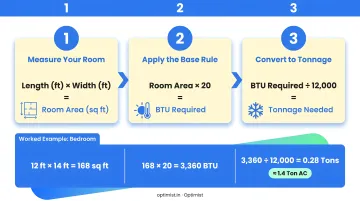
The Basic Calculation Formula
Three steps get you to the right number:
- Measure room length × width in feet to get area in sq. ft.
- Multiply area by 120 BTU/sq. ft. to get minimum BTU requirement
- Divide by 12,000 to convert to tons
Worked example: A 12 × 15 ft bedroom = 180 sq. ft. → 180 × 120 = 21,600 BTU → 1.8 TR → choose a 2-ton AC
When to Move Up a Tier Automatically
Some room conditions make the chart baseline unreliable from the start:
- Top-floor rooms under a concrete flat roof with no false ceiling
- South- or west-facing rooms with large unshaded windows
- Rooms with floor-to-ceiling glass panels
For any of these, start one tier higher than the chart suggests — before you apply the six adjustment factors.
Some rooms can stay at the lower end of the calculated range:
- Hill station locations with cooler ambient temperatures
- Well-insulated homes with double-glazed or tinted windows
- North-facing rooms with permanent external awnings
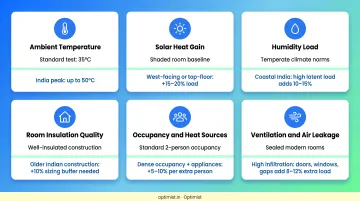
6 Factors That Adjust the Baseline AC Size for Indian Conditions
A compact flat in Mumbai and a top-floor apartment in Jaipur can have the same square footage but need meaningfully different AC capacities. These six factors help you refine the baseline calculation before finalising your purchase.
1. Room Height and Volume
The chart assumes a standard 10 ft ceiling. Rooms with higher ceilings contain proportionally more air volume.
- 12 ft ceilings: Multiply calculated capacity by 1.1 (add ~10%)
- 14 ft ceilings: Multiply calculated capacity by 1.2 (add ~20%)
A 180 sq. ft. room that would need a 2-ton AC at 10 ft ceiling may need a 2.2-ton equivalent at 12 ft , which means firmly choosing 2 ton rather than the 1.5 ton lower end.
2. Roof and Wall Insulation
Around 64% of urban Indian homes have RCC (reinforced concrete) roof construction. Concrete flat roofs without a false ceiling absorb heat throughout the day and radiate it into rooms well into the evening. A room under an uninsulated concrete roof can require up to 25–30% more capacity than the chart baseline.
The practical fix: adding a false ceiling or reflective roof insulation before buying the AC can allow you to choose a smaller, more energy-efficient unit. It's a one-time building investment that reduces running costs across the AC's entire lifespan.
3. Window Area, Glazing, and Orientation
West-facing windows without curtains or double glazing are the single biggest controllable heat entry point in most Indian rooms. For rooms with:
- Multiple large windows facing south or west: increase by one full capacity tier
- Heavy curtains, blinds, or heat-reflective window film: can offset this and allow you to stay at the chart baseline
BEE's Eco-Niwas Samhita 2024 residential energy code specifically addresses window-to-wall ratio (WWR) and solar heat gain as key factors in residential cooling load — which confirms this is not a minor variable.
4. Occupancy and Heat-Generating Appliances
Each person beyond two occupants adds roughly 500–600 BTU/hour of heat load (based on ASHRAE Fundamentals data for sedentary occupants). A practical rule of thumb:
- Add 0.1 ton per additional 2 people
- Add 0.1 ton for rooms with high-wattage appliances — computers, multiple TVs, or active kitchen cooking
A home office used by 4 people with two workstations and a printer is generating significantly more internal heat than a standard bedroom. The chart alone won't capture this.
5. Outdoor Ambient Temperature
This factor is uniquely important in India. Standard AC capacity ratings are tested at 35°C outdoor ambient temperature (per IS 1391 Part 2). In cities like Delhi, Jaipur, Nagpur, and Hyderabad — where summers regularly cross 45°C — the compressor works harder and effective capacity drops.
IMD reported a peak of 48.3°C at Sri Ganganagar, Rajasthan, in May 2024. IMD also notes an increasing trend in heatwave frequency and duration, with total heatwave duration rising approximately 2.5 days over the last 30 years.
For homes in high-heat zones (peak temperatures above 43°C): size one tier up, or specifically choose an AC rated for high-ambient operation. Some units, including Optimist's, are rated for 50°C ambient operation, which means the capacity you see on the spec sheet holds up during peak summer days rather than dropping under load.
6. Room Location Within the Home
Where the room sits in the building affects how much external heat it absorbs:
| Room Location | Adjustment |
|---|---|
| Interior room, high-rise, north-facing | Deduct 5–10% from calculated capacity |
| Corner room (two exposed external walls) | Add 10% |
| Top-floor room, no ceiling insulation | Add 15–20% |
| Ground floor (natural coolness from floor) | No adjustment needed |
How to Calculate the Right Split AC Size: A Step-by-Step Method
Step 1 — Calculate Base Requirement
- Measure room length × width in feet
- Multiply by 120 BTU/sq. ft.
- Divide by 12,000 to get tons
- Identify the closest standard size (0.8T, 1T, 1.5T, 2T)
Step 2 — Apply Adjustment Factors
Go through each adjustment factor and assess whether your room's conditions are better or worse than standard. For each adverse condition:
- One adverse factor (e.g., west-facing only): add 10–15% to calculated tonnage
- Two or more adverse factors (e.g., top floor + west-facing + high-heat city): move up one full tonnage tier
A room that calculates to 1.5 ton but sits on the top floor of a Rajasthan apartment with west-facing windows should be treated as a 2-ton room.
Step 3 — Factor in Technology
A high-ISEER inverter AC with a capacity boost mode changes the borderline calculation. Optimist's Turbo+ Mode delivers 1.9 tons of cooling from a 1.4-ton AC (a 135% capacity boost during peak demand). In a borderline sizing situation, this means the lower-tier unit can handle occasional heat spikes without running in a permanently stressed state.
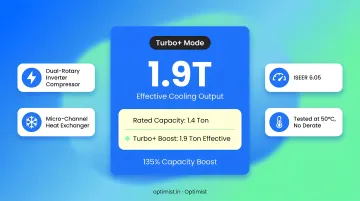
That said, Turbo+ mode is not a substitute for correct sizing:
- When it helps: Borderline rooms where peak demand occasionally exceeds base capacity
- When it doesn't: Rooms that clearly need the next tonnage tier — on a sustained 47°C afternoon, no boost mode changes what the AC must maintain all day
If your calculation clearly points to the higher tier, size up.
Why Optimist Is Engineered for India's Sizing Reality
Most ACs on the Indian market were designed and tested for temperate climates. When outdoor temperatures cross 43°C, they "derate" — delivering less than their rated capacity at the moment you need it most. A 1.5-ton AC that derates to 1.2-ton output on the hottest day of the year makes the sizing calculation meaningless.
Optimist engineers its ACs specifically for Indian conditions, with cooling performance proven at 50°C ambient. The capacity you calculate and buy is the capacity you get — in May in Delhi, not just in September in Bengaluru.
Protecting the Investment Long-Term
- 5-year all-inclusive warranty covering the outdoor unit, indoor unit critical parts, and refrigerant gas — all at ₹0 to the customer
- 10-year compressor warranty for the component most affected by sustained high-load operation
- Gas Level Indicator (the first of its kind in Indian residential ACs) monitors refrigerant levels in real time via the app, preventing the gradual capacity loss that happens when gas levels drop undetected
- Intelligent diagnostics with app-based alerts that flag issues before they affect cooling performance
Sizing determines what you need. How an AC handles peak heat determines whether it delivers — month after month, summer after summer.
Conclusion
Split AC sizing works when you combine three things: the square footage baseline, an honest assessment of the six room-specific factors, and an understanding of the technology inside the unit. Using the chart without the adjustments is exactly why many Indian homes end up with an AC that either struggles in May or runs up electricity bills year-round.
Indian summers are intensifying — IMD data confirms the trend — and the value of this 15-minute calculation only grows with each passing year. A correctly sized AC, genuinely engineered for extreme heat, pays off across a 10+ year lifespan in comfort, lower electricity costs, and fewer repair calls. If you're buying an AC built specifically for India's warming reality, like Optimist's units tested to perform at 50°C without derating, getting the size right from day one ensures that engineering actually delivers what it promises.
Frequently Asked Questions
What size split system AC do I need?
The general starting rule is 1 ton per 120–130 sq. ft. From there, ceiling height, roof insulation, window orientation, and outdoor temperatures in Indian cities often push the requirement one tier higher. Always run through the six adjustment factors before finalising — the chart gives you a baseline, but the adjustments determine the right size for your specific room.
How do I calculate the right AC tonnage for my room?
Multiply room area (sq. ft.) by 120 BTU, then divide by 12,000 to get tonnage. Round up to the nearest standard size (1T, 1.5T, 2T), then adjust upward if the room faces west, sits under a concrete roof, or is located in a high-heat city where summer peaks cross 43°C.
Is 1.5 ton AC enough for a 150 sq. ft. room?
Yes, for standard conditions. If the room is on the top floor, faces west, or is in a city with peak temperatures above 43°C, move up to 2 ton — the extra capacity will be used.
Does ceiling height affect the AC size I need?
Yes, directly. A room with 12 ft ceilings holds roughly 20% more air volume than the same footprint at 10 ft, so the sq. ft. chart alone will undersize it — always apply the ceiling height multiplier to your base calculation.
What happens if I buy an AC that is too large for my room?
An oversized AC short-cycles — turns on and off rapidly — and never runs long enough to remove humidity, leaving the room feeling damp and clammy. The compressor wears out faster from repeated start-stop cycles, and electricity bills rise despite the AC running less total time.
Can a high-efficiency inverter AC with turbo mode substitute for buying a larger tonnage AC?
In borderline situations, a premium inverter AC with a capacity boost mode can handle occasional heat spikes. But if your calculation clearly points to the next tonnage tier, buy the higher tonnage unit — turbo mode handles peaks, not your daily sustained cooling load.