
Introduction
You walk into a bedroom that's been shut all day. It's peak Delhi summer, the walls feel warm to the touch, and the air is thick and still. Your first move? Grab the remote and hit that button marked "Turbo," "Jet," or "Powerful."
It's become second nature. Nearly every AC sold in India today ships with some version of this rapid-cooling function, a direct response to summers that keep getting longer and harsher.
According to the IMD FAQ on Heat Wave, aggregate heatwave days across India climbed from 413 in 1981-1990 to 600 in 2011-2020, a jump that has pushed manufacturers to build faster relief into every remote.
Yet most people press that button without knowing what's actually happening inside the machine. This guide breaks down turbo mode step-by-step, not just in theory.
TL;DR
- Turbo mode overrides standard cooling logic, running the compressor and fan at maximum output for 15–30 minutes before auto-reverting
- Prioritises speed over efficiency, drawing more power during the burst than standard cooling
- Most ACs lock temperature and fan settings while turbo runs, switching back once the timer or safety threshold hits
- Optimist's Turbo+ Mode delivers 1.9-ton cooling from a 1.4-ton unit through advanced heat-exchanger engineering
- Best reserved for short, occasional heat emergencies, not daily use
What Is Turbo Mode in AC?
Turbo mode is a special operating setting that overrides an AC's standard thermostat-driven cooling logic. Instead of gradually adjusting output, it pushes the compressor and indoor fan to maximum for the fastest possible temperature drop.
Normal cooling modulates output to balance comfort against energy use. That balance is exactly why a hot room takes time to feel comfortable. Turbo mode exists to close that gap.
What turbo mode is NOT:
- Not a permanent or default cooling setting
- Different from manually cranking fan speed while leaving cooling logic untouched
- Distinct from Eco or Sleep mode, which are built to conserve energy rather than maximise speed
Why It Still Matters With Inverter Technology
Inverter compressors already modulate speed continuously based on room conditions. So why add turbo at all? Because inverter modulation is designed for steady-state efficiency, not emergency response. Turbo mode adds a deliberate, temporary override to full output, a feature that matters more, not less, as Indian summer temperatures regularly cross 40–45°C.
Different Name, Same Idea
| Brand | Rapid-cooling mode name |
|---|---|
| LG | Viraat Mode |
| Samsung | Fast Cooling |
| Daikin | Power Chill |
| Voltas | Turbo Cooling |
| Hitachi | Powerful Mode |
| Haier | TURBO Mode |
Despite the different labels, the underlying idea stays consistent: maximum compressor and fan output for a fixed window. Optimist's own AC applies this same principle through Turbo+ Mode, pushing its 1.4-ton, 4.85 kW dual-rotary inverter compressor (ISEER 6.05) to deliver up to 1.9 tons of effective cooling when the room needs it most.
How Does Turbo Mode Work?
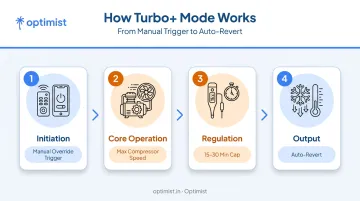
Turbo mode isn't a single switch flip. It runs through a defined internal sequence: initiation, core operation, regulation, and output. Each stage decides how quickly and safely your room actually cools.
Initiation
Activation is manual. You press a dedicated button on the remote, or tap it in a connected app, and that instantly signals the control board to override the current set-point logic.
This trigger is condition-independent. It doesn't matter if the room is 2 degrees or 15 degrees above target; the AC jumps straight to full output rather than ramping up gradually.
Here's a bottleneck few people account for: if refrigerant gas is low or filters are clogged, turbo mode's real-world effectiveness drops sharply. The system can't deliver cooling beyond what its underlying health allows, no matter how hard the compressor tries.
This is why Optimist built a gas-level indicator directly into its app, showing red-to-green status so a turbo burst that isn't working gets diagnosed instead of ignored.
Core Operation
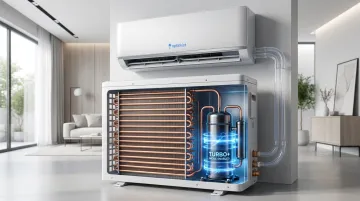
The working principle is simple: the compressor ramps to its highest possible speed while the indoor fan locks at maximum, maximising refrigerant flow and air circulation together.
Physically, this means:
- Drops evaporator coil temperature faster for quicker heat absorption
- Pushes larger volumes of chilled air into the room at maximum fan speed
- Shrinks the cool-down window compared to standard mode
Most standard ACs simply push their existing rated capacity to its 100% ceiling during turbo mode. But heat-exchanger design determines how much extra output is genuinely achievable.
Optimist's Turbo+ Mode uses a micro-channel heat exchanger with 1,180 flow paths in advanced aluminium alloy, delivering 4X faster heat transfer, paired with a twin-rotary inverter compressor.
Together, these turn a 1.4-ton unit into a 1.9-ton performer, a 135% capacity boost, pulling rooms from 42°C down to 25°C at the fastest available speed. That's real turbo performance driven by hardware engineering.
Regulation and Control
Running at full tilt puts real stress on components, so onboard sensors monitor compressor temperature and current draw, capping the high-intensity burst to a fixed window, typically 15–30 minutes. Voltas, one of India's major brands, states this exact range as its standard manufacturer guidance for turbo cooling.
This cap matters. Without it, extended full-power operation could strain components or waste electricity once the room's already comfortable. Temperature and fan-speed settings are usually locked during this window too, since the system is deliberately bypassing normal thermostat control for that short period.
Output and Result
Room temperature drops noticeably within minutes. Once the timer or safety threshold is reached, the AC automatically reverts to whatever mode you had selected before.
From there, Auto or Cool mode takes over at a lower, modulated compressor speed, maintaining the target temperature rather than chasing it.
According to Voltas' guidance on turbo mode energy use, turbo consumes more energy than Eco or Sleep modes. Because the burst is time-limited, the added cost stays confined to that short high-power window rather than the entire cooling session.
To put a number on it: at a rated input of 1,070 W, a 15-minute burst uses roughly 0.27 kWh, around ₹1.6 to ₹2.1 at typical residential tariffs. That's a small fraction against Optimist's annual consumption of 620.2 kWh, which is already 25–35% lower than typical 5-star inverter ACs thanks to its 6.05 ISEER rating.
Where Turbo Mode Is Used
Turbo activates in a handful of everyday moments:
- Right after entering a closed, heat-soaked room
- Before sleep, for quick pre-cooling ahead of bedtime
- During gatherings, when extra people add noticeable body heat to a small space
It performs best in small to medium, well-sealed rooms with limited heat leakage. The burst has less area to cover, so the effect shows up faster and more clearly. Optimist recommends its 1.4-ton unit specifically for 120–200 sq ft rooms, such as standard Indian bedrooms, study rooms, small living rooms, and hostel or PG spaces. This is precisely where a Turbo+ boost to 1.9-ton equivalent output makes the most practical difference.
Format also matters. Split ACs tend to show a stronger, quieter turbo effect thanks to wider airflow reach, while window units cool compact spaces well but run noticeably louder during the burst. According to Consumer Reports' air conditioner buying guide, ductless split systems are generally much quieter indoors and outdoors than window units.
Conclusion
Turbo mode is a deliberate, time-boxed override of compressor and fan output, built for rapid relief, not sustained efficiency. It reverts automatically once its safety window ends, handing control back to Auto or Cool mode.
Knowing this logic helps you make better decisions. Reserve turbo for genuine heat emergencies, and lean on Auto or Eco modes for daily comfort.
It also helps to know what's under the hood before you buy. Optimist's 1.4-ton AC pairs Turbo+ Mode, a 135% capacity boost verified at 50°C ambient with no derating, backed by a 5-year comprehensive warranty and 10-year compressor cover.
That's turbo performance backed by real, verified engineering.
Frequently Asked Questions
How long is the AC Turbo mode?
Most ACs run turbo mode for 15 to 30 minutes before automatically switching back to the previously selected cooling mode. Exact duration varies slightly by brand and model.
Does turbo consume more electricity?
Yes, turbo mode draws more power while active since the compressor and fan run at maximum capacity. Because the burst is time-limited, the added cost per session is usually modest rather than a major bill increase.
Is it good to use turbo mode in AC?
Turbo mode is safe and useful for occasional, short-duration use during extreme heat. Relying on it constantly instead of standard cooling modes can add unnecessary strain and cost over time.
What mode is best for AC?
There's no single "best" mode. Turbo suits rapid initial cooling (Optimist's Turbo+ delivers up to 1.9-ton cooling from a 1.4-ton unit), Auto or Cool handles daily comfort, and Eco or Sleep modes save energy at night.
Does turbo mode work if the AC has low refrigerant gas?
No. Turbo mode cannot compensate for low refrigerant gas, so the compressor and fan run at maximum speed without cooling effectively. Optimist ACs include a built-in gas-level indicator that flags this issue early, so you're never left guessing.
Can I change the temperature or fan speed while turbo mode is on?
Most ACs lock temperature and fan-speed controls during turbo mode since the system is deliberately overriding standard thermostat logic for that fixed window.