
ICRA reported record room AC sales of 12.5–13.0 million units in FY2025, reflecting just how central cooling has become to Indian households. More ACs running for longer hours means noise exposure is a daily reality — not an occasional inconvenience.
This article covers what actually makes an AC quiet, how to read dB ratings in product specs, and which brands lead the Indian market for low-noise operation.
Key Takeaways
- Split ACs with inverter compressors are significantly quieter indoors than window ACs — confirmed models range from 27–34 dB at low settings
- The dB rating in product specifications is the most reliable way to compare noise across brands
- Daikin, Mitsubishi Heavy Industries, LG, and Panasonic are the established quiet-operation leaders in India
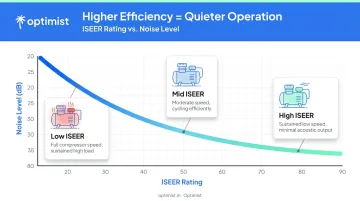
- Higher-ISEER inverter ACs run at lower compressor speeds, which directly reduces noise output
- Optimist carries India's highest ISEER rating (6.05) and an indoor noise range of 32–46 dB, sustained even at 50°C ambient
What Makes an Air Conditioner Quiet?
The Inverter Compressor Difference
The single biggest factor in AC noise is the compressor: whether it uses inverter technology or not.
A conventional fixed-speed compressor works like a light switch: fully on, fully off. Every time it kicks back on, you hear that jarring startup sound. An inverter compressor works more like a dimmer — it modulates speed continuously to maintain the target temperature, eliminating those loud on/off cycles.
This is why inverter split ACs consistently measure 5–15 dB quieter than their non-inverter equivalents under real operating conditions.
Other Noise-Reduction Technologies
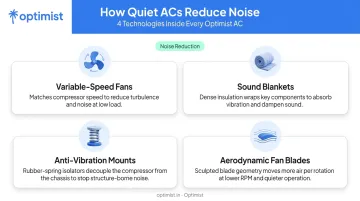
Beyond the compressor type, quieter ACs typically incorporate several additional design elements:
- Variable-speed fans run slower at lower loads, cutting airflow noise directly
- Sound blankets wrap the outdoor compressor unit to absorb vibration before it escapes
- Anti-vibration mounts isolate the compressor from the casing, blocking structural noise transmission
- Aerodynamic fan blade designs reduce turbulence and the whooshing sound at the indoor unit
Indoor vs. Outdoor Noise — What Actually Matters
Most brands advertise indoor unit noise levels, and that's the number that matters for your sleep and comfort. The compressor — by far the loudest component — sits in the outdoor unit, outside your room. The indoor unit only houses the fan and evaporator coil, which is why split ACs feel so quiet compared to window models.
When comparing specs, always look for the dB rating at low fan speed — that's the number that reflects what you'll hear during overnight operation.
Quietest AC Brands in India
The brands below were evaluated based on published indoor noise levels, inverter compressor technology, BEE star ratings, and confirmed performance in Indian climatic conditions. All dB figures are manufacturer-published values measured per BIS IS 1391 (Part 2):2023 standards.
Daikin
Daikin is Japan's largest HVAC manufacturer and has had a strong presence in India for decades. Its inverter split ACs consistently post some of the lowest published indoor noise figures in the Indian residential segment, with PM 2.5 filtration, low-noise aerodynamic fan blades, and Daikin's proprietary inverter compressor technology.
| Spec | Detail |
|---|---|
| Quietest Model | ATKL35U / ATKL35UV16W |
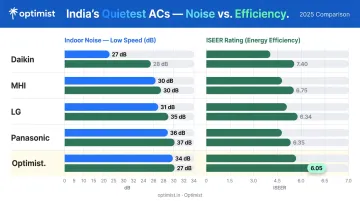
| Noise Level (Indoor) | 27 dB(A) at super-low; speed range 42/40/37/34/30/27 dB(A) |
| Key Quiet Technology | Inverter compressor, noise-insulated casing, aerodynamic fan blades |
| Star Rating / ISEER (this model) | 3 Star / ISEER 4.00 |
| Highest Efficiency Model | FTKF50XV — 5 Star / ISEER 6.3 (lowest noise: 31 dB(A)) |
The trade-off worth knowing: Daikin's quietest model (ATKL35U at 27 dB(A)) and its most efficient model (FTKF50XV at ISEER 6.3) are not the same unit. Buyers seeking both low noise and high efficiency will need to choose or find the middle ground within Daikin's range.
Mitsubishi Heavy Industries (MHI)
Mitsubishi Heavy Industries operates separately from Mitsubishi Electric and sells in India through IAPL, its long-term distribution partner. The two companies formalised a joint venture in India in early 2026. MHI's inverter split ACs are built around anti-vibration motor design and quiet-mode operation developed through its residential HVAC programmes across Japan and Southeast Asia.
| Spec | Detail |
|---|---|
| Quietest Model | SRK13YAMDA-W |
| Noise Level (Indoor) | 34 dB(A) at low speed; H/M/L = 42/38/34 dB(A) |
| Key Quiet Technology | Inverter compressor, anti-vibration fan motor, quiet-mode operation |
| Star Rating / ISEER (this model) | 3 Star / ISEER 4.50 |
| Highest Efficiency in Catalogue | SRK27YAMDA-W — 3 Star / ISEER 4.55 |
MHI's current India catalogue tops out at ISEER 4.55, which sits below the 5-star threshold. For buyers prioritising noise over efficiency, MHI remains competitive — but those wanting both should look elsewhere.
LG
LG is one of the best-selling AC brands in India and has built its residential range around Dual Inverter Compressor technology — a variable-speed design that reduces both energy consumption and the operational noise associated with single-speed units.
| Spec | Detail |
|---|---|
| Quietest Model | AS-Q20ENZE |
| Noise Level (Indoor) | 32 dB(A) at super-low; SH/H/M/L/SL = 47/45/41/37/32 dB(A) |
| Key Quiet Technology | Dual Inverter Compressor, BLDC motor, low-noise fan blades |
| Star Rating / ISEER | 5 Star (ISEER not publicly confirmed on the official product page) |
LG's 5 Star models offer strong noise performance, but the brand's official India product pages don't publish numeric ISEER values for all models. Buyers comparing efficiency figures across brands should verify current ISEER scores directly through the BEE star label registry.
Panasonic
Panasonic brings Japanese acoustic engineering expertise to the Indian market. Its Econavi sensor-driven technology adjusts fan speed based on room occupancy and heat load — a feature that naturally reduces noise during low-activity periods. Select models also include a Quiet Mode, though Panasonic's India listings don't publish a separate dB figure for that mode.
| Spec | Detail |
|---|---|
| Quietest Model | CS/CU-SU12BKY3W |
| Noise Level (Indoor) | 32 dB(A) at low; H/L = 44/32 dB(A) |
| Key Quiet Technology | Inverter compressor, Econavi sensor-driven speed adjustment, aerodynamic blade design, Quiet Mode |
| Star Rating / ISEER (this model) | 3 Star / ISEER 4.50 |
| Highest Efficiency Model | CS/CU-NU18AKY5WX — 5 Star / ISEER 5.20 (H/L = 47/34 dB(A)) |
Similar to Daikin, Panasonic's quietest and most efficient models are different units. The 5-star model runs at 34 dB(A) on low — 2 dB louder than the quietest model. Buyers who sleep lightly or run the AC in a study room will notice those 2 dB more readily than those cooling a living space with ambient noise. The 3-star model is the better pick for silence; the 5-star model for lower bills.
Optimist
Optimist is India's newest climate tech AC brand, founded in 2024 and launched in January 2026. Its 1.4 Ton 5 Star+ Inverter Split AC holds India's highest ISEER rating of 6.05 — built at the Nalanda 1 R&D Lab in Delhi in collaboration with IIT Delhi, and specifically engineered for the extreme heat conditions of the Indian subcontinent.
| Spec | Detail |
|---|---|
| Noise Level (Indoor) | 32–46 dB(A) operating range |
| Key Quiet Technology | Dual-Rotary Inverter Compressor, microchannel heat exchanger (4× faster heat transfer), sustained low-speed operation at 50°C ambient |
| Star Rating / ISEER | 5 Star+ / ISEER 6.05 — India's highest |
The engineering logic behind Optimist's quiet operation is particularly relevant to Indian summers. Most ACs lose cooling capacity (called derating) above 43°C, forcing the compressor to run harder and louder to compensate. Optimist's microchannel heat exchanger, with 1,180 flow paths, dissipates heat efficiently enough that the Dual-Rotary Inverter Compressor holds rated output at 50°C without climbing to high-stress speeds.
The result: the unit stays near the quieter end of its 32–46 dB(A) range precisely when other ACs are getting loudest.
The Optimist app also lets users report unusual noise through its intelligent diagnostics module and book a technician within 24 hours — covering any noise-related manufacturing defects under the 10-year compressor warranty.
How to Choose the Right Quiet AC
What the Numbers Actually Mean
A common mistake is shortlisting ACs purely on brand name or cooling capacity while ignoring the dB rating entirely. Here's what to look for:
- Check the low-speed dB rating specifically — manufacturers often publish noise at multiple fan speeds; the low-speed figure reflects overnight operation
- Compare ISEER alongside dB — higher ISEER generally means the compressor runs at steadier, lower speeds, which correlates with quieter operation
- **Match capacity to room size** — an oversized AC short-cycles (rapid on/off) in a small room, creating noise regardless of its rated dB level. A 1.5 ton unit in a 100 sq. ft. room will cycle aggressively and sound louder than its spec suggests
Why Efficiency and Quiet Operation Are Connected
According to BEE's India Energy Scenario report, household ACs can run 10–15 hours per day during Indian summers. That's significant runtime — and the compressor's behaviour during those hours determines both your electricity bill and your noise exposure.
A high ISEER inverter compressor runs at variable, lower speeds to maintain temperature rather than cycling at full power. Less mechanical stress means less vibration, less heat, and lower acoustic output.
The dB rating tells you the ceiling. The ISEER tells you whether the compressor will spend most of its time near that ceiling or comfortably below it.
Additional Factors Worth Considering
The dB and ISEER figures get you most of the way there — but three practical factors decide the rest:
- Prioritise brands with strong service coverage in your city; clean filters and maintained refrigerant levels directly affect how quietly a unit runs over time
- Check user reviews from your region — an AC that performs quietly in Bangalore's mild climate may sound noticeably different during Delhi NCR's 48°C summers
- Look for extended compressor warranties (10 years is the benchmark to seek); since the compressor is the primary noise source, longer coverage reduces long-term risk if vibration or wear develops
Conclusion
The quietest ACs in India share two traits: inverter compressor technology and genuine energy efficiency. Here's how the top brands compare at their quietest settings:
- Daikin — 27 dBA (ATKL35U at super-low speed); lowest published figure in the market
- LG & Panasonic — 32 dB on low settings (5-star and 3-star models respectively)
- MHI — 34 dB at low speed
- Optimist — 32–46 dB range; microchannel heat exchanger keeps the compressor quiet even when ambient temperatures push past 45°C
Always check both the dB rating and the ISEER score together — and make sure the capacity matches your room size. An 8-ISEER number on paper means little if the unit short-cycles noisily in a room that's too small for it.
For homeowners who want quiet cooling without performance compromises during India's peak summers, Optimist's inverter AC delivers ISEER 6.05, full-rated cooling at 50°C, and a 10-year compressor warranty. Visit Optimist's website or contact the team for a personalised recommendation.
Frequently Asked Questions
How many dB is a quiet AC?
Split AC indoor units below 34 dB at low speed are considered very quiet — similar to a quiet library at around 30 dB. Ratings between 34–45 dB are acceptable for most rooms, and above 50 dB begins to disrupt sleep or focused work.
Which is the most silent window AC in India?
Window ACs are inherently louder than split ACs because the compressor sits inside the same unit in your room. Most Indian window models measure around 45–56 dB under standard conditions. For noise-sensitive buyers, an inverter split AC is a significantly better option.
Does inverter technology make an AC quieter?
Yes. Inverter ACs modulate compressor speed continuously instead of switching fully on and off, which eliminates the loud startup sound and reduces steady-state vibration. That translates to a typical 5–15 dB reduction compared to non-inverter models at equivalent load.
Is a split AC quieter than a window AC in India?
Significantly so. In a split AC, the compressor — the loudest component — is located in the outdoor unit outside your room. The indoor unit only runs the fan and evaporator, which is why confirmed indoor noise levels for split ACs range from 27–46 dB across the brands covered here.
What causes an AC to become noisy over time?
The most common culprits are:
- Clogged filters forcing the fan motor to work harder
- Low refrigerant causing the compressor to strain
- Loose internal components rattling
- Worn fan bearings
Regular servicing and filter cleaning prevent most of these issues. Optimist's app tracks filter health and sends reminders so you don't have to think about it.
Does a higher star rating mean a quieter AC?
Yes, with a caveat. Higher-star inverter compressors run at lower, steadier speeds — which typically results in quieter operation. But star rating is not a substitute for the dB figure; always check the product spec sheet for the actual noise rating before buying.