

Introduction
Most people shopping for an air conditioner assume bigger is always better. Walk into any electronics store and you'll hear the same advice: "Just buy the higher tonnage, it'll cool faster."
That logic is backwards: the real goal is matching AC capacity to your room's actual cooling load, not maximising horsepower.
Get the sizing wrong and you pay for it every single month. An undersized unit runs non-stop and never quite catches up. An oversized one cools too fast but leaves the air cold and clammy.
India's Bureau of Energy Efficiency has flagged this directly: improper sizing, refrigerant charge, and airflow can meaningfully affect a split AC's energy performance. That's the difference between a comfortable room and a compressor working overtime.
This guide walks through the actual math, the factors that shift your ideal tonnage, and how newer inverter technology changes the calculation.
Key Takeaways
- AC tonnage should match your room's square footage, not your budget or brand loyalty
- The Area Method (sq ft × 120 BTU ÷ 12,000) gives a fast, reliable starting estimate
- Ceiling height, sunlight, occupancy, and insulation can push your ideal tonnage up or down
- High-efficiency inverter ACs with boost modes give borderline room sizes more flexibility
Why Getting Room Size Wrong Costs You
Sizing errors show up in two very different ways, and both cost you money.
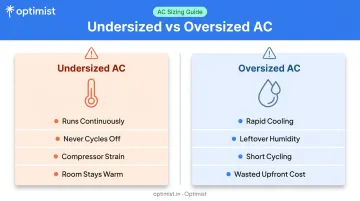
Undersized AC problems:
- Runs continuously trying to reach your set temperature
- Never fully cycles off, driving up electricity consumption
- Compressor faces constant strain, accelerating wear over time
- Room still feels warm even after hours of operation
Oversized AC problems:
- Cools the room too quickly, then shuts off before removing enough humidity
- Leaves the space cold but damp, that clammy, uncomfortable feeling
- Cycles on and off frequently, a pattern known as short cycling
- Costs more upfront for capacity you're not actually using efficiently
Neither mistake is cheap, and the effects compound over months of use.
There's no single verified rupee figure for how much incorrect sizing adds to an Indian household's annual bill. But the mechanism is well documented: an AC that's the wrong size works against itself, whether that means running too long or cycling too often. Either way, you end up paying more for less comfort.
How to Calculate the Right AC Capacity for Your Room
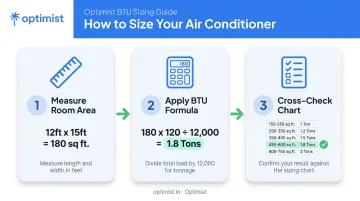
Getting the tonnage right involves three simple steps: measure your room, run a BTU calculation, and cross-check the result against a sizing chart. None of it requires an engineering degree.
Measure Your Room's Area
Start with basic length times width, in feet, to get your square footage.
Example: A room measuring 12 ft x 15 ft = 180 sq ft.
That single number becomes the input for every calculation that follows, so measure carefully. Round up if your room has an irregular shape or alcove.
Also include any balcony or open dressing area that shares airflow with the main room—open connections let cool air escape faster than sealed walls. Don't subtract space for doors, windows, or furniture; the calculation only cares about total floor area.
This measurement assumes a standard 10 ft ceiling. Unusually tall rooms need a different formula, covered next.
Apply the BTU/Tonnage Formula
The most widely used approach among Indian AC manufacturers is the Area Method, published by brands including Hitachi India:
Minimum BTU = room area (sq ft) x 120
Using our 180 sq ft example: 180 x 120 = 21,600 BTU.
Since 1 refrigeration ton equals 12,000 BTU/h, you simply divide:
21,600 ÷ 12,000 = 1.8 tons
This is Hitachi's own worked example, a genuinely useful starting point rather than a rigid rule.
If your room has an unusually high ceiling, the Volume Method works better:
Tonnage = (Length x Width x Height) ÷ 1,000
Use this whenever ceiling height departs meaningfully from the standard 10 ft.
Reference the AC Room Size Chart
Quick-reference charts help you sanity-check your BTU math:
| Room Size (sq ft) | Recommended Tonnage |
|---|---|
| 80–120 | 1 Ton |
| 120–180 | 1.5 Ton |
| 180–240 | 2 Ton |
Treat this as a helpful starting point, since manufacturer bands vary slightly. Hitachi's chart places 176–250 sq ft in the 2 Ton category, while Haier's places 151–250 sq ft at 1.5 Ton. That gap alone tells you why the six factors in the next section matter so much.
6 Factors That Change Your Ideal AC Tonnage
Square footage gets you close, but it doesn't account for how your room actually behaves under heat. These six variables fine-tune the final number.
Ceiling Height and Room Volume
Standard charts assume roughly 10 ft ceilings. Anything taller, or an open-concept layout connecting rooms, means more air volume to cool; a 12-foot ceiling adds roughly 20% more volume than standard charts assume for the same floor area. Use the Volume Method here instead of relying purely on floor area.
Sunlight Exposure and Window Count
South- or west-facing rooms absorb far more solar heat through the day. Multiple large windows compound the effect. Industry cooling guidance confirms that high sun exposure pushes you toward a larger unit, while heavily shaded rooms may need less.
Number of Occupants and Heat-Generating Appliances
Every person in a room adds body heat. So does every TV, oven, or desktop computer running nearby. A home office with two people and a computer setup carries a different thermal load than an empty guest room of the same size.
Insulation Quality
Poorly sealed doors and windows let cooled air leak out constantly. Your AC then works harder just to hold steady, let alone lower the temperature. Check for gaps around frames before assuming your calculated tonnage will hold up.
Regional Climate and Ambient Temperature
BEE's climate zone classifications separate Indian cities meaningfully:
- Hot and dry: Jaipur, much of Rajasthan
- Warm and humid: Mumbai, Chennai
- Composite: Delhi
- Temperate: Bengaluru
These zones don't come with a fixed percentage adjustment, but they matter. A unit that performs fine in Bengaluru's moderate summer may struggle differently in Delhi's extreme dry heat or Mumbai's humidity load, so look for models tested at real extreme heat, like Optimist's 1.4-ton AC, government-lab tested at 50°C with no cooling drop.
Compressor Technology (Inverter vs Fixed-Speed)
Inverter compressors, like the dual-rotary design in Optimist's 1.4-ton unit, start at high output, then modulate down to maintain temperature rather than switching off completely. Fixed-speed units rely on blunt on-off cycling instead. Inverter technology improves comfort at your chosen size, but it doesn't erase the underlying room load, so you still need to calculate tonnage correctly first.
Why Optimist Changes the Traditional AC Sizing Equation
Most sizing charts assume standard AC behaviour. Optimist's 1.4 Ton inverter split AC was engineered specifically for conditions those charts don't fully account for.
Turbo+ Mode adds real flexibility for borderline rooms:
- Delivers a 135% capacity boost, equivalent to up to 1.9 Tons of effective cooling power
- Bridges the gap for rooms that fall between the 1.5 Ton and 2 Ton bands on standard charts
- Uses a dual-rotary inverter compressor paired with a micro-channel heat exchanger
Built for actual Indian summer conditions:
- Maintains full cooling at 50°C ambient temperature, government-lab tested, without the performance derating common in many split ACs beyond 43°C
- Removes the need to pad your tonnage estimate upward as a hedge against hot-weather performance loss
Efficiency you can verify yourself:
- Carries an ISEER of 6.05, currently India's highest declared rating on a residential split AC
- Tracks real-time energy consumption and projected monthly bills through the Optimist app, confirming your sizing choice pays off after installation
For most bedrooms, studies, and small living rooms in the 120–200 sq ft range, this positions the 1.4 Ton Optimist unit as a genuine alternative to a standard 1.5 Ton AC. You get equivalent cooling without the oversized-unit humidity trade-off.

Conclusion
Choosing the right AC size means matching tonnage to your room's real cooling load, not simply grabbing the biggest unit on the shelf or the cheapest one in your budget. Measure the load properly, then adjust for the factors that actually affect heat gain.
Sunlight, insulation, occupancy, ceiling height, and regional climate can all shift the textbook recommendation up or down. Run the calculation, check it against a chart, then adjust for your specific room.
Once installed, don't just assume the sizing decision was correct and forget about it. Reviewing performance periodically, whether through Optimist's app-based energy tracking or routine servicing, tells you whether your AC is actually delivering the comfort and savings you sized it for.
Frequently Asked Questions
How many tons of AC do I need for a room of a given size?
Use the Area Method: multiply your room's square footage by 120 BTU, then divide by 12,000 to get tonnage. Then cross-check the figure against a room size chart to confirm it.
What size AC do I need for a 12x12 room?
A 12x12 room is 144 sq ft, which typically falls in the 1 Ton to 1.2 Ton range. The exact figure depends on sunlight exposure and how many people regularly use the room.
Is a 1.5 Ton AC enough for a large living room?
A 1.5 Ton AC comfortably covers living rooms up to roughly 180 sq ft. Larger halls, or ones with heavy sun exposure, usually need 2 Ton or more for effective cooling. Optimist's 1.4 Ton model also covers this bracket, since Turbo+ Mode lifts its effective cooling to 1.9 Tons on demand.
Does ceiling height affect how I calculate AC tonnage?
Yes. Standard charts assume a 10 ft ceiling. Taller ceilings or open-plan spaces need the Volume Method (length x width x height ÷ 1,000) for an accurate figure.
Can a smaller-tonnage AC still cool a larger room effectively?
Boost technologies like Turbo+ Mode let a 1.4 Ton unit deliver up to 1.9 Tons of effective cooling temporarily. This helps with borderline room sizes but isn't a substitute for correct sizing in genuinely large spaces.
Does room orientation or sunlight exposure change my AC size?
Yes. South- or west-facing rooms with multiple windows absorb more heat through the day. These rooms typically need one size up from what a standard chart recommends.